
I’ve already bought VR for several months now. Overall, it was money well spent. Aside from occasionally letting classmates experience it at reading groups, I myself use it quite a lot; in fact, several days a week I even go to Tsinghua specifically to play VR, with the aim of exercising. The amount of exercise really is huge, and the immersion is very strong. I can do high-intensity exercise in there for more than an hour straight.
Of course, I have also not forgotten that playing VR has at least some academic significance, so after playing it for a while, it’s time to write a little summary.
I. The Body
1. Eyes
Playing VR does not hurt the eyes; at least in terms of experience, the eyes do not feel tired. I saw news saying that someone became addicted to VR and as a result their eyesight improved. Although that is just an individual case, it really did exceed many people’s expectations. The key is that after putting on VR glasses, we are actually more often looking at faraway things. In the sense of the naked eye automatically adjusting focus, we are indeed looking into the distance rather than staring at the screen right in front of us. So when we read books or look at our phones, our eyes get tired after a while, but playing VR basically does not make them tired—unless the game is poorly designed, for example if there are too many special effects like flashing lights. Otherwise, the eyes are basically comfortable.
Existing VR technology has already been fairly successful in visual presentation. One friend said that he gets motion sickness from playing 3D games, but does not get motion sickness when playing VR. Of course, besides vision, the more important factor behind this effect is the kinesthetic intervention to be discussed below.
2. Kinesthesis
VR first deceives the human eye: the crisp, lifelike images make one feel as if one is there. But in fact, what truly gives one a strong sense of immersion is definitely not vision, but the body’s entry. Current technology still cannot bring every inch of the whole body’s skin into the virtual world, but even bringing in just a tiny bit—for instance, bringing in the “neck”—is enough to produce a decisive change. Compared with ordinary 3D video, the decisive difference in VR video is the neck.
When reading texts related to McLuhan, one often encounters the term “kinesthetic sense,” which sounds somewhat unfamiliar in Chinese contexts, but it really is different from “tactile sense.” This is easy to tell in a VR experience. The tactile feedback VR provides at present is very limited; at most it is just the vibration of the controller. But the feedback in terms of kinesthesis is much more vivid.
What is kinesthesis? It is the perception of one’s own body’s state of movement and spatial position. For example, when my scalp itches, I immediately raise my hand and reach over to scratch it. In the process, I neither rely on vision to locate it nor use touch to grope around. This awareness of the spatial positions of my hand and head is a kind of kinesthesis.
With our eyes closed, when we pick our noses, we can basically stick our fingers directly into the nostrils rather than poking them into our mouths or eyes. This shows that we have long possessed awareness of the “spatiality” of our own bodies. This “inner spatial consciousness” also cannot be simply explained as a muscle-and-tissue inner sense; in fact, it is a synthetic result. Although we can perceive the body’s position without visual locating or tactile groping, if from birth we had had no vision or touch at all, then such awareness would probably be difficult to establish.
In the visual space of VR, generally we cannot really see our own bodies; what is mainly rendered realistically are the controllers (the two hands), while the torso and feet are usually invisible. But that does not mean that the perception of the torso and feet has not been absorbed into the virtual space; on the contrary, they have gone in too. When the VR space is initialized, the position of the floor has already been located, and in different games there are also some real-time adjustment techniques that determine the player’s height. The distance moved in virtual space is also comparable to that in reality, which ensures that in virtual space my kinesthetic cognition is not disrupted. When I extend both hands, the position of my hands as perceived visually and the position of my hands as perceived kinesthetically are still exactly the same.
3. Feet
At present, if one does not buy additional peripherals, what the VR trackers actually monitor are only the headset and controllers; the movement of the legs and feet cannot be monitored. But we can still experience the existence of our feet in the virtual world,
Although I cannot see my feet, my feeling of standing firmly on the ground does not feel out of place. If the floor position is not initialized accurately, when playing one might feel as if half the body were buried underground, or floating in midair, and the sense of awkwardness becomes very obvious.
But the absence of the feet still constitutes the biggest obstacle in the VR experience, because what we can actually move within is only an area of a few square meters. If one is playing those games that require running long distances, then one inevitably has to use parts of the body other than the feet to control movement—for example, using buttons on the controller—and this instantly greatly diminishes the sense of immersion, and can even lead to severe dizziness.
Earlier I mentioned that some people get dizzy in 3D games but not in VR. But conversely, if foot movement is involved, then the situation in which one did not get dizzy playing 3D games will also turn into dizziness in VR. Although when playing 3D games we also use a keyboard or controller to control movement, because the sense of immersion is limited from beginning to end, this kind of control does not feel especially awkward. But in the VR world, once I am standing firmly on the ground and suddenly move by pressing a button, at least in my experience the dizziness is extreme and the whole body feels uncomfortable. Another method is teleportation, which can reduce motion sickness, but feels even more out of place.
Of course, if one frequently comes into contact with this kind of out-of-body experience, perhaps one can gradually adapt to this mode of control. But for now, the VR games with a better experience are still those that do not require much long-distance movement—games that only require moving the hands, or only small movements within the space of one or two steps.
4. Hands
What affects the VR experience the most is still the hands. The first time one puts on a VR headset, the first reaction is often not to gaze into the distance, but to look down at one’s hands. In many works of literature and art, when the protagonist goes through scenes such as dreams, time travel, rebirth, and the like, the first thing they do upon opening their eyes is often also to look at their hands. That is because the hands are the first “interface,” the front line of the self and the foremost edge of the world, the “first mirror.” The hands being looked at are the original convergence of “me as subject” and “me as object.”
To gaze at the hands is in fact to gaze at my “will”: I imagine my fingers coming together, and then I see my fingers coming together. This is not seeing someone else’s fingers come together; it is seeing “I am bringing my fingers together.” My will is externalized, embodied, made present, and confronts me outside myself. This face-to-face encounter reveals a “interface” between me and the world.
In VR experience, our palms still cannot yet be rendered in vivid detail, but the rendering of the controllers is very exquisite. After opening the VR platform, it precisely presents the positions and images of the two controllers, more exquisite and realistic than any other scenery. After putting on the headset, the first thing to do is find the controllers; only after taking them in hand does one have the grounded feeling of settling into this world.
II. Games
1. Beat Saber
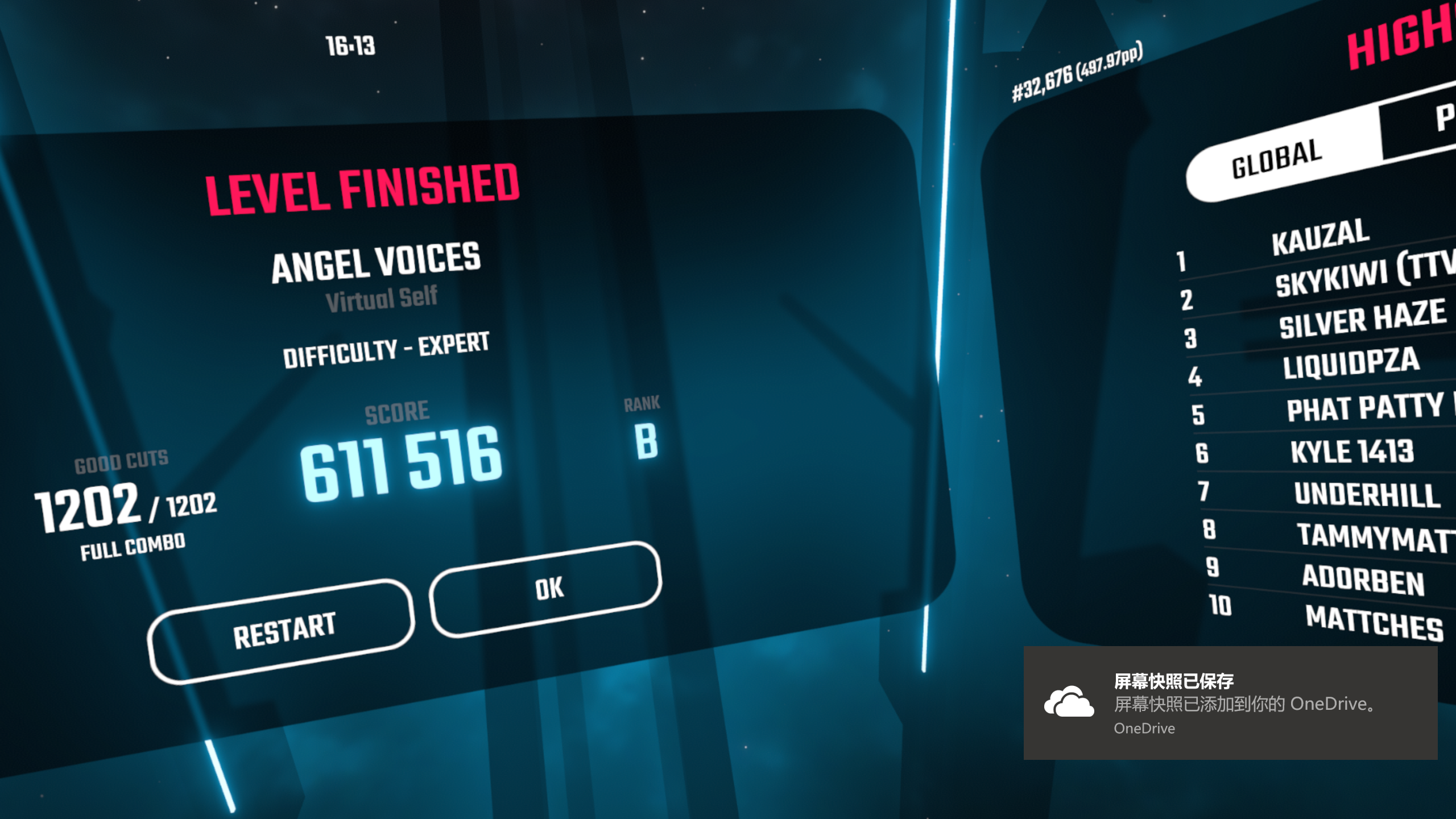
In fact, of all my so-called VR play and exercise, 95% of the time I only play this one game, Beat Saber. Just this one game makes the VR purchase worthwhile.
Beat Saber is a game with a very simple design concept, and the scenes are not particularly flashy. I heard that the studio that made this game only had three people. Yet once released, the game immediately occupied a position of absolute dominance on the charts, and it can be said to have fully grasped the essence of VR games.
Many earlier VR games were designed with this idea: realism, and the feeling of being there. So there were horror games such as zombie shooting, or games with magnificent scenery. But Beat Saber seized the key point: the sense of immersion is obtained mainly not through vision, but through kinesthesis. What Beat Saber emphasizes is not visual space, but “auditory-tactile-kinesthetic” space (McLuhan’s space).
First of all, it is a rhythm music game, whose gameplay is to time your actions precisely to the beat of the music. Second, it is a “lightsaber” game: you swing two lightsabers with both hands to slash at red and blue blocks flying toward you in rhythm with the music. The game’s elements are extremely simple visually: nothing more than blocks with arrows of two colors, and lightsabers of two colors. But it is executed with exquisite precision in auditory and kinesthetic terms: the blocks are perfectly matched to the rhythm of the music, and the whole body is completely immersed in it.
Windows MR devices can also play this game, but the experience is much worse, because MR controller recognition is not so sensitive, and it can only recognize the controllers when they are within the field of view in front of you. But when swinging lightsabers—not to mention the speed, since many times you are not swinging within the field of view—the eyes are fixed on the blocks flying toward you from the front, while the lightsabers swing at the blocks passing by the body by means of peripheral vision. MR headsets often fail to catch this kind of movement, because the arms are outside the line of sight. It is like reaching out to scratch your head: we do not rely on our gaze to locate our hands. So only devices like Vive, with full-space tracking, can provide a good experience.
By the way, let me boast a little: in standard mode I have already achieved Full Combo clearing of all the original tracks on Expert difficulty! Besides the original tracks, you can also download fan-made mods.

2. Virtual Sports
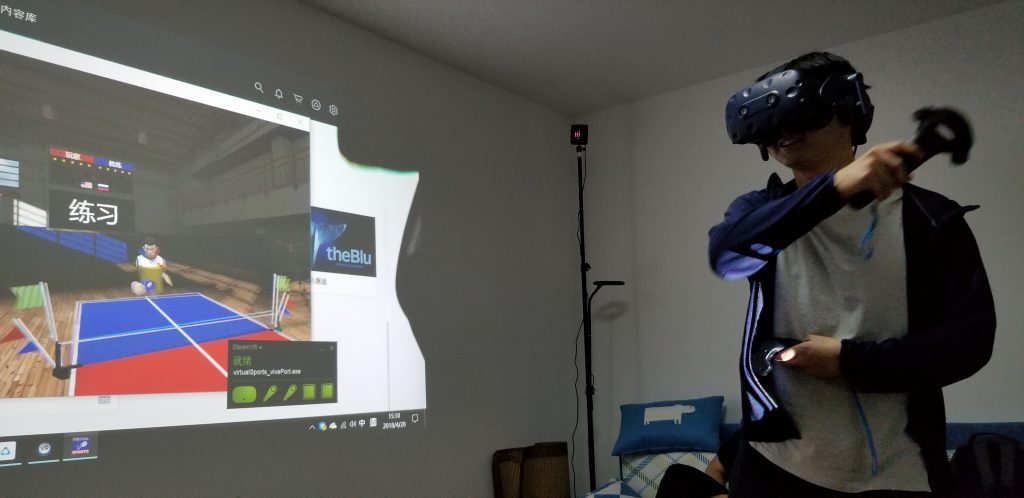
Virtual Sports is the only one of the games I rate highly that I bought in the Vive store; the other good games were all bought on Steam. This game is also very simple: it offers two events, table tennis and tennis. The tennis experience is a bit weaker, because the width of a tennis court is much larger than the room, so the footwork movement is not fully synchronized. But in table tennis, it really is much like playing ordinary table tennis. The controller directly becomes a paddle; you can chop and you can loop. The only difference is that when the ball is hit, the paddle face has no sense of weight (though there is vibration feedback). This was the earliest game I played before Beat Saber, and at the time I felt that just this game alone could basically replace my going out to play table tennis for exercise.
The friends from the reading group also tried this game. One of them even made a funny mistake: after getting tired from playing, he unconsciously wanted to lean on the table tennis table to catch his breath, but where would there be any table tennis table? He almost fell over. I myself have also made a similar mistake: when I got tired from playing, I casually placed the ping-pong paddle on the table, and the controller immediately dropped down… Luckily, there is a cord to strap the controller to the wrist.
The game also offers online versus mode, but unfortunately I failed to connect with anyone several times; perhaps there still aren’t enough players. Recently I also saw another game on Steam called Racket Fury: Table Tennis VR, also a table tennis simulation. Its interface is much flashier, and its feature options are far more numerous, but I haven’t really gotten the hang of it yet (the feeling of holding the paddle isn’t right). Since I’ve recently been obsessed with lightsabers, I haven’t had time to study table tennis.
3. The Elder Scrolls V: VR Edition
The Elder Scrolls V is a great game, so I bought the VR version and started playing it right away. But I gave up after just a short while, because of the sense of incongruity in the footstep movement I mentioned earlier.
4. Serious Sam VR: The Last Hope
The VR version of Serious Sam very neatly solves the problem of the awkwardness of foot movement in VR action games: simply don’t move at all. Just stand still and mow down the enemy troops charging in with a pair of guns. The experience is pretty good. But later I bought several other VR games in the Serious Sam series, and found that they still require movement; the stationary monster-slaying mode seems to exist only in this The Last Hope.
5. The Lab
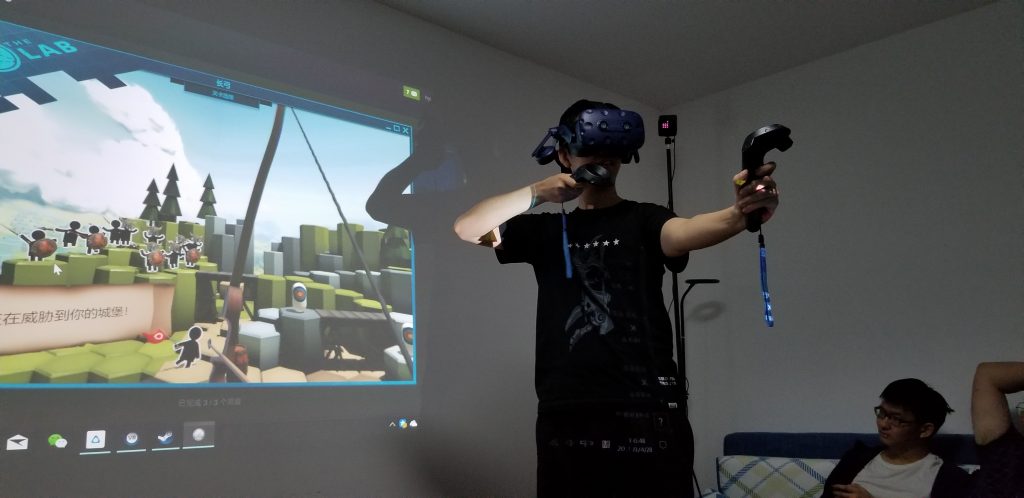
The Lab is an official Valve production, and as a free game it can be said to be excellent value for money. It contains several mini-games: some are just for taking in the scenery, while a few are quite replayable. For example, there is a tower-defense archery game and an airplane bullet-hell game; both are very replayable, and to this day I still haven’t seen any similar paid games.
6. Superhot VR
Superhot is an action game with a very unusual design: time moves only when you move (and enemies move only then), while when you stand still, time also comes to a standstill. You dodge and counterattack within a small space, without needing long-distance movement. The experience is quite distinctive.
7. Keep Talking and Nobody Explodes
This is a very uniquely designed cooperative bomb-defusal game (something of a breakup, friendship-ending game), requiring two or more people to work together: one person defuses the bomb, while the others hold the bomb-defusal manual and guide them remotely. I had played it a few times before getting VR, but after buying VR I never played it again. There isn’t much difference between the VR version and the ordinary version; the only thing is that the bomb defuser feels a bit more immersed in the scene.
8. Rush
This is an extreme gliding simulation game, playable with MR. I’m not sure whether it can be played on standalone headsets or mobile VR, but it probably can. It’s basically gliding through the air, controlling direction by swinging your arms (you can also set it to head movement), and it’s fairly thrilling. Similar extreme skiing games actually feel worse than this one, perhaps because skiing after all uses your feet, but the sensations in your feet are hard to simulate; flying, on the other hand, doesn’t originally use your feet, so the experience turns out better.
9. VR Girlfriend
VR Girlfriend is undoubtedly the best VR adult game at present; the problem is that the plot is simply too short. Given the nature of the game, I won’t comment too much.
10. VR Chat
As someone with social anxiety, I personally don’t play this kind of social game, but one of the reading-group buddies came to the scene and played a round. At present, VR social platforms still seem too crude; the biggest highlight is that you can create your own distinctive virtual persona to appear and interact. But making a virtual persona still seems to require tech-savvy people who understand modeling techniques to handle it.
I’ve of course also played quite a few rhythm games, shooting games, sports games, and scenic games, but the ones that left the deepest impression on me for now are the above ones~
Translated from the Chinese original with AI assistance. The original text is authoritative.