
On July 16, I was invited to give a short talk at an event organized by Shiliu Blockchain. The original title was “Newtonian Mechanics and Modern Currency.” A couple of days ago, they released the video and a written transcript, retitled “The Hidden Connections Between the Scientific Revolution and Modern Currency.” The manuscript was prepared by them based on my lecture; in fact, before the lecture I had already written my own speaking notes, which of course differ from the actual talk. I’m posting them below for reference.
The Affinity with Bitcoin
Like many people, I saw news about Bitcoin very early on in the tech media, but I never paid it much mind. Of course, I was always a poor student and never thought about investing. It wasn’t until that surge in March 2013 that I finally bought in: on the one hand, there was a lot of news at the time; on the other hand, the national scholarship I had received the year before had finally been credited to my account. In the end, it was a round of philosophical reflection that led me to decide to buy. I also wrote quite a few articles in 2013 and 2014, had a column on Babbitt, and appeared on Yangyang Interviews. People in the crypto circle called me Dr. Hu. Later, I finished my doctorate, and Bitcoin happened to enter a trough; I also wrote far fewer articles.
Actually, I have no particular desire to invest or manage money, let alone to strike it rich overnight. I just wanted to buy some coins to verify my view. I’m still continuing on the academic path and have never thought of coming to the crypto world to make money. The main significance of buying Bitcoin is that it proved that those of us who study philosophy can also make money.
There is a story about the founding sage of our philosophy. It goes that the first philosopher in the West, the ancient Greek Thales, was mocked by others for doing philosophy, which was said to be utterly useless: he couldn’t even deal with the stinking ditch outside his door, so what was the point of studying the heavens? Thales said that philosophers are not incapable of making money; they just do not want to spend too much energy on such mundane affairs. It is not that they cannot, but that they do not wish to—just you wait. Then, through his study of the heavens, Thales predicted a bumper olive harvest for the coming year. He went ahead and bought up all the olive presses on the market in advance, and when the olives indeed had a bumper harvest the next year, Thales made a huge fortune. But did Thales then become an olive-oil magnate? No, he continued to devote himself to philosophy. The point of his windfall was not to accumulate wealth, but merely to prove to others that philosophers are not foolish; they simply pursue different things. Merchants know only how to measure success by how much money they make, but for philosophers, so long as the money is more or less enough, that’s fine—they are throwing themselves into a more meaningful cause.
I approached Bitcoin with the same mindset. From now on, if someone tells me that studying philosophy is useless, I’ll bring up Bitcoin and tell them that this is the result of my philosophical studies. Then they won’t have anything to say, will they?
The Ontology of Money
So what philosophical reflection led me to accept Bitcoin? It was mainly reflection on the essence of money. In particular, many people say that Bitcoin is a virtual currency, completely “virtual”—just a string of numbers—so it has no value. That made me think: what, after all, is virtual, and what is real?
In my view, reality is not an absolute, either-or label; it is a relative concept. Anything at all, so long as we can talk about it, recognize it, or even use it, is after all some kind of thing, and cannot be nothing whatsoever. There is no such thing as something that is unreal in an absolute sense, otherwise we would not be able to talk about it. Only as a particular kind of thing can we discuss whether it is real or unreal. Take a table, for example: it may be a real wooden table; it may also be a solid-wood table that is actually fake—a decorative object that falls apart at the slightest touch; or it may be a genuine table, but the wood itself is fake—such as plastic made to imitate wood. Only when you have fixed the angle from which you are measuring its reality does it make sense to speak of real and virtual. A paper tiger is a virtual tiger, but a real piece of paper. And paper money is real paper, but not necessarily the most real money. From the standpoint of money, I think Bitcoin is actually more real; what it seeks to overturn is precisely the virtuality of fiat currency.
I already discussed this line of thought in my first article on Bitcoin back then (Bitcoin: The Essence of Money), so I won’t go into it further here. Today I want to speak from the angle of my other specialty, namely the perspective of the history of science. In fact, the issues are connected; we still need to oppose absolutism.
Two Important Scholars of Money
First let me introduce two very famous scholars of money in the history of science. But because their contributions to the natural sciences are even more famous, their work on money is seldom heard of.
The first is Copernicus; the second is Newton.
We know that the so-called “Scientific Revolution”—that is, the formative process of modern science as a whole—basically runs from Copernicus to Newton. Copernicus’s heliocentric theory overturned the ancient cosmological system, dismantling the harmony between ancient astronomy and physics, until Newton proposed universal gravitation, reintegrated astronomy and physics, and completed the new system of classical mechanics.
But these two men at the beginning and end of that story were also closely connected with money.
Copernicus
Let us start with Copernicus. Copernicus was Polish. In his later years he served for a long time in Poland as a bishop, more or less playing the role of a local official. He had a very good relationship with the Polish royal family, and also a very good relationship with the Roman Curia. He died peacefully in his bed; he was not suppressed or burned at the stake or anything of the sort.
Copernicus was a physician and treated many powerful and prominent people. The image below is said to be Copernicus’s self-portrait, with him holding medicinal herbs in his hand; this was one of his images.
His other identity was as fiscal advisor to the King of Poland, and he carried out many studies on monetary questions, very likely influencing the monetary policies of Poland and Prussia at the time. What has survived are mainly three essays, including “On the Value of Money” (1517), “On Money” (1522), and “On Coinage” (1526)[1]. These writings were originally internal correspondence and were not republished until the nineteenth century.
The situation Copernicus faced was one of political turmoil in the regions around Poland, where coins minted under several generations of different kings were circulating at the same time and the market’s currency was in complete disorder. The Polish king was determined to remint new coins and unify the monetary system, and in this context he asked Copernicus for advice.
Copernicus studied the existing state of monetary circulation and put forward many insights. Most insightful of all was his discovery of the phenomenon of “bad money drives out good.” We know that modern economics usually calls this the “Gresham’s law,” but in fact Gresham was fifty years later than Copernicus; the name was given by later economists after rediscovering Gresham’s letters. It is now understood that Gresham was certainly not the first. The earliest was a medieval scholar, Oresme, followed by Copernicus, and Copernicus’s formulation was the clearest and most complete.
In his 1517 essay, Copernicus wrote: “When a new, inferior currency is introduced while an old and good currency is still in circulation, it not only harms the value of the good money, but also drives it out.”[2]
Why does good money disappear? Copernicus summed it up as nothing more than three possible destinations: 1) it is melted down (because the gold or silver is worth more); 2) it is hoarded; 3) it flows abroad (because foreign countries do not accept bad money).
So what should the government do? Copernicus proposed two measures: 1) when issuing new currency, prohibit the circulation of old currency at once (allow exchange according to gold and silver content); 2) unify the minting institution, strictly mint coins according to a single standard, and not allow local princes to privately mint inferior money.
Some people also believe that Copernicus proposed the “quantity theory of money,” meaning that the value of money does not depend entirely on metal content, but rather that the greater the quantity in circulation, the lower the value. Copernicus put it this way: “…the face value of coinage (market value), although based on the value of the metal, must be distinguished from its intrinsic value. For the face value of coinage may exceed the value of the metal it contains, or the reverse.” [3]
(I also wrote an article before on Why Doesn’t Bitcoin Apply Gresham’s Law (bad money drives out good)?, so I won’t expand on that here.)
[1] Liu Wangxin: “A Preliminary Exploration of Copernicus’s Monetary Theory,” Science & Culture Review, vol. 11, no. 5 (2014): 39–54
[2] Liu Wangxin: “A Preliminary Exploration of Copernicus’s Monetary Theory,” Science & Culture Review, vol. 11, no. 5 (2014): 39–54
[3] Liu Wangxin: “A Preliminary Exploration of Copernicus’s Monetary Theory,” Science & Culture Review, vol. 11, no. 5 (2014): 39–54
Newton
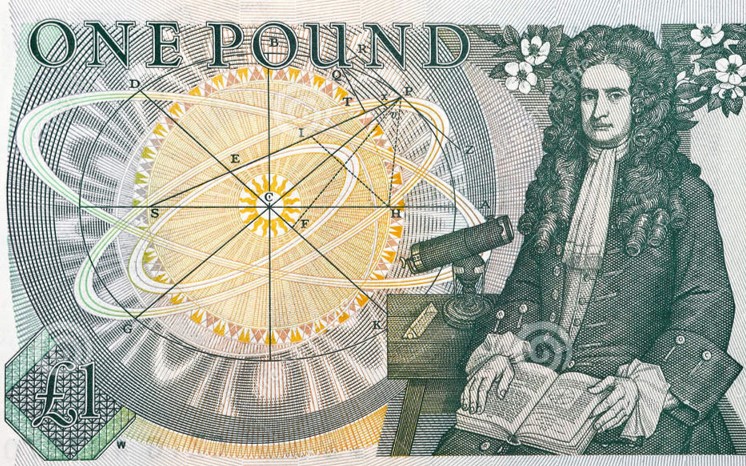
Newton’s place in monetary history is even more important. In his later years Newton served continuously as the Warden of the Royal Mint of England (Director from 1696–1700, Warden from 1700–1727), and this was by no means a ceremonial post; he indeed did many things there.
The situation Newton faced was one in which counterfeit and debased coins circulated wildly. On the one hand, technological progress meant that forgers became ever more skilled; on the other hand, the official mint also produced lower-quality coinage, so the fineness of coins kept declining. The public lost more and more confidence in the currency, and people began abandoning silver coins and buying gold to preserve value, which caused gold to soar and silver coinage to fall into contraction.
At this point there were two views[1]. One camp, represented by Lowndes, held that monetary devaluation was already an accomplished fact, so one might as well increase the face value while reducing fineness; the other camp, represented by Locke, insisted that face value should still correspond to the silver content, and that what the government should do was try to stabilize the price of gold. Newton supported the latter camp. He improved minting techniques, cracked down hard on counterfeiters, and achieved considerable results.
But Newton’s management of the recoinage was in fact a failure. Silver coins continued to flow out, the mint ran out of silver, and it simply could not strike many new coins. Newton believed the problem still lay in the excessively high price of gold. In order to stabilize the gold price, he proposed linking the pound to the value of gold. Newton set the price of gold at 3 pounds, 17 shillings, and 10 pence per troy ounce of gold (at 0.9 fineness). This pricing was made into a resolution in 1717 and lasted until 1931 (with two interruptions in between).[2] Thus, more than a hundred years before Britain officially enacted the gold standard, it had already long been operating a de facto gold standard.
[1] Guan Qingyou: “Newton and the Formation of the British Gold Standard,” The Economist’s Tea House, 2005, third series, total volume 21.
[2] Guan Qingyou: “Newton and the Formation of the British Gold Standard,” The Economist’s Tea House, 2005, third series, total volume 21.
Two Kinds of Value
We see that Copernicus and Newton seem to have faced two opposite problems: the former was about bad money driving out good, the latter about bad money being driven out (silver coins being replaced by gold); but in fact the problem they faced was the same, namely the mismatch between “two values.” In Copernicus’s case, it was the split between the nominal value of money (market value) and the metal content of money (intrinsic value). Of course, in Newton’s case the problem was made a bit more complicated by gold entering the competition, but the basic conflict was still nothing other than this: the value chosen by the market is different from the value prescribed or अपेcted by the government.
This separation of the two values is the starting point of the modern monetary system. To people in antiquity, the value of money was simply the value of the metal it contained; although in fact all sorts of bad money were always circulating, it was not until the era from Copernicus to Newton that scholars gained a more systematic understanding of this problem.
But this understanding was also, for a long time, incomplete. The key point is that Copernicus and Newton both always believed that this deviation was something to be corrected. They still hoped that the government would determine an exact nominal value for money, a nominal value that corresponded precisely to a certain quantity of metal.
So the question that interests us is: why did this understanding emerge precisely in this era? From Copernicus to Newton, what were their creativity and their limitations? Why were they able to see what people in antiquity could not see, and what were the limits of their vision?
The key to modern science: mathematization / symbolic abstraction
I would like to propose a view: from Copernicus to Newton, the perspective they brought to monetary theory was shared with their perspective in the natural sciences. Compared with ancient science, if we do not talk about specific knowledge and experience but instead speak of general methods or attitudes, where does the basic difference lie?
There is a lot to say here, so I will state the conclusion simply: the mathematization of nature. This does not merely mean that modern science makes more use of mathematics; it means that modern science takes the world of mathematics—that is, the relations among symbols—as the essence of a certain world that is more real than reality and more ideal than the ideal.
Put more simply, the meaning of mathematical symbols no longer depends on real things; instead, mathematical symbols acquire a kind of independence, and real things in turn have to depend on the system of mathematical symbols for their understanding.
Take an example: what does “force” mean in Newtonian mechanics? We say to exert force, great force, lose one’s strength… Is the force in Newtonian mechanics the same as the force in our everyday speech? No. The force in Newtonian mechanics is the F in F=ma, and what this F actually means is defined solely—and only—by the “mathematical principles” laid down by Newton. In principle, this F can be replaced by L, or by P, or by love, or by chakra; all are possible. The system of love in L=nb and the system of mechanics in F=ma are completely equivalent.
The Newtonian system does not depend at all on your understanding of force in the real world; on the contrary, force in the real world must be reinterpreted in the language of Newtonian mechanics.
The monetary system is similar. Money is a symbol. Both ancient and modern people speak of one pound, one string of cash, and so on; “pound” is a unit of measurement. But the difference is that initially a pound was itself a unit of weight: a pound’s worth of money was equal to a pound of silver. Later this correspondence changed, but on the whole, “a certain unit of money corresponds to a certain weight of metal” always meant that real metal was the standard, while the abstract monetary unit was understood only by depending on real things.
But by the modern period, especially by the time Newton anchored 1 ounce of gold at 3 pounds 17 shillings 10 pence, the relation between the two had quietly changed. He was pricing gold in pounds, rather than pricing pounds in gold. “Pound” itself no longer depended on gold or silver, and thus became an independent standard of measurement.
Abbreviated symbols that turn the guest into the host
We shorten the sentence “in market exchange, value is equivalent to one pound of silver” to 1£. That may seem no big deal, but once we make repeated use only of the abbreviated symbol, its original meaning may be completely ignored.
In fact, the entire mathematization or symbolization of modern science is also related to this reversal in which the guest turns into the host. We know that ancient Western mathematicians were extremely scrupulous; they did not accept negative numbers, imaginary numbers, and the like, because any mathematical symbol should, in principle, have its corresponding reality in order to be understood. Saying you have one cow makes sense; what does it mean to say you have -1 cow? But merchants more readily accepted these concepts, because they could take negative numbers as shorthand for expenditure or debt. So long as these symbols make sense in the course of calculation, they can be accepted, no matter what real thing they initially or ultimately refer to. And once modern people grow accustomed to a system of calculation that freely uses negative numbers, they no longer find “negative numbers” surprising. Even modern elementary school students can “understand” negative numbers, while ancient Greek mathematicians supposedly could not. This is not because modern people suddenly became smarter, but because of the consequences of abbreviated symbols turning the guest into the host. It is not that ancient people were too stupid; it is that the starting point or direction of their thinking was different from ours. Their starting point was real things, whereas ours is symbols and the rules of their operations.
Once we use these symbols to establish a complete and self-consistent mathematical system, then regardless of whether they were originally taken merely as shorthand or as an intermediate process, these symbols themselves have already become established. Their meaning is first understood within the symbolic system itself, without any need to rely on a linkage to real things; rather, only after the symbolic system has been established do we go on to use it to explain real things.
Originally, money was actually only an intermediate link, not the most basic standard. Pounds and ounces are units of weight, while the pound sterling is a unit of money, and money is the measuring rod for the value of commodities, the medium of exchange, or a shorthand in accounting. When we assess value, what we are essentially doing is comparison: one cow is worth two sheep, one bolt of cloth is worth one sack of rice—these are all ways we measure the value of commodities. And the most commonly used objects of comparison are gold and silver. When we say one bolt of cloth, one sack of rice, one tael of silver, these are all similar things: they are commodities, and value is nothing other than the comparison between things—this one is more worth having, or that one is more worth having.
But some commodities are the most widely used, the most frequently employed, and the most often taken as points of reference, and they become “currency,” or rather “money”; the special unit for measuring such commodities, such as “tael” or “pound,” then becomes the unit of money. Thus “pound” is no longer used only to measure the weight of metal; it can also be used to measure the value of other commodities. If a commodity is worth 1 pound, that simply means its value is equal to 1 pound of silver.
In other words, this pound as a monetary unit is actually just an abstract symbol, a kind of “shorthand,” and at bottom it means “equivalent to a certain quantity of gold or silver.”
But in actual use, this shorthand symbol gradually turns the guest into the host; it acquires meaning in its own right and no longer depends on the object to which it originally referred, and things become strange. Just as F in Newtonian mechanics can be understood without depending on a person’s strength, modern monetary symbols themselves can be used to measure value. But then the question arises: what, exactly, does this symbol rest on? For F, it is the mathematical system constructed by Newton; for £, it is the equally mathematized modern financial system. In this financial system, all ledgers use £ as the basis for marking every transaction relation, and there is no direct relation to gold or silver.
What happens if the Paris meter bar is lost?
This new situation is, to make a comparison, like the meter system after the Paris meter bar has been lost.
Length is nothing other than comparison among things. To ask how long something is is, in essence, to find another thing to compare it with. And the lengths of some things are relatively stable, or easy to reproduce, so they are taken as standards of measurement. A ruler is nothing other than a thing. Then we unify all kinds of rulers and find a more basic reference object; that is the work of standardizing weights and measures. In the early nineteenth century, the French established the metric system. They made a standard meter bar out of platinum, and later replaced it with a platinum-iridium alloy, kept in Paris. This standard meter bar (the prototype meter) was the ultimate reference object for the unit of “meter.” To say that something is one meter long is equivalent to saying that it is the same length as the standard meter bar.
But suppose this meter bar is lost, and this ultimate reference object suddenly disappears. Is the metric system then finished? Does it become meaningless to say that something is one meter long? Obviously not. Length is a concept formed through comparison, and “meter” is also a convention that emerges through comparative practice. Losing the Paris meter bar may make length measurement less precise, and may also prompt people to agree on a more precise reference object.
Modern people have discovered that monetary units have gradually become detached from their original reference objects, yet the units of money can still function and can still be used to measure value in exchange activities.
The introduction and dismantling of absolute space
Newton claimed to have produced the mathematical principles of natural philosophy, but in essence he replaced natural philosophy with mathematical principles, making mathematical symbols the essence of nature. On the other hand, Newton also, in essence, reversed the relation between monetary symbols and the weight of metal, using monetary symbols as the measure of value. The value of money no longer depends on gold and silver for its measurement; instead, the value of gold and silver needs to be measured by money. Money itself, especially the symbol of money itself—regardless of whether it is paper money, coins, or electronic ledgers—has become the benchmark for measuring value.
But Newton, whether in mechanics or in monetary matters, did not go far enough. Newton built nature on mathematics, but what mathematics can provide is only the measurement of external relations among things; it can only describe the motion of one object relative to another object (or reference frame), and all relations are relative. Newton was clearly not satisfied, so he introduced absolute space and the existence of God. Absolute space is like the body of God; God’s existence provides a reference frame that transcends relativity and is absolute.
From the perspective of relativity, Newton’s introduction of absolute space is entirely unnecessary, an overelaborate addition. The mathematical system Newton built already describes relative motion throughout; there was no need for an absolutely motionless frame of reference in the first place. The later development of relativity and quantum mechanics was, in fact, a further deepening of mathematization and symbolization, beginning from the invariance of mathematical laws in order to understand nature. But we should not be too harsh on Newton: he had only just completed the reversal of mathematics and nature, and such historical limitations were unavoidable.
In monetary policy, Newton of course did not introduce God, but rather the government, hoping that the government would anchor an absolute standard of value and bind the monetary unit to gold. And his limitation was also that he did not think of the fact that this “external force providing an absolute reference frame” was simply unnecessary: the symbol itself can be money, and the meaning of money comes only from the relative relations of market exchange activity, without needing an absolute standard.
Sadly, this superstition about an absolute reference frame in the monetary system has not been dispelled to this day. Although this absolute reference frame has gradually shifted from nature (gold and silver) to the government (the central bank), when people confront Bitcoin, this Newtonian limitation becomes very obvious: “How can something that is merely a symbol, without government backing, be money?”
Translated from the Chinese original with AI assistance. The original text is authoritative.