
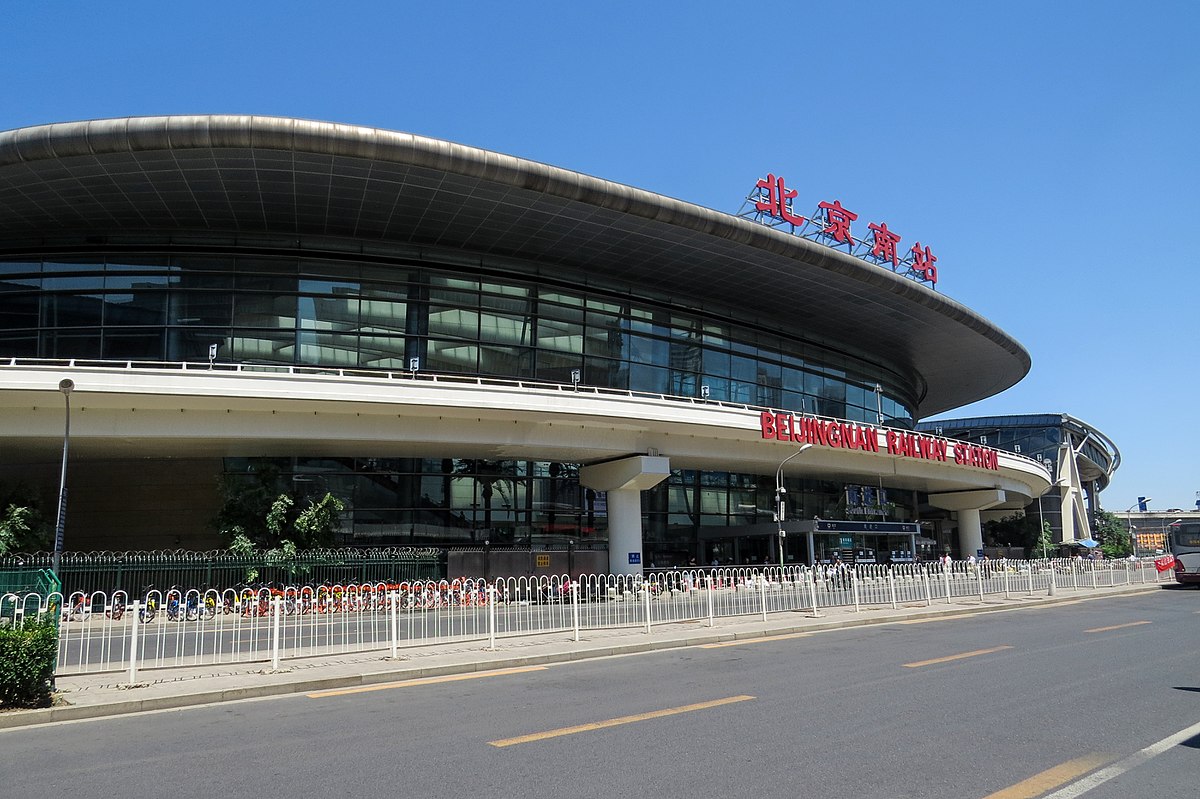
This article was a commissioned piece, published in the 7th edition of China Science Daily on August 13, 2018, with the title changed to Where Does Governing Beijing’s “Hard-to-Get-to” Stations Become Difficult?, with slight revisions. The original draft is reproduced below:
Recently, both CCTV and People’s Daily reported that Beijing South Railway Station had become “Beijing’s hard-to-get-to station,” focusing on issues such as the prevalence of illegal taxis and the difficulty of hailing a cab, which sparked heated discussion. Those who took the high-speed rail had already arrived in Tianjin, while those dropping people off were still standing in line waiting for taxis. Such poor service conditions obviously do not match the hardware level of Beijing South Railway Station, nor do they accord with the image of Beijing as an international metropolis.
So how should these problems be solved? Referring to the management experience of excellent stations and cities, both abroad and at home, is of course necessary, but it is even more crucial to grasp the direction of improvement. If you learn in the wrong direction, the result will be nothing but Dong Shi imitating X Shi’s frown.
After the news exposure, various functional departments also made statements. For example, the law-enforcement department said it would “focus on governing illegal taxis.” But this direction is highly problematic. Of course, the problem of illegal taxis also needs to be addressed, but among the problems exposed at “Beijing’s hard-to-get-to station,” the proliferation of illegal taxis is undoubtedly a result rather than a cause. Ordinary people are not fools: if cheap, legitimate taxi capacity were sufficient, why would they choose illegal taxis that raise prices on the spot? The reason illegal taxis proliferate is that legitimate taxis come too few, not that it is the proliferation of illegal taxis that leads to people being unable to hail a cab. However black they may be, illegal taxis are still satisfying part of the demand for rides; if illegal taxis were eliminated, but the shortage of legitimate taxis were not solved at its root, then Beijing’s hard-to-get-to station would only become even more “hard to get to.”
So why do legitimate taxis come so few? The reason is easy to see: taxi drivers are not fools either. If the money earned is the same, why not pick up passengers wherever you are? If making a special trip to Beijing South Railway Station to pick up passengers means extra time lost along the way (for example, waiting in line), while on any other stretch of road, with platforms like Didi, the efficiency of picking up passengers is higher and the time spent driving empty is less, then why would they be willing to make the trip to Beijing South Railway Station to pick up passengers?
As a transportation hub, Beijing South Railway Station has a certain public-welfare nature. Letting passengers disperse more quickly is necessary for safety and the public interest, but we also cannot demand that all taxi drivers become living Lei Fengs, defying economic laws to provide capacity out of sheer devotion—what are we to do then?
In fact, the issue of urban governance, in the final analysis, is precisely the problem of how to handle the balance between public welfare and the market, between fairness and efficiency. If the market economy alone could determine everything, then there would be no need for government management at all. But if government management deviates too far from the laws of the market economy, it will also backfire and plunge public affairs into chaos.
“Smart city” is a popular concept. Its basic aim is to make extensive use of high technology, centered on information and communications technology, to serve urban construction and management.
So what can information technology do for urban governance, or rather for the balance between fairness and efficiency? The key is that, first of all, we can make this balance dynamic.
Why is a “smartphone” smart? The concept opposite to it is the “feature phone.” In other words, the reason a smartphone is smart is not merely that it has added more “functions”; a phone with many functions is still a feature phone. The outstanding characteristic of a smartphone is that its functions are no longer fixed, but can be continuously adjusted according to actual user use and the ongoing innovation of developers. Similarly, “smart city” can be understood in this way too—it does not merely mean that several new functions have been added; rather, it means that it must establish a mechanism of “real-time feedback” and continuously make new responses to new situations.
Traditional urban governance often consists in formulating a set of rules and then letting the relevant institutions execute them according to the book, until they are truly outdated, and only then revising the rules anew. For example, if we set the taxi base fare at 13 yuan, then a uniform rule is established, and all taxis in all circumstances simply have to obey it. Of course, sometimes the rules will be adjusted somewhat, such as adding nighttime pricing standards, or revising them every few years, and so on.
The relationship between traditional rules and the market is not without feedback, but the feedback is asynchronous, delayed, and clumsy. Such rules can hardly be adjusted at any time according to the conditions of different seasons, let alone according to the conditions of different years, much less according to the time of day, road sections, and road conditions.
But what if we gather together countless travel and congestion data, and adjust in real time according to the specific situation at every moment? For example, suppose we give taxis that go to Beijing South Railway Station to pick up passengers during peak hours the right to charge more, while ensuring that they cannot raise prices on the spot, thereby achieving a balance between passengers and drivers, ensuring the efficiency of hailing a cab at the railway station, and at the same time guaranteeing that passengers enjoy the most affordable prices under existing resources—wouldn’t that be a win-win for everyone?
Traditional technological conditions cannot satisfy such dynamic adjustment in real time and on the spot. Legitimate taxis have neither the right to alter prices at will nor the ability to choose exactly the right fare; this leaves room for illegal taxis to talk nonsense and raise prices on the spot. But with the latest information technology and the mining of big data, such dynamic adjustment is entirely possible. In fact, Didi Chuxing has already achieved this to a great extent. So can government transportation management learn from it?
Translated from the Chinese original with AI assistance. The original text is authoritative.