
本文发表于《Science and Technology Daily》,with only minor changes at the time of publication.
Galileo as an Artist
Galileo was born in 1564, the very year Michelangelo died. From Michelangelo to Galileo, one sees modern European history moving from the age of the Renaissance into the new era of the Scientific Revolution.
The bond between Galileo and Michelangelo was not merely the coincidence of their years of birth and death; there was a deeper connection between them.
Galileo was born into an impoverished noble family. Among his ancestors there had once been a highly respected physician, so Galileo’s father put great effort into having the young Galileo study medicine. Although Galileo himself was more interested in mathematics, in his father’s eyes the idea of studying mathematics was plainly a sign of neglecting one’s proper calling, and he flatly refused to agree.
The turning point in Galileo’s career came in 1582–1583, when he listened to a mathematics lecture by Ricci (Ostilio Ricci) and was deeply moved, firmly resolving to study mathematics. Ricci happened to be a close personal friend of Galileo’s father, so Galileo invited Ricci to their home to persuade his father to support his study of mathematics. Galileo’s father finally yielded: although he still insisted that Galileo continue his medical studies, he allowed Galileo to study Euclid and Archimedes under Ricci.
Who, then, was Ricci? He was a student of the famous mathematician Tartaglia and taught at the Academy of Art and Design in Florence (Accademia delle Arti del Disegno). This academy happened to have been founded by Vasari, a student of Michelangelo; Michelangelo himself had also served as honorary dean of the academy.
Why would a mathematician be a professor at an art academy? In fact, before Galileo accomplished the great feat of “mathematizing nature,” the relationship between mathematics and physics (what was then called natural philosophy) was far less intimate than it is today. By contrast, mathematics was more closely tied to the art of painting. In particular, the new technique of “perspective” was practically a practical course in geometry.
In the eyes of artists at the time, perspective was by no means merely a technical skill; it also embodied a new worldview. Vasari explicitly highlighted the concept of “design” (disegno), which at the time encompassed a whole range of meanings, including design, composition, sketching, and more. Vasari believed that nature was the mother of art, while disegno was the father of art; in a certain sense, disegno was even more fundamental than nature.
So in a sense, the “mathematization of nature” should rather be credited to the artists of the Renaissance, who overturned the traditional ideas of ancient Greek natural philosophy—Plato believed that activities such as painting and sculpture were nothing but crude imitations of nature, activities that strayed far from truth and were full of distortion and fabrication. But in the eyes of Vasari and his contemporaries, design, composition, and their mathematical elements were instead revelatory activities that drew closer to the nature of things; painting brought people nearer to truth rather than farther away from it.
What Galileo actually received under Ricci was training in disegno, including both mathematics and the art of drawing. At the same time, Galileo also formed a lifelong friendship with another of Ricci’s students, the painter and architect Cigoli, with whom he corresponded for many years on all sorts of artistic and scientific topics. Galileo reported to Cigoli on his telescope observations of the moon and sunspots, and he also discussed with him in depth artistic theories such as perspective and its visual principles.
For example, in a letter Galileo wrote to Cigoli in 1612, Galileo pointed out that the human eye can see only two dimensions, length and width; depth is in fact conveyed through light and shadow, and painting artistically presents the third dimension of things.
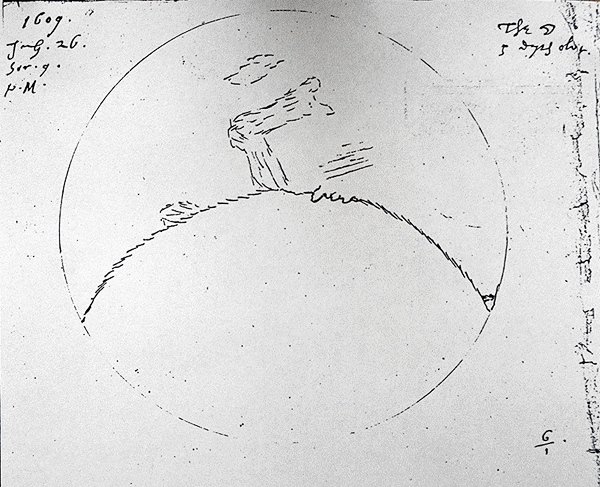
This art of expressing the depth of things through the light and shadow of flat images was put by Galileo to perfect use in his observations of the moon. In fact, Galileo was not the first person to observe the moon with a telescope. Four months before him, Harriot pointed a lens at the moon and drew the first map of the lunar surface, but Harriot neither realized that the shadows on the moon’s surface signified the existence of craters nor depicted those shadows clearly. Galileo, however, was able at once to identify the shadows on the moon’s surface as mountains, and with professional sketching skill drew lunar maps that were attached to his works and widely circulated, ultimately breaking through the traditional philosophical belief in the perfection of the heavens. This was due not only to his improvements to the telescope, but perhaps also to his solid artistic training.
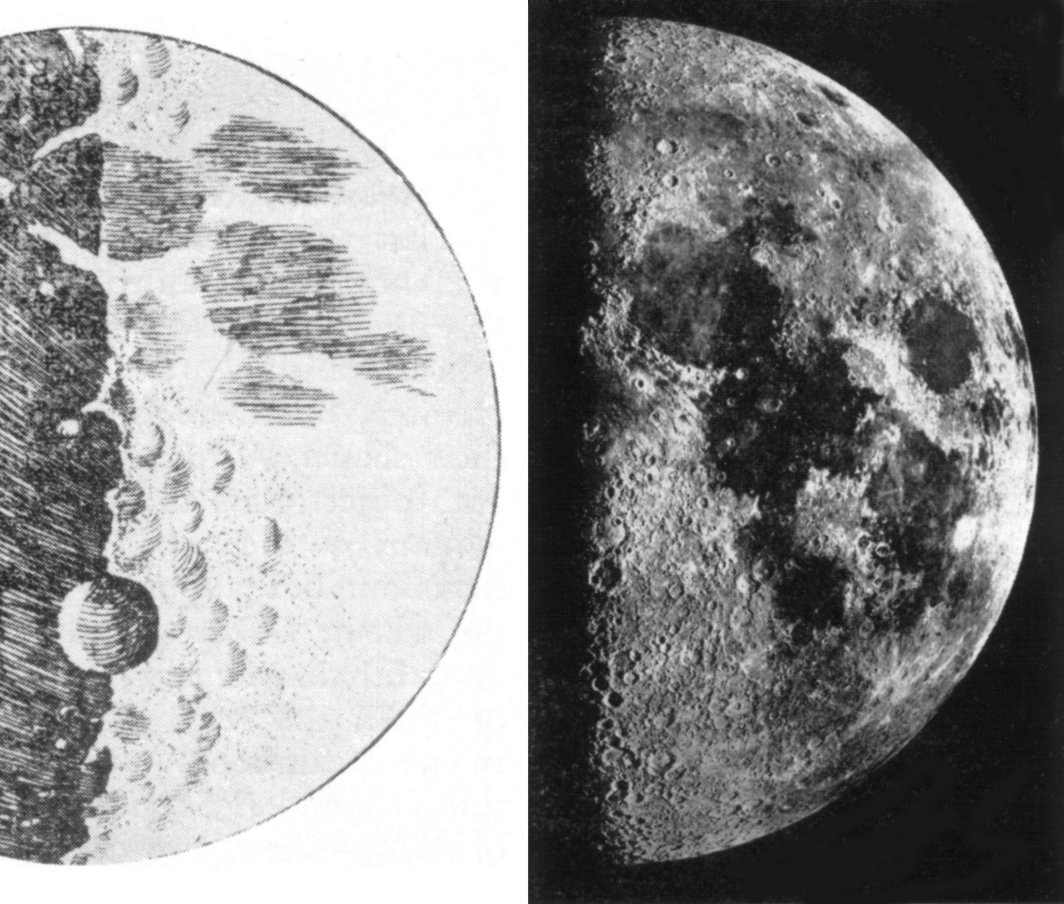


Cigoli quickly learned of Galileo’s observations through letters and urged him to publish an Italian version of the Starry Messenger as soon as possible. Cigoli later also carried out observations himself, making sketches of the moon’s surface and of sunspots. In the dome painting he created in 1612 for the Cathedral of Santa Maria del Fiore, the image of the Virgin Mary, “clothed with the sun, and the moon under her feet,” was, for the first time, shown with a moon full of pits and hollows.
In a letter Cigoli wrote to Galileo in 1611, they spoke of a certain priest who denied that there were mountains on the moon. Cigoli believed that ignorance of composition (disegno) was the reason he could not see the craters. He said: “If a mathematician does not understand composition, then he is not merely an ordinary mathematician, but also a blind man.”
Galileo would of course agree with Cigoli’s view: disegno not only means the basic skills of painting, but also a basic perspective or viewpoint for knowing the things of the world. It is precisely this basic viewpoint that enables people to properly understand the significance of the telescope and of experimental science as a whole.
That is to say, visual images and their (mathematized) structures of design should be regarded as revealing the foundations of all natural things, rather than as mere crude imitations.
According to Plato’s understanding, the crafts of painting, sculpture, and the like are merely “imitations” of nature; as for re-copying a work of art itself—for example, outlining its compositional structure—that is only the imitation of an imitation, and can only become more and more distorted, farther and farther from truth. Therefore, the use of a telescope or any experimental apparatus would only add another layer of imitation, thereby magnifying the subjectivity of the senses and intensifying the possibility of distortion; in short, it would take people away from nature rather than bringing them closer to essence. Thus we can understand why many of Galileo’s contemporaries, even when they saw evidence of the moon’s uneven surface through a telescope, still insisted that this was merely an enlargement of sensory illusion.
But in Galileo’s eyes, and in the eyes of the artists of his time, activities such as obtaining flat images and extracting mathematical structures were not ways of moving away from nature but rather ways of approaching essence; the addition of intermediate media such as the telescope could facilitate, rather than hinder, our approach to truth. This view may seem self-evident to us today, but in the history of science, it probably owes much to the artists, Galileo among them.
Translated from the Chinese original with AI assistance. The original text is authoritative.