
This book review was a commissioned piece I wrote in the first half of this year, but after I handed it in, it seems it was never published? (No feedback.) I suppose they thought I had written it badly. In fact, although this book really is quite good, it is not all that stunning, and there is no especially strong central idea to comment on, so I did not go all out in singing its praises either. But since I wrote it, I might as well post it here.
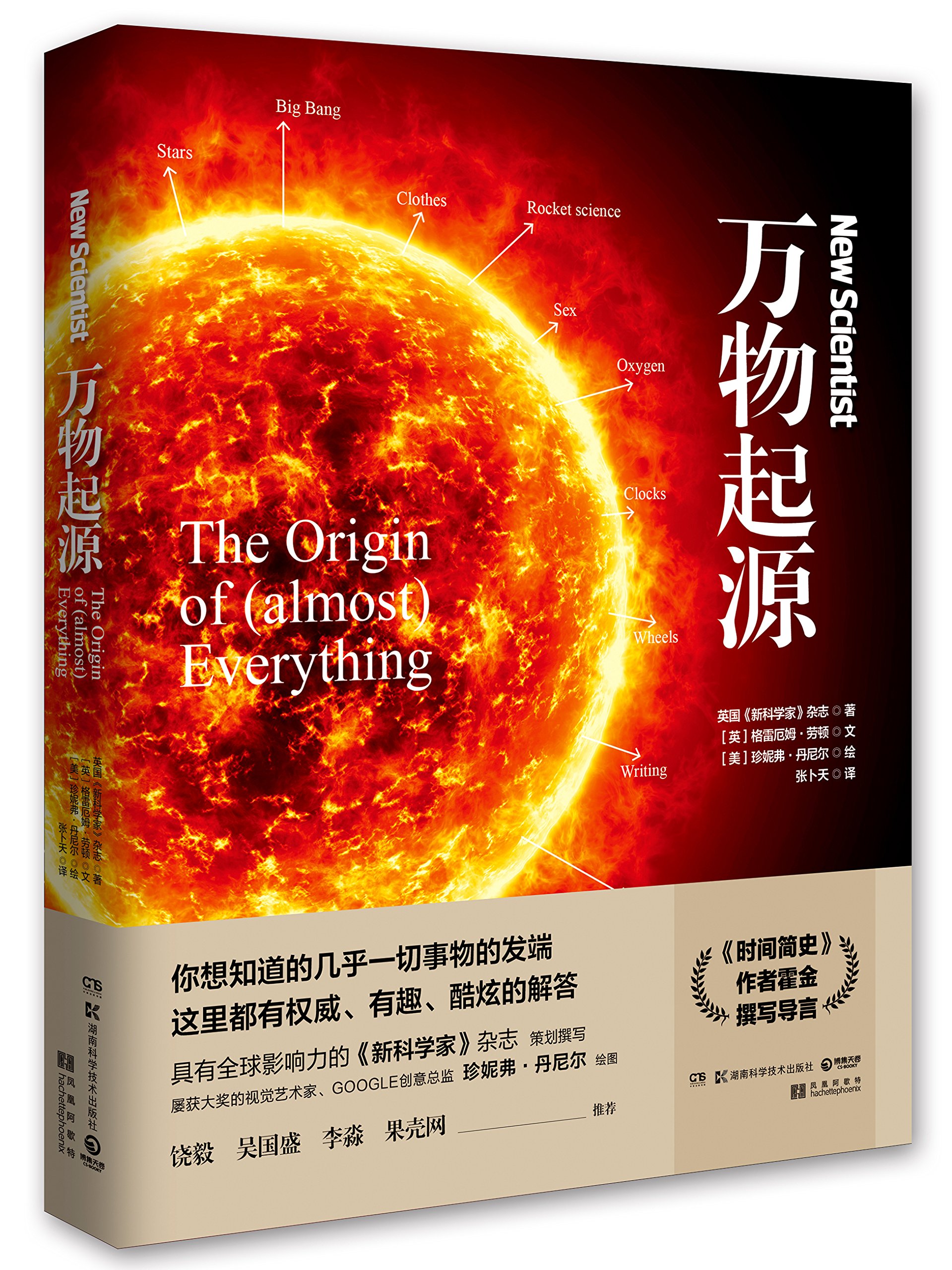
The popular science book Origins of Everything, compiled by the British magazine *New Scientist*, has recently been introduced and published by Hunan Science and Technology Press. The book has an introduction written by Hawking, is translated by Zhang Butian, a veteran translator in China’s history of science circle, and is jointly recommended by well-known scholars such as Rao Yi, Wu Guosheng, and Li Miao, so one might say its lineup is luxurious.
The book’s binding is likewise splendid: all 240-plus pages are printed in color on coated paper, and every page is rich in both text and illustrations. These illustrations were drawn by Jennifer Daniel, the famous designer at *The New York Times* and creative director at Google, and they are beautiful without sacrificing simplicity. Of course, the price tag of 108 yuan is also, in its way, a kind of luxury.
*Origins of Everything* consists of six chapters: the universe, the Earth, life, civilization, knowledge, and inventions, and each chapter contains more than ten questions. The scope of the questions is very broad: “from the Big Bang to belly button lint,” everything is there. But the amount of actual text is not much; one can finish it in half a day. Considering its price and presentation, it does not seem especially cost-effective. Still, if it is positioned as a gift, it is very appropriate—especially for young people with a strong thirst for knowledge. What gift could be better than such a beautifully produced and edifying popular science book?
Indeed, teenagers (and adults who retain a teenager’s thirst for knowledge) have always been the main audience for popular science books. This is not because teenagers lack knowledge more than adults do, but because teenagers are more full of “questions”; they are more curious about this world and ask more things, unlike adults, who take things “for granted.”
“Taking things for granted” is a terrifying state. The so-called “frog in warm water” is nothing other than a form of “taking things for granted.” It dulls one’s senses, makes one forget concern for one’s own situation, and gradually saps vitality and courage amid an undisturbed calm.
Busy adults may think they naturally care more about their own situation than children do, but in fact they are often merely continuing their habits, long since having given up concern. For example, adults care about “money,” but what they care about is how to “make money,” how to “spend money,” how to “save money”; they no longer pay attention to questions like the “origin of money” (this book discusses that issue on page 122). Why should a small piece of paper have such high value? Isn’t that astonishing? Adults have long ceased to bother with such questions, or else are satisfied with some plausible-sounding answer like “state backing.”
The key point is that what “adults” focus on is often precisely those ready-made, established things, which form a pool of “warm water” in which people immerse themselves—whether that immersion is comfortable or painful. Only children, who have only recently been thrown into this “pool” (this richly colored world), find everything around them full of novelty; rather than drifting along with the current, they prefer to trace things back to their source, and even if they are only flailing about in place and splashing up little flowers of water, it is still fun.
“Where will next month’s money come from?” and “What is the origin of money?” are questions with very different intentions. The former seems more “realistic,” while the latter seems grand and illusory. What good would it do my bank balance to trace the history from gold to credit money?
But is that really so? In a recent interview, the translator Zhang Butian was asked a similar question, and he answered: “Is being busy making money every day and busy with all kinds of worldly things what you call realism? People who suddenly fall gravely ill or who are on their deathbed know best what is truly real; the most real things are those closest to human life. From this perspective, I am very realistic.”
Indeed, those about to leave this world, like those who have just arrived in it, are more likely to perceive the world’s strangeness, because the existence of all things is no longer something self-evident. Ordinary people have not solved all their perplexities; they have merely grown used to the world and take the various things around them as a matter of course.
To seek knowledge for the sake of knowledge—this attitude is often described as aloof and otherworldly, something to be kept at a distance. But in fact, one only has to look at the lively, inquisitive youth and the elderly person who still wants to know the truth even at the end of life to understand that this is not some unattainable realm; rather, it is each person’s more originary desire.
Myth and religion try to respond to humanity’s desire to trace things back to their source and understand our own situation, but this is not religion’s monopoly. In fact, this desire is also the driving force of science. Schrödinger put it well: “I was born into such a situation—I do not know where I come from, nor where I am going, nor even who I am. This is my situation, and yours too, and that of each of you. Every person is in such a situation, and always will be. This reality can give me no answers. We eagerly want to know where we came from and where we are headed, but the only thing observable is the environment in which we find ourselves. That is why we are so urgently striving with all our might to find answers. This is science, scholarship, and knowledge; it is the true source of all human spiritual pursuits.” (*Nature and the Ancient Greeks*)
Of course, from a practical standpoint, tracing things back to their source also has its benefits: if one takes everything for granted, naturally one will not have the drive or vision for change. Only by recognizing that reality is not self-evident will one explore other possibilities and thus promote the development of science and technology.
To ask questions is always to seek answers, but the significance of asking questions does not necessarily lie in some definite answer. More crucial is that questioning itself shakes the state of “taking things for granted,” making people no longer measure things within ready-made frameworks, but instead examine them from historical and dynamic dimensions. As the history of things is revealed, the future of things also opens itself to us.
*Origins of Everything* contains both first-order and second-order popular science content. By first-order, I mean the scientific knowledge itself, such as the origin of the universe (knowledge of physics), the origin of life (knowledge of biology), and so on. By second-order, I mean the further questioning of the history and development of scientific knowledge itself—for example, when alchemy became science, or the history of the discovery of zero, and other kinds of history of science knowledge. In fact, in this book the boundary between first-order and second-order knowledge is not clear-cut. While introducing first-order knowledge, it is also always interwoven with history of science. For example, when asking “Where did black holes come from?” the primary question is “Since no one has ever seen a black hole, how do we know they exist?” (p. 30). The author then introduces the fact that ideas similar to black holes can be traced back as far as a paper from 1783, then discusses the work of Einstein, Schwarzschild, and others, and only then explains in physical terms how the formation process of black holes is understood. Even when introducing first-order scientific knowledge specifically, the book often treats it as a stage in the history of science rather than a final conclusion, unapologetically stating that on many questions there is “a lack of generally accepted explanations” (p. 94), and that on some issues “we may never know” (p. 71), and so on.
All kinds of knowledge, like anything else, also have their “origins.” Many forms of knowledge that were taken for granted by our predecessors have long since become outdated or even foolish dogma in today’s eyes; so would the knowledge we take for granted today not also develop and change? Popularizing scientific knowledge is certainly important, but even more important is that it should be taught as historical scientific knowledge, not as ready-made and definite scientific knowledge. An attitude of questioning the origin of things is more important than any specific answer to questions of origin. *Origins of Everything* carries through this attitude of tracing things back to their source: it not only provides knowledge of “where things come from,” but also pays attention to the origins of this knowledge itself, namely the question of “how we know.”
In this respect, perhaps China’s excellent popular science works represented by *One Hundred Thousand Whys* still have something to learn. *One Hundred Thousand Whys* also begins from questions, but it often still aims at conveying ready-made and definite knowledge, lacking a historical dimension. Many questions seem merely to replace declarative sentences with interrogative ones in form, without carrying through the attitude of questioning to the end—curiosity and inquiry should not appear only in the titles.
Translated from the Chinese original with AI assistance. The original text is authoritative.