
Last class we talked about ancient Greece as the birthplace of science. The key word of Greek learning is “freedom,” and this freedom has several layers of meaning. As for things, free things are natural things, as distinct from artificial things; natural things provide their own causes, so the discipline that seeks causes within things themselves is natural philosophy. As for human beings, freedom stands opposed to utility, and free persons stand opposed to slaves; one should pursue excellence rather than chase immediate material gain. As for learning, free learning stands opposed to imitation and authority; mathematics is the paradigm of free learning, because knowledge displays itself, without relying on the dogmas of authority, and is not something one can obtain merely by parroting or imitation.
It should be noted that it is hard to say whether these traits were really the mainstream among the Greeks of the time. Strictly speaking, the majority of the Greek population at that time were probably slaves, and among the educated class there were probably more sophists than philosophers. But that tiny band of eccentric philosophers really was a specialty of Greek culture; they were respected in their own time, and in the modern era they have been traced back as the sources of science. So our “general history of science” inevitably has to focus on them, which means that, one way or another, we will ignore other aspects of Greek culture such as Sparta. In our very first class, I said that bias is unavoidable in historical research, but we need to remain aware of it.
At the end of last class we mentioned several paradoxes. Parmenides said change is impossible, Zeno said motion is impossible, and Plato said learning is impossible. These paradoxes were not put forward merely as wild flights of fancy or word games; they all emphasized one thing, namely the gulf between the senses and reason. In Plato’s hands, this becomes a division of the world into the world of appearance and the world of ideas, the former being changeable, perishable, and defective, the latter immutable, eternal, and perfect. Plato set the goal of the pursuit of knowledge in the world of ideas, while the senses and the body, which confuse the mind, became obstacles to the pursuit of knowledge.

Plato has a famous allegory, usually called the “cave allegory.” It tells of a group of people chained in a cave, who can only stare at the cave wall in front of them. On the wall many images flicker and move about in great commotion, and some wise people can even derive a great deal of “knowledge” from them and predict how the images above will move. But when one person breaks free of his shackles and turns around, he realizes that all those images are merely shadows cast by the fire behind them. Step by step he makes his way out of the cave, sees the things under the sunlight, and finally sees the sun itself; only then does he discover the real world. He wants to go back and liberate his companions, but finds it very difficult to do so, because eyes that have gradually adapted to sunlight can no longer make out the dim images on the cave wall. Compared with those prisoners who know the images so well, he is more like a blind man; and even if the prisoners are forced to catch a glimpse of the firelight, they are all dazzled into seeing stars, thinking that that, rather than the shadows, is the illusion. With this story Plato allegorized the relation between the philosopher-king and ordinary people, and also his understanding of the path to knowledge. To pursue true knowledge, one must escape illusion, break the chains, and see truth with the free eye of the soul.
The body and the real world are basically just disturbances as far as truth is concerned, but that does not mean one must wait until the soul leaves the body before one can approach truth. In the real world there are some activities that can train the eye of the soul, such as geometry; and there are also certain things that are closer to the eternal and imperishable, namely the heavens. So disciplines such as geometry and astronomy became required courses for training the soul.
Against this background, Plato opened up a very distinctive astronomical tradition, which we may as well call “mathematical astronomy,” or more precisely, astronomy as mathematics. Plato stated explicitly that the heavens should be studied the way geometry is studied—that is, one should “start from the problem,” which means not starting from actual celestial phenomena. Plato’s astronomy requires theoretical imagination and logical deduction, and does not much require actual observation.
We have said that in the astronomical traditions of the great ancient civilizations, the main topic is the calendar. And the calendar problem is first of all the problem of how to reconcile the relation between the solar calendar and the lunar calendar. We know that a month refers to one cycle of waxing and waning of the moon, roughly a little less than 30 days, while a year is one cycle of the sun’s annual revolution that brings about spring, summer, autumn, and winter—twelve months plus a few extra days. So exactly how many extra days? And how are the vernal equinox, autumnal equinox, winter solstice, and summer solstice each year to be determined? This is an empirical scientific problem. In ancient Greece, Meton announced at the Olympic Games in 432 BCE that he had discovered the rule that 19 years is roughly equal to 235 months, that is, the so-called 19-year, 7-leap-month “Metonic cycle.” Of course, this cycle was probably not first discovered by the Greeks; the Babylonians very likely had already been using this calendar system long before.
Besides the calendar, the need for astrology was also a major driving force behind the development of astronomy. Ancient Babylonians believed that the positions of the sun and the five major planets at a person’s birth affected his character and fate; even today, young people “studying” horoscopes are still inheriting the Babylonian system. In ancient China, people believed that celestial phenomena were related to the fortunes of dynasties. To study these astrological questions required detailed records of celestial phenomena, and some deduction and prediction were also necessary.
But by the time we get to Plato, what drives astronomy is a wholly new demand, namely “saving the phenomena.”
At this point, let us first supplement the basic background of Plato and the cosmology before him in Greece.
Cosmology and astronomy are two different words. Cosmology, as the name suggests, is the doctrine concerning the origin and structure of the cosmos, whereas astronomy is mainly the observation, explanation, and prediction of astronomical phenomena. These two things are often unrelated, and there is no such thing as them confirming or promoting each other. For example, in ancient China cosmology was for a long time “heaven is round and earth is square,” but this did not prevent astronomers from developing highly accurate predictions of celestial phenomena. Even when Zhang Heng developed the more advanced “spherical heavens” theory, this cosmological model still had little to do with specific astronomical research; Chinese astronomy generally used algebraic methods and paid little attention to the physical meaning behind the data.
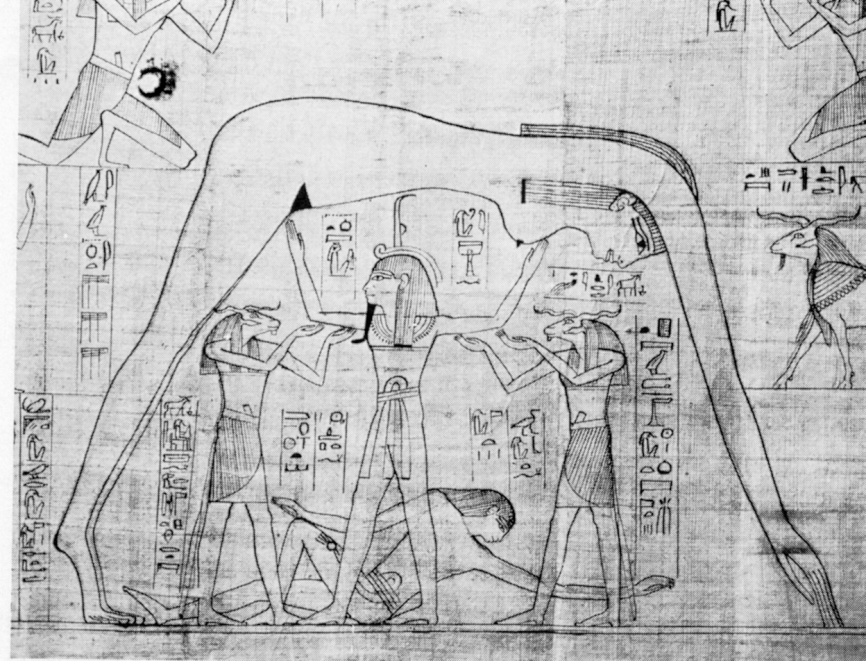
The following picture shows the cosmology of the ancient Egyptians: the personified sky god is on the outside, held up by the god of air, while the earth god lies at the bottom. Clearly, this Egyptian cosmology also had nothing whatsoever to do with their precise achievements in calendrics.
 The Course of Science
But from Plato onward, Greek cosmology and astronomy gradually came into alignment. Imagination about cosmic models and understanding of astronomical phenomena were unified. Although this unity was ultimately only relative, the lack of harmony between the two was precisely one of the forces driving the development of astronomy.
The Greeks recognized very early that the earth is a sphere. Of course, among the earliest philosophers such as Thales, this was not yet explicitly understood; for example, Anaximander thought the earth was a cylinder.
Plato’s cosmological thought mainly came from the Pythagorean school. The Pythagorean school was a secret society with a very strong religious character. They worshipped mathematics, revered the circle, and eating beans was taboo. As for the mathematical content, I may introduce that separately when I give a class on the history of mathematics. Here I will say something about their cosmology.
Because it was an esoteric religion, the specific ideas of the Pythagorean school are shrouded in fog. Some scholars think that Plato’s school was also some kind of esoteric tradition, or even simply that the texts he publicly disclosed may not have represented his core ideas. That is entirely possible as well.
From some of the views that have come down to us, the Pythagorean scholar Philolaus (ca. 480–385 BCE) seems to have held some kind of geocentric cosmology. They proposed that the center of the cosmos was the “central fire,” and that the earth, the sun, the moon, the planets, and the sphere of fixed stars all moved around the central fire. In order to make up the number 10, which symbolizes perfection, they also invented a planet called “Counter-Earth,” which stood opposite the earth on the other side of the central fire. Since all the inhabitants on earth live on the side facing away from the central fire, we can see neither the central fire nor the Counter-Earth. It is not very clear whether this idea was a consensus of the Pythagorean school or a distinctive notion.
The Pythagorean school seems already to have known that the earth is a sphere, and to have known the causes of solar and lunar eclipses (the moon’s blocking and the earth’s shadow), as well as having clearly identified that the morning star and the evening star (that is, the morning star and the evening star) are the same star (Venus).
The recognition that the earth is spherical may perhaps have something to do with the Greeks being a seafaring people: the fact that one first sees the mast of a distant ship appear above the horizon is evidence for the earth’s sphericity; the position of the starry sky at the same moment at different latitudes is another piece of evidence. The shape of the earth also explains the formation of lunar eclipses; the Greeks believed that a lunar eclipse is the earth’s shadow.
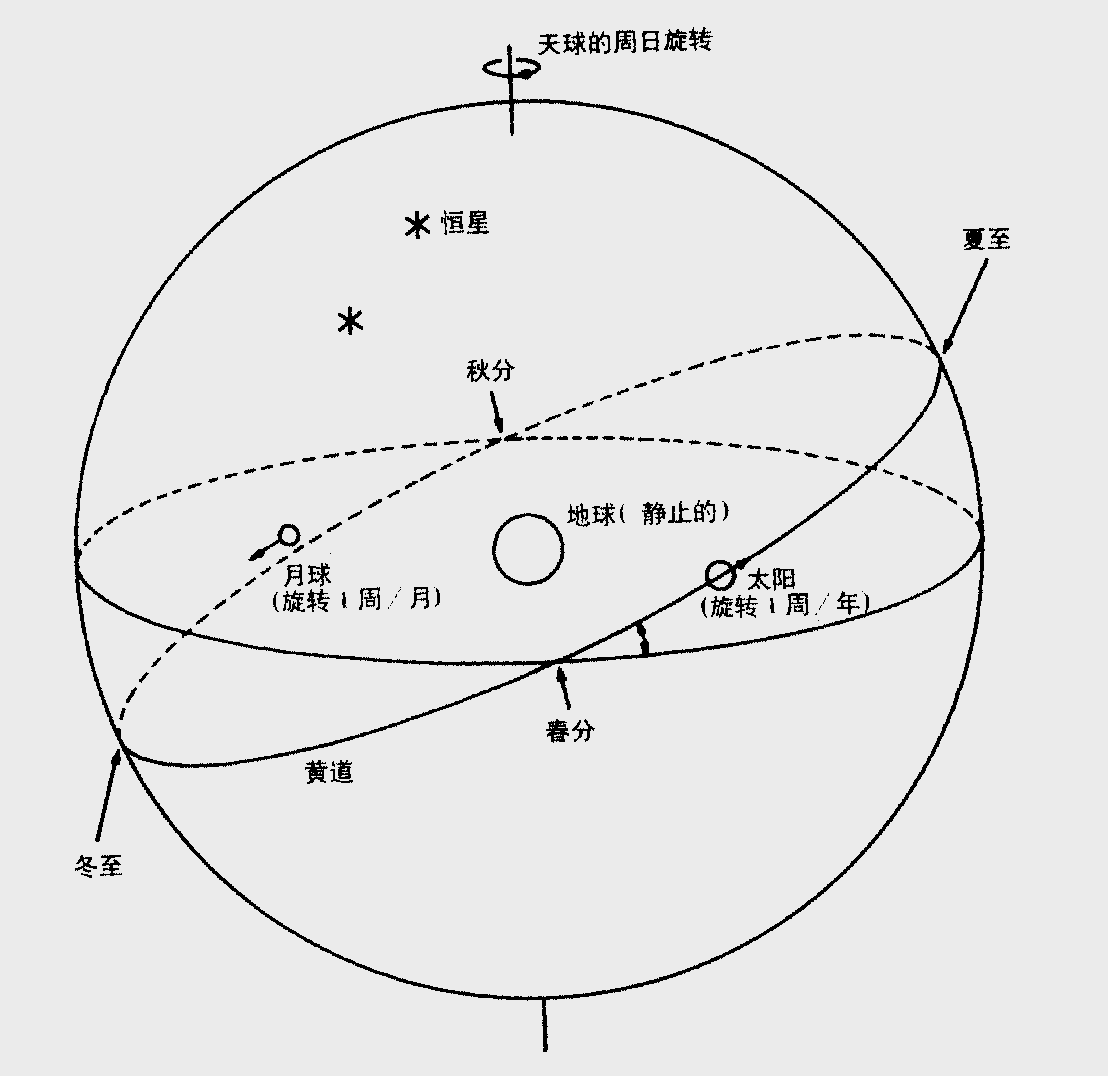
In short, around the time of Plato, the cosmic model in the minds of ordinary Greek philosophers was as follows:
The earth is a sphere, located at the center of the cosmos and motionless. All the fixed stars are “embedded” in another large sphere, which is the sphere of fixed stars, and the sphere rotates once every day. In addition, besides following the sphere of fixed stars in their daily rotation, the sun and moon also carry out additional rotations on monthly and yearly cycles, and the axis of rotation stands at a certain angle to the axis of rotation of the sphere of fixed stars—that is, the angle between the ecliptic and the equator.
 The Origins of Western Science
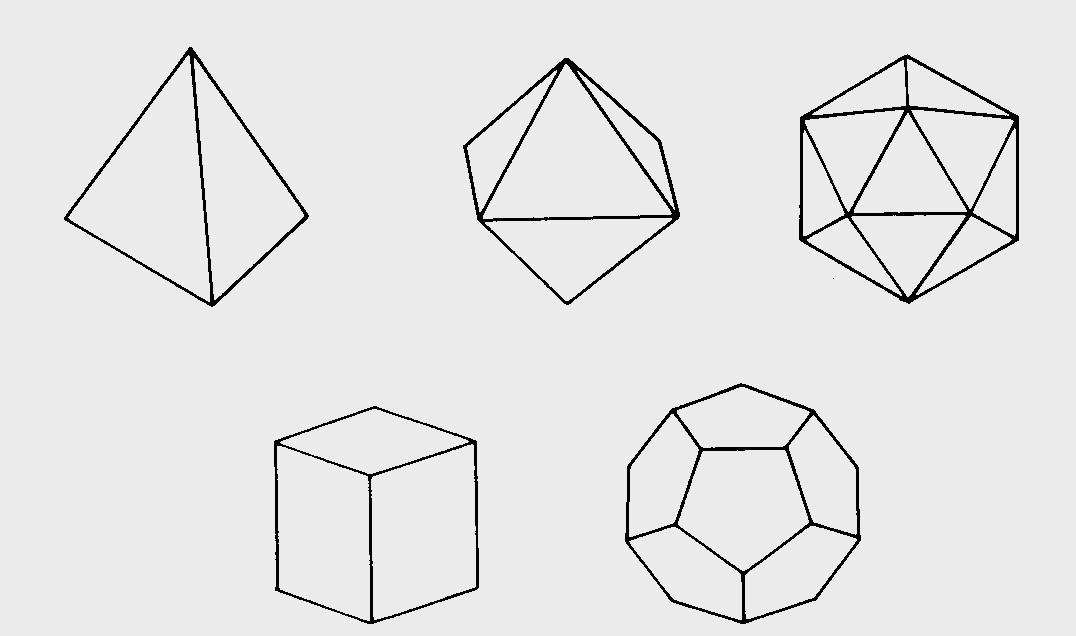
In his work Timaeus, Plato described in detail a Pythagorean cosmology. He held that the cosmos is the work of a divine craftsman, or “Demiurge.” This craftsman does not create out of nothing; rather, he imparts eternal ideas to ready-made materials. This cosmos is essentially geometrical. Plato correlated the five regular polyhedra with the five basic elements: fire is the tetrahedron (the sharpest), air is the octahedron, water is the icosahedron, earth is the cube (the most stable), and the dodecahedron, which is closest to the sphere, is the element of the heavens, later called aether.
Each element is further reduced to geometric figures. Fire, air, and water, composed of triangles, can transform into one another. Heaven and earth are the most different of all.
Timaeus is the only complete work of Plato to survive in medieval Europe, and it had a tremendous influence on later generations. It provided a rationalist, or rather geometrical, picture of cosmology.

The Latin manuscript of Timaeus in the 16th century
In short, Plato’s cosmology was so distinctive that it could provide astronomy and physics with a certain theoretical model. In particular, the “two-sphere model” gave an excellent explanation of calendrical problems and phenomena such as solar and lunar eclipses.
But it had one flaw: there was still one phenomenon it could not explain, namely the problem of the planets.
As we said, Plato believed that the starry heavens are the thing closest to the world of ideas. The starry heavens rotate in endless cycles, unchanged through the ages. Circular motion is different from linear motion: circular motion has neither beginning nor end; it is eternal motion, utterly different from the linear motion of earthly things, which has a beginning and an end.
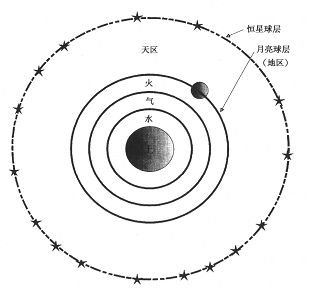
The Greeks insisted, in a rather forced way, that the heavens are eternal and unchanging. Later Aristotle clearly distinguished the superlunar and sublunar realms, holding that below the moon is the world filled with changeable four elements, while above the moon is the world of the eternally unchanging fifth element. Thus Aristotle classified comets, meteors, and the like as atmospheric phenomena, thinking they were things happening in the sublunar realm and belonged to “meteorology.” As for sunspots, supernovae, and the like, the Greeks simply failed to see them at all. But the five major planets, uniquely, really could not be ignored.
We know that the starry heavens are not a monolithic slab: there are a few unruly stars that do not keep pace with the others, but instead wander about constantly. The Greeks called them “wanderers,” which is what we call “planets.” Why do these few planets wander about in confusion? Is the apparent chaos actually still governed by some law in the background? This was the astronomical problem Plato put forward: to explain apparently chaotic phenomena with eternal, uniform circular motion. This is what is meant by “saving the phenomena.”
The wandering of the planets mainly refers to “stopping and retrograde motion.” First, the major planets, of course, also rotate together with the sphere of fixed stars once every day (we now know this is because the earth rotates on its axis). Then each planet, like the sun and moon, also moves on the plane of the ecliptic with a certain period: the moon in one month, the sun, Venus, and Mercury in one year, Saturn in about 30 years (we now know this is because planets revolve around the sun). All of that is easy to explain. But the problem is that the planets move restlessly along the ecliptic—they go faster or slower, and during certain periods they even stop and move backward.
We now know that this is because the earth, like the other planets, revolves around the sun, so the speed of a planet’s motion along the ecliptic depends not only on its own revolution, but also on its relative speed with respect to the earth. When the earth is relatively close in distance to a certain planet, the earth’s relative speed may be faster than the planet’s own orbital speed, and from the earth’s point of view the planet appears to go into retrograde. But this phenomenon is very hard to explain under the model of a geostatic cosmos. Of course, in other cultures this could be explained quite simply as the planets being “willful,” and all kinds of corresponding omens could then be elaborated from that. But the Greeks stubbornly believed that the heavens are unchanging, and the planets’ unruliness is not some mysterious omen, but merely a phenomenon still awaiting explanation.


Plato threw out this question, and at once someone came up with a whole set of answers. Plato’s colleague and student Eudoxus (c. 390–337 BCE) proposed the “homocentric sphere model.”
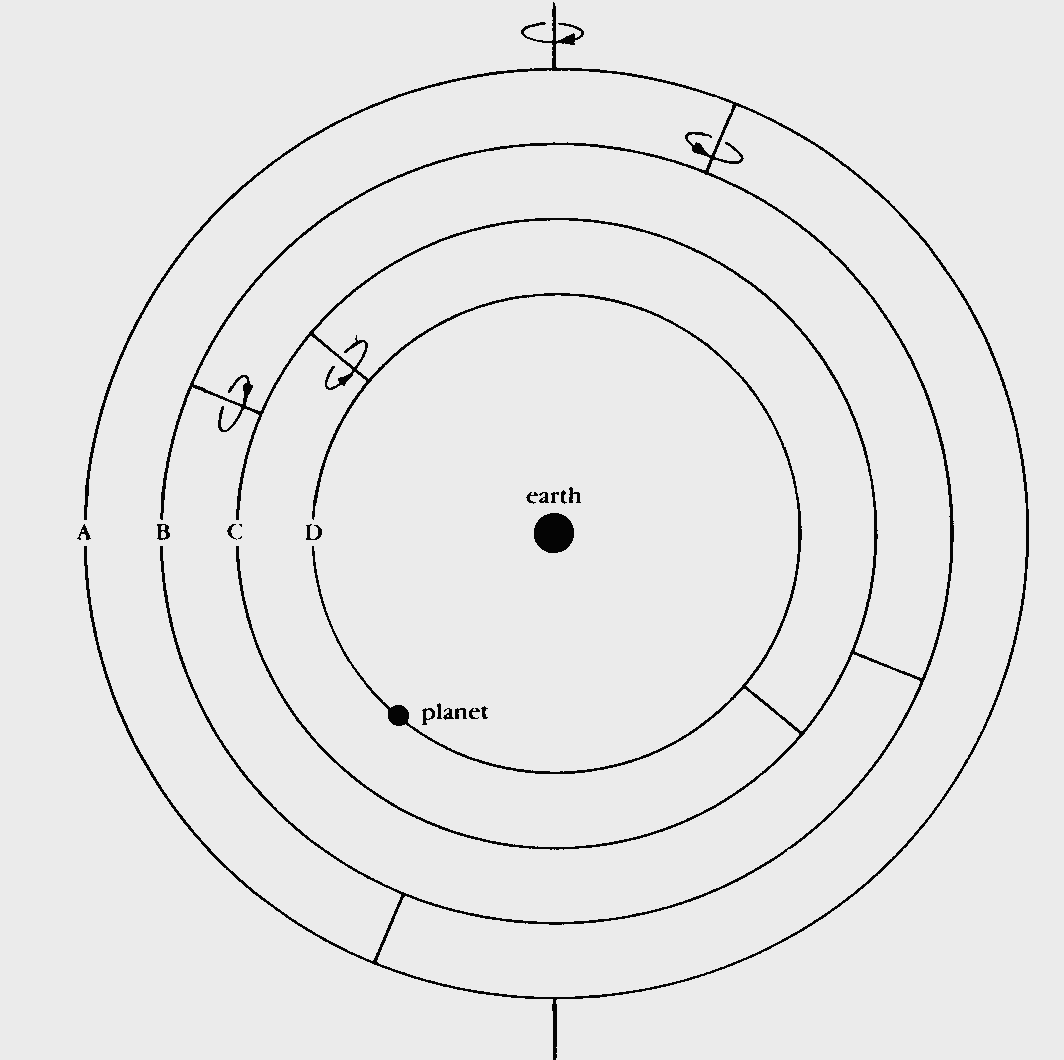
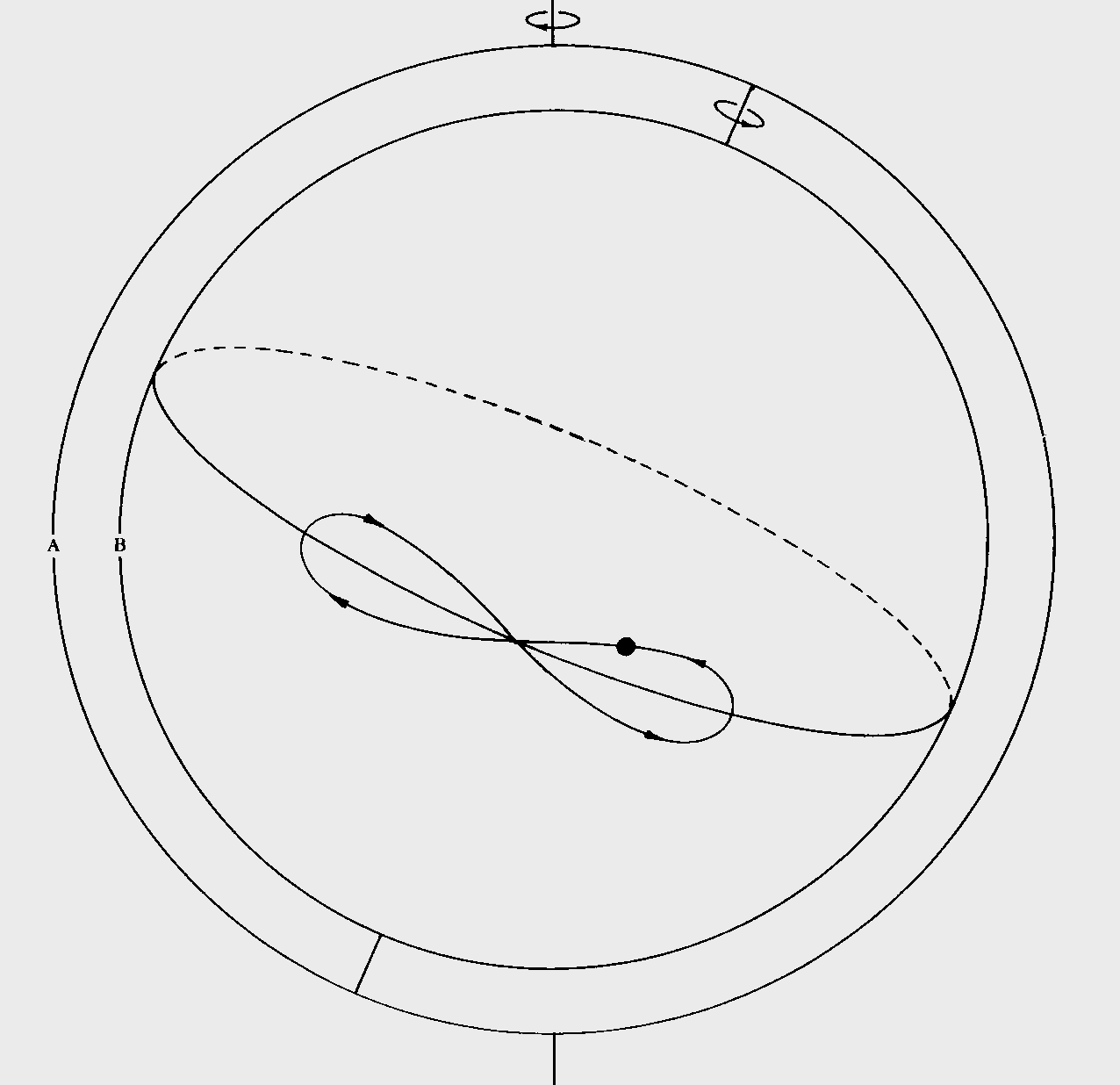
The homocentric sphere model proposed that planetary motion is the superposition of several circular motions. Each planet is encased in four celestial spheres; the outermost sphere completes one rotation per day, the second sphere fits the planet’s revolution along the ecliptic—for example, Mars takes 687 days for one circuit—and the innermost two spheres are specifically used to fit the phenomenon of retrogradation. The rotation axes of the several spheres are offset at different angles, so that the superposition of multiple uniform circular motions can fit a complex trajectory; by adjusting the angles and rotation speeds of the inner two spheres, one obtains a saddle-shaped path, thereby explaining the retrograde motion of the planets.
Eudoxus assigned the cosmos a total of 27 celestial spheres—four for each of the five major planets, three each for the Sun and Moon (they do not have retrogradation, but an extra sphere was still added to explain motion deviating from the ecliptic), plus the outermost sphere of the fixed stars. Later Callippus revised the model, adding seven more spheres in order to fit the orbits better and explain the differences in the lengths of the seasons. Finally Aristotle made additions: he made no mathematical repairs at all, merely inserted some extra spheres between the homocentric spheres of the major planets to take charge of transmitting motion continuously. This shows that, at least in Aristotle, the homocentric sphere model was regarded as a mechanical model of the real cosmos.
We are not quite sure what Plato thought of Eudoxus’s solution; in any case, this was a successful attempt, showing that a very simple theoretical model can fit apparently complex and disorderly phenomena. Of course the homocentric sphere model had major defects. First, the horseshoe-shaped curve it produced for retrogradation was always constant, whereas in actual observations each retrograde track differs somewhat from the others; second, it could provide only a rough qualitative explanation, but the actual data diverged from it too much; finally, it could not explain changes in planetary brightness. Such changes can be explained by changes in the distance between a planet and the Earth, but the homocentric sphere model could not represent changes in distance—of course, the Greeks believed that the heavens were unchanging, so they would not accept an explanation that treated changes in brightness as changes in the planet itself.
Even so, the homocentric sphere model was also very likely to have been approved by Plato, because what Plato required in the first place was only a qualitative explanation. In Plato’s view, the heavens are merely the closest thing to the world of Ideas, but still fall short in the end, so a certain amount of imperfection is always inevitable. Perhaps the homocentric sphere model was the form set by the master craftsman-Demiurge, but ultimately, because of the limitations of matter, it could not operate in complete accordance with the Ideas; there was nothing to be done about that. Further development of mathematical astronomy would have to wait until the Hellenistic period.
 Origins of Western Science
Before formally entering the Hellenistic period, let us say a bit more about Aristotle. Aristotle was the great synthesizer of classical Greek scholarship; he was an encyclopedic scholar who covered almost all the questions discussed by the philosophers of Greece at the time. At least 30 works survive to this day, and most were probably lecture notes or internal materials; it is said that Aristotle wrote more than 150 works in all.
Aristotle’s writings display a striking systematicity and analytical rigor. The way he dealt with questions is very close to modern academic work: pose the question, review the literature, comment and present one’s own view, argue and consider possible objections… Many insights of early Greek thinkers are known to us precisely because Aristotle organized and criticized them.
In modern times, Aristotle is often portrayed as an “obstinate academic authority,” as if modern science had only been able to establish itself tenaciously after struggling to break the authority of Aristotelian dogma. But in fact, this certainly was not Aristotle’s fault. Aristotle opened up the basic paradigm of Western scholarship centered on analysis and critique, laying the groundwork for many disciplines. He himself had a motto: “I love my teacher, but I love truth more.” By this he meant that although he studied under Plato and respected his teacher, he did not compromise in matters of thought. Aristotle’s students also upheld this attitude. The successor to the Lyceum, Theophrastus, questioned Aristotle’s teleological doctrine, doctrine of the four elements, and views on optics, and the next generation of successors did the same; they were also ready at any time to accept the views of other schools, so long as those views were reasonable. Even in the Middle Ages, it would not necessarily be fair to say that Aristotelianism was an immovable dogma; we will talk about this in a later class.
Table of Contents of The Complete Works of Aristotle (the crossed-out items are generally regarded as spurious; the italicized ones are disputed)
| Volume I: Logic
Categories On Interpretation Prior Analytics Posterior Analytics Topics On Sophistical Refutations Volume II: Physics Physics On the Heavens On Generation and Corruption Meteorology On the Cosmos Volume III: Psychology and Physiology On the Soul On Sense and Sensible Objects On Memory On Sleep On Dreams On Divination in Sleep |
On Youth and Old Age On Life and Death On Respiration On Breath On Length of Life Volume IV: Zoology History of Animals Volume V: Zoology On the Parts of Animals On the Gait of Animals On the Motion of Animals On the Generation of Animals Volume VI: Short Physical Treatises On Colors On Sounds Physiognomics On Plants On Marvelous Things Heard Mechanics Problems
|
On Indivisible LinesOn the Situations and Names of Winds;
Volume VII: Metaphysics Xenophanes and Gorgias Metaphysics Volume VIII: Ethics Nicomachean Ethics Magna Moralia Eudemian Ethics On Virtue and Vice Volume IX: Politics and Literary Theory Politics Economics Rhetoric Rhetoric to Alexander Poetics Volume X: Supplements Athenian Constitution Fragments |
Because Aristotle’s thought is so rich, we cannot introduce it in detail here. So, with the theme of astronomy, let us simply mention Aristotle’s cosmology.
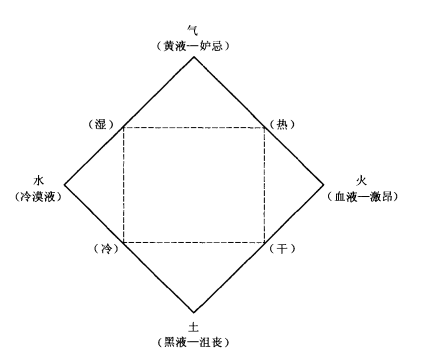
Like Plato, Aristotle also accepted the five elements of earth, water, air, fire, and ether. The difference is that he did not reduce these elements to geometric figures, but to the four sensible qualities of cold, hot, dry, and wet. Water is wet and cold, fire hot and dry, and so on. Through the correspondences between the four elements and the humors and emotions, they were also linked to physiology and psychology.
In the cosmos, these four elements each have their corresponding “natural place”; that is to say, earth’s natural state should be near the center of the cosmos, water should form the next layer outside earth, and beyond that, in sequence, are the air layer and the fire layer. Once something departs from its natural position, it will try to return to its natural place. So earth above the water layer will fall downward, and fire below the air layer will rise upward. The Earth happens to be at the center of the cosmos precisely because it is made mainly of earth, and earth naturally gathers at the center of the cosmos. Human beings on Earth always fall downward rather than float upward, also because the elements composing human beings are mainly earth and water, not air or fire.
Aristotle brought together cosmology, physics, physiology, ethics, and more into a vast philosophical system. This philosophical system is what modern science needed to challenge and overturn, but it is also the model toward which modern science aspired.
 History of World Science and Technology
The “Hellenistic period” is more or less marked by Aristotle’s death. In fact, we usually take the death of Alexander the Great as the beginning of the Hellenistic period, but Aristotle happened to die just one year after his student.
Aristotle was born in northern Greece. His father was the personal physician of King Amyntas II of Macedon, Alexander’s grandfather. At 17, Aristotle was sent to Athens to study under Plato. After Plato died 20 years later, Aristotle left Athens and traveled widely. In 342 BCE he returned to Macedon and became the private tutor of the young Alexander. At this time Aristotle was a little over forty, while Alexander was only 13. After Alexander the Great came to the throne at 20, he began campaigns east and west, and in just 13 years built a vast empire stretching across Asia, Africa, and Europe.
After Alexander the Great crushed Athens in 336 BCE, Aristotle returned to Athens and established his Lyceum there. Until 323 BCE, when Alexander died young and the empire fell into turmoil, Aristotle took the initiative to leave Athens to lie low. He said, “I do not want the people of Athens to commit a second crime of destroying philosophy.” But he died of illness the following year.
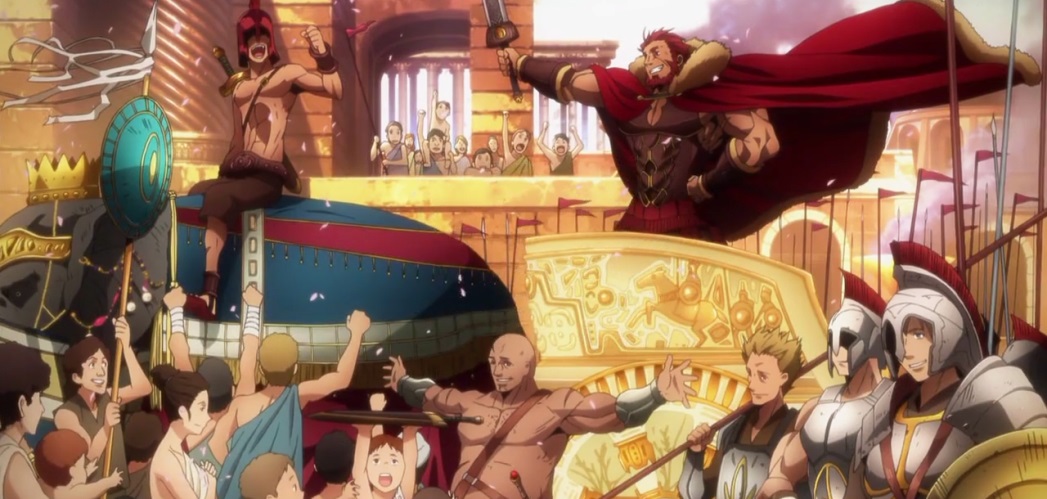 Shown here is Alexander as depicted in the Japanese anime Fate/Zero
Alexander the Great conquered the Nile basin and the Tigris-Euphrates basin, and only met resistance when he reached the Indus basin. Unfortunately, he died young at 33; his wife was still pregnant at the time, so there was no heir. Several generals fought over control of the empire, which quickly fell apart.

Cassander controlled the Greek region, Lysimachus controlled Thrace, Seleucus controlled western Asia, and Ptolemy controlled Egypt. This period was one in which Greek culture was being “worldized”: on the one hand Greek culture spread eastward, while on the other hand the Greeks themselves came into contact with many Eastern cultural influences. Hence the historical label “the Hellenistic period.”
In historical usage, the “Hellenistic period” generally begins with the death of Alexander the Great (323 BCE) and ends with the death of Cleopatra VII, the Egyptian queen, in 30 BCE, when the Ptolemaic dynasty was annexed by the Roman Empire. But culturally speaking, the period of “Hellenization” was much longer. After the Greek cultural sphere was incorporated politically into the Roman realm, it still remained relatively independent culturally: the Greeks continued to speak Greek, continued the Greek scholarly tradition, and identified themselves as Greeks rather than Romans. So we still count the Ptolemaic astronomy of the second century CE as Hellenistic science.
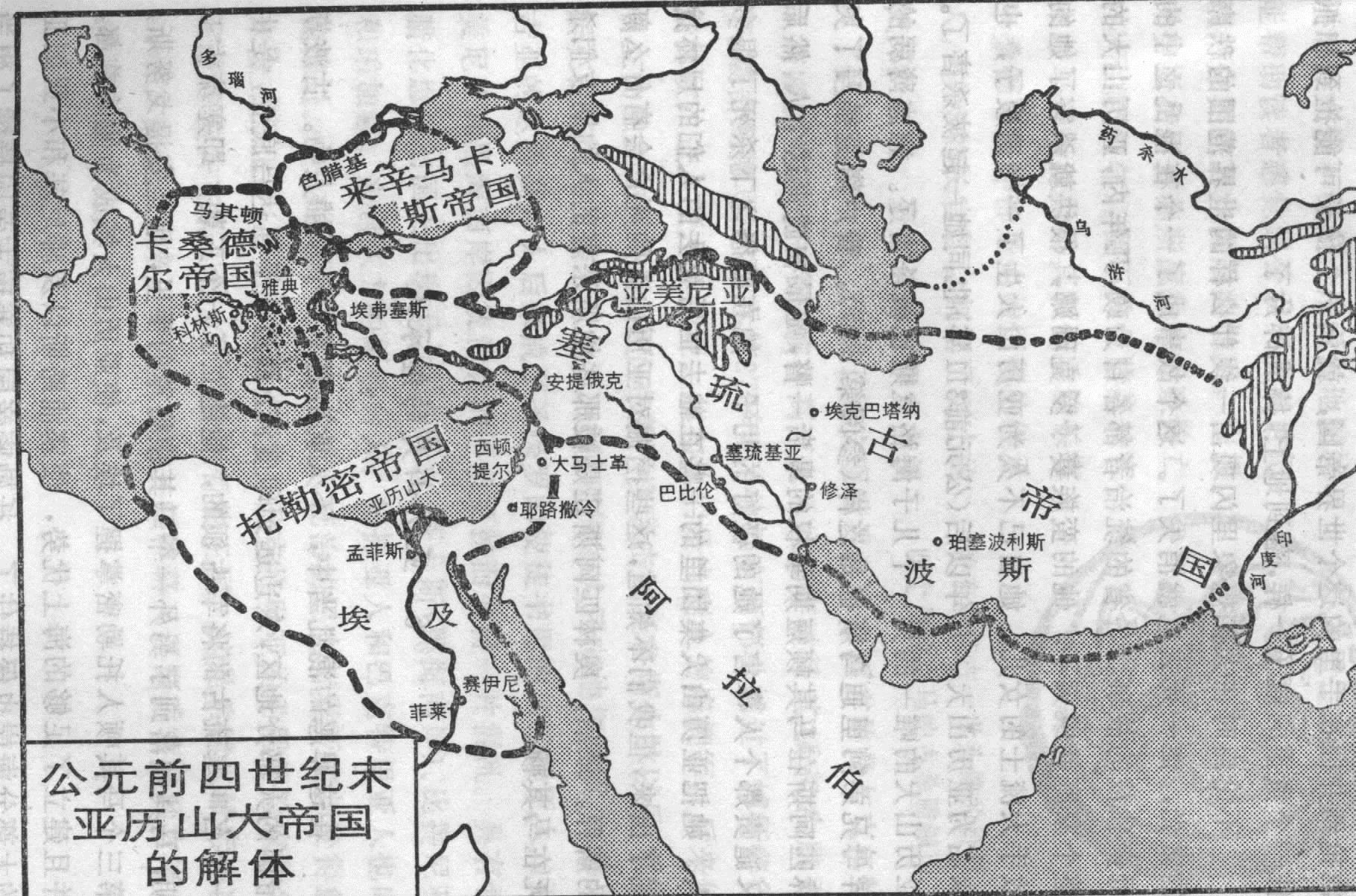 (Wu Laoshi’s courseware)
The scholarly center of the Hellenistic period shifted from Athens to Alexandria. Alexandria was a port city built by Alexander the Great in northern Egypt and named after himself; after Alexander’s death, this city became the capital of the Ptolemaic kingdom. In 307 BCE, Demetrius of Phalerum (Demetrius Phalereus), who was then ruling Athens, was overthrown, and Ptolemy brought him to Alexandria. Demetrius had studied under Theophrastus, the first successor of the Lyceum, and may even have been a student of Aristotle himself. With his encouragement, Ptolemy built a Museum in Alexandria, or, transliterated, a Mouseion; this is also the origin of the modern word “museum,” though the Mouseion at that time had nothing to do with the display of exhibits.
As its name suggests, the Mouseion was a temple dedicated to the Muses, the goddesses who presided over the arts and the sciences, including the goddesses of history and astronomy. But the Mouseion in Alexandria was in fact a large research institute, supported by the royal family and housing many scholars. It contained workrooms, lecture halls, dissecting rooms, a zoo, and an observatory. In addition, Alexandria also built a great library, said to have held 500,000 scrolls, though of course most of them were burned up in the subsequent wars.
The scholars of the Mouseion maintained close ties with Athens, especially with Aristotle’s Lyceum. As Athens declined, the torch of classical Greek scholarship was taken up by Alexandria. Of course, apart from Alexandria, other regions such as Pergamon and Athens itself were also influenced by the Mouseion model, namely academy-style scholarly research funded by royal patronage. Right down to the Roman period, Roman emperors such as Antoninus Pius and Marcus Aurelius also supported Greek scholarship, allowing the Greek scholarly tradition to continue uninterrupted.
It was not until 415 CE, when the female scholar Hypatia of the Mouseion was murdered by Christians, that the end of the Hellenistic scholarly tradition was symbolically marked (Hypatia’s father may have been the last professor at the Mouseion; Hypatia herself lectured from her home). The closing of Plato’s Academy came later still; tradition says it was shut down by order of Emperor Justinian in 529 CE, though it seems to have been interrupted for a long time before that. The New Academy was rebuilt on the original site by later Neoplatonists.
In any case, the Mouseion of Alexandria lasted for nearly 700 years—about as long as the oldest universities in Europe today.
The Mouseion embodied the distinctive character of Hellenistic science. First, the intellectual elite entered into an alliance with royal power: scholarly research was funded and supported by the royal household, but the royal household did not impose too many additional demands on scholars, who were still free to conduct research and teach. Of course, the academy encompassed fields of study that Greek philosophers tended to look down on, including medical dissection and military science, but on the whole disciplines such as astronomy still retained their purity and were not pursued for practical ends. With the support of enlightened monarchs, scholars’ freedom was even better protected, and the existence of stable institutions also allowed scholarly achievements to be transmitted and accumulated. Some auxiliary work could be carried out with government support, such as copying and calculation. If Alexandria really did have several hundred thousand scrolls in its library, then behind it there must have been a professional team of scribes providing support.
In terms of its scholarly form, Hellenistic science was a combination of Greek free scholarship and Eastern practical knowledge, and this is already evident in Ptolemaic astronomy.
Let us return to astronomy. In the Hellenistic period, Greek scholars took notice of the achievements of Babylonian astronomy. As we mentioned, Greek astronomy was unified with cosmology; the astronomy of Plato and Eudoxus focused on the planets, and the models they proposed were geometric, qualitative, and purely theoretical. Babylonian astronomy, by contrast, was numerical, predictive, and observational. Hellenistic scholars introduced Babylonian astronomy into Greek astronomy, and this new Hellenistic astronomy was both geometric and numerical: it included pure theoretical cosmic models, and at the same time attempted to conform to actual observational data.
The representative figure among Greek astronomers influenced by Babylon was Hipparchus, active around 140 BCE. Most of his own writings have been lost, but Ptolemy absorbed the results of his work, and it is thus known to us.
Hipparchus’s contributions ranged across theory and observation. For example, he developed spherical trigonometry, an important mathematical tool; invented a “dioptra” capable of measuring the apparent diameters of the Sun and Moon; and invented stereographic projection for the making of astrolabes. He also discovered the precession of the equinoxes through observational records—that is, the phenomenon of axial precession. We now know that this is because the Earth’s axis of rotation does not point permanently to a fixed spot in the sky, but instead rotates slowly, with a period of 26,000 years, so the positions of the equinoxes and the north celestial pole change slightly from year to year. Hipparchus also compiled a star catalog and organized systematic observational data, which became the basis for Ptolemy’s work and even for later European astronomers. (Hipparchus’s star catalog included the concept of stellar magnitude, though at the time magnitude was defined in terms of the size of the fixed stars.)
Hellenistic astronomers did not forget Plato’s task of saving the phenomena; they provided new models for planetary astronomy.
Apollonius, active around the second century BCE, offered two models: the eccentric-circle model and the epicycle-deferent model. By the way, Apollonius’s principal surviving work is the 《Conics》, in which he nearly achieved the highest possible accomplishment in the study of conic sections by purely geometric means, before analytic geometry existed.
The eccentric-circle model no longer placed the Earth at the center of the celestial sphere, but shifted it somewhat off-center; this explained the unequal lengths of the seasons and the variation in the apparent size of the Moon.
The epicycle-deferent model made the planets not revolve directly around the Earth, but first rotate on an epicycle, whose center then revolved around the Earth. This explained both the changes in the planets’ distance from the Earth and also simulated retrograde motion: when a planet was relatively close to the Earth, the speeds of the epicycle and deferent could cancel one another, and from the Earth the planet would appear to move backward.
Apollonius pointed out that the eccentric-circle model was in fact a special case of the epicycle-deferent model: when the epicycle’s speed takes certain specific values, the combined path of motion is exactly an eccentric circle.
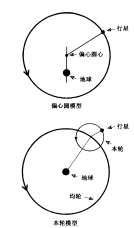
Apollonius’s creations, through Hipparchus’s transmission, were ultimately integrated by Ptolemy. Ptolemy was active in Alexandria in the second century CE, some 300 years after Hipparchus; for Hipparchus’s materials to have been preserved intact and passed down to Ptolemy was already no easy matter, but it was precisely the institutional support of the Mouseion that ensured Ptolemy still belonged to the same scholarly tradition.
Ptolemy was the great synthesizer of Greek astronomy as a whole. He absorbed his predecessors’ theoretical tools and observational records, used both of Apollonius’s models at once, and added an additional model of his own: the equant. These three models were employed simultaneously and superimposed on one another. That is to say, the planets rotate around an epicycle, the epicycle revolves around an eccentric circle, and sometimes the center of the larger eccentric circle must in turn rotate around yet another epicycle; later revisers could even attach a smaller epicycle to the epicycle in order to increase precision.
The Earth is not at the center of the eccentric circle, but neither does the planet’s epicycle move uniformly in a circle around the center of the eccentric circle; rather, it moves uniformly around another point, the “equant,” which in essence means uniform angular motion.
This complex mathematical system, by carefully adjusting the size and speed of each wheel, could not only qualitatively explain planetary retrograde motion, but also predict planetary trajectories with remarkable precision. In theory, if we were to keep repairing this system, its degree of precision need not be lower than that of the Keplerian system. Of course, in fact, its accuracy was no worse than the Copernican system’s; we will come back to that later.
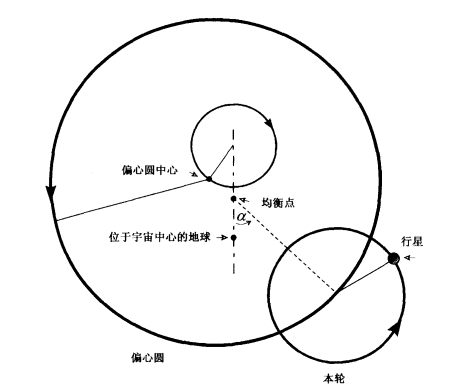 (Ptolemy’s model of Mercury)《A Comprehensive History of World Science and Technology》
Ptolemy’s masterpiece, the Almagest, was a perfect integration of theory and observation. For the first time, theoretical science displayed its power through formidable predictive ability. The Almagest was admired by later Arabs as “the greatest of the great,” and thus came to be known as the Almagest (Almagest, from Almagestum), and one might say that it represented the highest achievement of ancient science. Not until Copernicus did a European astronomer possess mathematical skill comparable to Ptolemy’s.
But Ptolemaic astronomy was unquestionably also a departure from Plato. For Plato, the real world was subordinate to the world of Forms; reality was only an imitation of Forms, while mathematics was merely a kind of training that liberated the soul, not a practical tool for calculation. By the time of Ptolemy, mathematics had indeed become a tool. It was no longer reality that submitted to the Forms, but the Forms that had to submit to reality. The theoretical model of the cosmos had to adjust itself according to observational data; these models seemed to be nothing more than fictive tools invented for convenience and precision, things that could be changed or discarded at any time, and entirely unrelated to the eternal and immortal world of the Forms.
If the epicycle-deferent model in Apollonius was still only a qualitative model for “saving the phenomena,” akin to the concentric-spheres model, then once the “equant” was added, Ptolemy’s system had almost given up the requirement of saving the phenomena altogether. Uniform angular motion was not at all the eternally unchanging uniform circular motion that Plato had in mind. This was also the aspect of Ptolemy that Copernicus found most unsatisfactory. Copernicus retained the eccentric circle and the epicycle-deferent, but abolished Ptolemy’s equant, which Copernicus regarded as one of his important contributions to setting things right and returning to the Platonic tradition. But that is a story for later.

The Hellenistic period naturally also produced many other important scientific achievements. Here I will add a few figures, though by no means exhaustively.
Aristarchus (ca. 310–230 BCE) is celebrated as the Copernicus of ancient Greece. He was the first to propose a heliocentric cosmic system, though his insight was overshadowed by Ptolemy’s brilliance. But this was by no means an injustice. In that era, heliocentrism had not much that could make it convincing; it lacked evidence and was met with powerful counterevidence. One of these was the question of why people are not thrown off at high rotational speeds, something that was difficult to explain before the theory of inertia had developed. By contrast, Aristotle’s physics could provide a more harmonious and systematic explanation for geocentrism. Another counterevidence was empirical: “stellar parallax” had not been observed. If the Earth revolved around the Sun, then observing the same star at the same time in spring and autumn should reveal parallax, just as the position of an object as seen by the left eye and the right eye is not identical. Failing to see stellar parallax could only mean that the stars are unimaginably far away. But at that time people still believed that the stars had an apparent size, and Hipparchus’s star catalog defined stellar magnitude in terms of the size of the fixed stars. Thus the actual area of such distant stars would be absurdly huge, and such a disproportionate cosmos did not seem any more reasonable than a central-fire cosmos or any other cosmology. So it is quite understandable that Aristarchus’s doctrine met with neglect.
The surviving work of Aristarchus is 《On the Sizes and Distances of the Sun and Moon》. He estimated the size relationship between the Moon and the Earth from the shadow of the Earth cast on the lunar surface during a lunar eclipse, and estimated the distance relationship between the Sun and the Earth, and between the Moon and the Earth, by observing the Sun at the crescent Moon, and so on. Because of errors in the measured data, his estimates were not accurate enough, but the methods of reasoning he used were rigorous and valid.
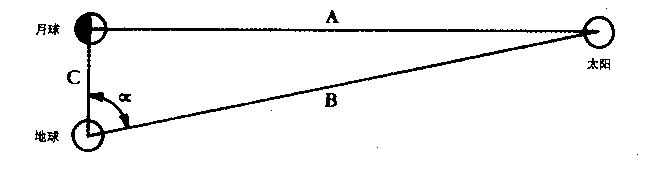
Eratosthenes (ca. 275–193 BCE) once served as chief librarian of Alexandria. He is celebrated as the father of geography; he invented cartographic methods based on latitude and longitude, and proposed the concept of “geography.”
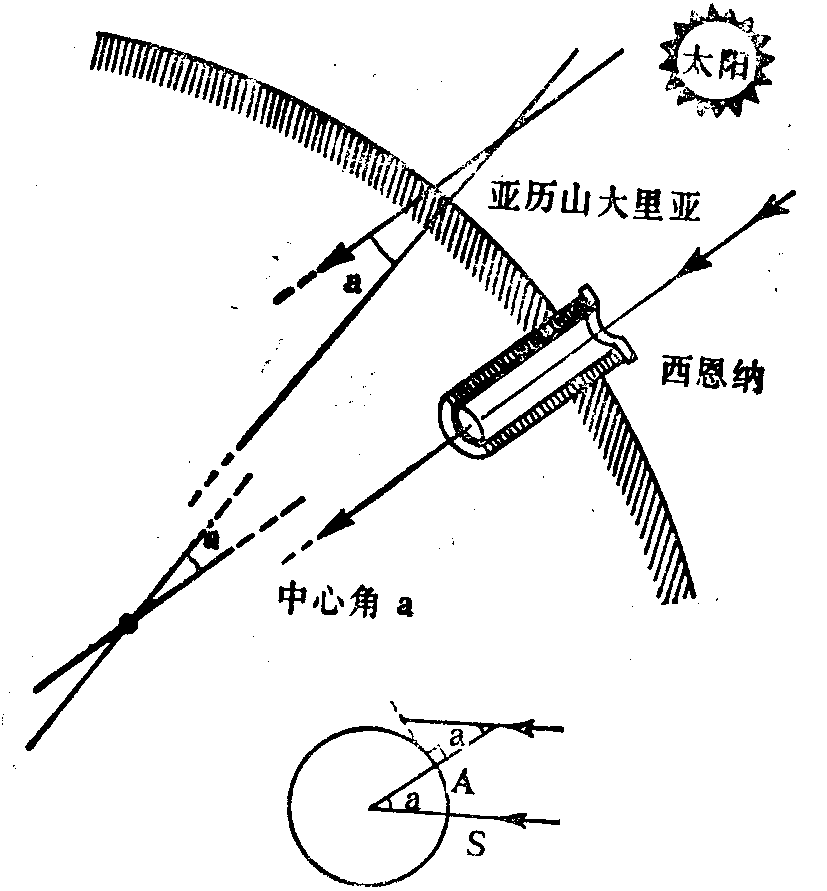
Another of his famous achievements was estimating the size of the Earth. At noon in a city in southern Egypt (Syene, roughly today’s Aswan), the Sun shone straight down to the bottom of a well. At the same time he measured the angle of the Sun at noon in Alexandria. Once the distance between Alexandria and Syene was known, one could calculate the Earth’s radius and circumference. Eratosthenes’s estimate was extremely accurate, though later Columbus used Ptolemy’s estimate, with the result that he thought the Earth was far too small.
Finally, Archimedes (287–212 BCE) has to be mentioned. He was a Syracusan from Sicily in southern Italy. In his youth he studied in Alexandria, apprenticed under Conon, a disciple of Euclid, and after finishing his studies returned to Syracuse. Archimedes’ chief achievements are as follows:
Mathematical achievement I: the surface area of any sphere is two-thirds the surface area of its circumscribed cylinder, and the volume of any sphere is also two-thirds the volume of its circumscribed cylinder; this theorem was inscribed on his tombstone. Witnessed by Cicero (106–43 BCE)
Mathematical achievement II: discovered the centroid of a parabola
Mathematical achievement III: using the method of exhaustion, derived π = 3.14
Mathematical achievement IV: created a notation for large numbers
Physical achievement I: research on equilibrium, the principle of the lever
Physical achievement II: the law of buoyancy
Mechanical engineering achievements: catapults, cranes, screw pumps, planetarium
(Professor Wu’s lecture notes)
Archimedes’ death is full of legend. When the Roman army was besieging Syracuse, it is said that Archimedes displayed remarkable powers: the catapults and cranes he built dealt devastating blows to the Roman fleet, and he even organized women and children to use mirrors to reflect sunlight and set fire to the Romans’ sails. So much so that the Roman general Marcellus exclaimed, “This is a war between the Roman fleet and one man, Archimedes.” In the end, however, the Roman army still breached the city walls, and Roman soldiers, crazed with bloodlust, burst into Archimedes’ home. At the time, Archimedes was calculating on a sand tray, and he said to the soldiers, “Don’t damage my circle,” before being killed. General Marcellus later executed that soldier and gave Archimedes a grand funeral.
These legends come from the biography of General Marcellus; their authenticity is impossible to know. But in any case, from them we see the contradictory image of the Hellenistic scientist: on the one hand, they had begun to engage in practical, craftsman-like research, no longer regarding uselessness as a source of pride and practicality as a source of shame, as classical Greek philosophers had done. But on the other hand, when Archimedes died, he again presented the Greek image of being absorbed in the world of ideas and heedless of reality.
In the first century CE, Hero went even further in organizing the mathematical work of his predecessors from the standpoint of applications; he studied mechanical technologies such as levers, pulleys, wheels, inclined planes, and wedges, and designed a steam engine.
A marvelous machine from the Hellenistic period (around 100 BCE) was discovered in a Roman shipwreck near the island of Antikythera in 1900, and researchers finally deciphered it in 2006 (the image below is a reconstructed model). It is said that it could predict solar and lunar eclipses as well as the positions of the sun and moon in the zodiac on any given day, and could calculate the cycles of various solar and lunar calendars, including the Metonic cycle. Although scholars still disagree on the specific details, even the lowest estimates suggest that the astronomy and mechanical technology behind this machine are fully comparable to those of the early modern period.


Further Reading
Kuhn: “The Copernican Revolution — Planetary Astronomy in the Development of Western Thought”
Hoskin: “The Cambridge Illustrated History of Astronomy”
Newcastle: “History of Astronomy: A History of Humanity’s Understanding of the Universe and of Itself
Translated from the Chinese original with AI assistance. The original text is authoritative.