
First, a quick notice: we still have two classes after this. The classroom will be changed for these two sessions; it seems that the entire Jiao Eight building has been requisitioned by the school. Next week and the week after next, we will move to Jiao Nine201for class.
Last time we mentioned that in the eighteenth century, the development of theoretical science, experimental science, and industrial technology was still relatively independent; theoretical science did not directly drive the Industrial Revolution, and even theory and experiment were out of sync.
Last time, one student raised an objection and showed me a clip from *The Rise of Great Powers* and an academic paper. Documentaries like *The Rise of Great Powers* are, first, made by Chinese people, and second, they did not consult scholars in the history of science and technology; their understanding of the relation between science and technology still remains at an earlier level of “common sense,” so we should distinguish carefully. As for that academic paper, on close reading it actually supports what I said; if you’re interested, you can look it up yourselves.
Today we are going to talk about the nineteenth century. By that century, theory, experiment, and industry had truly come together, serving as each other’s foundation and mutually reinforcing one another. Humanity officially entered an era of scientific explosion.
Our general history course aims only at an overview, not at exhaustiveness; when it comes to nineteenth-century science, it is of course even less possible to cover everything. Listing the new achievements in each science one by one would be impossible in terms of time, and it would not be all that interesting either. So we plan to start from a few cases to show the general characteristics of nineteenth-century science. We will focus on electromagnetism and evolution. Electromagnetism marks the integration of theory and experiment, and also the alliance between science and industry; evolution, meanwhile, marks the rupture between science and theology.
Still, let us first add a bit more on the Industrial Revolution, and first talk about the technological tradition before it came together with theoretical science.
If the technological innovations of the eighteenth century were not driven by theoretical science, then what drove them? Simply put, it was mainly social demand. Urbanization and the rise of capitalism laid the foundation for the Industrial Revolution, and the Industrial Revolution in turn promoted urbanization and capitalism. Industry and capital entered a positive-feedback loop, and in the end the process became unstoppable.
In the fifteenth and sixteenth centuries, with the opening of new maritime routes and the discovery of the New World, demand for foreign trade grew day by day. In England, woolen cloth was an important export commodity. Demand for wool led to demand for pastureland, which in turn promoted what was called the “enclosure movement”: nobles and capitalists used all kinds of means to enclose and seize peasants’ land, establishing pastures to raise sheep. This caused large numbers of peasants to lose their land and be forced to leave home and country. This is what later Morus denounced in *Utopia* as “sheep eat people.”
At the same time, agricultural technology in England also underwent innovations. The use of mechanical seeders and agricultural reforms such as the four-field crop rotation system strengthened agricultural production.
The ultimate result was a steady decrease in the agricultural population. Large numbers of peasants who had lost their land had to become “migrant workers in the city,” promoting the growth of urban populations and the development of workshop handicrafts, which further promoted the development of capitalism.
As the urban population grew, people’s needs also grew day by day. Among them, one important need became increasingly difficult to satisfy: timber. England’s timber resources had never been especially abundant, and in the eighteenth century they became particularly scarce.
So what needed timber? Everything. Because timber was the most basic fuel at the time, needed for things like baking bread, brewing, glassmaking—pretty much all kinds of commodity production relied on it.
Although people had long since known how to use coal mines, coal could not replace charcoal in most situations, because when coal burned it produced a great deal of harmful impurities, which would contaminate products. For example, we say charcoal-grilled chicken is delicious, but “coal-grilled chicken” would probably be inedible.
And in most industries at the time, production methods that could completely separate the product from the burning material were not yet possible, including the iron industry. In early iron production, it was common to heat the raw materials together with the fuel; only in this way could a sufficiently high temperature be reached. So if coal was used as fuel, the resulting steel and iron would contain too many impurities.


The English were the first to replace timber with coal in the iron industry. In 1709, Abraham Darby pioneered the use of coke instead of charcoal for iron smelting; the technology of coke smelting became widespread in the 1730s and 1740s, and from then on demand for coal increased greatly.

Demand for coal naturally also promoted the development of mining technology. In the coal industry, one very important task was to drain groundwater from mine shafts, which required the use of pumps.
Early pumps were driven by animal power. In 1698, the English engineer Savery invented the steam pump, which used the vacuum formed by steam condensation to draw water, and then used steam to force the water out. Savery’s steam pump was only a simple water pump; it did not transform steam into mechanical power.
 Savery steam pump
In 1712, Newcomen invented the first practical steam engine. He separated the cylinder from the boiler and added a cold-water injector in the cylinder. After the cylinder was filled with steam, he condensed it to create a vacuum, letting atmospheric pressure do the work and producing reciprocating mechanical motion.
The Newcomen steam engine truly transformed fuel into mechanical power, but in practice it was still mainly used for pumping water out of mines.


By the middle of the eighteenth century, as demand for coal increased, improving the steam engine also became increasingly urgent. James Watt (1736–1819) was not the only person trying to improve it. John Smeaton, for instance, was also working on improvements. His method was to keep testing, changing the dimensions of each part of the Newcomen steam engine to see the effect; in the end, he doubled the efficiency of the Newcomen engine. But it still could not compare with Watt’s new design.
Watt was an instrument repairman. Last time we mentioned that an instrument industry took shape in the eighteenth century. Experimental instruments were often used repeatedly and therefore kept breaking, so people were needed to repair them, and Watt was a professional repairman. In 1764, he was invited to a university to repair the local Newcomen steam engine. He noticed the problem of the Newcomen engine’s low efficiency. By 1765, he had a flash of inspiration and thought of a way to improve it. In 1769, he obtained a patent for his invention.
One key improvement in Watt’s steam engine was to make the condenser independent and separate it from the cylinder, thereby ensuring that the cylinder remained hot throughout operation rather than constantly cooling and heating up. This greatly reduced energy loss and improved efficiency.
In addition, he transformed the reciprocating motion produced by the Newcomen engine into the rotation of a shaft, which greatly expanded the range of applications for the steam engine; of course, it was first popularized in coal mines.
The spread of Watt’s steam engine was due not only to its higher efficiency, but also to Watt’s marketing strategy. At the time, mine operators were already used to the Newcomen steam engine and had no clear idea of how much better Watt’s engine really was, and replacing an entire machine was very costly. How, then, could he convince them to switch? Watt’s solution was simply to give them the steam engine to use first, and then charge rent according to a certain percentage of the coal costs saved by using the new machine compared with the original Newcomen engine. In this way, for mine owners, replacing the machine involved absolutely no risk and no cost; for Watt, collecting rent over the long term was actually more profitable than selling the machine outright. In this way, Watt’s steam engine quickly became widespread in Britain, and Watt himself achieved both fame and fortune.
 Principle of Watt’s steam engine

Both Newcomen’s and Watt’s steam engines relied on atmospheric pressure to do work, and they were enormous in size, suitable only for operation in fixed locations, or for driving large steamboats, but difficult to use for vehicles. So the arrival of the railway had to wait until around 1800, when Richard Trevithick invented a small high-pressure steam engine. The high-pressure steam engine was vastly reduced in size, yet its efficiency was no worse. Trevithick initially imagined that he could compete with Watt and offer mine owners a better choice. But what he ran into was the marketing master Watt, who quickly stirred up public opinion by claiming that high-pressure steam engines were unsafe. As a result, Trevithick’s sales pitches met with obstruction everywhere, and no one dared to buy.
In the end, Trevithick had no choice but to take another route: he set up a circular railway in London, and let a steam-driven train run around inside it, calling it “Catch Me Who Can.” Admission was charged; once inside, you could ride the train for several circuits, or run after it from below.
In 1814, the steam locomotive was finally put to practical use, first in coal mines, where it was used for short-distance hauling of coal. By 1830, the first railway line open to the public appeared (Liverpool to Manchester). Beginning in the 1840s, railways became a craze, and railways were being built everywhere in Britain.
 Trevithick’s promotional image on a ticket

Railway industry itself, in turn, required vast amounts of steel, which in turn drove the development of the steel industry. We can see that the whole Industrial Revolution was a chain of interlocking links, with technological innovations in all areas pushing one another forward.
Steel industry → needs coal → coal industry → needs pumping and transport → steam engines, railways → needs steel → steel industry……
In textile technology, spinning and weaving technologies also innovated in alternation, pushing one another forward and creating a situation of leapfrogging competition. I won’t go into that in much detail.
In short, the Industrial Revolution was a series of self-reinforcing achievements: agriculture, commerce, and industry stimulated one another; different technologies stimulated one another; and an industrial age of constant renewal and change began to unfold.
The mutual stimulation of theory, experiment, and technology was also beginning to come into its own. We said that in fact in the eighteenth century, theoretical science and the development of the Industrial Revolution were out of sync, with no direct influence between them, but this statement is not only rejected today by many popular science writers, it was also rejected by many people at the time. In the eighteenth century, many already believed that scientific research could drive technological development and thereby promote social progress. Bacon said, “Knowledge is power,” and this was the spirit of the age.
For example, there is a story that Newcomen once received guidance from Hooke, and that Watt was inspired by Black’s theory of latent heat. These claims were constructed already in the eighteenth century. Though lacking evidence, people would rather believe them.
From the common people to the government, everyone believed that science could be useful in practice. For example, around 1800 Britain planned to build a single-span cast-iron bridge with a span of about 180 meters (p. 398). Parliament decided to establish two committees, one of mathematicians and natural scientists, the other of experienced architects, and then to synthesize the opinions of both sides for implementation. The result was almost a farce, and some theorists’ proposals became a laughingstock. At the time, Milner, the Lucasian Professor at Cambridge, sighed: “Perhaps [the theorists] seem learned, and are able to carry out long and complicated calculations based on imagined hypotheses, and the symbols and numbers may also be absolutely correct, precise down to the smallest decimal place, but the bridge is still unsafe.” (p. 400)
But although theoretical scientists did not come in handy this time, people did in fact place great hopes in theoretical science. This hope itself was a mechanism of encouragement; it made theoretical scientists pay more attention to experimental research and practical activity; it also raised the social standing of craftsmen, allowing the craft tradition to consciously move toward theorization.
The aspiration to combine theory and practice became reality in the nineteenth century. First came the theorization of practical experience—for example, the French physicist Sadi Carnot, in 1824, published On the Motive Power of Fire, offering the first scientific analysis of how steam engines work. He proposed the “Carnot cycle,” a theoretical model that can describe all heat engines.
James Prescott Joule (1818–1889), around 1840, discovered the thermal effect of electric current. He also measured with very high precision the mechanical equivalent of heat—that is, the work done when a certain weight falls through a certain height is equivalent to raising a certain amount of substance by a certain temperature.
In the 1840s, several scientists independently proposed the law of conservation of energy (that is, the first law of thermodynamics). Today the earliest proponent is generally considered to be the German physician Mayer, but the principle was systematically formulated by the German physicist Helmholtz in 1847.
Then in the 1850s and 1860s, the German physicist Clausius proposed the second law of thermodynamics. Thermodynamics matured as a theoretical science, and its development was inseparable from experimental research, especially high-precision measurement techniques.
 Carnot cycle (isothermal heat absorption, adiabatic expansion, isothermal heat release, adiabatic compression.)
Increasingly precise experiments and observations began to provide support for theoretical science.
For example, the annual parallax of the fixed stars—promised by Copernicus more than three hundred years earlier—was finally discovered. First, in 1834, the annual parallax of Vega was found to be 0.25 arcseconds, equivalent to looking at a coin from 20 kilometers away.
Uranus had been discovered at the end of the eighteenth century, but its motion deviated from the orbit predicted by Newtonian mechanics. Of course, very few scientists thought this was because Newtonian mechanics itself was inaccurate; instead, they were more inclined to think that another planet was disturbing it. In 1846, the French astronomer Le Verrier calculated the orbit of a new planet that would perturb Uranus, and he asked a friend at the Berlin Observatory to help verify it. Soon afterward, the planet was discovered in the corresponding region of the sky—that is, Neptune. (Britain’s Adams carried out similar calculations even earlier, but his request for observation was rejected by the British observatory.)
We know that early experiments were mostly demonstrative in nature, at best adding icing on the cake to theoretical science; the link from theoretical prediction to experimental verification was not very strong. But by the nineteenth century, we see that the relationship between experiment and theory was no longer merely demonstrative, but increasingly one of verification or prediction.
On the one hand, traditional theoretical science moved closer to experiment; on the other, the experimental tradition was continually being theorized. Last time we mentioned that the chemical revolution at the end of the eighteenth century was a major milestone, and nineteenth-century electromagnetism was another.
After the Scientific Revolution, two scientific traditions can be said to have taken shape: theoretical science and experimental science, or alternatively, mathematical science and Baconian science. The tradition of theoretical science was mainly things like physics and astronomy. These disciplines had existed since ancient times, but during the Scientific Revolution they were successfully mathematized.
The other tradition emerged after the Scientific Revolution and was termed “Baconian science” by Kuhn—that is, the mode of research advocated by Francis Bacon, based on observation and induction. In the eighteenth century, the Baconian tradition mainly consisted in the continual accumulation, through observation and experiment, of all kinds of novel phenomena, which were then recorded qualitatively and their regularities inductively summarized.
A variety of novel phenomena—such as electrification by friction, the Leyden jar, and “fixed airs”—were continuously discovered and collected, but initially people were content merely to master the means of observing and demonstrating them, and to describe and explain them qualitatively, without mathematizing them.
Lavoisier’s chemical revolution was a major sign of the mathematization of the Baconian tradition, but the mathematization of Lavoisier’s chemistry was still not sufficient. By 1808, the British scholar Dalton had published A New System of Chemical Philosophy, systematically proposing chemical atomism, and the theoretical system of chemistry had become fairly mature. Atomism finally made clear what exactly is conserved in chemical reactions. We say that a mathematical theory system in the modern sense must have the concept of conservation, so that equations can be set up. But conservation of mass alone is certainly not enough. Chemical atomism clarified the structural changes in molecules before and after a reaction, while each atom and its quantity remained conserved. From then on, chemistry, as a mathematical science, became a matter of course.
The theorization of electricity also began at the end of the eighteenth century, and Coulomb was then the highest achievement. But with regard to the proposal of Coulomb’s law, as we mentioned last time, experiment still played a relatively limited role, and the entire field of electricity at that time was still far from being a systematic theoretical science.
Electromagnetism developed rapidly in the nineteenth century, with experiment and theory promoting one another.
In 1820, the Danish scholar Oersted (Hans Christian Oersted, 1777–1851) discovered the connection between electricity and magnetism. While tidying up his demonstration apparatus after a class, which included an electric circuit and a compass, he unexpectedly found that when the wire was parallel to the magnetic needle, switching the current affected the direction of the needle (p. 412). Of course, this was not entirely an accidental discovery. Oersted had always believed that there was a connection between electricity and magnetism, and had tried many ways to uncover it. So when he saw the disturbance of the magnetic needle, he immediately realized its significance.

Upon hearing of Oersted’s discovery, the French scholar Ampère (1775–1836) immediately began research, and clearly established the relationship between the direction of rotation of the magnetic needle and the direction of the current—that is, the right-hand rule or Ampère’s rule. He also proposed Ampère’s law to calculate the force of interaction between current-carrying conductors. He designed the galvanometer, which measures current by means of the magnetic effect of electricity.
In addition, the German scholar Ohm (1789–1854) published Ohm’s law in 1826, namely that current is proportional to potential difference and inversely proportional to resistance. Before that, the concept of resistance had not yet existed; Ohm created this concept as well.
All these developments originated in the Baconian tradition—that is, repeated attempts, recording and inductively summarizing a large number of novel phenomena. Yet we can note that the study of novel phenomena had already moved from the qualitative to the quantitative, from simple empirical description to the establishment of mathematical equations—the earliest experimental science also derived “laws” from empirical observation, as in “rubbing a glass rod with silk can attract bits of paper,” which is a law. Nineteenth-century Baconian science was also summarizing laws, but now the laws had taken forms such as “I = U/R.”

Faraday (1791–1867) was one of the high points of the experimental tradition.
Faraday was born into a poor blacksmith’s family, and at the age of thirteen he dropped out of school and became a child laborer, working for a bookseller and helping him bind books. He was diligent and eager to learn, and in the course of binding books he read many things, including articles on electricity in the Encyclopaedia Britannica and popular science books such as Chemical Dialogues, all of which influenced him greatly. His employer treated him well too, encouraging him to carry out some simple chemical experiments and often to interact with young friends who were enthusiastic about science.
In 1812, an old customer at the bookstore where his employer worked gave Faraday a ticket to a lecture, allowing him to attend a series of lectures by the famous chemist Humphry Davy at the Royal Institution. Last time we mentioned that in the eighteenth century such public lectures, centered on demonstration experiments, were very popular, and Faraday was also a beneficiary of this tradition.
Faraday was deeply fascinated by Davy’s lectures. He took detailed notes, then, using his own trade, arranged and reproduced them, added illustrations, bound them into a volume, and sent them to Davy, expressing his wish to work under him. Davy, moved by the exquisitely bound notes, hired Faraday to work for him. At first Faraday was assigned tasks like washing bottles, but in the second year he became a formal assistant. Davy took him traveling on the European continent, where they visited many scientists.
From then on Faraday’s outstanding experimental talent came to the fore. In a word, he was exceptionally dexterous, doing experiments quickly and accurately, with great creativity.
Because his contributions to electromagnetism were so immense, we often now overlook Faraday’s contributions in other areas. In chemistry in particular, Faraday also made many pioneering advances, and in fields such as organic chemistry and electrochemistry he holds a founder-like status.

We know that in 1820 Oersted discovered the magnetic effect of electricity, and in the same year Ampère advanced the research. By the end of 1821, Faraday had, on this basis, devised a new apparatus for “electromagnetic rotation” (as shown in the figure): around a stationary magnet, a wire carrying current is made to rotate; at the same time, around a stationary wire, a magnet is made to rotate. In essence, this was also the first electric motor (converting electrical energy into mechanical energy).
This invention brought Faraday great fame, but it also strained his relationship with Davy. For Davy had once discussed the problem of electromagnetic rotation with his friend Wollaston, and Faraday was present at the time. Davy believed that Faraday had plagiarized Wollaston. In fact, this design really was Faraday’s own idea, and he publicly acknowledged Wollaston’s contribution, but he rushed to publish the paper without discussing it with Wollaston or Davy. That was indeed not very proper conduct.
From then on Faraday gradually came into his own, but his relationship with Davy worsened. He was elected a Fellow of the Royal Society in 1824, though only Davy, then the president, objected. Later Davy even used his authority to create various difficulties for Faraday, and only after Davy’s death in 1829 was Faraday truly free to act as he pleased.
 Electromagnetic rotation
As early as in notes from 1822, Faraday had expressed the idea that magnetism produces electricity. It was not until 1831 that he returned to this topic and discovered and clarified the phenomenon of electromagnetic induction. He found that rapidly inserting a magnet into a closed coil would generate an electric current (as shown in the figure).

Faraday, who had dropped out of school in childhood, was not good at mathematics and could not use calculus at all. But he had a genius for insight and theoretical intuition. He proposed the concept of the “field” to explain the transmission of electromagnetic force, and used “lines of force” to provide an intuitive diagram. He even conjectured that electromagnetic force, like light, is some kind of wave, and even that light waves are themselves the product of some kind of electromagnetic vibration.

Faraday’s mathematical shortcomings were soon filled in by Maxwell (James Clerk Maxwell, 1831–1879).
In 1855 Maxwell wrote “On Faraday’s Lines of Force,” beginning to systematically expound and advance Faraday’s electromagnetic ideas. In 1864 he published “A Dynamical Theory of the Electromagnetic Field,” which gave the Maxwell equations, proposed the concept of electromagnetic waves, and proposed the electromagnetic theory of light. His Treatise on Electricity and Magnetism, published in 1873, was the grand synthesis of electromagnetism.
The place of the Treatise on Electricity and Magnetism in the history of science can be compared with Newton’s Principia; we can regard it as a stage-setting summary in the history of science, a milestone.
Although Newtonian mechanics marked the triumph of the mechanistic worldview, the mechanical world of that time was still not complete enough. Many phenomena such as electricity, magnetism, heat, and chemistry had not yet been brought within the domain of mechanics. By the end of the nineteenth century, however, with the successive establishment of chemical atomic theory, thermodynamics, and electromagnetism, the world of mechanics was finally unified. Matter, ether, and energy could explain all phenomena.

The development of electromagnetism also marked the alliance of science and industry. First came the rise of “applied science,” and science began to become a “productive force.” Faraday discovered electromagnetic induction in 1831; by 1837 Wheatstone had invented the telegraph on the basis of electromagnetic induction, and with the Morse code invented in the same year, the telecommunications industry rose rapidly. In 1854 telegraph service opened between London and Paris; in 1857–1858 a cable was laid across the Atlantic; and by 1861 the cable had already run from the east coast of the United States to the west coast.
After Maxwell proposed the theory of electromagnetic waves, Hertz experimentally confirmed the existence of radio in 1887. Marconi, after hearing about it in 1894, immediately developed a wireless communication system and applied for a patent. By 1899 radio signals had crossed the English Channel, and by 1901 the Atlantic.
On the one hand, scientific research was consciously applied to technology and industry; on the other hand, industrial needs consciously pushed forward scientific research. This was even more evident in the chemical industry, which was first driven by the field of dyeing, and in the second half of the nineteenth century the petrochemical industry generated a particularly large demand for applied science.
Large companies directly established ties with universities, sending trainees to universities for further study, following the latest advances in basic research, hiring scientists, and even setting up specialized laboratories to carry out applied research on the basis of fundamental research. Beyond universities and academies, industrial laboratories became new strongholds for scientists, and many large companies competed to establish their own laboratories, such as:
Bayer Laboratory (1874), Edison Laboratory (1876), Standard Oil Company (1880), General Electric Company (1901), Du Pont Company (1902), Parke-Davis Company (1902), Corning Glass Works (1908), Bell Laboratories (1911), Kodak Company (1913), General Motors Company (1919)…… (A General History of Science and Technology in the World, p. 429)
Universities themselves also continued to change, with a large number of institutes of technology emerging, and traditional comprehensive universities also strengthening their science and engineering disciplines.
The social status of scientists became prominent, and associations intended to seek benefits for scientists appeared, such as the German Association of Natural Scientists (1822), the British Association for the Advancement of Science (1831), and the American Association for the Advancement of Science (1847), promoting science as a basic national policy.
Finally, let us briefly talk about Darwin’s (1809–1882) theory of evolution. The word evolution perhaps should more accurately be translated as “the theory of evolution,” because Darwinian evolution is directionless and therefore cannot be said to be progress. But I think using “theory of evolution” is harmless, because the term evolution was not Darwin’s own patent. Darwin himself did not use the term much; it was more often Spencer and others who helped promote it, and among many promoters at the time, the theory of evolution did indeed carry the sense of progress.

Of course, evolution did not appear out of thin air. It was built on the foundations of eighteenth-century biological taxonomy and geology, which we have not discussed before, so let me add a little here.
In the eighteenth century, the Swedish botanist Linnaeus (1707–1778) proposed binomial nomenclature and established a system of plant classification. Linnaeus’s system of classification was an artificial classification; that is, classification was made according to externally perceived traits. Linnaeus classified based on the number, state, and proportion of the parts of fruits, stamens, and pistils.
By contrast, his French contemporary Buffon (1707–1788) opposed Linnaeus’s classificatory method and proposed natural classification, arguing that species should be classified according to their position in natural history. He had already put forward the idea of species transformation, and his evolutionary thought was a theory of degeneration: he believed that some different species were formed by degeneration and differentiation from a common ancestor.
Lamarck (1744–1829), the French scholar sponsored by Buffon, expounded the idea of biological evolution in the early nineteenth century—that is, the idea of acquired inheritance, “use it and it will develop; disuse it and it will atrophy.”
In geology, thanks to Bacon’s scientific tradition of emphasizing practical investigation and the collection of experience, there were also many discoveries, including the phenomena of strata and fossils. Fossils had been discovered long before, but they had not attracted much attention. As empirical cases accumulated, however, fossil phenomena increasingly became a question awaiting explanation. People could sometimes discover the fossils of marine organisms high in the mountains, which showed that Earth seemed once to have undergone sweeping transformations, where seas became mulberry fields and mulberry fields became seas. More importantly, people discovered the fossils of many organisms that seemed no longer to exist, especially the fossils of many large animals found around 1800. And people found that in some regions the land was clearly divided into different strata, each containing different fossilized organisms, and that the deeper the stratum, the more different the organisms were from those living today.
All this evidence led more and more people to believe in the phenomenon of extinction. For example, Cuvier (1769–1832) proposed catastrophism, explaining changes in strata through floods and natural disasters. He acknowledged extinction, but did not recognize biological evolution.
Hutton (1726–1797), by contrast, proposed uniformitarianism, holding that geological phenomena were formed over immense spans of time and did not require appeal to global catastrophes. Later, Charles Lyell (1797–1875) developed Hutton’s doctrine, emphasizing gradual change.
During Darwin’s famous voyage on the Beagle from 1831 to 1836, he carried Lyell’s Principles of Geology with him.
 Frontispiece to Lyell’s Principles of Geology
In 1831 Darwin joined the Beagle’s circumnavigation with the captain. His job was really to keep the captain company in conversation, because circumnavigation was extremely dull. Captains were generally of aristocratic background, cultured and refined, but ordinary sailors were all laboring men from the bottom rung of society, and the captain could not really talk to them, so he was especially lonely. A good solution was to hire a naturalist to sail along; on the one hand, the captain would have a companion of relatively high status to talk with, and on the other hand, the naturalist would also have an opportunity for scientific investigation.
The voyage’s main purpose, of course, was economic, but along the way it also carried out many scientific surveys, collected many plant and animal specimens, excavated paleontological fossils, and observed the lifestyles of organisms in different regions.

The Beagle’s voyage overturned the creationist ideas Darwin had held in his youth, ideas represented by William Paley’s Natural Theology, published in 1802. Paley said that if you picked up a watch by the roadside and observed its ingenious structure, you would certainly think it had been made by some skilled craftsman; likewise, when you see a butterfly and observe the structure of living things, you are even more likely to marvel at the ingenuity of the design, and therefore there must also be a designer behind it. But after the Beagle voyage, Darwin began to believe that species evolved naturally.
After returning from the voyage, he read Malthus’s Essay on the Principle of Population, from which he drew the idea of “struggle for existence.” Malthus pointed out that human reproduction increases in a geometric progression, while food production increases only in an arithmetic progression, and is ultimately constrained by land; in the end, population growth cannot continue indefinitely, and a large proportion of the population must be eliminated in the cruel struggle for existence. Darwin thought: isn’t every species the same? Reproduction is always exponential, but the environment is always limited; in the end, mustn’t survival also depend on the struggle for existence? In this way, the concepts of survival of the fittest and the elimination of the inferior naturally followed.
In 1842 Darwin wrote a thirty-five-page outline of evolution; in 1844 he produced a 230-page “Outline of a Treatise on the Question of the Origin of Species.” By then the basic ideas of evolution had largely taken shape, but he was not eager to publish. He was a bit like Copernicus, worrying that his theory would be too novel and thus mocked, so at first he only exchanged ideas within a small circle. Darwin planned to collect more evidence before publishing, for example by breeding pigeons himself to study the effects of artificial selection on species. It was not until 1858 that Darwin received a letter from Wallace (1823–1913), in which Wallace enclosed his recent paper, “On the Tendency of Varieties to Depart Indefinitely from the Original Type.” Wallace had proposed a similar theory of evolution, and Darwin was then alarmed: he had delayed too long, and priority was about to be snatched away. Darwin recommended Wallace’s paper for public presentation at the Linnean Society of London, and at the same time attached a summary of his own unfinished Origin of Species to be presented as well. Only at the end of 1859 was the great work On the Origin of Species finally published, under its full title, On the Origin of Species by Means of Natural Selection, or the Preservation of Favoured Races in the Struggle for Life.
We usually still count priority as belonging to Darwin, but some have wondered whether Darwin plagiarized some core idea from Wallace’s paper in order to complete his evolutionary theory. The study of the manuscripts shows that this was not the case: the basic ideas of Darwin’s theory of evolution had long since taken shape, and were more comprehensive and accurate than Wallace’s; he had also accumulated richer arguments and evidence, and had already discussed them with colleagues in the field before the book was written. His delay in publishing was indeed caused only by procrastination or perfectionism. Wallace, for his part, had little standing in academic circles; overall, he was more benefited by Darwin’s patronage than suppressed by him.
Wallace’s presence also confirms that Darwin did not emerge out of nowhere. The theory of evolution was a product of the intellectual currents of the age, and therefore many similar ideas arose independently. Britain at the time was in the midst of its splendid “Victorian era” (1837–1901), with the Industrial Revolution and capitalism in full swing. The idea of ruthless competition had taken deep root, and religion and theology were also under heavy resistance. Darwinism could be said to have arrived just when it was needed. Although it met with much opposition, it also had many advocates and enthusiasts. Similar to the case of Copernicus, many people did not fully understand the scientific content of evolution, and for reasons of certain political beliefs and the like, they nevertheless raised the banner of evolution—for example, by using evolution to promote the struggle for existence, the survival of the fittest, or social progress, or by using the resources of evolution to oppose religion.
The core of Darwin’s theory of evolution lies in the theory of natural selection: species blindly produce hereditary variation in the process of reproduction, and among the different variants, the fittest survive in the natural environment, while the winners possess hereditary traits better adapted to that environment.
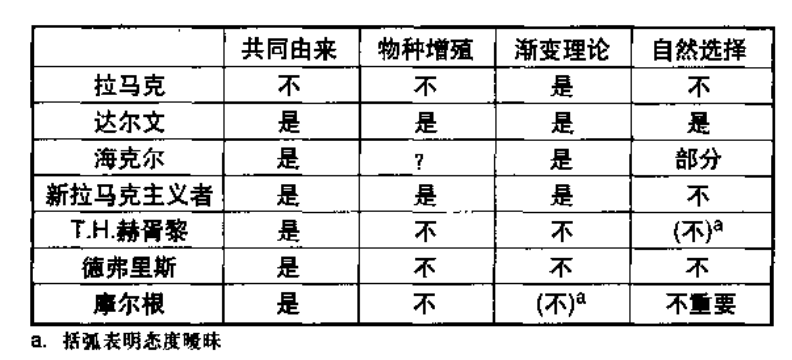
Evolutionists of the same era, including Darwin’s supporters, basically did not endorse the theory of natural selection. The biologist Ernst Mayr divided Darwinism into five theoretical components. The first was the idea of biological change shared by all evolutionists: species are not fixed and unchanging. The other four components—common descent, species multiplication, gradualism, and natural selection—were each denied to varying degrees by different scholars (as shown in the table below).
 “A Very Long Argument”
Finally, by the way, among Darwin’s critics, one important line of criticism came from physicists, including the venerable Lord Kelvin. Because, based on the newest thermodynamic research at the time, the estimated lifespan of Earth derived from the planet’s radiative cooling and the burning of the sun was extremely short, leaving no room for the picture of species changing through long, random selection.
Of course, the lack of a theory of heredity was also Darwin’s weakness. In his later years, Darwin himself also retreated somewhat, moving toward a Lamarckian evolutionism.
Darwin’s theory of evolution marked the rupture between science and religion—not in the sense that evolution itself dealt a blow to religion after it appeared, but in the sense that evolution itself was born in an era when science and religion had already split apart.
Further Reading
McLelland III: 《A History of World Science and Technology》 — this is the panoramic work on world history that I recommended at the outset. It is not as good as Lindberg on ancient science, but it is very well written on the Industrial Revolution.
Bowler: 《A History of Evolutionary Thought》
Thomas: 《Faraday and the Royal Institution》
Translated from the Chinese original with AI assistance. The original text is authoritative.