

Today is the penultimate class, so let me first talk a little about the course assignments.
For this course, the requirements are a midterm reading report (optional) + a final paper. I have currently received four midterm reading reports, and I should already have replied to all of them by email. If you sent one but did not receive my reply, please send it again, or try another email address. Under normal circumstances, I should send a confirmation reply within two or three days, and I may also discuss some specific issues in the assignment with you by email.
The point of assigning the reading report is to encourage everyone to read and think independently after class. As a new teacher just starting out, my teaching level is certainly limited. But in fact, for a university course, three parts of the gain come from the teacher and seven parts from yourself. If you do not read and think on your own, then it is like casually listening to a storytelling performance in a teahouse: even if the teacher is very capable, and even if you feel very good about it at the time, when you look back soon afterward you will have forgotten it all. But if you study independently after class, then even if there are many things the teacher did not explain well or clearly, you can fill them in yourself and develop them outward. The teacher merely plays a guiding and inspiring role; learning is still, to a much greater extent, the student’s own affair.
As a general elective, of course I cannot demand that everyone study independently to any particular depth, but in any case, taking this opportunity to read two good books on history of science is always worthwhile. I am confident that the books I recommended in class are basically all quite good. You can also search for related books and articles according to your own needs, or come to me to have them assessed before reading. The material I covered in class can provide you with a clue: the best effect comes from reading with questions in mind, based on the things you found interesting or puzzling in class.
The reason I am emphasizing reading again is not because I hope that those who did not hand in a reading report will go back and write one; I already said from the beginning that the midterm assignment could be omitted, and of course I will not renege on that. We are almost at the end of the term now, so everyone should be preparing the final paper. I still want to emphasize reading precisely in order to make everyone notice that it is not the case that, once the reading report is omitted, reading can also be omitted. Independent reading and thinking are the basic requirements of this course, and they should be reflected in the final paper.
So I do not want to receive a “paper” that has been patched together from here and there. A paper may be rough, it may be immature, but it must be built on your own reading and thinking, rather than simply cutting and pasting together other people’s reading and thinking. Of course, if you insist on patching things together, you must also indicate the sources. I absolutely do not allow plagiarism in my assignments. Anything with signs of plagiarism will definitely receive a low grade; if the plagiarism is serious—for example, if large sections are copied—I will resolutely fail it.
Considering that many students may not know how to write a paper, I will briefly talk about that here.
A paper, at the very least, must have an “argument”; it is not enough simply to do some popularization or tell a story and be done with it.
A paper needs a problem-awareness: it unfolds around a question, rather than drifting along as a freeform essay and talking about several different things. One paper only needs to make one theme clear.
The theme of a paper may be to argue for a viewpoint, or it may simply be to make one thing clear. But this is different from merely telling a story. A paper not only needs to tell the story; it must also explain why I am telling it this way, on what grounds I can tell it this way, and what my logic and evidence are. So a paper needs to provide evidence and argumentation around its thesis.
We can provide ourselves with support by citing other materials.
One of the most basic requirements of an academic paper is to cite sources and indicate where they come from. There are two aspects to this. First, a paper needs citations: you must quote or refer to other articles. Why cite other articles? First, because you need the support of others to bolster your own case; second, because you need to stand on others’ foundations and make further progress from there. We are not doing research in some airy tower that has no predecessors before it and no successors after it. Our thinking and exploration are always built on the foundation laid by those before us. Citing others’ achievements is a way of determining one’s own footing; once you have stood firmly on the foundation of your predecessors, whether what comes next is extension and advancement, or reflection and critique, you are in any case pushing forward in a solid way. So there is no need to fear “copying” when writing a paper, because collecting and organizing the work of earlier scholars and excerpting it is itself a basic task. Advancing even a little bit from there is already progress. If you have not clarified where earlier work has actually advanced to, and the whole paper is merely self-important chatter, then there is no originality to speak of at all.
Second, citations must indicate their sources. This is not only respect for earlier work, but also a convenience for later scholars who may wish to further develop your work. For often each assertion or viewpoint rests on a great deal of verification and debate, but we cannot possibly re-examine everything from scratch every time we speak. Some things have already been proposed in authoritative academic texts, and we can directly take them up and use them. But nothing is absolutely beyond question; no matter how authoritative, no matter how much consensus there is, anything may still be re-examined. A citation then provides later scholars with a trail to follow, allowing them to retrace the chain and pursue the matter back to its source. So the academic world needs to acknowledge and cite authority. This is not blind submission to authority; on the contrary, it is to ensure at all times the possibility of criticizing authority. If you doubt this point, you can follow the citations to trace other references, and those references will in turn provide further citations, which you can then follow back to still more original materials.
When our undergraduate students write papers and cite references, of course we cannot require them to find the most authoritative or the most cutting-edge resources. But it is still necessary to screen resources, and a simple way to do that is to look at their citations. A good source may be cited by many other works, and it will also provide rich and solid materials itself, so a source that is cited a lot or has many citations of its own is often relatively reliable. By contrast, if a source’s author does not have a professional background and does not provide reliable references, then it is relatively unreliable.
Most of the books I recommended in class are relatively reliable. However, my own lecture notes were written somewhat hastily, and I did not have time to make the citations proper. I hope everyone will not take my notes as a model. The resources on which my handouts rely are mainly within the range of the recommended readings. After the class is over, I will set aside time to revise the lecture notes once, and at that point I will complete the citations.
Today we are discussing a special topic in the history of mathematics. This is a pit I dug for myself, but now I feel I have been trapped by my own pit, because this topic is really difficult to explain.
It is certainly impossible to compress the entire history of mathematics into a single class, so today’s lecture is only a special-topic class, not a “general history of mathematics.” Therefore I do not intend to introduce, one by one, those great mathematicians and mathematical achievements. Rather, in the context of the history of science, I want to discuss some issues in the history of mathematics.
As everyone has noticed, up to this point our course has basically still been a humanities course. We have talked all along about ideas and concepts, and have not touched any formulas, calculations, or the like. The nature of this class will not change either, which is to say that we will necessarily have to ignore a great deal of technical detail in the history of mathematics and focus instead on conceptual and intellectual issues.
But traditionally, accounts of the history of mathematics have often been the most technical of all. Some textbooks on the history of mathematics look more like mathematics textbooks than history books: after each chapter they also include a set of exercises, for example, after discussing Euclid, they extract a few problems from the Elements for students to do.
In the very first class, I mentioned that independent research in the history of science tries to break with “Whiggish history.” Whiggish history looks down on the past from the standpoint of contemporary achievements, describing history as a struggle toward a predetermined result, ignoring historical context, and taking the conclusions in today’s textbooks as ready-made standards—doing nothing more than labeling each ready-made conclusion with the person who proposed it and the time it was proposed.
Throughout this course, I have tried to show that the history of science is not simply a process of accumulating one piece of new knowledge after another. We do not merely list the dates of one new discovery after another; instead, we try to return to historical context and attend to the intellectual presuppositions and social environment of scientific activity, and to those things that were “wrong.”
Such anti-Whiggish historical research had already become mainstream in the academic field of history of science in the second half of the twentieth century, but history of mathematics is an exception. Many ways of writing the history of mathematics are still Whiggish: they extract from the works of the ancients the mathematical theorems and methods recognized within the modern mathematical system and list them out, and thus the history of mathematics is written as a collection of exercises under a modern mathematics course, with only the discoverer and the date attached to each problem.
The following passage from Asimov is quite representative. He believed that the history of mathematics is different from general history of science: “Only in mathematics are there no major revisions—only expansions. Once the Greeks developed deductive method, in what they did they were right, and forever right. Euclid was incomplete; his work was enormously expanded, but it did not need correction. His theorems, all of them, remain valid today.” (Preface to Boyer’s History of Mathematics)
This view has some merit, but it cannot stand up to scrutiny. First, ancient mathematicians were not free of mistakes; it was just that their errors were excluded from view as non-mathematical elements or as mere oversights. Second, the scope of mathematics itself has been continuously revised. For example, ancient Greek mathematics included astronomy and music; the idea that mathematics includes only those things that are forever correct is itself a judgment made from the standpoint of modern mathematics. Finally, this perspective—one that focuses only on things that are forever correct—tends to “translate” the “theorems” given by ancient mathematicians back into modern mathematical concepts and symbols, and to think that the clumsy concepts and cumbersome descriptions used by ancient mathematicians merely obscure the “mathematical content” at the core. This makes it easy to overlook the different ways ancient mathematicians understood mathematical problems—for instance, what exactly these “theorems” are talking about, and what their meaning actually is.
When we investigate the history of mathematics from the history of science, it is not only because those mathematical theorems discovered one by one were used by scientists throughout history as practical tools. More importantly, the conceptual changes embedded behind the history of mathematics form one thread in the development of science.
We mentioned earlier that Newtonian mechanics completed the so-called “mathematization of nature.” In classical mechanics, mathematical calculation replaced Aristotle’s natural philosophy’s questioning of “causes.” This was obviously not simply because modern people developed more sophisticated mathematical tools, but because modern people’s understanding of what mathematics is and what it means underwent a transformation. And this transformation is difficult to detect within the Whiggish framework of historical narration.
Of course, it is extremely difficult to provide a new picture of the history of mathematics. Here I only hope to open up a little room for thought, so that everyone can reconsider the transformations in the history of science from the perspective of mathematics.
What, after all, is mathematics? In fact, we also have not discussed what “science” itself is. I do not intend to provide a definitive answer to these questions. Our understanding of science is itself part of the history of science, and our understanding of mathematics is also part of the history of mathematics. But let me first offer a rather conventional definition, and we can start from the doubts contained in that definition to trace things back.
The Modern Chinese Dictionary says that mathematics is “the science that studies the spatial forms and quantitative relations of the real world.” There are many problems in this sentence that can be pursued:
First, are the spatial forms studied by geometry really part of the “real world”? What exactly is the relationship between mathematical objects and the real world?
Second, what does “quantitative relations” mean? Are number and quantity the same thing? Is quantity a kind of relation?
Third, why are the study of space and the study of quantity grouped together? What is the relationship between geometry and algebra? Are they complementary or subordinate? Which is subordinate to which?
Finally, is mathematics a “science”? What does that mean? Perhaps it is a craft rather than a science?
The above questions are all historical. At different stages in the history of mathematics, different people understood them differently, and these understandings not only influenced the development of mathematics but also the application of mathematics in the natural sciences.
So let us now take these questions as our guide and look back at the development of the history of mathematics.
Our ancient ancestors already had activities of counting and measurement. Of course, in the beginning these activities were all concrete. People counted with their fingers and measured length with their hands and feet. If we were to say that such activities are mathematics, then mathematics originally consisted of these bodily techniques.
Only after writing appeared did mathematical activity begin to detach itself from the body. People used written symbols to record numbers and measures, and more complex mathematical techniques were developed. Ancient Egypt and ancient Babylonia, as well as ancient India and ancient China, all achieved very high levels of mathematics.
The Babylonians had already begun to use sexagesimal fractions. They could calculate the square root of 2 to 1.4142129 (the actual value is 1.4142135…), they could solve arithmetic problems equivalent to quadratic equations in one unknown, and they could even find approximate solutions to cubic equations and even higher-degree equations.
The mathematics of ancient civilizations was more of a practical technique. Although in many respects their efforts had already gone far beyond actual needs, this is like the way various practical techniques all develop some playful or artistic dimension, yet practical intent remains the dominant tone. This is very different from the mathematics that came after Greece. For example, the Babylonians would “verify” calculation results, but they did not care about “proof” in the logical-deductive sense. In addition, they often made no distinction between exact and approximate solutions.
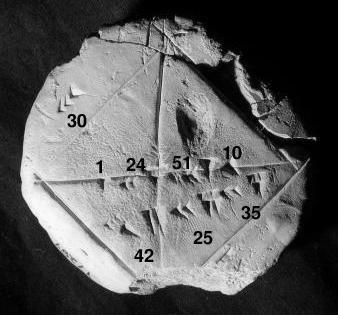 The Babylonian calculation of the square root of 2. In the image, the hypotenuse is marked with a sexagesimal decimal value: “1,24,51,10,” which converts to the decimal value 1.4142129… We now know the exact value is 1.4142135… The accuracy achieved by the Babylonians was at the level of one part in a million.
Greek mathematics was undoubtedly influenced by Babylonia and Egypt, but it took a distinctive path of its own.
According to legend, Thales, one of the earliest natural philosophers, studied in Egypt and introduced the Egyptians’ “land-surveying technique” into Greece, developing geometry with an emphasis on deductive argumentation. It is said that Thales himself proved several mathematical theorems, such as “If two angles and one side of one triangle are respectively equal to those of another triangle, then the two triangles are congruent.” But these legends lack evidence, after all, because the early documents have mostly been lost. Still, such legends reflect the ancient Greeks’ sense of self-positioning, and Greek mathematics did indeed show a different tendency from the very beginning.
Speaking of the origins of Greek mathematics, one cannot fail to mention Pythagoras (ca. 570–495 BCE). The life and thought of Pythagoras are also shrouded in fog. On the one hand this is because of the loss of sources; on the other hand, it is also because Pythagoras himself was the leader of a kind of esoteric religious community, and many achievements that may well have been collective achievements of this community were also attributed to Pythagoras himself. For example, the famous Pythagorean theorem (the theorem of the right triangle) very likely was not actually completed by Pythagoras himself. So when we speak of Pythagoras, we are in fact speaking more about the contributions of the Pythagorean school.
Both the words philosophy and mathematics have to be traced back to Pythagoras. The original Greek meaning of “philosophy” is “love of wisdom” (Pythagoras was the first to call himself a “lover of wisdom”), while the original meaning of “mathematics” is “what can be learned.” Put together, these two words imply something important. What the Pythagoreans pursued was wisdom, and what they taught and transmitted was mathematics. That is to say, in Pythagoras’s hands, mathematics was no longer merely a practical technique of calculation, but a genuine and lofty form of knowledge.
What, then, was Pythagoras’s mathematics concerned with? It was concerned with “number.” But what, after all, is number? We say “one, two, three, four, five” are numbers; a three-year-old child already knows how to “count.” But when people count, what exactly are they counting?
Primitive people may have counted cattle and sheep, or fingers, stones, notches, bamboo slips, and so on. For ancient people, number is always the number of something. The activity of counting contains a grasp of the nature of things. First, the things that can be counted always belong to the same class; second, the things being counted are independent of one another and distinguishable from one another. For example, when we count one sheep, two sheep, this counting activity already contains a grasp of the category “sheep,” and also a discrimination among each sheep as one item after another. If sheep and cattle can be counted together, that is because they belong to a larger category, such as livestock or animals. In short, the prerequisite for counting is a grasp of the “unit”: a certain unit is something that can be separated from others and yet belongs to some category.
So then, as mathematics in the broad sense, what exactly is it that counting counts? The Pythagorean school held that the object of mathematical study is pure units, units that are not only applicable to cows and sheep but to everything in the universe. Hence the Pythagoreans put forward the slogan “all things are number,” elevating mathematics to a kind of ontological or cosmological position.
But “quantity” is different from “number”: the activity involved with quantity is measurement, not counting. Quantity grasps how large a thing is, not how many there are. In the early Pythagorean school, geometry, which concerns quantity, had a lower status than arithmetic concerned with number (or, more properly, what we would call number theory). Although the Pythagoreans did discuss “figured numbers” (for example triangular numbers, square numbers, and so on), in general, apprehending number does not require the mediation of the external senses, whereas apprehending quantity, or size, does require the intervention of the senses.
Based on the creed that all things are number, the Pythagoreans believed that problems of quantity could also be reduced to problems of number; figured numbers are one example.
The tradition of dividing mathematics into four branches may also have begun with the Pythagorean school, namely arithmetic (the study of motionless number), geometry (motionless quantity), astronomy (quantity in motion), and music (number in motion).
Pythagoras also endowed numbers with various attributes: 3 represented harmony, 4 justice, 5 marriage, and 10 perfection, and so on. This was not merely a metaphorical meaning, because if all things are number, then to grasp number is to grasp the secret of all things.
The reason music was also classified by the Pythagorean school as part of mathematics was that they discovered that when a string produced a harmonious note, the lengths of the strings always stood in integer ratios; the secret of music lay hidden in numerical proportions. The Pythagoreans believed that the universe was harmonious, and that mathematics was precisely the study that reveals the harmony of all things. We can still see the influence of this tradition in Kepler.
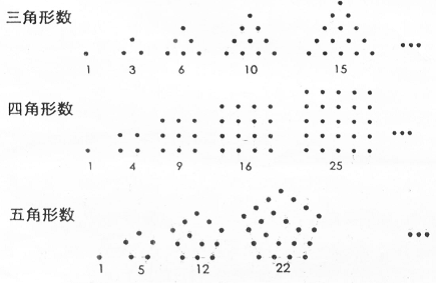
By the time of Plato and Aristotle, the relationship between arithmetic and geometry had changed. Two things are worth mentioning here: first, the discovery of irrational numbers; second, Plato’s theory of Ideas, or, more precisely, of Forms.
The theory of irrational numbers was discovered by the Pythagorean school. It is said that the first person to discover an irrational number was thrown into the sea and drowned by the group. Whether this legend is true or false, it is enough to suggest the seriousness of the discovery.
We just said that the Babylonians had already calculated the square root of 2 to an accuracy of one part in a million; using “irrational numbers” in other civilizations was no big deal at all. What was the importance of the fact that the square root of 2 cannot be expressed as a ratio of two integers? Apart from the Greeks, nobody cared about this. But the Greeks treated it as a matter of life and death. This, of course, was not because the Greeks were especially stupid; in fact, many things that strike us as stupid in the ancients are often not a matter of what they failed to think of, but rather because they thought too much.
We say that the object of counting is the “unit”; yet between the hypotenuse and the side of a square, one cannot find a “common divisor,” that is, there is no unit that can simultaneously count these two lines. This means that the “pure unit” applicable to all things cannot be found; and once that is the case, the Pythagorean school’s basic creed is shaken—which, of course, is an extremely serious matter.
The existence of irrational numbers also means that some problems of quantity cannot be reduced to problems of number. Conversely, problems of number can always still be reduced to problems of quantity, because representing numbers by line segments is always possible, whereas representing line segments by numbers often is not. So geometry began to stand on its own and was placed at a certain more fundamental level than arithmetic. Although numerical ratios and quantitative ratios are formally much the same, they were often divided into two different kinds of problems and discussed separately. Problems of number can be handled as problems of quantity, but problems of quantity cannot be calculated as problems of number unless the quantities involved are commensurable.
On the other hand, there is Plato’s theory of Ideas. In Plato, arithmetic’s status still at times seems subtly higher than geometry’s, but Plato also elevated both arithmetic and geometry into kinds of knowledge detached from the senses. He believed that what geometry truly confronts is not the shapes of objects in the sensible world, but the ideal prototypes in the intelligible world beyond the sensible. The real world is a mimicry of the world of Ideas, and geometry’s grasp of shapes in the real world is nothing more than a means of inducing the soul to intuit the world of Ideas, or, in other words, merely a teaching method. Plato distinguished between the activity of constructing figures and genuine geometrical knowledge; the so-called “proofs,” or demonstrations, produced by mathematicians using instruments to draw on a sand table are only teaching devices, meant to lead you to intuit the eternal and unmoving truth.
We have mentioned Plato’s “paradox of learning.” Plato thought that learning is nothing but recollection of knowledge the soul already knew in the first place. Therefore, although the teaching of geometry needs to appeal to the senses, this is only an evocative means of awakening recollection; the geometrical knowledge recollected itself has nothing to do with the senses. In this way, geometry draws a clear boundary between itself and the practical skills belonging to craftsmen, becoming true knowledge rather than merely an imitative craft.
Geometry as the foundation of arithmetic, and geometry as a teaching method—both of these are reflected in Euclid’s Elements.
The Elements is basically an introductory textbook for mathematical education; its main purpose is teaching, not constructing a rigorous axiomatic system.
The Elements also includes a great deal of number theory. Number is defined as “a multitude composed of units”; problems of number are strictly distinguished from problems of quantity, and discussions of the theory of proportion concerning number cannot be directly extended into the realm of the theory of proportion concerning quantity.
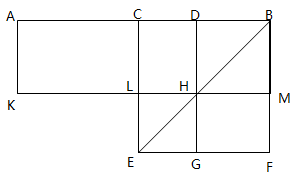
Euclid used geometry to handle many of what we now call algebraic problems. For example, in the figure below, assume AC=CB=a and CD=b; then this figure can be used to demonstrate a2-b2=(a+b)(a-b)
When the Greeks used geometry to handle problems of quantity, they strictly observed the principle of homogeneity. That is to say, only quantities of the same kind could be added, subtracted, or compared. For example, a person 180 centimeters tall and a pig weighing 180 kilograms cannot together make any kind of “360,” because these two 180s measure two entirely different things. The same is true in geometry: a measure of length cannot be added to a measure of area, nor can a measure of area be added to a measure of volume; not even the measures of straight lines and curved lines can simply be added together. Multiplying the quantities of four or more straight lines has no meaning. We can see that higher powers, which the Babylonians had long been able to handle, were once again excluded here by the Greeks. This too is some kind of “thinking too much,” and this influence continued all the way until the rise of modern symbolic algebra.
 Fragment of the Elements (around 100 CE)
Euclid lived in the early Hellenistic period. Roughly contemporary with him were two other unprecedented mathematical giants, Archimedes and Apollonius.
In addition to his work in mechanics, Archimedes also achieved much in mathematics. He created a system for representing very large numbers, calculated the volumes of ellipsoids and paraboloids, used the method of exhaustion to determine π to 3.14, and so on. He also used methods that can be regarded as precursors of calculus. But Archimedes’ writings had relatively little influence in the ancient world; their manuscripts survived only by accident and were not rediscovered until the Renaissance. Another important work did not come to light again until 1906. It had once been copied onto a parchment manuscript, then erased and overwritten with a prayer book; twentieth-century scholars reconstructed the traces of the writing, which fortunately had not been completely wiped away, and among the reconstructed works were two articles long thought lost.
Apollonius was the creator of the epicycle-deferent model; his Conics was even more influential, and he provided mathematical models for both Ptolemy and Kepler.
Many of his other works have been lost as well. The Elements and the Conics reflect the highest achievements of geometry in the Greek period, to such an extent that many works prior to them were lost.
Apollonius reached the highest achievement in the study of conic sections before analytic geometry. In a sense he was a precursor of analytic geometry, but in essence he was still far from it. When studying conic sections, Apollonius often used certain reference lines, whose function was somewhat like coordinate axes; but these reference lines were still, more often than not, auxiliary lines drawn on the figure according to the specific circumstances, rather than a coordinate system established prior to the specific figure.
Between Apollonius and Ptolemy there were many developments in trigonometry; we will skip over them and go straight to Diophantus of the late Hellenistic period (c. 246–330).
Diophantus is called the father of algebra. He was markedly different from the traditional Greek mathematical style: no longer based on geometry, he used a series of abbreviations to describe equations and indeterminate equations.
He also began to handle higher powers. The fourth power was called square-square, the fifth power square-cube, and so on, each with its own abbreviated expression. For example, the expression 2x4+3x3-4x2+5x-6 could be written in a form like “SS2 C3 x5 M S4 u6,” where S, C, x, M, and u respectively stand for square, cube, unknown, minus, and unit (though originally they were Greek letters).
But Diophantus did not position his research as the study of some general algebraic laws. His writings are more like a collection of problems, answering only questions with definite instances. When an equation has multiple solutions, he often takes only one of them; even for indeterminate equations with infinitely many solutions, he often gives only one solution and is done with it. Of course, negative roots and irrational numbers were not accepted.
Diophantus stands out as unique in ancient mathematical history, though this may of course also be because the works before and after him were lost. In the Middle Ages, Diophantus had little influence; the main source of algebra came from the Arab mathematician al-Khwarizmi. But in the Renaissance, Viète reinterpreted Diophantus’ writings and promoted the rise of modern symbolic algebra.
We mentioned al-Khwarizmi when talking about Arab science. In some respects, al-Khwarizmi was “more backward” than Diophantus: he did not adopt any abbreviated forms, and even the Indian numerals he himself introduced were used only sparingly; the entire text is a great mass of verbal exposition. His algebraic methods were also based on geometry, but if translated into modern symbols, we would find that the problems he focused on were actually closer to modern algebra.
Indian numerals, together with Arab mathematics, entered Europe and gradually became popular. A famous medieval mathematician was Fibonacci (c. 1170–1250); his real name was Leonardo, and the more famous name Fibonacci means “son of Bonacci.” His father was a merchant doing business in Africa, and Fibonacci followed him in learning mathematics from the Arabs. His celebrated book was called Book of the Abacus. It had little to do with the abacus, but it was indeed heavily concerned with practical commercial mathematics such as bookkeeping, calculating interest, and exchange rates. The book promoted the “Arabic numerals,” including zero, and also introduced the method of indicating fractions with a horizontal bar.
However, his notation for fractions was often quite clumsy, for example in a question like this:

(p. 282 of History of Mathematics)
Contemporary with Fibonacci, Jordanus of Saxony (1190–1237) is also worth mentioning. His book Arithmetic began to attempt to use letters to represent numbers. In fact, Euclid was already able to use line segments or areas to correspond to numbers; for instance, the product of AB and BC is ABCD. At times Jordanus omitted one of the endpoints, for example using only C to represent BC, and thus he wrote expressions like the following:
Let the given number be abc, and let it be divided into two parts, ab and c. Let d be the given product of these two parts, ab and c. Let the square of abc be e, let four times d be f, and let g be the result of e minus f. Then g is the square of the difference between ab and c. Let h be the square root of g. Then h is the difference between ab and c. Since h is known, c and ab are both determined.
Let us jump again to the Renaissance. With the spread of printing, European scholars of the Renaissance devoted themselves to reviving ancient learning. At the same time as many ancient works were brought to light, they were also understood in new ways.
Scholars of the Renaissance believed mathematics to be a calm discipline. They thought that learning mathematics could free people from the noisy world of scholastic philosophy (we mentioned that the main teaching form of scholastic philosophy was “disputation”), and emphasized that geometry could be studied quietly by oneself. But this was in fact a kind of misunderstanding of Greek mathematics. Greek mathematics was still mainly taught within an oral environment of instruction by word of mouth and example, and geometrical proof was also a method of demonstration.
And the way of studying by silently reading to oneself was something formed entirely after the age of print. Before printing, people’s main way of reading texts was aloud; texts were merely tools for assisting speech and had not yet acquired independence.
Once mathematics began to be detached from oral tradition, the result was naturally that those more general and more easily recognizable abbreviated symbols became more popular than cumbersome verbal descriptions. Today we may feel that mathematical texts lacking abbreviated symbols and filled with verbal exposition are cumbersome and difficult to read, but if you imagine yourself in a teaching environment dominated by oral communication, that would no longer count as a defect.
Once mathematics began to be detached from oral tradition, the result was naturally that those more general and more easily recognizable abbreviated symbols became more popular than cumbersome verbal descriptions.

Many interpretations of Greek learning in the Renaissance were actually somewhat skewed. For instance, the discussion in the Elements about the ratio of magnitudes was too complicated, and early Renaissance translators understood it in terms of number. Another example is that the Greek concept of “unit” was translated as “quantity unit”; these two concepts are not quite the same. A unit is an object of counting, whereas a unit is the basis of measurement.
These misreadings reflect the Renaissance tendency to try to unify number and magnitude. Of course, there is nothing especially remarkable about conflating number and magnitude; Indian mathematics, Babylonian mathematics, Chinese mathematics, and so on all lacked the kind of tormenting concern the Greeks had. Yet early modern Europe was not simply returning to a naive, pragmatic mathematical form; rather, while retaining the Greek belief that mathematics is true knowledge and the serious theoretical attitude toward it, it broke down the distinction. The revival of Pythagorean–Platonic thought once again emphasized the cosmological status of number; moreover, since the Middle Ages there had also been the idea of imagining God as a geometer. So while number and magnitude were tending toward unification, mathematics did not lose its theoretical standing.
History is indeed, in many cases, a dialectical process of the sort Hegel called “thesis–antithesis–synthesis.” The breaking down of distinctions and the absence of distinction from the start are two different things. It is like moving from “first, mountains are mountains and waters are waters,” through “mountains are not mountains, waters are not waters,” and then returning to “mountains are still mountains, waters are still waters”; this third state is not the same as the first. Earlier we also mentioned how modern people broke down the Greek distinction between natural objects and artificial objects, and between interiority and exteriority; none of this was a simple return to some primitive state before distinctions existed.
In the Renaissance, the symbolization of mathematics was greatly advanced; the modern forms of the plus sign, the equals sign, decimal fractions, and so on all took shape in this period.
And certain “incomprehensible” numbers that appeared in symbolic calculation gradually became familiar—for example, negative numbers, irrational numbers, imaginary numbers, and so on. They could conveniently be used as calculation tools and were acknowledged as intermediate terms in many operations. But their reality was still not recognized, so they were often called false numbers, negative numbers, imaginary numbers, sophistical numbers, and so on. Even so, people no longer simply discarded them as ancient mathematicians had done; instead, they still expressed them symbolically and kept them in reserve.
François Viète (1540–1603) made important contributions to the founding of modern algebra. He proposed the concept of parameters and distinguished them from unknowns.
Traditionally, there had long been methods of using certain abbreviated symbols to refer to unknowns, but there was no universal way to describe an entire class of algebraic expressions, such as ax2+bx+c=0. This required the concept of parameters, distinct from unknowns. Viète’s method was to use vowels to represent unknowns and consonants to represent known parameters.
This symbolic algebra accomplished a kind of “abstraction of abstraction.” In traditional mathematics, numbers are abstractions of things, and words or abbreviated signs are also abstractions of things; here, however, the symbols a, b, c are abstractions of numbers. The result of this further development of abstraction is that abstract activity is no longer an activity directed toward things, but rather some kind of activity between symbols and symbols.
Only within this horizon of symbolic abstraction can concepts such as irrational numbers and imaginary numbers be acknowledged. For if numbers are always abstractions of things, then what on earth are the things corresponding to negative numbers, irrational numbers, and imaginary numbers? This question was never fully settled even by the twentieth century. With the addition of concepts such as infinitesimals, limits, infinity, and non-Euclidean geometry, the question of what mathematics’ “objects” actually are became more and more perplexing. But if these symbols are not abstractions directly aimed at things, but are one layer removed—abstractions of abstractions, symbols of symbols—then one can calmly suspend their “meaning” for the time being and focus only on the relations between symbols.
The question of the relation between mathematical symbols and the real world continued into the early-twentieth-century debates over the foundations of mathematics. But in any case, within the system of symbolic algebra, we can at least, just as mechanics replaced natural philosophy by replacing “why” with “how,” replace the demand for “rationality” with “legitimacy” (rule-governed validity), thereby accepting all kinds of mathematical objects—no matter what they ultimately refer to—as long as they can be used according to the rules, they are legitimate.
Viète himself still adhered to the principle of homogeneity, that is, only lines can be added to lines, planes to planes. For example, in an equation like x3+ax=b, a is called a plane and b is called a solid. This stubborn principle was later broken by Descartes.
Descartes (1596–1650) occupies a crucial place in the history of mathematics. Of course, we all know that he invented analytic geometry, but the key question is: what does analytic geometry mean? What kind of conceptual transformation is implied by solving geometric problems by algebraic methods?
Analytic geometry originated in Descartes’ search for a “universal method.” The exaltation of “method” was a trend in the early modern period, but in the Greek world the word method generally referred only to a teaching technique: depending on the problem, the context, or even the audience, the proper teaching method would differ. Modern people in Descartes’ time, by contrast, were committed to seeking a “universal method” that could obtain all knowledge and transcend any specific context; this demand was unprecedented. Mathematics was no longer a pedagogical means of inducing recollection of knowledge; it became the very mode of constructing knowledge itself.
Descartes reinterpreted the concept of “unit,” defining it as a quantity that can be arbitrarily chosen, thereby breaking the principle of homogeneity among magnitudes, because the quantity of the length of any line segment can at any time be multiplied by a unit 1 and thereby become the quantity of an area. And this basic unit of measure is detached from any specific figure and is posited a priori; it is understood before any concrete figure. Descartes’ coordinate axes are not auxiliary lines drawn on a figure; they are grasped prior to any specific figure whatsoever.
Correspondingly, a concept of pure “space” detached from concrete things, infinite, uniform, and isotropic, also came into being; only in such an ideal a priori space can an object maintain eternal uniform straight-line motion. In an Aristotelian “space” that is finite, non-uniform, and dependent on actual bodies, such motion is hard to imagine. We call this new space Euclidean space, but in fact Euclid’s geometry does not necessarily posit such a space.
There is simply too much content in the history of mathematics, and in this class we can only go this far. In my original teaching plan, I inserted a section on the “mathematical revolution” between Newton and alchemy. The reason I placed this special topic in the history of mathematics here was, on the one hand, that I had not had time to prepare it; on the other hand, I was considering carrying the history of mathematics all the way to the early-twentieth-century debates over the foundations of mathematics. But in fact I found that this plan would require at least two lectures, and by the time I prepared up to Descartes, the length was about right. So in substance I still spoke according to the original theme of the “mathematical revolution.” You can read about the other material after class, or discuss it with me.
Further Reading
Carl B. Boyer: A History of Mathematics (It is hard to find anti-Whiggish works on the history of mathematics on the market; this one, relatively speaking, felt pretty good to me after reading it)
M. Kline: Mathematics: The Loss of Certainty (The material I did not have time to cover in this class can be found in this book)
The Collected Writings on Intellectual History of Jacob Klein (the Science Origins Series will be published soon)
Zhang Donglin (doctoral dissertation): “Descartes’ Transformation of the Concept of Magnitude”
Translated from the Chinese original with AI assistance. The original text is authoritative.