
Today is the final class, and we are talking about twentieth-century science.
By “the twentieth century,” our main focus is on the scientific revolution in physics in the early twentieth century—that is, the rise of relativity and quantum mechanics. As for the scientific frontiers of the second half of the twentieth century and even the twenty-first century, we will not be dealing with them in this course.
History can never be exhausted; any narrative strategy is, in the phrase, “to miss much while touching on little” (挂一漏万). The issue is not how to avoid omissions, but rather what manner of omission one adopts. The choices I have made in this course are, on the one hand, of course related to my own capacities, and on the other hand also based on my own understanding of the history of science and its meaning.
From the very beginning I emphasized that our course focuses on understanding, not memorization. There are no fixed “knowledge points” in what is called “history of science” that I must drill into you through this course. As for the knowledge points, you can just consult reference books or search Baidu, and that will be more or less enough; what we are after is a deeper understanding. Not just historical events A, B, C, and so on, but also how one could get from A to B, and why one could then get from B to C, and so forth. We would rather, from a historical perspective, turn back to investigate the conditions of our own era, and reflect on the worldviews and mental habits we have already taken for granted, because these things are historical too.
What history shows us is not some determinate law. If you want to find in the history of science a definite scientific method, and then simply copy it in order to drive scientific discovery forward, then you are certainly going to be disappointed; there is no such thing to be found in the history of science. What history shows us is precisely uncertainty, a certain abundance of possibilities. In other words, what we now think of as fixed and commonplace may not be fixed at all; all of it has its own historical origins. Ancient people did not think this way, and future people may not think this way either. What history provides us is not a dogma of “how we ought to be,” but a “fallback option” of “how else we might yet be”; only then can we transcend the limitations of the age.
So many scientific developments or intellectual transformations in history are, in some respects, always a return to tradition, a rediscovery of possibilities that were once missed in history.
In short, my history of science pays more attention to those “outdated” things, to tracing change back to its sources and restoring historical context, rather than introducing ready-made knowledge after the dust has settled. These considerations have led me to place greater emphasis on the history of Western science in antiquity and the early modern period. Even so, within those ranges, what I have omitted is still a great deal. I have focused on ensuring the coherence of the narrative, but I cannot guarantee the comprehensiveness of the perspective. These are things the students will have to fill in on their own after class, according to their own understanding and interests.
We have already said that Newtonian mechanics marked the mathematization of nature, while Maxwell’s electromagnetism marked the unification of this mechanical world; heat, sound, light, electricity, and all sorts of other phenomena were all subsumed under “mechanics.” By the end of the nineteenth century, many people believed that the edifice of physics had basically already been “roofed over,” and that what remained was nothing more than some repair work.
In a famous lecture in 1900, Lord Kelvin, then said to be 76 years old, reportedly sighed that there was nothing left to discover in theoretical physics; what remained was mainly to make measurements a little more precise. He is also said to have made a remark along similar lines: the future of physics could only be found beyond the sixth decimal place.
Whether these two statements were actually made by Lord Kelvin himself is disputed, but they certainly reflect the way many scientists at the time understood the state of physics. Planck later recalled that when he was preparing to devote himself to physics, his teacher advised him that there was already very little room left for young people to explore in physics, and that dedicating oneself to physics was not worthwhile.
Indeed, the system of classical mechanics completed at the end of the nineteenth century looked extremely perfect. Various phenomena had all been unified within a mechanical system derived from a few succinct formulas, and this system in turn was capable of delivering astonishing precision. Of course, there were still many unsolved problems, but people generally thought of them as no more than a few missing pieces in a nearly finished jigsaw puzzle—pieces that could always be added sooner or later, and that in the meantime made no difference to the overall situation. Very few people imagined that filling these gaps would require completely disrupting the entire existing picture of the world.
In his 1900 lecture, Lord Kelvin mentioned “two clouds over the dynamic theory of heat and light.” The first was Michelson’s ether-drift experiment; the second was the problem of black-body radiation. In the end, what dispersed these two clouds were, respectively, relativity and quantum mechanics.

Aside from these two “clouds,” a series of new discoveries at the end of the nineteenth century also shook the foundations of physics. For example:
In 1895, Röntgen discovered X-rays (with wavelengths far beyond the usual limits of electromagnetic radiation);
In 1896, Becquerel (1852–1908) discovered radioactivity (uranium ore could affect unexposed photographic plates; this was later named radioactivity by Madame Curie, who also isolated polonium and radium);
In 1897, J. J. Thomson discovered the electron (that is, discovered that the cathode rays produced when current passed through a vacuum vessel were a stream of particles far smaller in mass than the hydrogen atom);
In 1898, Rutherford discovered alpha and beta rays (and by 1911, on the basis of alpha-particle scattering experiments, Rutherford proposed the nuclear model of the atom).
……
These discoveries led physics to begin exploring the interior of the atom, and they also shook up some commonsense notions that classical mechanics had only just established. But even more subversive were those two clouds.
Let us first talk about the first cloud, namely Michelson’s ether-drift experiment.
What is “ether”? Ether is an ancient concept. Among the ancient Greeks, it referred to the “fifth element” of the heavens; and this concept was reintroduced into physics in the nineteenth century with the revival of the wave theory of light.
Hooke and Huygens, who were contemporaries of Newton, already maintained that light was a kind of wave, while Newton believed that light was made up of particles. Because of Newton’s authority, and because the particle theory really could better explain phenomena such as the straight-line propagation of light, the particle theory once became mainstream. But in 1801, Thomas Young carried out the famous “Young’s double-slit experiment” and discovered the interference of light. Interference is a phenomenon peculiar to waves: coherent light from the same source passes through two narrow slits and forms two light sources. If these two light sources have the same frequency and a phase difference, then in some places wave crests will add to wave crests, while in other places wave crests and troughs will cancel each other out, forming alternating bright fringes, rather than simply superimposing two beams of light to make one large bright patch.
A little later, Fresnel revived Huygens’ doctrine and perfected the wave theory of light, providing mathematically precise explanations of the interference, diffraction, polarization, and other phenomena of light. After that, physicists began to regard light as a transverse wave like water waves.
Later still, as we know, Maxwell refined electromagnetic theory, proposed the concept of electromagnetic waves, and also regarded light as a kind of electromagnetic wave.
Wave phenomena themselves do not violate the worldview of classical mechanics. Water waves, sound waves, and so on were already well-known wave phenomena. But from the perspective of classical mechanics, waves are always waves in some medium: without water there are no water waves, and without air or some other medium that transmits vibration, sound cannot propagate. So what is the medium for the propagation of electromagnetic waves? Experiments had already shown that electromagnetic waves could propagate in vacuum. Classical mechanics could accept waves, but not waves detached from a medium. So physicists introduced the concept of “ether,” believing that light and electromagnetic waves propagate in the “ether” that permeates cosmic space.


Based on the properties of light waves, scientists speculated about the properties of ether—for instance, that it was extremely rigid, but also extremely rarefied, and so on—but no one ever really detected the existence of ether itself. Even so, scientists remained firmly convinced of ether’s existence, because it was necessary for explaining the wave nature of light. This sort of situation is common in the history of science. For example, scientists believed in the existence of atoms before they were actually able to detect them; more recent quarks, dark matter, and so on are similar. Although we do not directly “see” them, given their consequences, we are firmly convinced of their existence.
In the 1880s, Michelson began trying to measure the effects of ether. Michelson was a great experimentalist, and he devoted his life to the precise measurement of the speed of light.
At the time, people believed that ether was a stationary background permeating cosmic space, while the Earth and the Sun were both moving through cosmic space, and thus moving at high speed relative to the ether. If that was the case, then in two perpendicular directions on the Earth, motion relative to the ether would certainly be different; if one moved in the direction facing the “ether wind,” the speed of light ought to be a little slower.
Michelson therefore designed the following experiment: he let a beam of light pass through a polarizing mirror, with one half transmitted and the other half reflected, thereby forming two coherent light sources perpendicular to each other. After traveling a certain distance, these two beams were reflected back and ultimately converged on a screen. If the speeds of the two beams differed, then a phase difference would form when they converged, and thus interference fringes would appear; if the speeds were the same, then they would simply superimpose and no interference fringes would form.
The result of the experiment was simple: no matter how he adjusted the experimental setup, no interference fringes were found. Later, he collaborated with his colleague Morley (hence the experiment is called the Michelson-Morley experiment) to improve the precision of the experiment, but the result remained zero.
With hindsight, this experiment had actually already demonstrated the constancy of the speed of light, and deriving relativity from it was only a matter of course. But at the time, very few people thought that this experiment proved that ether did not exist. So-called decisive experiments in the history of science are often hindsight constructions. There are always countless interpretations of an experimental result. For example, the failure to detect annual stellar parallax can be interpreted as the failure of the Copernican theory, or as evidence that the stars are simply too far away; similarly, the anomaly in the orbit of Uranus can be interpreted as a failure of Newton’s theory, or as evidence that there is another as-yet-undiscovered planet interfering. The Michelson experiment could be interpreted as showing that ether simply does not exist, but it could also be interpreted as reflecting some as-yet-undiscovered effect.
At the time, most physicists did not abandon classical mechanics because of the null result of the Michelson experiment; instead, they tried in various ways to repair it. Among these, Lorentz’s proposal was highly ingenious: he suggested that when objects move through the ether, their length along the direction of motion contracts, and time also dilates with motion, thereby yielding the result that the speed of light remains constant. This treatment is known as the Lorentz transformation, which Einstein later rederived from special relativity. In form, the Lorentz transformation is consistent with special relativity, but it is still constructed from the standpoint of classical mechanics.


Einstein’s (1879–1955) special relativity ultimately gave a perfect explanation of the Michelson experiment, and turned this experiment into a refutation of ether. But Einstein’s starting point was not to explain the Michelson experiment; he began by thinking about a more fundamental theoretical problem.
Einstein often mentioned that the idea of relativity came from a thought experiment he did at the age of sixteen. He said:
“If I were to chase after a beam of light with the velocity c (the speed of light in vacuum), then I should observe this beam of light as a kind of electromagnetic field oscillating in space but standing still. Yet such a thing seems impossible, both on the basis of experience and according to Maxwell’s equations. From the beginning, it was intuitively clear to me that from the standpoint of such an observer, everything ought to proceed according to the same laws as those seen by an observer at rest relative to the Earth. For how could the first observer know or be able to determine that he was in a state of rapid uniform motion? From this paradox we see that the germ of special relativity was already contained within it.”
The paradox of this thought experiment lies, on the surface, in the fact that a “frozen wave” is intuitively hard to accept. But at a deeper level, it points to some long-standing lack of coordination between Newton and Maxwell.
We know that, from Galileo to Newton, classical mechanics had already provided an original version of the “principle of relativity”: simply put, inside the cabin of a uniformly moving ship, you cannot discover, by means of mechanical experiments, whether you are at rest or in motion. The Earth is moving at high speed, yet we do not feel this motion; this is an expression of the principle of relativity. More precisely, the laws of mechanics remain invariant in all “inertial frames.” Whether on the ground, in a ship’s cabin, or in a space shuttle, so long as a mechanical system as a whole remains in uniform motion, the mechanical laws governing the interactions among its parts should be the same.
But here the laws of mechanics that remain the same are limited to Newtonian mechanics; what about Maxwell’s electrodynamics? Do the laws of electrodynamics also remain invariant in different inertial frames? Do Maxwell’s equations need to be rewritten in a rapidly moving reference frame?
According to Einstein’s thought experiment, Maxwell’s equations definitely have to be rewritten. From the standpoint of Newtonian mechanics, a reference frame moving at the speed of light is still an inertial frame, and Newtonian mechanical laws within it would still be consistent; but electromagnetic waves would all be frozen, and electrodynamics would certainly break down.
Another inconsistency was also unbearable to Einstein: in electromagnetic induction, so long as there is relative motion between a magnet and a coil, an electric current will be produced, yet this relative motion had not been given a unified explanation in classical mechanics. When the magnet moves, the explanation is that the magnet’s motion through the ether produces an electric field; but when the coil moves, the explanation is that the coil’s motion in a magnetic field produces an electric current (Einstein, p. 83). These two explanations are asymmetric. And according to the principle of relativity, a magnet moving relative to a coil and a coil moving relative to a magnet should be completely equivalent.
 Young Einstein (1893)
So Einstein was not concerned with the Michelson experiment; what concerned him was the internal coherence of theory. The starting idea of special relativity, when stated plainly, is quite simple: the principle of relativity must be carried through within electrodynamics as well—in other words, in different inertial frames, the laws of electromagnetism should likewise remain invariant.
Thus Einstein’s 1905 paper on special relativity was titled “On the Electrodynamics of Moving Bodies,” because it was meant to address the consistency of electrodynamics.
Galileo had already said that inside a sealed ship’s cabin, mechanical experiments cannot determine whether the ship is at rest or moving uniformly in a straight line; Einstein believed that, similarly, electromagnetic experiments should likewise be unable to determine this.
But traditional electromagnetic theory depended on the ether, a medium pervading the entire universe, and the existence of ether provided an absolute frame of reference; therefore, through electromagnetic experiments—that is, by reference to the ether—it was theoretically possible to distinguish absolute motion from rest. To carry the principle of relativity over into electromagnetism meant abandoning the concept of an absolute ether.
To make the laws of electromagnetism invariant in inertial frames, one way would be to rewrite the electromagnetic laws; Einstein tried this too, but the result was unsatisfactory. Another way was to keep Maxwell’s equations and hold that the electromagnetic laws invariant in all inertial frames are precisely Maxwell’s equations.
Maxwell’s equations contain a constant c, the speed of light in vacuum. If Maxwell’s equations are to remain invariant in all inertial frames, then that means the speed of light must be invariant.
So the whole of special relativity rests on two basic postulates: first, the principle of relativity; second, the invariance of the speed of light. In fact, the key point lies in the relativity of measurement.
 Young Einstein (1904)
But unifying these two postulates is not easy, because they seem contradictory. For example, if you are on a speeding train and fire a beam of light toward the front of the train, and you measure the speed of that light as c, then should I, standing on the platform, seeing you fire the beam from the speeding train, not measure the speed of that light as c plus your speed relative to the light—that is, the speed of the train relative to me? How, then, can the speed of light remain unchanged?
One day in 1905, while chatting with his friend Besso, Einstein had a flash of insight and realized the key. The key was that “measurement” itself is relative. To measure the speed of light, you need a clock; but what exactly does an activity such as “timing” mean? Timing is nothing more than some activity of comparing the “simultaneity” of different things. When we say that class starts at six o’clock, what we mean is that if we look at our watch at the same moment we hear the school bell ring, the hands on the watch will happen to point to six. If my watch is not accurate enough, I can only seek out another, more authoritative clock to calibrate it. There is no absolute clock that stands above all things and floats free of all clocks, and then, when we measure time, we compare against that absolute clock.
Since the measurement of time always compares two relative things, must the results of such comparison be the same for observers in different reference frames? Einstein said, not necessarily.
Einstein gave an example to explain this: one person is on a speeding train, another is standing on a stationary platform. Now the person on the platform observes that the two points A and B at the front and rear of the train are “simultaneously” struck by lightning, because the time needed for light to travel from each end to the middle is the same. But for the observer on the train, by the time the light from the two ends reaches his eyes, he has already moved forward some distance with the train; therefore the flash at the rear has to travel a little farther before it is seen, so in his eyes the two lightning strikes are not simultaneous.
So who is right, then? Which lightning strike came first and which came later? There is no absolutely correct answer here. Is the observer standing on the stationary platform the one who is correct? But rest and motion are relative: we can say that the train is moving relative to the platform, or that the platform is moving relative to the train. Or let us imagine that the situation occurs on two trains (supposing they run in an unseen external void): the people on these two trains know only that there is relative motion between them, but do not know who is absolutely moving or who is absolutely at rest. Then for the same two events, one person on one train thinks they occurred simultaneously, while another person on the other train thinks they did not; who is right and who is wrong? The two of them can never settle the matter between themselves, unless they ask a person on a third train to arbitrate for them—but why should the third train be right?
So Einstein’s conclusion was that there is no absolute time. Measurements of both time and space depend on their respective reference frames. To the person on the platform, the clocks used by the people on the train run slower, and their rulers are shortened as well; the relativity of measurement guarantees the absoluteness of the speed of light.
Special relativity also has some important consequences, such as the impossibility of accelerating any object to the speed of light, and the famous formula E=mC2.

At this point, relativity has dealt only with inertial frames and has not yet dealt with non-inertial frames—that is, with accelerated motion. At the same time, the assumption that the speed of light is constant has not yet taken gravity into account, because in Newtonian mechanics gravity was regarded as an instantaneous action at a distance; but if such instantaneously propagating signals existed, then the relativity of measurement discussed earlier would collapse.
Thus Einstein’s next task had two parts: to bring accelerated motion and gravity into relativity.
In 1907 Einstein made a major breakthrough, and this breakthrough too came from a thought experiment. He imagined a person in a sealed chamber who feels a downward gravitational force, but cannot determine whether this gravity is due to the chamber being at rest on the surface of a planet and therefore subject to gravity, or due to the chamber accelerating through interstellar space. Thus accelerated motion is still not an absolute motion.
This thought experiment contains a corollary: light beams will bend in a gravitational field, because if one observes a beam of light crossing a sealed chamber from outside, then if the path of that beam is a straight line for the outside observer, its trajectory inside the chamber will be curved, because while the light is traveling from one end of the chamber to the other, the sealed chamber itself is accelerating upward.
If observers inside the chamber cannot distinguish accelerated motion from gravity, then under the influence of gravity they should also be able to see bent light beams; otherwise, when they observe a bent beam of light, they could conclude that they are definitely in accelerated motion.
The phenomenon of light bending in a gravitational field was confirmed by Eddington in an observation during the solar eclipse of 1919, which brought Einstein great fame. But the significance of this famous verification has been overstated. Based on a reconstruction of the observational records, historians of science have found that there were problems with how errors were handled in that observation, and its actual probative force was very limited. On the other hand, in fact Newton’s theory of light as a stream of particles could also predict the bending of light, though its estimate of the degree of bending differed from Einstein’s. Einstein himself was not particularly concerned with this observational confirmation.

 Einstein (1921)
When we say that light bends, we still have to carry through the principle of the relativity of measurement: what is bending, and what is straight? Aren’t curved and straight themselves also the result of measurement—that is, the result of relative comparison? A carpenter uses a straightedge to measure straightness and crookedness, but the straightness of the straightedge is itself measured by other straightedges; the measurement of straight and crooked remains an activity of relative comparison. So is there an absolutely accurate straightedge that can provide an absolute judgment of crookedness and straightness? If there is anything like the most accurate straightedge, it would have to be light; the most meticulous craftsmen are those who use light to judge straightness and crookedness. But if light itself can bend, what does that mean?
If we insist on the relativity of measurement and the absolute status of “light,” then we can arrive at such a conclusion: light is still traveling in a straight line, because the measure of “straight” is determined by light itself. That is to say, light always takes the shortest distance between two points. Of course, this straight line is no longer the one in Euclidean geometry, but the “straight line” of non-Euclidean geometry.
Thinking this over, Einstein went to seek help from his old classmate Grossmann in 1912. Back when Einstein was studying at the Swiss Federal Polytechnic in Zurich, he often skipped math classes, and relied on borrowing notes from Grossmann. Grossmann’s doctoral dissertation was about non-Euclidean geometry. With Grossmann’s inspiration, Einstein developed general relativity by means of Riemannian geometry. By 1915, he began corresponding with Hilbert. On the one hand he was inspired; on the other hand he also felt the pressure of competition—because Hilbert himself also wanted to try completing the construction of this mathematical system. In short, at the end of 1915 Einstein and Hilbert almost simultaneously arrived at the final mathematical equations of general relativity.
Of course, the honor of proposing general relativity unquestionably still belongs to Einstein. Einstein was indeed not very good at mathematics, but the theoretical conception of the whole theory was undoubtedly completed by him independently. Hilbert himself was also full of admiration for Einstein’s physical intuition. It is said that he once remarked: “As far as four-dimensional geometry is concerned, every child on the street in Göttingen knows more than Einstein, … and yet, despite that, it was Einstein, not the mathematicians, who did this work.”
General relativity explains gravitation as the curvature of space. The moon’s orbit around the earth can be understood as still “moving in a straight line” within a Riemannian space. This spatial theory of non-Euclidean geometry seems to bring back the background “absolute space,” but in fact it does not. In a certain sense, general relativity is a return to the Aristotelian concept of space—that is to say: space cannot be discussed apart from concrete objects.

Beyond relativity, the rise of quantum mechanics was perhaps even more subversive.
The rise of quantum mechanics was related to another “cloud,” namely the problem of black-body radiation. A “black body” is an idealized object physicists set up in order to study thermal radiation. It reflects no incoming electromagnetic waves; of course it emits radiation, but its radiation depends only on temperature and wavelength.
Scientists simulated a black body with a hollow apparatus that has a small window, because once external electromagnetic waves enter the window, they are difficult to reflect back out again, so the thermal radiation at this window can be approximately studied as black-body radiation.
As for the laws of black-body radiation, physicists starting respectively from classical thermodynamics and from Maxwell’s theory obtained two formulas. The former fits very well in the short-wave range, but fails in the long-wave range; the latter fits very well in the long-wave range, but fails in the short-wave range, and even yields an infinite value.
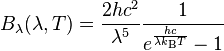
Then Planck (1858-1947) combined the two formulas and cobbled together a new one (as shaped in the figure below). People found that this new formula fit all experimental results from short waves to long waves perfectly.
But the question was: what is the physical meaning of this new formula? The first formula started from classical thermodynamics, the second from Maxwell’s theory, while Planck’s formula was put together starting from those two formulas; it had no theoretical foundation of its own. Yet Planck believed that since this formula matched the data so perfectly, it could not be a coincidence, and he began to think about the meaning behind it.
In the end he realized that to understand this formula, one needed to add a further assumption: that “when energy is emitted and absorbed, it is not continuous, but comes in packets.” This smallest packet of energy was called a quantum.
Planck was therefore regarded as a pioneer of quantum mechanics. Later people discovered that this discontinuity was not confined to black-body radiation, and quanta were not limited to energy either; any physical quantity is not continuous, but comes in small packets, one after another.

.
Einstein was also one of the pioneers of quantum theory. In 1905 he explained the photoelectric effect using the light quantum theory. But when quantum theory later developed many bizarre conclusions, both Planck and Einstein backed away.
The central figure who laid the theoretical foundation of the quantum-mechanical system was Niels Bohr, and he began from the model of atomic structure.
We said that Thomson discovered the electron in 1897, a charged particle thousands of times lighter than the atom. Thomson himself subsequently proposed an atomic model, namely the plum pudding model: electrons were embedded within the atom like raisins.
However, by 1911 Rutherford proposed the nuclear model of the atom on the basis of the phenomenon of alpha-particle scattering. He believed that most of the space inside the atom was empty, like the solar system: most of the mass was concentrated at the center, while electrons revolved around the nucleus on the periphery like planets. This model explained very well the alpha-particle scattering experiments Rutherford had carried out.
But Rutherford’s model faced a serious problem, and this problem was again related to Maxwell’s theory.
If electrons revolve around the nucleus, then according to electrodynamics they should emit electromagnetic waves outward, and according to the law of conservation of energy, once electromagnetic waves are emitted the electrons’ energy must decrease. Then electrons would no longer be able to maintain their original orbits, and electrons that lost energy would ultimately have to fall into the nucleus. But this clearly did not happen. So how could electrons possibly maintain their orbital motion?
Bohr introduced the concept of quanta and proposed an improvement to Rutherford’s atomic model. Bohr held that if energy comes in packets, then orbits should also come in levels; the orbit of an electron cannot be at just any height, but can only take certain specific energy levels. Electrons do not fall continuously; they only undergo transitions—that is, they jump from one orbit to another—and on the orbit of the lowest energy level they cannot fall any further.
Bohr’s model could explain some experimental phenomena, but it was still not complete. It still did not explain why rotating electrons did not emit electromagnetic waves, nor could it explain why each electron shell could contain only a specific number of electrons.
Thereafter de Broglie, Pauli, Heisenberg, Schrödinger, Born, Dirac, and others each contributed their own bricks and tiles to quantum mechanics. (Time is limited here, so I won’t expand on this much.)
In the final interpretation of quantum mechanics, an electron does not have a definite orbit; it can only be given, in the form of an “electron cloud,” as the probability of where the electron may appear. The motion of electrons cannot be analogized to macroscopic little balls or planets. Microscopic particles have “wave-particle duality”: they are both waves and particles. If we want to observe their position, we can always find them appearing somewhere like a particle; but when we are not observing them, they are omnipresent like a wave, with no definite orbit or position, and they can interfere with themselves.
 原子核模型的发展:汤姆逊 → 卢瑟福 → 玻尔 → 海森堡/薛定谔
To understand the strangeness of wave-particle duality, we might as well return to the double-slit interference experiment. If electrons are also waves, then an electron beam passing through two slits should, like light passing through two slits, produce interference and display interference fringes. Experiment has indeed confirmed this.
But at the same time, electrons are particles, and we can fire them out one by one. In that case, after each electron is fired, what appears on the screen is naturally not a large patch of light, but a point with a definite position. (Because light is also made of particles, we can also do the following experiment by firing photons out one by one.)
If we fire electrons out one after another, and in the end accumulate countless spots on the screen, we will find that the interference fringes have returned. Firing electrons out one by one and firing all electrons out simultaneously have the same effect.
What does this mean? It means that interference has occurred. But who is interfering with whom? When the later electron is emitted, the earlier one has already long since hit the screen, so it cannot be interference between the preceding and following electrons. The conclusion can only be that each electron interferes with itself.
But interference means that the electron passes through both slits at the same time. If the electron passes through only one slit and hits the screen along a definite trajectory, then no interference will occur. So the question is: since the electron is an indivisible quantum, how does it “pass through” both slits at the same time?
We want to see exactly how the electron passes through the double slit. For example, we can imagine placing a sensor at the slits so that when an electron passes through, it will be recorded. Then what we will not record is an electron split into two halves; we will find that each electron passes through either slit A or slit B.
But once we choose to observe in the middle, in the end we will find that the interference fringes disappear again. The image that finally appears on the screen once again becomes a simple superposition of electron beams emitted separately from the two slits.
With carefully designed experimental apparatus, we can even achieve “delayed choice,” that is to say, after the electron has already actually passed through the double slit, we can still decide whether or not to observe which slit the electron passed through. The result is still the same: if we observe, the interference fringes do not appear; if we do not observe, the interference fringes do appear. Similar experiments have already been accomplished.


Quantum mechanics is mathematically extremely precise, but physically it is bewildering. Quantum mechanics contains a profound revolution in thought; traditional, or rather everyday, notions of reality and causality seem to have been shaken.
And yet we need not demonize quantum mechanics too much. In fact, rather than revealing the world’s ambiguity, quantum mechanics reveals the ambiguity of human language. The reason we find quantum mechanics hard to understand is that the language and concepts with which we understand and describe the world are themselves limited.
Bohr said: “What do we human beings fundamentally depend on? … We depend on our words. … Our task is to communicate experiences and ideas to others. We must constantly struggle to expand the range of our descriptions, … ‘reality’ is also a word, a word we must learn to use correctly. … There is no quantum world. There is only an abstract quantum-mechanical description. The idea that the task of physics is to investigate how nature is is wrong. Physics concerns what we can say about nature.”
Heisenberg, for his part, said: “Can one speak about atoms themselves? This is a question of physics and also a question of linguistics. … The Copenhagen interpretation of quantum theory begins with a paradox. It starts from the fact that we describe our experiments in the terms of classical physics, while at the same time starting from the recognition that these concepts do not fit nature exactly. The antagonism between these two starting points is the source of the statistical character of quantum theory.”
On the other hand, we notice that in both relativity and quantum mechanics the status of the observer is brought to the fore. In relativity, measurement depends on the observer’s reference frame, while in quantum mechanics even whether something happens at all depends on measurement. But this highlighting of the observer does not mean the addition of some mysterious subjective will. In fact, the key issue is less the introduction of some mysterious subjective perspective than the expulsion of the “God’s-eye view.” What we speak of as “objectivity” under the horizon of classical mechanics is often just a “God’s-eye” view: what an anonymous, omnipotent observer sees in a state completely isolated from the object observed. But speaking of such a thing is illegitimate.
For example, when we describe an electron, we cannot say: if a mark appears at X, then this electron came from path a (or path b). For only the fact that a mark appears at X is observed by the experimenter, whereas saying that this electron passed through path a is not an observed phenomenon but a theoretical reconstruction, because according to our understanding (which in fact treats the electron as if it were a small everyday ball), we can only imagine it coming through path a and arriving at the X screen. In short, the matter of “the electron passed through path a” is merely the result of imagination, not a fact.
Even the so-called “electron” itself is an imagined construction. To say that it is an imagined construction does not mean that it is illusory or dependent on human will; on the contrary, in this case the behavior of the electron does not depend on the experimenter’s will. By construction, I mean that its state and properties are a theoretical tool we posit according to the phenomena we can observe. If the concept of an entity or property cannot provide anything relevant to our observations, then positing that concept is meaningless.
To get rid of the God’s-eye view means that we can only, honestly and straightforwardly, describe what has happened according to our own observations and in our own language. And to speak of events that no one can realistically observe in any way, events stated on the basis of some abstract God’s-eye view, is illegitimate.
Besides this, another thing quantum mechanics needs to break is the “principle of sufficient reason,” but not causality. By causality, we mean the interconnection between things: no event occurs in isolation. For example, Zhang San’s blow with a club is the cause of Li Si’s death. To say that causality exists universally is to say that Zhang San’s blow will certainly produce some results, or that Li Si’s being beaten to death must have some cause. However, the causality we usually talk about is not the principle of sufficient reason. The principle of sufficient reason maintains that every event has a sufficient reason that produces it and necessarily produces it, that is, necessary and sufficient conditions. Such sufficient reasons are themselves theoretical fantasies; in reality, apart from the abstract mathematical world, people have never exhausted the necessary and sufficient conditions of any real event.
Quantum mechanics has shattered the fantasy of the principle of sufficient reason, but it has not destroyed causality. For example, in delayed-choice experiments, once the God’s-eye view has been removed, the only events we can actually talk about are these three: 1. electrons emitted one by one — 2. the detector inserted or withdrawn — 3. the appearance of light spots. We can ask: why did the light spots appear in such and such a way? The answer: because electrons were emitted and the screen was inserted, and so on. This is to provide a reason that is not a sufficient reason; here causality is not confused, and the order of precedence and succession is perfectly in order. Only when we additionally insert some illegitimate events reconstructed on the basis of a God’s-eye view does the so-called “delayed experiment” produce the paradox of causal reversal. For example, the event “the electron had already passed through the double slit before the observation choice was made” — this “passing through” was not observed by anyone, and this “already” is inferred from a God’s-eye view. If one insists on describing the antecedents and consequences of such an event that only God can see, then the order of cause and effect is reversed.

After finishing relativity and quantum mechanics, there is basically no time left to talk about anything else. In fact, I also covered these two parts under very tight time constraints. There was still a great deal of important twentieth-century content that we simply had no way to cover, such as the atomic bomb, particle physics, computers, the Big Bang, the DNA model, nonlinear science, ecology, and so on. One way to handle this would be to rattle through everything in a disorderly way; another would be to spend the time concentrated on several key topics. Of course, the things I did not get to are not unimportant; it is simply that I always have to leave some things out in order to make sure that what I do cover can be discussed as deeply as possible.
I have always emphasized the conceptual side of things, and the ideas involved in relativity and quantum mechanics are the deepest of all, so I concentrated my time on discussing them. For the other parts, everyone can learn about them after class, or we can continue the discussion.
Further Reading
Cao Tianyuan: “A History of Quantum Physics” — the best high-level popular science book by a domestic author that I have ever seen, presented in a historical setting in a graceful, conversational way. As a history book it is not rigorous enough, but as a popular science book it is very successful.
Isaacson: “The Biography of Einstein” (“Einstein: His Life and Universe”) — written by the author of the biography of Jobs, translated by Zhang Butian; the best Einstein biography on the market, which also includes a popular explanation of relativity.
Wu Guosheng: “Lectures on Reflecting on Science” (there is an essay in it, “A Historical Review and Philosophical Reflection on a Century of Science and Technology,” which can be consulted as a supplement)
Translated from the Chinese original with AI assistance. The original text is authoritative.