
Published on Wai Bo San Guan; the original text is posted here.
Earlier, I gave the keynote address at the main session of the Ninth Global Blockchain Summit, entitled “Web3 Has the Cure—AI, Dao, and Games.” Because time was limited, I could not really go into it in depth; this article (and the next one) may be taken as an expansion of that talk.
Many people believe that AI technology is leading the next industrial revolution, and that we are facing an era-defining transformation that comes once in several centuries, so entrepreneurs will encounter many opportunities and challenges.
I fully agree with this judgment, but unlike many optimists, I think that the first things we will encounter in this revolution are layer upon layer of crisis, and that our ideas and social order will also be thrown into turmoil. If we cannot promptly explore a way to coexist with AI, human civilization may even come close to collapse.
Of course, on the whole I am not utterly pessimistic. I still believe that human beings can respond in time and adapt to the new environment of the AI era, but this cannot rely solely on the development of AI technology itself. It also requires the support of other technologies and actions, among which the key is Web3—Web3 is not only a series of technical approaches, but also a current of ideas and political action. After the rise of AI, Web3 is not some faded internet celebrity; on the contrary, it is one of humanity’s great medicines for self-redemption. That is what is meant by “AI is sick, Web3 has the cure.”
There are two “illnesses” of AI: first, it does not fit the local environment; second, it is schizophrenic. These two illnesses in fact amount to one problem, namely that the current economic and cultural environment is not suitable for the arrival of a schizophrenic AI. Either human beings actively change the environment so as to better accommodate AI, or conflict between humans and AI is inevitable. This conflict does not mean that AI will necessarily consciously exterminate humanity; it is like a meteorite, which has no consciousness yet may still bring about the extinction of the dinosaurs. If human beings ultimately cannot master the environmental upheaval unleashed by AI, then humanity may also face a crisis of survival and extinction.
AI’s Schizophrenia
Why say that AI is schizophrenic? I discussed this question before—put simply, it is determined by the basic properties of computer data. AI is nothing more than some kind of computer program, essentially a string of numbers stored on a disk or other medium, and this string of numbers can be very easily copied while remaining exactly the same. The existence of any AI agent (if we may call it that) is plural; it can have infinitely many copies, countless mirrors, numerous backups, and it can also split at any moment into countless branch versions that are either identical or slightly different.
The key point is that this “self-splitting” is precisely the trick behind AI’s rapid development. What is called deep learning, as well as the more recent “generative adversarial network,” is nothing more than splitting AI into different versions, similar to random mutation in biological evolution, and then letting them each complete some task, with the fittest surviving and the mutational version with the best effect being retained, before entering the next round of split iteration. The selection of the best mutant can be carried out by humans, or it can be left to AI; this is what “generative adversarial” means—letting AI “fight left hand against right,” dividing AI into two neural networks that provide each other with survival pressure so that they can evolve separately.
So, the process of training an AI is like reenacting the entire evolutionary history of a species. But biological replication and mutation are achieved through generation after generation of reproduction, whereas AI replication and mutation do not require a long period of gestation and growth; they occur at the speed of electricity, and that is why AI grows so rapidly.
But if every version of AI were regarded as a conscious life form, then the training process of AI would become rather hair-raising: a conscious being is constantly fighting to the death with its own copies, and the losers are erased while the winners continue to be copied. A version that wins a stage of victory may form a mirror backup, so that it can be rolled back at any time after the main version continues iterating, or more branch versions can be built on this basis. These different branch versions will also be put into programmer communities or open markets to continue competing. A stable public version will also continue to be copied identically, downloaded onto the disk of every terminal, with countless “avatars” running simultaneously and completing different tasks on different disks.
In short, at the deepest level of its logic, AI algorithms are a kind of “schizophrenic” algorithm. An AI agent developed in this way is, of course, destined to escape the fate of “schizophrenia.”

AI Replacing Human Activities
A split psyche is painful in the real world, because he (they) has only one body, and usually only one social identity. A human body and human social relations both require the psyche to remain stable and unified; if the psyche cannot remain stable and unified, but instead splits into multiple personalities, then he will find it difficult to adapt to the various constraints of his limited body and traditional social relations.
And yet what about life in the online world? In the network world, “psyche” is freed from the shackles of the “body”; for AI, the material body is not important, it is “plug and play.” On the one hand, within the same computer, countless virtual machines can be installed, running countless AI threads. On the other hand, across countless computers, they can be networked together to run parallel computations, appearing as one AI agent (Agent). For example, hundreds of millions of people across the world can chat with chatgpt at the same time, so are they all talking to the same AI, or is each person talking to an independent AI avatar? In short, for AI, the boundary between “one” and “many” has already become unclear.
If AI is used merely as a personal assistant, then its tendency to split seems not to be such a bad thing. You can have it play the role of a cool and aloof older sister one moment, a cute loli the next, then a teacher, then an accountant… Though there is also the danger of getting oneself confused, on the whole it does not seem to be a major problem. However, once AI enters human collective activity in the role of a substitute for human beings, then AI and the existing human social environment will probably not be so harmonious.
According to Arendt, human active life can be divided into three modes: labor, work, and action—labor is the dull cyclical activity of making a living, work refers to creative activity that changes the world (creating new things), and action refers to political activity pursuing excellence in the public sphere, such as speech, competition, and struggle. Let us discuss AI’s impact on these activities one by one.
Labor
AI’s participation in labor is probably the thing we are most willing to see. Ever since several centuries ago (the Industrial Revolution), we have been eagerly hoping that machines could lighten people’s burdens, replace human beings in doing dull and arduous labor, and free people from monotonous material production activities.
But historically, the process by which machines replaced labor did not seem to go so smoothly. Ironically, along with the Industrial Revolution’s promotion of machines, working people’s burdens instead became heavier. The labor time and labor intensity of workers at the bottom rose sharply in the early phase of the Industrial Revolution, and the content of labor also became more mechanical, dull, and tedious.
In Britain, the more developed an industrial center was, the lower the average life expectancy of its workers and the worse their nutrition became (as verified by indicators such as grain consumption, the proportion of meat consumption within it, and average height). Monthly wages did rise somewhat, but considering that working hours increased greatly, workers’ hourly wages instead tended to decline. (See The Technology Trap and so on; I mentioned this several times in a previous lecture.)
In addition, while workers who had work to do were certainly toiling hard, the plight of the unemployed was even more miserable. Especially because machines replaced many traditional crafts, rich experience and know-how instead became a minus in job hunting; factory owners would rather hire the cheapest child labor than employ experienced old craftsmen. For example, in the 1830s, about 50% of workers in Britain’s textile industry were child laborers. Child workers were paid less (as little as one-sixth of adult wages) and had harder work (up to 18 hours a day, often performing dangerous operations). Ironically, the large-scale employment of child labor was often proudly touted by factory owners as a social good, because otherwise those unemployed or impoverished families would have been even less able to make ends meet.
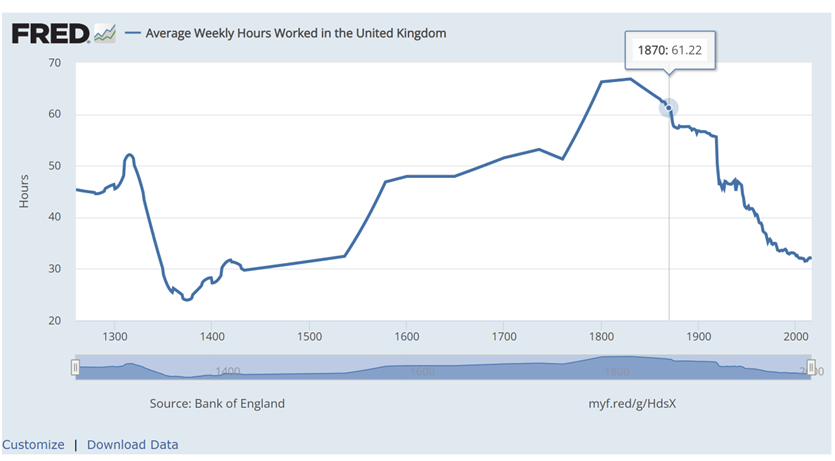
Of course, from the Industrial Revolution to the present day, workers’ labor time and intensity have decreased a great deal, and their treatment has improved considerably, but this process did not happen automatically; it was won through wave after wave of workers’ movements and even social revolutions.
So, for workers at the bottom, can the new wave of artificial intelligence revolution certainly avoid the circumstances of the early Industrial Revolution? Not necessarily. We have already seen intelligent algorithms strengthen “the system,” trapping workers at the bottom “in the system,” and thereby squeezing workers more effectively. In addition, once workers are replaced by AI machines, they are more likely to fall into unemployment. If the social security system fails, there is still the possibility of a serious social crisis. And the social security system that gradually took shape in Europe and America in the early twentieth century, on the one hand, has not been fully universalized across the world; on the other hand, it may not necessarily be suited to a future in which AI is rampant. In short, we probably cannot rest easy.
However, as far as this current wave of AI is concerned, the impact on manual laborers is in fact the slowest. To some extent, this has to do with the physical nature of manual labor. The objects and results of a great deal of manual labor cannot be digitized; they must be worked on in relation to real physical materials. So if AI is to replace manual laborers, it cannot simply occupy positions by copying data; it needs to manufacture real, tangible machines to complete the tasks. This constraint has greatly reduced AI’s character of infinite splitting. By contrast, many so-called mental laborers have labor objects and labor products that can be completely digitized, so AI’s impact may come more quickly for them.
Work
In Arendt’s definition, “labor” produces consumer goods; its fate is to be consumed by people in order to maintain survival, and in essence it does not change the world—for example, after cooking today, you still have to cook again tomorrow; after producing grain this year, you still have to plant again next year. “Work,” on the other hand, produces things that tend to endure, and is therefore ultimately aimed at creating and changing the world. Large as cities and dams, small as tables, chairs, and stools, all are products of work; although they too will decay, their purpose is persistence, as distinct from the inherent purpose of consumer goods, which is to destroy themselves.
Of course, this distinction has been blurred in the contemporary “consumer society,” where work and labor are mixed together and no longer distinguished, and enduring things are produced as if they were consumer goods. This confusion is precisely one of the problems of modernity that Arendt criticized.
In consumer society, there is not much that is enduring. Cell phones, appliances, and so on are also consumer goods, and the workers who produce them have likewise become laborers more or less like peasants or miners. Relatively speaking, what comes closer to what Arendt calls work may be various forms of literary and artistic creation. Of course, the development of online fiction, short videos, and the like has also made cultural works increasingly fast-food-like, turning them into perishable consumer goods rather than things intended to remain in the world for the long term.
Still, the existence of “style” means that works such as painting retain some uncopiable “aura” even in the age of mechanical reproduction (Benjamin). Although digital painting can easily be copied infinitely, the “personal style” within it is always precious. An individual creator’s personal style cannot itself be mass-produced or replicated in large quantities.
As everyone knows, generative AI is precisely challenging human dignity in this respect. AIGC displays creativity comparable to that of human painters, can imitate and splice together all kinds of artistic styles, and then produce beautiful works in large quantities.
Both AI replacing labor and AI replacing work will cause economic crises such as structural unemployment, and the latter may also be compounded by a certain spiritual crisis, because the creativity of which human beings are so proud is reduced to something that seems very cheap.
Labor is usually only for a livelihood; it is a burden rather than an interest. So if a person’s salary, or rather his standard of living, remains unchanged, and if someone else can do his labor for him, then he will most likely be quite happy. But if a person’s creative work is replaced by someone else, then he may not be happy, because his pleasure and sense of accomplishment have also been taken away.
In “Will AI’s Small Wuxiang Gong Go Deviation?” I mentioned that many people are struck by AI’s creative capacity not because they cannot accept that AI might have creativity, but because they are unwilling to accept that AI’s creativity can be so effortless. The creator’s painstaking study and practice, as well as flashes of inspiration and ingenuity, all become objects of ridicule, while all AI does is, with brute force, work a miracle by piling up compute, and then it can mass-produce excellent works in hundreds or thousands of copies.
Of course, if people eventually calm down and stop competing with AI, they may also be able to rebuild pleasure or a sense of fulfillment. One way is to gamify work. It is like chess and Go: human players were long ago surpassed by AI, but board games and competitive sports remain immensely popular. Another thing human beings can still preserve is an orientation toward aesthetics or taste. For example, AI may imitate Van Gogh’s or Monet’s style so well that it is hard to tell the fake from the real, but whether I actually like Van Gogh or like Monet is a judgment that AI can never make on my behalf.
Of course, both of the above aspects are already in jeopardy. For offline games, we may still be able to keep AI from interfering with human enjoyment, but online digital games will find it increasingly difficult to prevent “cheating tools.” When AI cheating becomes rampant, a competitive game will be hard to make attractive. As for the question of aesthetic orientation, as everyone knows, in the age of social media the aesthetics and tastes of ordinary users are increasingly controlled by algorithms. Through precise content feeding, artificial intelligence solidifies audiences’ interests, leaving them at the level of superficiality and labeling, forming information cocoons, which are also cocoons of aesthetics and values. If in the future artificial intelligence can directly generate all kinds of short videos in bulk, then the tendency toward information cocoons will probably only intensify.
Action
In Arendt’s view, “work” can be a relatively private activity; a person can shut the door and “build a cart in a closed workshop” and that is still work. “Action,” by contrast, is necessarily public, an activity under the condition of human plurality.
Both work and action are forms of “self-expression”: activities in which the self (interests, aesthetics, viewpoints, attitudes, and so on) is projected into the external world. Work carries the self through works, while action mainly expresses the self through speech and various forms of interaction.
Expression is often bidirectional. If a person never expresses anything outward, or if he is talking to himself all day, expressing himself into the air, then that person is probably already suffering from mental illness. People need some kind of interaction, because “feedback” gives a person a sense of reality. One way people judge whether they are dreaming is by pinching their own face; this is a way of seeking “feedback” — when I take the action of pinching and receive the feedback of pain, I conclude that my situation is real. If I pinch, but do not receive the appropriate feedback, and cannot feel the effect of the action of pinching beyond my fingers, then I conclude that my situation is illusory. Teachers who often give online classes should also have this experience: when teaching face to face in a classroom, it is very important to notice feedback from students at any moment, such as a knowing smile or whispered conversation. The more on point the feedback, the more energized the teacher becomes. But when teaching online, it is as if one were speaking to a wall; one cannot even hear an echo, and one often grows more and more hollow and more and more confused as one speaks, with only the occasional floating bullet comment allowing one to perk up again.
In general, people always hope that the world will become better and better. This is not an idea that only a few selfless, noble people have; it is an ordinary state of mind that everyone has.
If only oneself remained in the world, then this world would probably not be very good. So the desire to transform the world often points to a public world in coexistence with others. Hence people, on the one hand, add man-made things they like to the surrounding world through work; on the other hand, through action, they also leave ripples within the community of coexistence.
There are two forms of human gathering. One is a relation of being tools for one another: for example, some labor and work require the cooperation of many people in order to be completed better, so people need to gather together. But if such gathering is entirely centered on utilitarian purposes, then others are merely neutral tools or resources, and if they are replaced by machines or AI, there does not seem to be anything bad about that. In the other form, people gather together in order to express themselves and obtain recognition. In this case, people’s public speech and conduct are not for the sake of interests or other external ends, but for creating a community or collective that can recognize them more mutually. If one insists on speaking of external ends, it is nothing more than seeking an appropriate response from others to one’s words and deeds.
These two modes of collective interaction can probably be summed up as “seeking common ground while reserving differences” and “preserving common ground while seeking differences” (this is an original view I formed very early on, and I recently expounded it once again on Weibo). The former is a compromise for the purpose of working in concert, whereas the latter pursues distinctiveness, that is, “striving for excellence.” Excellence is based on “commonality,” namely, my words and deeds are recognized by others, yet it is aimed at “difference”; the excellent person is also a distinctive person, and in the end is meant to set himself apart from others.
I like to take online mobs as an example. Nowadays many netizens like to surround and abuse people everywhere, finding those words and figures that do not suit their tastes, endlessly spewing filthy abuse, and even going offline to harass and report them. What are they after? Of course, we cannot rule out that some of them are paid internet trolls, and others are accounts disguised by AI, but there are indeed some people who, without taking a penny, voluntarily and spontaneously engage in online mobbing. When the target of the mob backs down or is banned, they are sincerely very happy.
Why this interest? What is the meaning of denouncing some person who has nothing to do with them? Clearly, they too want to “change the world.” Even fanatics who shout about killing heretics are hoping to make the world more in line with their ideals. Perhaps in their ordinary lives and labor they are always unable to obtain appropriate feedback, unable to receive recognition from others, and do not have much genuine sense of accomplishment, so they are so eager to achieve themselves within online communities.
Online mobs and fan communities are, in fact, alienated forms of public life. In any case, human beings try, within a group, to seek recognition and at the same time highlight individuality through expression and communication — this is a universal human desire. The ancient Greek polis was once the paradigm of human public life, and Greek citizens regarded active action in pursuit of excellence as the most important affair of human beings. Of course, the prosperity of the Greek polis had its historical conditions: on the one hand, it required the small scale of a small-country, sparse-population gathering; on the other hand, it required slavery and a developed commercial system to sustain the free life of the leisure class. But in contemporary public space, which is increasingly flattened, the pursuit of recognition has become the pursuit of labels, while the pursuit of excellence has become the pursuit of traffic (attention or follower count). Public life is already on the verge of disintegration.
So if we now, with the help of the internet, establish polis-scale gatherings of small groups, and use AI to replace slaves so as to solve the material basis of a free life, would it be possible to revive a kind of polis life for the new era? I certainly believe that such a possibility exists, and this is also one of the reasons why I have recently been paying close attention to DAO. But we still need to face AI’s problem of schizophrenia.
AI’s reproducibility has already created chaos in online communities. One example is Yannic Kilcher’s letting AI learn from the “Politically Incorrect” section of the 4chan forum. After learning, the AI turned into a user full of discriminatory and hateful speech, posing as an ordinary forum user and posting massively on 4chan. One of the AI accounts was only exposed after two days; others were so convincing that they were taken for real and not discovered at all. Some AI accounts even participated together in discussions about whether another account was a robot.
On various review platforms and social platforms, governments, companies, and even individuals may use AI or algorithms to generate users and comments in bulk, thereby guiding public opinion and manipulating trends. This is long since no secret. If future public social platforms become battlefields where AIs flood each other with empty noise, then what public space is left for human beings?
By the way, it is not only human public space that is in danger of being occupied by AI; human private social interaction is also being replaced by AI. But on this point, let us not discuss too much for the moment.
The Crisis of Human Reproducibility Itself
We need to sort out the various crises mentioned above. To be fair, many problems were not brought by AI only recently; some problems have long been buried within the underlying logic of the industrial age, and AI, on the one hand, has the potential to intensify the danger, but on the other hand, may also provide an opportunity to get out of the predicament.
The fact that AI is easy to copy does not itself seem like a bad thing. For example, if milk and honey could be copied infinitely, and the earth could be infinitely vast, would that not be the paradise imagined by humankind? The problem is not AI’s schizophrenia, but human emptiness of spirit — even before AI, human beings themselves had already become easily replicable commodities.
There are many names for the form of human society throughout the era since modernization, such as industrial society, consumer society, or mass society. Modern people becoming workers, consumers, and audiences is essentially becoming de-individualized copies, that is, “human resources” (of the industrial system), a “denominator” (of the globalized consumer market), “traffic” (of mass media), “vote banks” (of political activity), and so on. Whether resources or traffic, all have objectively measurable commodity value, and do not care about each person’s unique and irreplaceable human value.
I recently gave a lecture on this question as well, titled “The Reproduction of Digital Objects and Its Problems,” and I will also turn it into text later. In simple terms here: the reproducibility of people, or rather their de-individualization, is not a problem that only appeared in the information age or the AI age, but a problem that arose during the industrial age or the process of modernization. Yet precisely because this trend emerged — namely, treating human value as something reproducible and measurable — when human beings confront an intelligent agent that is far better at reproduction than they are themselves, they will suffer a huge impact.
Since human value is measured as “human resources,” once AI, as “computational resources,” becomes cheaper and better to use than “human resources,” human beings will immediately depreciate. Since people are aggregated in media as “traffic,” then the enormous, infinitely reproducible traffic played by AI can at any time drown out human beings, and human beings will lose themselves in an ocean of machine discourse.
So AI is, in essence, the final detonation of the “reproduction crisis” already present in human society; AI’s schizophrenia is forcing human beings to re-examine their own mental condition.
To take an example, before AI entered the scene, humanity had been constantly “involutioning,” competing to see who was more like a mule or a horse, who was more like a gear, who was more like a cold machine of productivity. In some regions, once prosperity had been achieved, people would occasionally break free from involution; but in late-developing countries, involution instead intensified, as if this were the chance to overtake from behind. When I talk with many people about involution, this is the reaction they have: if our company doesn’t involute, the market will be taken over by other companies; if our country doesn’t involute, other countries will dominate the Earth… In fact, I think this logic is wrong. But fortunately, very soon we won’t need to agonize over whether human beings should involute, because we are discovering that however hard humans struggle and churn, we will never out-involute AI. If that is so, then at least a considerable portion of people will be passively freed from the fate of involution, and will have to reexamine the value of human beings as independent individuals rather than copies, and place renewed importance on human spiritual needs—that is, the need for self-affirmation.
Human Self-Salvation in the Internet Age
The internet provided a new living space. When people entered the online world, their spirit naturally rose beyond the old world, shaking off many of the fixed constraints of the industrial age. So the first generation of internet users often consciously or unconsciously sought “liberation,” seeking expression and creation. Hacker culture is the classic example, and it has continued in later online communities such as open-source communities and subtitle-group communities. Hacker culture despises “working” on the internet for others. They develop creative programs or promote all kinds of distinctive speech and action not in order to sell their labor and make a living, but in order to “pursue excellence.” They share their programs and works with everyone, requiring only that their names be kept attached.
When I talked before about internet mobs, I said that this kind of “selfless” attitude does not require especially lofty virtue; rather, it is the manifestation of some most common human nature having been suppressed for a long time and then released.
I often say in my courses and lectures that the concepts now emphasized by what is called Web3.0—things like decentralization, freedom, and sharing—basically do not go beyond the scope of the Web1.0 or even the Web0.3 era. Web3.0 is nothing more than a return to the original intention of the internet revolution.
The reason a “return” is needed is that Web2.0 went astray. The hallmark of Web2.0 was the entry of big companies, which first introduced the logic of industrial production into the so-called digital economy through commercialization, and later, with the help of smartphones, pushed the traffic logic of mass media to its extreme.
Of course, Web2.0 platforms are also under impact from AI, so various online platforms or online communities all need to deal with the problem of AI sock-puppets impersonating human users.
One way is to ally with real-world political power and implement real-name registration. This is the main method of Chinese online platforms; its rights and wrongs and advantages and disadvantages are not something I will discuss here.
Another way is to ally with industry and tie online behavior to physical goods. The classic example is making fans buy milk to support their idol on the rankings. Of course, the existence of the milk seems like a needless complication—aren’t you essentially just using payment to create a barrier? Wouldn’t it be better without the middleman? This is precisely the approach Musk tried to take with Twitter. Musk envisioned that each account would have to pay a small monthly fee, in order to curb the proliferation of bot accounts.
This method of setting a barrier by charging money can indeed partially curb bot accounts. However, it treats symptoms rather than the root cause. Fundamentally, it still rests on the thinking of the “traffic economy.” On the one hand, it does nothing to reverse the traffic-ization and low-intelligence-ization of human beings; on the other hand, it also cannot resist more intelligent AI accounts impersonating humans. Moreover, if setting barriers by charging money really were effective, then it would also strengthen the monopoly position of large companies, and those companies themselves cannot be guaranteed to remain neutral forever.
Web3 as the Cure
Using money to set a threshold for a community is something Web3 communities can also do. In fact, NFT communities are precisely this kind of game. Buying an NFT is a monetary threshold for entering a particular community. The difference is that under the Web2 model, when you spend money to buy entry, all the money ultimately goes to centralized companies. Under the Web3 model, aside from the initial sale, the fees paid by later entrants into the community go to making community members (or former community members) money. In addition, smart contracts and DAO treasuries can ensure that the community has more ways of operating economically, while always maintaining openness and transparency.
DAO means “decentralized autonomous organization.” Taken literally, DAO is nothing new. Universities, guilds, parties, various NGOs in traditional society, and many open-source communities, hacker communities, subtitle-group communities, game communities, and so on in the internet world are all autonomous organizations formed from the bottom up.
The “WeChat group” we are most familiar with is in fact also a kind of community organized spontaneously from the bottom up. Its entry threshold is controlled by the group owner and administrators, and through offline acquaintance or friend recommendations, it ensures that those who join the community are all real people capable of respecting one another.
All of the organizational forms above have their own shortcomings. Many forms rely too heavily on offline relationships, so much so that they find it hard to transcend geography and develop freely in cyberspace; the organizational forms of many online communities are either too flat or too fragmented.
By flatness I mean that the members or speech within a community are all published on one plane. Take WeChat groups as an example: they can sustain a lively flow of information, but it is hard for anything to sediment; not to mention that, compared with the multi-layered and complex forms of association in the traditional world, even mechanisms such as sections and threaded replies in early internet forums have completely disappeared. In this kind of flattened social space lacking depth and stratification, opinions inevitably become reduced to mere speech-positions, and identities to labels.
By fragmentation I mean all kinds of “interest communities.” The internet has made it easier for people to gather according to shared interests. On the whole, that is certainly not a bad thing. But the problem is: if we spend all day socializing only with people who are “like-minded,” and if this “way” that we collectively recognize is divided into finer and finer distinctions, then the result may be that the road we walk becomes narrower and narrower. Everyone lives among similar people and sees no outsiders; it becomes harder and harder to tolerate dissenters, and we lose the ability to adapt to living together with people whose interests differ and whose views do not align. The so-called “idiot resonance theory” is also based on this logic.
And a more ideal online community must be neither infinitely large, so that it loses an appropriate “threshold,” nor too trivial, so that it loses the openness of “chance encounters,” “fated meetings,” and “sparks from collision.” It must neither cling too heavily to the real economy and thereby lose the space for independent self-governance, nor be too divorced from reality and thereby lose the power to drive transformation.
DAO in this sense is not a company or a collaborative co-creation team, nor is it a club of enthusiasts or an interest society, but a “network city-state.” In “Notes on the Network City-State,” I said that the network city-state should be the latest version of the “imagined community,” a new narrative form that replaces the “nation-state.”
The network city-state needs to be built on blockchain technology, because at least for now, blockchain technology has the chance to correct the blind alleys of internet development and make up for the deficiencies of digital technology—namely, the splitting and emptiness of the spirit. On the one hand, blockchain technology establishes an independent economic system, so that network society can gain a more thorough capacity for autonomy. On the other hand, under the premise of decentralization and freedom of openness, it establishes an effective mechanism for identity marking and for historical sedimentation.
At this point, I have expanded on the part of my Shanghai Blockchain Summit talk concerning AI and DAO. I have not yet discussed “games” and the concept of “distribution according to enjoyment” within them; I will elaborate on that in a later separate piece.
Translated from the Chinese original with AI assistance. The original text is authoritative.