
This article was published in China Economic Times (Yujian Sixiang, September 18, 2023)
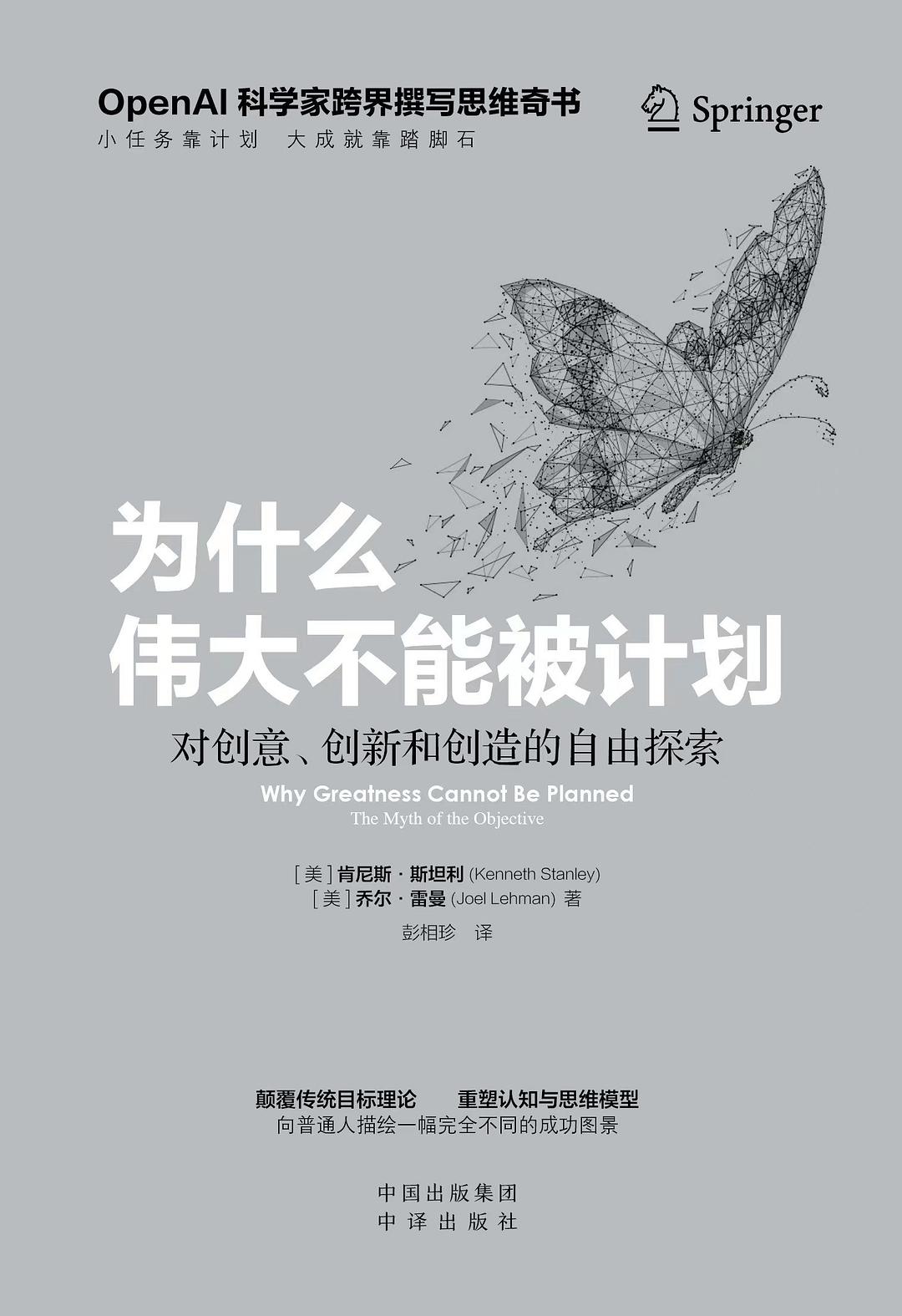
Recently, two scientists from OpenAI published a book called Why Greatness Cannot Be Planned, attempting to argue that great technological innovations are often not the result of prior planning.
In fact, Chinese tradition also has similar wisdom. For example, Daoism says, “do nothing, and yet nothing will remain undone”; Buddhism speaks of “no attachment, no form”; and there is the common saying, “If you set your heart on planting flowers, the flowers may not bloom; but if you casually stick a willow branch in the ground, it may grow into shade.” All of these mean something similar. In short, when you become too fixated on a goal, you may fail to accomplish great things instead; truly great things are often “encountered by chance, not sought.”
However, Why Greatness Cannot Be Planned is by no means simply offering a few lines of motivational soup for the soul. More importantly, first, the authors provide more arguments and examples to show why “planning” backfires; second, their call to give up planning is not a sermon on simply letting things take their course, but rather a clear alternative: if we do not make plans, then what exactly should we do besides relying on luck?
The authors first discuss why “planning” is so deceptive—because in most “small matters,” planning really does work. “Take a manufacturing company that decides to increase capacity by 5 percent: even if it succeeds, very few people would be surprised. Or take a software company that wants to update its product from version 2.0 to 3.0; that too will likely succeed, and there is nothing remarkable about that. Such ‘daily small goals achieved’ make us mistakenly think that setting goals works for almost anything.”
A method that works for small matters is of no use for great ones, and the reason is simple—because the very mechanisms that make planning effective in small matters are precisely what cause planning to fail in great matters. Planning works because many things have ready-made experience to draw on. When we carefully plan something, we can make full use of our predecessors’ successful formulas, and we can deploy tools and methods that have already been used before. The richer these existing resources are, the more precise my prescribed plan can be, and the easier it becomes for me to complete the task step by step.
But the problem is that the more “great” a thing is, the more it breaks out of the existing framework, and the harder it is to use ready-made formulas to achieve it; indeed, whether it is even feasible may be impossible to predict. If I do not know what steps to follow, do not know what tools are available, and even do not know whether the goal itself holds, how could I possibly make an accurate plan in such a situation?
If we insist on making plans for great goals, then those plans will either be completely formalistic, or they will reinforce path dependence on existing patterns to such an extent that they actually hinder us from freeing our minds and finding new paths. Yet the breakthroughs of new paths often emerge in areas that cannot be foreseen in advance.
In short, when we hope for great change or disruptive innovation, it is best not to make plans. But what should we do then? If we do not make plans, do we have no choice but to “fumble around blindly”? That is not the case either. The two authors offer a clear guideline: “Please note, this does not mean that life should be aimless and carried along by the current. The novelty search algorithm does not preset specific goals, but it does have the guidance of values, and that value is novelty and interest. As long as each time you choose the direction that is newer and more interesting, you will not be ordinary.””
The inspiration for the whole book actually comes from an artificial intelligence algorithm they invented themselves, namely the “novelty search” mentioned above. For example, if we want a robot to learn to walk, how should we design the iterative algorithm for deep learning? A traditional approach might be: fine-tune various parameters, choose the one that makes the robot walk farthest, and then continue iterating on that basis, constantly selecting the algorithm that makes the robot walk even farther. After all, the purpose of walking is to move forward as far as possible. But the iterative method designed by the two authors is completely different: they do not choose the branch that walks farthest or most steadily, but instead choose, each time, the branch that is the “most novel” to iterate on. For instance, if the robot falls, but in a never-before-seen posture and takes a spectacular tumble, then this path is regarded as the better branch and is further developed.
The eventual result is that, under the novelty algorithm, the robot learned to walk faster than with traditional training methods, and walked more steadily and farther.
The two authors believe that the novelty algorithm is not only applicable to the field of machine learning in artificial intelligence; it is equally applicable to understanding all sorts of innovative human activities.
As a teacher who has taught the history of science and technology for many years, I very much agree with this point. We can indeed see that, historically, some cultural environments have been more conducive to technological innovation than others, and a reverence for novelty and interest is a common characteristic of the former.
For example, the ancient Greek city-states were the source of Western philosophy and science, and the Greeks were renowned throughout the world precisely for their love of novelty and playful spirit. The Greeks’ love of novelty was so striking that even the apostle Paul, the apostle of Christianity, was astonished by it. He recorded: “All the Athenians and the foreigners who lived there spent their time doing nothing but talking about and listening to the latest ideas.” (Bible, Acts 17:21)
The famous art historian and philosopher of art Hippolyte Taine remarked: “Oh, Greeks! Greeks! You are all children! … Yes, they take life as a game, all the serious things of life as a game; religion and the gods as a game; politics and the state as a game; philosophy and truth as a game.”
Legend has it that Thales, the first philosopher of ancient Greece (and also a mathematician and scientist), was once gazing up at the stars and, not paying attention to the ground beneath his feet, fell into a ditch. A maid standing nearby mocked him: if you cannot even see the ditch under your feet clearly, what use is it to study the stars? The maid’s criticism was in fact valid. From a modern perspective, of course we can say that studying astronomy turned out to be very useful after all, capable of increasing productivity. But the problem is that in ancient Greece, research in philosophy, mathematics, astronomy, and so on was indeed largely of no practical use at the time. The researchers’ main motivation was nothing more than curiosity, or rather, interest—and at most, an added desire to outdo others in argument.
The Greeks’ game of speculation opened up the tradition of mathematical science, a tradition that was not proven “useful” until more than a thousand years later. This lag effect is no accident. Throughout history, all kinds of important science and technology, from their inconspicuous sprouts to the maturation of a sufficiently developed system, often require a very long time. And during that period, new technologies not only fail to provide higher productivity, but even seem like a waste of effort that neglects one’s proper business.
If we return to the eighteenth century on the eve of the Industrial Revolution, we find that all of Europe was suffused with an atmosphere of chasing novelty. Frontier science had not yet been transformed into productivity, but it was already widely popular among the public. For example, the great experimentalist Nollet often toured and performed across European countries. One famous program was this: in front of a Paris monastery, he gathered 200 monks, formed them into a large circle, connected them with iron wire, and then discharged charged Leyden jars. The audience then witnessed the magnificent sight of several hundred normally solemn monks all screaming in unison. The French king Louis XV personally came to watch. There were also many smaller experiments that can still be seen today in the children’s centers of science museums, such as suspending a person in the air and charging them with static electricity, so that their hand could attract and move the pages of a book from a distance… In all kinds of experiments, Nollet carefully prepared exquisite instruments, usually with beautifully painted lacquered surfaces, plus lavish gilt decoration. His experiments were widely imitated and became a fashion. Similar performance traditions remained popular until the nineteenth century. Faraday became fascinated with science after seeing Davy’s demonstrations while working as a bookbinder, and ultimately helped turn electromagnetism into a mature and useful science. Even by Faraday’s time, the electromagnetic rotation device he first invented looked like a completely useless toy, which is why there was Faraday’s famous reply: “What good is a newborn baby?”
Modern people often see only how technological inventions after the Industrial Revolution promoted productivity, and so they always want to plan technological innovation with the aim of promoting productivity. But perhaps the more this happens, the less likely great technological innovation is to occur. The same is true of today’s hot artificial intelligence technologies. Before launching ChatGPT, OpenAI originally got its start from intelligent algorithms for video games; Nvidia, before becoming a necessity for the AI industry, had long relied on and been driven by the gaming industry.
In short, in order to promote innovation, rather than making meticulous plans, it is better to create an atmosphere of innovation. We can see that the public’s enthusiasm for novelty and interest will naturally encourage investors and inventors to keep creating new technological products; on the other hand, scientists’ and inventors’ own pursuit of novelty and interest will also inspire them to break out of convention and open up their horizons.
Translated from the Chinese original with AI assistance. The original text is authoritative.