
Interviewee: Hu Yilin | Draft completed on July 16, 2026
A thought-provoking juxtaposition has recently emerged in European financial regulation: on the one hand, the EU is discussing reducing some banks’ capital and reporting burdens in the name of “competitiveness” and “simplification”; on the other hand, the EU’s Markets in Crypto-Assets Regulation (MiCA) requires issuers of e-money tokens to place the funds they receive under strict safeguarding arrangements, with at least 30% deposited in credit institutions and the rest invested only in safe, low-risk, highly liquid assets; for tokens deemed “significant,” the minimum bank-deposit ratio may even rise to 60%.
At the same time, a £5 million personal gift linked to stablecoin stakeholders in the UK is pushing the question of “who is qualified to influence financial policy” into the spotlight. On July 15, Bank of England Governor Andrew Bailey said that if he had known that the gift Nigel Farage received would come under parliamentary scrutiny, he might have postponed the meeting between the two in September 2025. Farage had opposed a British central bank digital currency at the meeting, and also opposed limiting individuals’ stablecoin holdings; the donor, Christopher Harborne, holds a significant stake in Tether. There is currently no evidence proving that the gift directly caused the Bank of England to change its policy; the controversy first concerns disclosure of interests, rules on lobbying by legislators, and access to public institutions.
Putting these two matters together, the issue is no longer simply whether bank regulation should be loosened or whether crypto lobbying is suspicious, but rather: why is it that whenever old financial institutions complain about regulatory costs, policy language swiftly turns to “innovation” and “competitiveness,” while stablecoins and Bitcoin, which may truly transform the banking system, must often first accept a compliance framework defined by the old financial system? “Europe’s problem is not so much that regulation is too strong as that it is too comprehensive,” Hu Yilin summarizes.
Regulation Should Not Eliminate Risk for Adults
Hu Yilin is not arguing for the abolition of regulation in the financial sphere. What he first asks is where the legitimacy of regulation comes from. “In fact, regulation should not be for the purpose of ‘preventing the public from encountering risk.’” In his view, the mere existence of risk is not enough to prove the necessity of government intervention.
In his distinctions, investing, starting a business, and trading can all fail. As long as participants are aware of the risks, act voluntarily, and the losses are borne mainly by the contractual parties themselves, regulation should not deprive ordinary people of the right to participate in the name of “protecting the public.” “If the public speculates in Bitcoin and goes bankrupt, that is a risk, but if it’s all voluntary, there’s no need to restrict it.” If high-risk investments are opened only to large capital and professional institutions, then so-called protection will instead solidify inequality of opportunity: those with less wealth are shut out of high-yield opportunities, while financial giants continue to enjoy the right to try and fail.
What truly requires regulation is when risk crosses the boundary of voluntary contracts and spreads to people who did not consent to bear it, or when market participants cannot make genuine choices because key information has been concealed. Hu Yilin uses smoking in public places as an analogy: after being informed and buying cigarettes on one’s own, accepting the consequences is, in principle, an exercise of freedom; but secondhand smoke causes harm to those unwilling to participate, and then public regulation has a reason to intervene. The same is true in finance: anti-fraud measures, mandatory disclosure, verification of the authenticity of assets, segregation of client assets, and restraints on spillover risks such as contamination, contagion, runs, and payment interruptions all have positive significance.
Banks need more regulation than ordinary start-up projects not only because banks may fail, but because many banks have already become social infrastructure. Individuals and businesses can hardly completely exit the payment, settlement, credit, and deposit systems, and bank failures can also transmit losses to countless third parties who never directly signed a contract. The intensity of regulation should therefore depend on the spillover nature of the risk, its infrastructural role, and the degree of information asymmetry, rather than in any blanket way on how “dangerous” an industry looks.
How “Too Comprehensive” Regulation Turns Compliance into a Moat
In policy discussions, “strict regulation” and “relaxed regulation” are often treated as two directions on a single line. But Hu Yilin believes that the more crucial question is how regulatory costs are distributed within an industry. “Within the same industry, the big players are often better able to adapt to regulation, while small and micro enterprises and new start-ups, even if they are simply subject to the same regulatory rules, are often in a weaker position.”
Audits, legal work, license applications, data reporting, and dedicated compliance teams often involve substantial fixed costs. For a bank with huge assets, these expenses may account for only a small portion of operating costs; for a start-up that has not yet generated revenue, the same compliance checklist may be enough to exhaust its capital. Formal “equal treatment,” therefore, can create substantive inequality.
A more hidden scenario is this: new institutions are tightly restricted during the start-up phase, and only after a few survivors or established giants have already occupied the market does regulation loosen in the name of “improving competitiveness.” At that point, deregulation does not reopen competition; instead, it gives even greater room to institutions that already have scale, licenses, and proximity to policy. Regulation first helps the market concentrate, and then deregulation helps the existing structure expand; these two seemingly opposite policies may together produce the result that “the strong get stronger.”
Hu Yilin advocates tying regulation to scale, spillover scope, and infrastructural status. In the early stages of a venture, if the product is only aimed at a small number of informed, voluntary investors and early users, and the losses from failure can be contained, then low-cost experimentation should be allowed; as the number of users, payment uses, and social dependence rise, audit, liquidity, stress-test, and orderly-resolution requirements should then be increased step by step. MiCA itself distinguishes between the 30% bank-deposit requirement for ordinary e-money tokens and the higher standard for significant tokens, but his criticism is that even at the lowest tier, new institutions still have to enter the e-money institution, bank custody, and full compliance system very early, leaving very limited institutional space for small-scale trial and error.
Why Stablecoins Are Required to Hand Their Reserves Back to Banks
There is a technical issue that is easily conflated in the discussion surrounding Tether CEO Paolo Ardoino’s criticism of MiCA. The minimum reserve requirement for banks in the euro area is calculated at 1% of certain short-term liabilities; since March 2020, the U.S. Federal Reserve has lowered the statutory reserve ratio to 0. Here, “reserve ratio” refers only to the minimum amount a bank must place in an account at the central bank; it does not mean that a bank supports all deposits with only 1% or 0% of assets. Banks are also constrained by capital adequacy ratios, liquidity requirements, deposit insurance, and resolution mechanisms.
But this terminological distinction does not erase the institutional contrast. Commercial banks are allowed to engage in maturity transformation and credit creation, and they enjoy a public safety net composed of the central bank, deposit insurance, and crisis-resolution mechanisms; stablecoin issuers, which originally support token liabilities with highly liquid reserve assets, are then required to place a substantial portion of those reserves back into banks that will use deposits for lending activities. On this basis, Ardoino argues that forcing bank deposits does not isolate risk; instead, it reconnects the redemption risk of new finance to the old banking system.
“I’ve never liked the stablecoin industry,” Hu Yilin emphasizes. Criticizing MiCA does not mean offering unconditional defense of Tether. Tether still faces questions about the composition of its reserves, disclosure of custodians, segregation of assets, and full audits. In November 2025, S&P Global Ratings downgraded USDT’s stability assessment to “weak,” citing a rising share of high-risk assets and insufficient transparency; Tether, by contrast, said in its Q1 2026 attestation report that its assets continued to exceed its liabilities, that its reserves were mainly made up of highly liquid assets such as short-term U.S. Treasury bonds, and that it had initiated its first full independent financial statement audit in 2026.
In Hu Yilin’s view, any assessment of Tether must first clarify the benchmark for comparison. If one compares it with commercial banks that operate with fractional reserves, maturity transformation, and credit expansion, then its reserve structure is not particularly radical; if one regards it as an emerging public payment infrastructure, then higher requirements for auditing, disclosure of information, and orderly liquidation are justified. The industry standard is not yet fully settled, and there are not many competitors either. Tether’s long-term redemption record and users’ choices are themselves part of the formation of that standard, but they cannot substitute for the institutional responsibilities required of public infrastructure. “Only when stablecoins truly become some kind of widely used infrastructure do they deserve stronger regulation.”
The controversy lies precisely in when this threshold has been crossed. The EU tends to intervene early on the basis of issuance scale, user numbers, and cross-border use; Hu Yilin, by contrast, requires each regulatory obligation to correspond to identifiable spillover risks, rather than simply transplanting the banking system wholesale onto a product because it challenges banks.
One Should Not Focus Only on the £5 Million in Crypto Money
The relationship between Farage and Harborne certainly deserves investigation. After an individual receives a large gift and then approaches the central bank about financial policy that may affect the donor’s interests, the public has the right to know the interest relationship, the content of the meeting, and the basis for any policy changes. But if scrutiny of conflicts of interest becomes suddenly strict only when emerging industries enter the policy arena, that too will create structural bias.
A 2026 analysis based on self-reported data from the EU Transparency Register shows that only 173 companies and industry associations with annual lobbying budgets of more than €1 million spend nearly €382 million a year on lobbying in Brussels, and the banking and financial sectors are among the dominant industries. These figures are institutionalized lobbying budgets and are not equivalent to direct donations to politicians; but legal teams, industry associations, think-tank funding, ongoing meetings, and suggestions on policy texts likewise constitute access power. A single conspicuous £5 million gift will trigger an outcry, while the long-term, dispersed, and specialized influence of traditional finance is easily taken as the everyday background of policy formation.
Hu Yilin does not therefore advocate abolishing scrutiny of political donations. He believes that transparency and access are both indispensable: one must disclose the source of money and the actual beneficial relationship, and at the same time allow participants of different scales and positions to have channels into policy discussion. In this sense, he believes that “using crypto for political donations is actually a very good direction, because blockchain itself is open and transparent, and opens up channels to all the public.”
The premise for this idea to work is that on-chain addresses can be tied to the real donor, the ultimate beneficial owner, and the legally declared identity. Public blockchains can improve the traceability of fund flows, but they do not automatically eliminate anonymous intermediaries, off-chain agreements, or unequal policy access. A more complete system would also require public disclosure of major interests, records of meetings with regulators, policy texts submitted by industry, and recusal decisions. Technology can make the path of money clearer, but it cannot replace democracy’s question of “who gets to see the decision-makers?”
Regulatory Power Must Carry a Backstop Responsibility
Finally, Hu Yilin pushes the issue toward another side of regulation that is often overlooked: the government is not only allocating power, but also manufacturing trust. Licenses, reviews, and ongoing supervision send the public a signal that this field has been placed under state oversight. He stresses: “Once the government strengthens regulation, power and responsibility must be commensurate, which means the government must also be responsible for this field and provide a backstop for the risks. It cannot be the case that the government only regulates, and then is not responsible when something goes wrong.” If regulators, in the name of protecting the public, restrict access and decide who may operate, but after systemic failure retreat entirely to “you bear your own risk,” then power and responsibility are no longer symmetrical.
Here, “backstop” does not mean guaranteeing that any investment will never lose money. A more reasonable meaning is this: when the state brings a certain kind of institution into a licensing system and allows it to become infrastructure on which the public must rely, it should establish deposit protection, orderly liquidation, client-asset return, and crisis-resolution mechanisms that match the regulatory commitment. Conversely, in a clearly marked high-risk test zone where participation is voluntary and losses will not spill over, the government can reduce prior approval while clearly stating that no fiscal bailout will be provided.
This also places a higher demand on the “regulatory sandbox” than merely easing procedures: it should allow innovation to fail, but not allow failure to be shifted onto non-participants; it should allow the public to take risks voluntarily, but not use opacity of information to fake voluntariness; it should allow the government to strengthen regulation, but not let it enjoy decision-making power while refusing to bear institutional consequences.
Who, in Fact, Is Really Blocking Innovation
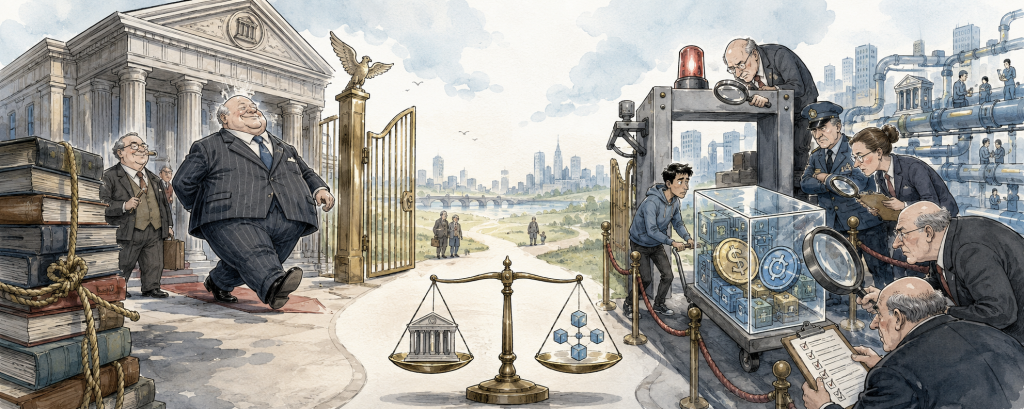
European banking deregulation and strict stablecoin regulation are happening at the same time, revealing the selective use of the word “innovation” in policy. When traditional banks ask for lower capital and reporting burdens, innovation is often understood as giving existing institutions more room to operate; when stablecoins seek to change the structure of payments and store of value, innovation is first understood as a risk that must be folded into the old system. Good regulation should not automatically become lenient simply because a technology is new, nor should it trust institutions simply because they are old. It needs to keep asking: will losses spread to people who did not consent? Is key information being monopolized? Can participants exit? Has the institution become social infrastructure? Has the government, by regulating, created a form of trust that should instead be borne by itself? From this perspective, true fairness is not making every institution fill out the same interminable compliance checklist, but making the same public risks bear the same responsibilities, while privately assumed voluntary risks remain matters of voluntary choice. Europe’s problem is not merely that there are too many rules, but that the rules cover the germinal stage of innovation too early and too completely, yet once the established giants have taken shape, they search for flexibility for them in the name of competitiveness.About the interviewee
Hu Yilin holds a PhD from the Department of Philosophy at Peking University, and formerly served as an associate professor in the Department of the History of Science at Tsinghua University; he is now an independent scholar. His research areas include the history of technology, philosophy of technology, and the humanistic significance of new technologies such as blockchain, artificial intelligence, and biotechnology.
Sources and fact-checking
Translated from the Chinese original with AI assistance. The original text is authoritative.