
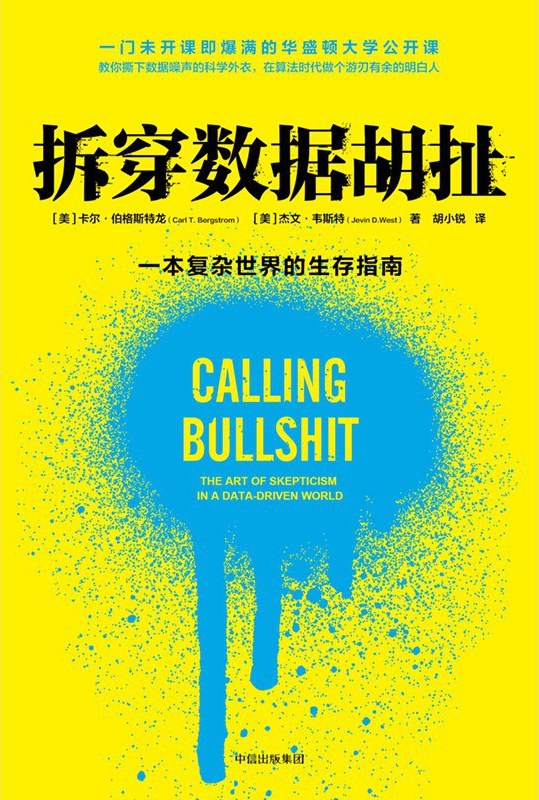
In the past I always wrote book reviews for newspapers; this time, for the first time, I was invited to write a recommendation foreword, which can be found in CITIC Publishing Group’s newly released Debunking Data Bullshit. Since it’s a recommendation and a bit of promotion, I suppose it can also be reposted here.
One thing needs to be explained: when I received the advance copy, the tentative Chinese title was The Signal and the Noise of Science; by the time it was officially published, it had been changed to the current Debunking Data Bullshit. So when I wrote the recommendation, I started from the translated title, and the part teasing the book’s name was trimmed somewhat in publication.
What the book discusses is not only “data bullshit.” Using data as packaging is merely one guise of “science”; in general, the book is aimed at “(apparently) scientific bullshit.” And the original English title itself is also bullshit. So the title of my piece, “Scientifically Fighting the Bullshit of Scientific Bullshit Bullshit,” is a play on the book’s title and theme.
The full text is as follows
The original English title of this book is Calling Bullshit, which means bullshit; but the Chinese title of the translated edition became The Signal and the Noise of Science. This translation itself is a kind of “bullshit”: it does not really fit the content of the book (in fact, the word “noise” hardly appears in the main text at all, and the few times it does appear, it is not discussed as the overarching theme of the book), but is merely a “seemingly scientific embellishment” to mask the bullshit.
What is marvelous is that this stiff, awkward “packaging” happens to point straight to the book’s theme: what the book discusses is not ordinary “empty talk” or “lies,” but rather the things used to package lies, especially those packaging devices that look “scientific” — what the authors call “modern bullshit.”
Old-school bullshit belongs to the “humanities”: it relies on florid rhetoric and ornate diction, whereas modern bullshit belongs to the “sciences,” and “uses the language of mathematics, science, and statistics to create an impression of rigor and precision. It uses numbers, statistics, and data visualizations to dress up dubious claims and give them a veneer of reasonableness.” (Preface, p. 6)
Right from the beginning, the authors tell us that bullshit is everywhere. From mantis shrimp to human beings, wherever there is “communication,” there is deception. Unfortunately, human beings possess more complex cognitive abilities and linguistic systems (p. 7), so human beings are capable of producing a richer supply of bullshit.
In the novel The Three-Body Problem, there is a plot point in which the Trisolarans decipher human language in a matter of seconds, but they cannot understand deception and concealment. In my view, that setup is itself bullshit. Regardless of what the Trisolarans’ language is like, at least as far as my understanding of Earth languages goes, deception and concealment are simply essential elements of any language.
In Sapiens, Yuval Harari argues that what sets Homo sapiens apart is the ability to “tell stories” — to put it bluntly, the ability to “make things up.” The birth of language itself was a double-edged sword: it strengthened human beings’ ability both to convey information and to fabricate information. It is hard to imagine that an intelligent species with a language system and free will (and thus the arbitrary freedom to choose how to use language) would not understand bullshit, no matter what species it is or what technological level it has reached.
The advancement of technology does not automatically eliminate bullshit; on the contrary, “technology has not eliminated the problem of bullshit, but has made it worse” (p. 19). Scientific research is no help either: on the one hand, many scientists themselves are knowingly or unknowingly producing bullshit; on the other hand, all kinds of deception and rumors can also seize the packaging of science to reinforce their spread. Data and charts are even more useful than ornate diction, and can give bullshit wings.
In the first chapter, the authors summarize several “principles” to explain the proliferation of bullshit: “(1) It takes less work to produce bullshit than to clean it up; (2) It takes less intelligence to produce bullshit than to clean it up; (3) Bullshit spreads faster than cleanup.” Science, technology, data, charts, and so on are all double-edged swords: they can aid in clearing away bullshit, but they can also aid in producing and disseminating bullshit; and with the same level of technology, it is often easier to use it to intensify bullshit than to eliminate it.
So we cannot pin our hopes on technology; instead, we have to sharpen our own judgment, as the book’s subtitle puts it: “A skeptical eye on the data-driven world.” Learning how to identify and resist bullshit is the main content of this book. And in identifying bullshit, the key is to strip away the outer layer that makes it seem real and substantial — that is, the various apparently scientific claims, the seemingly rigorous data, and the supposedly clear charts.
In short, this book provides us with “popular science,” including statistics and psychology, to help us identify those seemingly reliable “scientific bullshit.”
But this “scientifically fighting scientific bullshit” itself may also be a kind of “bullshit.” As the book’s title and the authors’ occasional self-mockery suggest, what the authors provide may themselves contain quite a lot of “bullshit.”
Do the methods offered in this book really work? On the one hand, even top scientists and the editors of top scientific journals can hardly be said to have X-ray vision (p. 238 mentions the phenomenon that many classic experiments are difficult to reproduce); how much discriminating power can we ordinary readers gain from having read a few popular science books? On the other hand, some of the “techniques” for identifying bullshit may themselves be double-edged swords. For example, the first technique the authors mention is “question the source,” arguing that one should investigate more carefully where the source comes from and what its motives are, and think about what they are trying to “sell.” But the same “motive theory” is also often used by the public to resist reliable information — for instance, people who claim that cell tower radiation is harmless must be trying to sell cell towers; people who claim the epidemic is serious must be trying to sell vaccines… A “skeptical eye” toward the “sellers” may both hinder the spread of rumors and also hinder the clarification of rumors.
Finally, the authors offer a maxim, teaching people to “think more, share less” when using social media. But can this advice really have a good effect? Because people who have patiently finished the whole book should, in some sense, be better than average at spotting bullshit; yet if they become more cautious and share less, the result may be that the masses, who are neither cautious nor able to discriminate, continue to forward large amounts of bullshit, while voices with judgment become fewer and fewer?
Perhaps the last chapter is where the truly important thing lies: “refuting bullshit.” The authors encourage us that when we have recognized bullshit, we should not remain silent, but can stand up and refute it boldly (of course, in an appropriate manner).
Of course, whether or not we can change the world, in this world full of bullshit, we should at least learn to cultivate ourselves properly; this book can serve as a survival guide to the world of bullshit.
Translated from the Chinese original with AI assistance. The original text is authoritative.