
This article was published in the April 2021 issue of Book City Magazine. It was a review from last year, but I forgot to repost it then. Since the magazine allows me to republish my own articles on my blog, I might as well put it here too.
Making Science—An Over-the-Syllabus Title
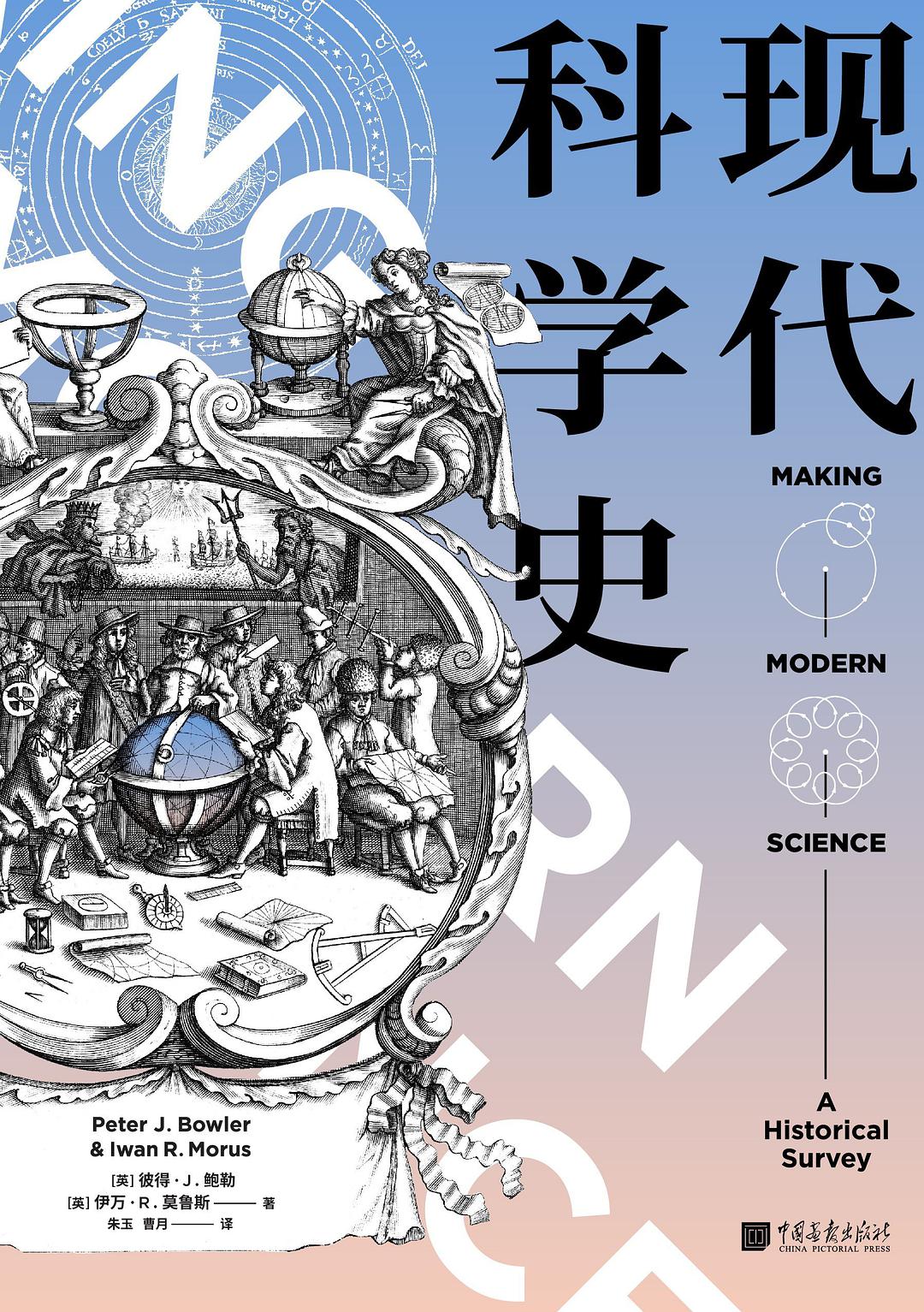
When Chinese publishers introduce foreign academic works, they often have the habit of changing the title. For example, A Short History of Modern Science: From the Steam Engine to Grebe Courtship, published by the Electronics Industry Press in 2018, had the original title “The Making of Modern Science: The Making of Modern Science: Science, Technology, Medicine and Modernity: 1789 – 1914”; and Modern Science History, published by China Pictorial Publishing House in 2020, was originally titled “Making Modern Science: A Historical Survey.”
Both books were first published at the beginning of this century, in 2009 and 2005 respectively. Their original authors both happened to use the word Making, and their translators likewise both happened to drop that word.
I can fully understand the translators’ approach. After all, publishing academic books is not easy these days, especially relatively serious, specialized books; sometimes the copyright fee cannot even be recouped. In order to expand sales and attract more general readers, it is harmless enough to tweak the title a bit, so long as the original meaning is not distorted.
However, in order to grab attention, the usual “clickbait” tactic is to change it into an exaggerated, even sensational title. For example, Kevin Kelly’s famous Out of Control has the English subtitle “The New Biology of Machines, Social Systems, and the Economic World,” which, as the title suggests, uses the ideas of biology (evolution) to understand technology and society. But the Chinese subtitle became “The Final Destiny and End of All Humanity,” instantly giving it a more “mystical prophet” vibe, as if it had turned into a book of apocalyptic prophecy.
But these two books on the history of science go against the grain; instead of sensationalizing, they make the titles plain and unremarkable. Why is that? I think that although the word Making is distinctive, when it is used to modify “science,” it points to a field completely unfamiliar to Chinese readers. The word is too “beyond the syllabus,” so much so that it cannot arouse curiosity or shock; instead, it only makes the public feel “baffled” — what on earth does “making modern science” mean? Is it talking about modern manufacturing?
Only those who know the relevant academic background can easily understand what Making means. It reflects the rise of Western sociology of science since the end of the last century and its influence on the history of science, especially the debates that became a scholarly hot topic around 2000 after the science wars sparked by Sokal in 1996. So it is easy to understand why these two history-of-science books written at the beginning of this century both use the word Making: it is a response to the relevant controversies, and it states the author’s basic position right from the start.
The so-called “science wars” took place between some scientists and sociologists. Leaving aside the emotional, ad hominem, and other ugly parts, the core dispute was actually this: who has the right to interpret science? Scientists or sociologists?
Independent Historians of Science—Dispelling Myths
The introduction to Modern Science History immediately points its spear at “scientists.” The author notes that from the perspective of traditional scientists, the course of science is nothing more than the history of the discovery of scientific facts and the struggle to eliminate superstition, whereas historians of science are to dismantle the various “myths” that scientists have organized in overly simplified ways. (See Modern Science History, pp. 6–7; this article mainly discusses this book, and the page numbers given here are from the Chinese translation, as below.)
The study of the history of science as a way of dispelling “myths” began as early as the first half of the twentieth century. Thanks to the efforts of pioneers such as Sarton and Koyré, the history of science gradually became an independent discipline, researched and written by professional historians of science rather than being confined to the introductory sections of textbooks for each science. “The traditional stories told in the introductory sections of science textbooks about the past are unquestionably a kind of Whiggism” (p. 7). The “Whiggism” criticized by professional historians of science is the practice of taking the existing achievements of modern science, as embodied in textbooks, as the sole criterion for selecting history; a historical overview of science then amounts to nothing more than appending the discoverer and date of discovery to every law or fact in today’s textbooks.
Independent historians of science who stepped out of the “textbook” adopted different historiographical strategies. For example, in the first half of the twentieth century, the idealist (ideational) history of science represented by Koyré was in head-to-head opposition to the Marxist history of science represented by Bernal. These two lines are sometimes called “internal history” and “external history”: the former pays more attention to the internal logic by which scientific ideas unfold and are generated, while the latter emphasizes the “external” driving forces of scientific development, such as the economic base and the political environment.
By the 1960s and 1970s, with the publication of Kuhn’s The Structure of Scientific Revolutions and the rise of the sociology of scientific knowledge represented by the Edinburgh School, sociological methods and positions gradually became the mainstream among historians of science, which is also the main inclination of the author of this book. I will return to the features of this historiographical strategy later; first, we should note that the various historiographical strategies mentioned above are not necessarily mutually exclusive. Although these schools sometimes seem to be at loggerheads, if we take a more generous view, we can also understand them as different “perspectives” or different “starting points” of historical narrative; or, to put it more bluntly, they reflect the different disciplinary backgrounds of historians of science. The ideational school represented by Koyré has a deep philosophical background; Marxist historians of science emphasize political economy; the Edinburgh School introduced sociology and anthropology. The differences among the various historiographical schools in the history of science are like the differences among philosophy, political science, sociology, and other disciplines: although each has its own characteristics and vivid distinctions, they are not necessarily mutually contradictory and can be complementary.
Whichever historiographical strategy one adopts, it is basically premised on being “anti-Whiggish.” Historians of science in different schools reveal the complex face of the history of science from different sides, breaking down the linear view of progress that sees scientific development as the overcoming of ignorance or the accumulation of facts. This “complex view of history” is also what the author of this book emphasizes first and foremost. They say: “What we hope you can learn from this book is that history is not just a list of names and dates; it is also something people argue about.” (p. 9)
Presenting Debate—Relative, Not Nihilistic
The author of this book indeed follows through on that claim. Throughout the book, the author is always trying to present “debates” rather than simply provide objective facts. This way of writing is actually very unfriendly to outsiders, especially to readers who think of history as a subject for “memorizing key points.” For them, this book will very likely be dizzying. The author often first presents a mainstream account, then dismantles it, and finally re-establishes it in another way, while occasionally interspersing objections… Impatient readers may already be cursing: just tell us what’s right and what’s wrong! Yet after reading to the end, one often still cannot make out what the author’s conclusion is.
For example, when discussing the relationship between science and technology, the author concludes: “The debate over natural science and technology, and over the relationship between the two, has still not stopped. Looking back at history, we can know that there is no so-called correct or incorrect answer to this debate. In different eras, different people will view the connection between science and technology from various angles.” (p. 492) For instance, scientists who hope the state will provide funding to support science will be more willing to emphasize the linkage between science and technology, whereas those who hope scientists can enjoy a freer and purer research environment are more inclined to stress the independence of science and its difference from technology.
Or take the “Scientific Revolution” as another example. The author begins by criticizing the traditional view of the Scientific Revolution, pointing out that the Scientific Revolution in that sense does not exist. But later the author once again recognizes the practical significance of the term, and throughout the book repeatedly uses concepts such as the Scientific Revolution, the chemical revolution, the Darwinian revolution, the cosmological revolution, and so on.
So is science closely connected to technology, or are they independent of each other? Does the Scientific Revolution exist, or does it not? Readers who expect to obtain “definitive facts” will find it hard to get what they want, and may even feel as if they are being toyed with.
This way of discussing history, like the Making in the title, is something many Chinese general readers find hard to adapt to. After talking at length, one discovers that both sides seem to have their own reasons—doesn’t that just amount to muddling things together? Not at all. Under the influence of the sociology of knowledge, the history of science has indeed moved toward a certain kind of “relativism,” but this relativism is by no means the historical nihilism of “anything goes.” What this relativism emphasizes precisely is that no conclusion can be viewed in an absolute, isolated way; instead, it must be placed in its corresponding context, and only relative to its topic, its speaker, its evidence, and its argument can it be fully examined. Any proposition whatsoever, such as “A scientific revolution took place in the seventeenth century,” “Lavoisier was great,” “science and technology are inseparable,” or “the law of conservation of energy was discovered by Mayer,” is meaningless if discussed outside its context. We must make clear exactly who is discussing these questions, in what context, and in what sense. Only relative to this entire background of debate do these conclusory propositions become meaningful.
If we do not clarify in what sense we are arguing over a given proposition, then what we have is a situation where each person says their own thing and the duck speaks to the chicken. To make a debate substantive rather than arbitrarily nihilistic, the first step is to examine and reflect on the “relativity” of each side, and to clarify their respective positions.
Facing Practice Head-On—The Real-World Significance of the History of Science
This kind of “relativism” is not only applicable to historians of science; it is also the basic stance of the new generation of historians of science in understanding scientific activity. Some traditional scientists believe that science is a completely objective discipline. Other disciplines can be relative—for example, philosophical views, political orientations, historical narratives, and so on should all take into account the position and context of the person putting them forward—but scientific conclusions have nothing to do with the background of those who propose them; they are objective truth. But this naïve view has long since been exposed by “the history of science.” For science itself has a history: many things once regarded by scientists as truth were later abandoned, while things once denounced by scientists as falsehood were later recognized. Moreover, in any historical period, including today, scientists are never all in complete agreement; all kinds of debates always exist.
This kind of “relativism” merely runs counter to the “myth” fabricated by some scientists, but it does not run counter to the actual development of science; on the contrary. Actual scientists yearn for truth, but they have never mastered it once and for all. A sincere scientist should see themselves only as a seeker of truth, not as a provider of truth.
Therefore historians of science influenced by the sociology of knowledge believe that the conclusions provided by scientists, like the conclusions provided by historians and sociologists, all have their relativity; all need to be discussed in connection with the social environment and historical background of the person who advances them, and do not enjoy the privilege of standing aloof from the world.
This is also precisely the focal point of the “science wars.” The author mentions: “In the science wars, scientists insist that they are experts who provide true information about the world, whereas sociologists insist that no kind of knowledge can possess such a special status.” (p. 19)
Like political activity, economic activity, academic inquiry, and all other forms of human practical activity, in the eyes of the new generation of historians of science, “science” is first and foremost also a form of human “practice.” “Recognizing science as a practical activity” — this is one of the major achievements brought about by introducing the new sociological methods into the history of science (p. 20).
What is the significance of recognizing “practice”? Obviously, “practice” does not mean “fiction,” nor does it mean acting arbitrarily. For example, when we say that the pyramids are the product of human practice and were “made,” we obviously do not mean that the pyramids do not exist, nor do we mean that anyone can use any material anywhere to build a pyramid of any shape whatsoever. Saying that science is “made” does not mean that scientific knowledge is arbitrarily fabricated. Tracing the process by which the pyramids were made can help us understand why the pyramids are so solid and enduring. Likewise, understanding the making of modern science can also help us understand why science is so solid and reliable.
To face up to the practical nature of science and take seriously the humanistic background of science is by no means to pull the rug out from under scientists; on the contrary, it is to place the reliability of science on solid ground, rather than sustaining the superstition that science possesses the truth in an imaginary castle in the air. So the author also notes that their work in history of science will not pose a threat to sincere scientists: “For those trying to defend the integrity and authority of science, anything that helps people understand why new research cannot provide instant answers to every complex problem is a reward, not a threat.” (pp. 24–25) Hypocritical scientists present themselves as possessors of truth; they will denounce divergent views as anti-scientific and see themselves as spokespeople for science, thereby treating historians of science who expose this as a threat. But a sincere scientist presents himself as a seeker of truth, and can face up to the fact that there are always disagreements within the scientific community as well. By tracing the origins of such disagreements, historians of science help people understand their legitimacy, and no longer treat scientists’ limitations and disagreements as embarrassing blemishes; such work will be more conducive to scientists speaking out on various public issues.
The theme of this book is focused on “modern science,” on the one hand because the history of ancient science already has very excellent books— the author strongly recommends Lindberg’s The Beginnings of Western Science (p. 25)—and on the other hand because of the author’s concern with present realities. Ancient science, after all, was still often an activity of reclusive aristocrats amusing themselves, whereas modern science has increasingly become entangled in everyone’s life-world; scientific issues are no longer merely independent intellectual games, but permeate all sorts of political, economic, and cultural issues. The author says: “We live in an era in which the public often finds that scientists must take sides on controversial issues bearing on public health or the environment.” (p. 24)
Under these circumstances, clarifying the origins and development of scientists and their scientific knowledge becomes especially important. Scientists are not priests or ministers, as if they were directly conveying God’s will to the public. What scientists convey has no added sanctity; rather, it takes shape amid complex historical accumulation and social background. Only by stepping down from the “altar” can scientists step onto the “forum,” and, as human beings rather than divine emissaries, clarify their own positions.
Stepping onto the Forum—A History of Science Organized by Theme
So, an important aim of the author in writing this book or offering the course corresponding to it is to guide scientists and the general public to participate more effectively in various public issues, and to position more appropriately the role that scientists and scientific theories play in public controversy.
The book is divided into two parts, and the second part most fully embodies this intention. Following “research themes,” the author discusses issues related to the history of science, such as science and religion, science and the masses, biology and ideology, science and war, science and gender, and so on. These issues are both historical and contemporary.
The first part of the book has a relatively orthodox structure, recounting the development of the Scientific Revolution, the chemical revolution, the science of energy, biology, and other disciplines along the lines of discipline and chronology. The first author, Bowler, is a renowned scholar in the history of biology, so the sections on biology are the richest, while some other disciplines are relatively neglected; in particular, the history of mathematics is scarcely touched upon at all. But the author’s purpose is not to provide a complete and comprehensive narrative of the history of science (the title of the Chinese translation may create a misleading expectation); rather, it is to present controversy and to step onto the forum. From this perspective, the first part is in fact the groundwork and preparation for the second.
What is presented first in the first part are the controversies among historians of science, such as whether there was a Scientific Revolution, whether there was a chemical revolution, and so on. Historians of science want to bring scientists down from the altar, but not to replace them there themselves. Before demonstrating the complexity and divisiveness of science, the author first demonstrates the complexity and divisiveness of the discipline of history of science itself. Then the first part offers some controversial conclusions, which will receive echoes in the second part.
For example, the conclusion reached in the first part when discussing the Scientific Revolution is often cited in the second part. For instance, in the first part, when discussing the meaning of the “Copernican Revolution,” the author argues that “the truly decisive change was not the shift from geocentrism to heliocentrism, but rather … the breaking down of the social boundary between astronomers and natural philosophers, … with more and more members of the public joining in discussions of astronomy and natural philosophy.” (p. 44) Then, in the second part, when discussing the relationship between science and the masses, the author mentions: “In the preceding chapters we saw that an important feature of the so-called Scientific Revolution of the sixteenth and seventeenth centuries was the shift of the center of natural-philosophical activity from the universities to more popular and more genteel settings.” (p. 440) If these foundations were not laid in the first part, and readers still believed that the development of science was reflected only in changes in the ideas of a small number of scientists, then it would be difficult to understand how the public could possibly take the initiative in participating in scientific development.
The echoing relationship between the two parts of this book points to an echoing relationship between historical research and controversies surrounding science-related issues. Historical research itself cannot provide operational solutions to real-world problems, but it can help us prepare intellectually, so that we can more keenly notice the complex entanglements behind many things that seem self-evident on the surface. For example, when we learn about the many historical entanglements between biology and ideology, can we still casually assume that today’s controversies in biology have no ideological background? When we understand that in history the masses once played a positive role in the development of science, can we still casually assume that science needs only top-down indoctrination of the masses? History can hardly offer straightforward guidance for real-world decisions, but it can at least help broaden our horizons and break through many overidealized beliefs or complacent prejudices.
Translated from the Chinese original with AI assistance. The original text is authoritative.