

The summer course series has finally reached the halfway point. After talking about getting up and eating, I’ve now moved into a more vulgar domain: this time, defecation.
1. Cross-section
The scene this time is something everyone knows all too well: going to the toilet.
Why do people go to the toilet? — So-called “three urgent needs” of human beings; excretion can be said to be one of the most basic natural needs of humankind, so there’s no need to say much more. But just like the example of eating breakfast, the ways and concepts of going to the toilet are also historical.
In addition, besides meeting basic needs, going to the toilet also has some incidental meanings. For us, it is often an entire stretch of time for playing on our phones; for the previous generation, it was probably the time for reading the newspaper.
Why is it called “going to the toilet”? Of course, this activity has many names; different civilizations have different names for it, and within the same language there are often also a great many names, such as restroom, bathroom, washroom, the big one, singing, convenience, relieving oneself… Defecation may well be one of the daily activities with the most “aliases.” Going to the toilet is a natural “sensitive word”; this cultural and psychological phenomenon is very interesting, but I won’t explore it in depth here.
Where do we go to the toilet? For me, undoubtedly, it is on the “flush toilet” in the “bathroom” of my own home.
What do we do after going to the toilet? Simple enough: wipe your butt, flush, pull up your pants, and leave.
2. Technical conditions
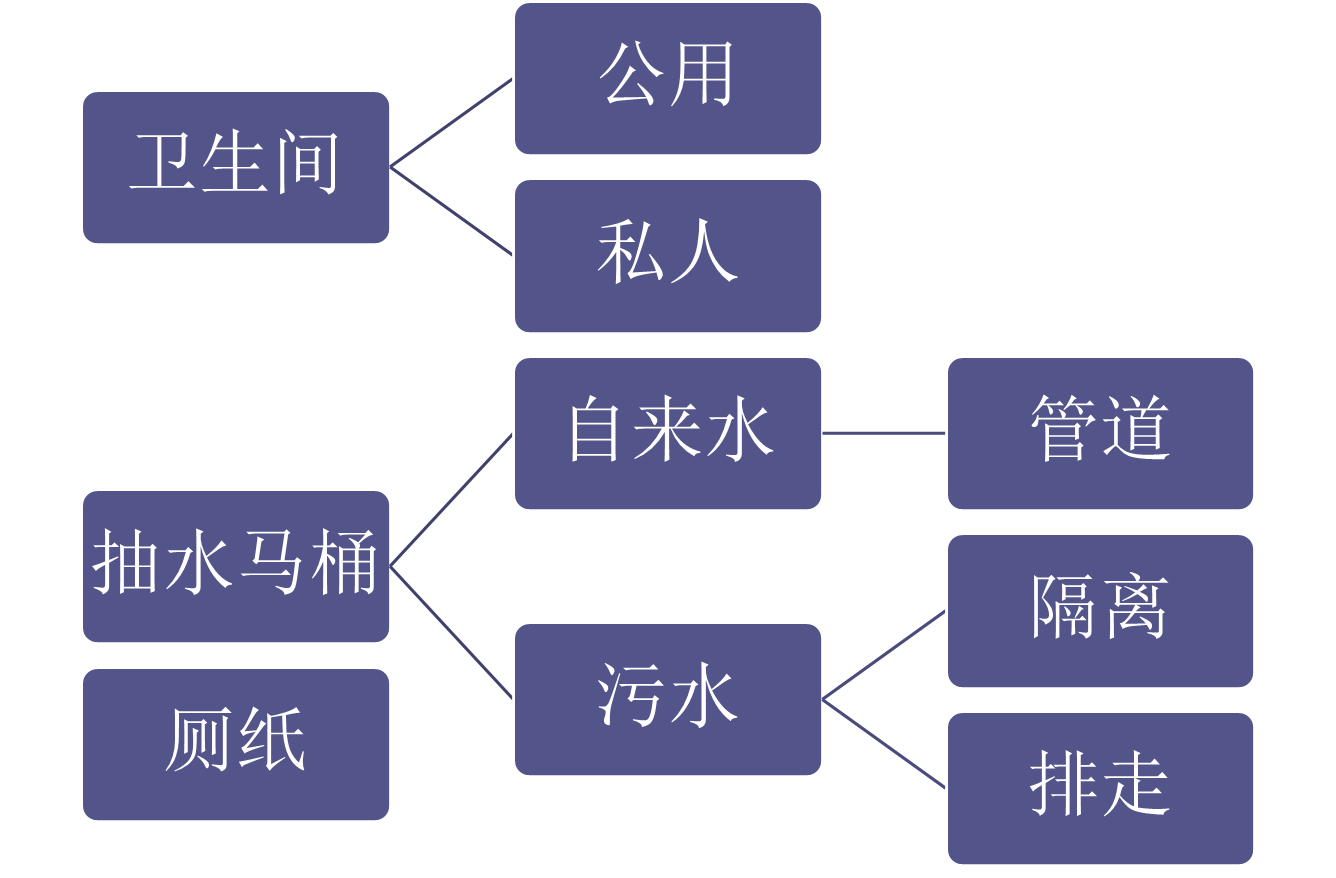
There are quite a few technical conditions involved in the activity of going to the toilet. First there is the bathroom as the venue: a private bathroom is often an essential part of modern housing, while public toilets are an essential public facility of the modern city. But both of these are very modern. For example, the Shanghai lane house where I lived as a child had no bathroom, and in many parts of India today there are still no toilets at all, neither private nor public; men and women in the villages simply defecate directly in the open fields.
The flush toilet is the core technology of the whole bathroom. Whether it is a sit-down toilet or a squat toilet is not important; the key technologies are flushing and drainage. This includes running water and its inlet pipes, as well as sewage discharge technology, including how to carry sewage away and how to isolate us from it so that we cannot smell it.
Finally, there is wiping one’s butt with toilet paper. This was a Chinese contribution to world civilization by the ancient Chinese, but its widespread use is actually quite recent. Our modern way of using paper—for example, needing several tissues just to wipe one’s nose—depends entirely on the industrialization of paper production, something the ancients could hardly have imagined. But I won’t dig into that further here for now.
3. Historical tracing
1. Toilets
A. The pigsty toilet of ancient China

In Chinese, one says “go upstairs to the toilet” and “go downstairs to the kitchen.” Although “up” is grammatically just a function word, historically it may well have had a literal directional meaning. In antiquity, people also said “climb to the east privy” when going to the toilet. Going to the toilet required climbing upward because ancient toilets were indeed often built in elevated places. The image above is a ceramic model from the Han dynasty, depicting a characteristic toilet of ancient China: the pigsty toilet (溷). The toilet is set above the pigsty; excrement falls into the pigsty, mixes with pig manure (and occasionally is eaten by the pigs), and after fermentation becomes fertilizer, which is then periodically shoveled out and used to water the fields.
Pigsty toilets were popular within the East Asian cultural sphere, and could still be found in Japan and Korea as late as the 20th century.
Even if one does not raise pigs, building the toilet in a high place is still a good idea. The reason is simple: people never want to remain in a foul-smelling environment, so the farther the cesspit is from oneself, the better. One way is to defecate in a chamber pot and then have servants carry it away to the cesspit; another way is to squat on the second floor, letting the feces drop to the first floor below, so that at least there is the distance of one floor between you and the cesspit.
B. Ancient Rome and public toilets
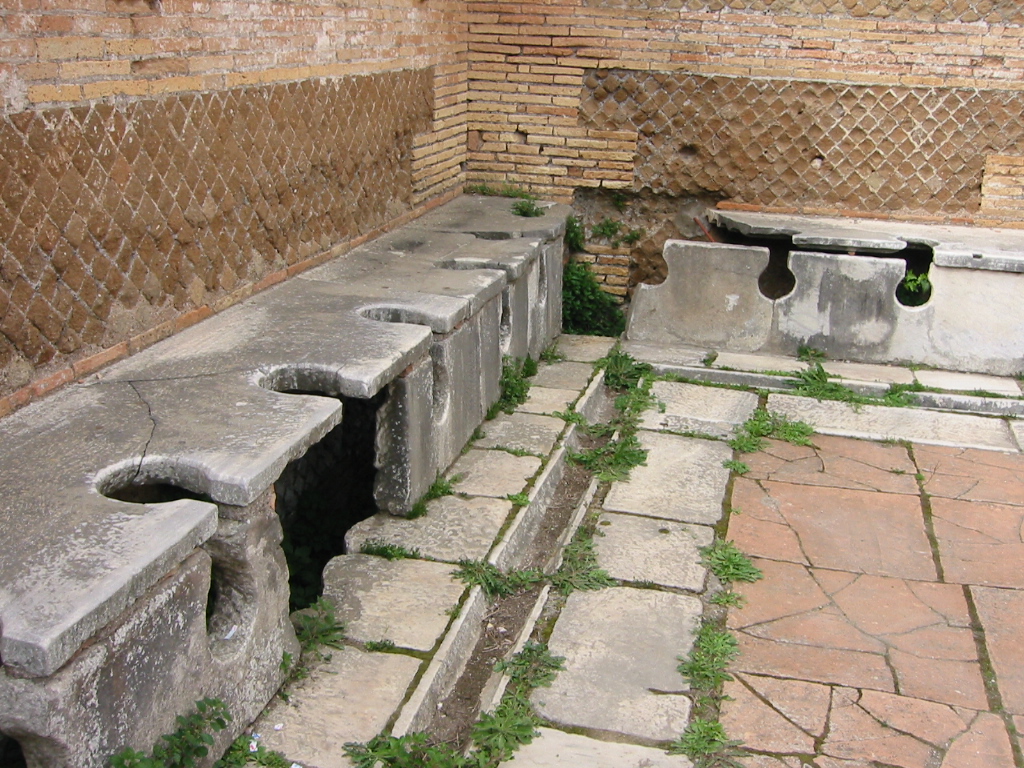
The toilet culture of ancient Greece and ancient Rome was quite different from that of China; their distinctive feature was the public toilet, which became one of the important public social platforms. Of course, public toilets generally belonged to public bathhouses.
The Greeks and Romans attached great importance to public bathhouses. Along with the agora, theaters, and stadiums, bathhouses were indispensable public spaces in the Greek city-state. By the Roman period, thanks to aqueducts and concrete technology, public bathhouses were further greatly enhanced.
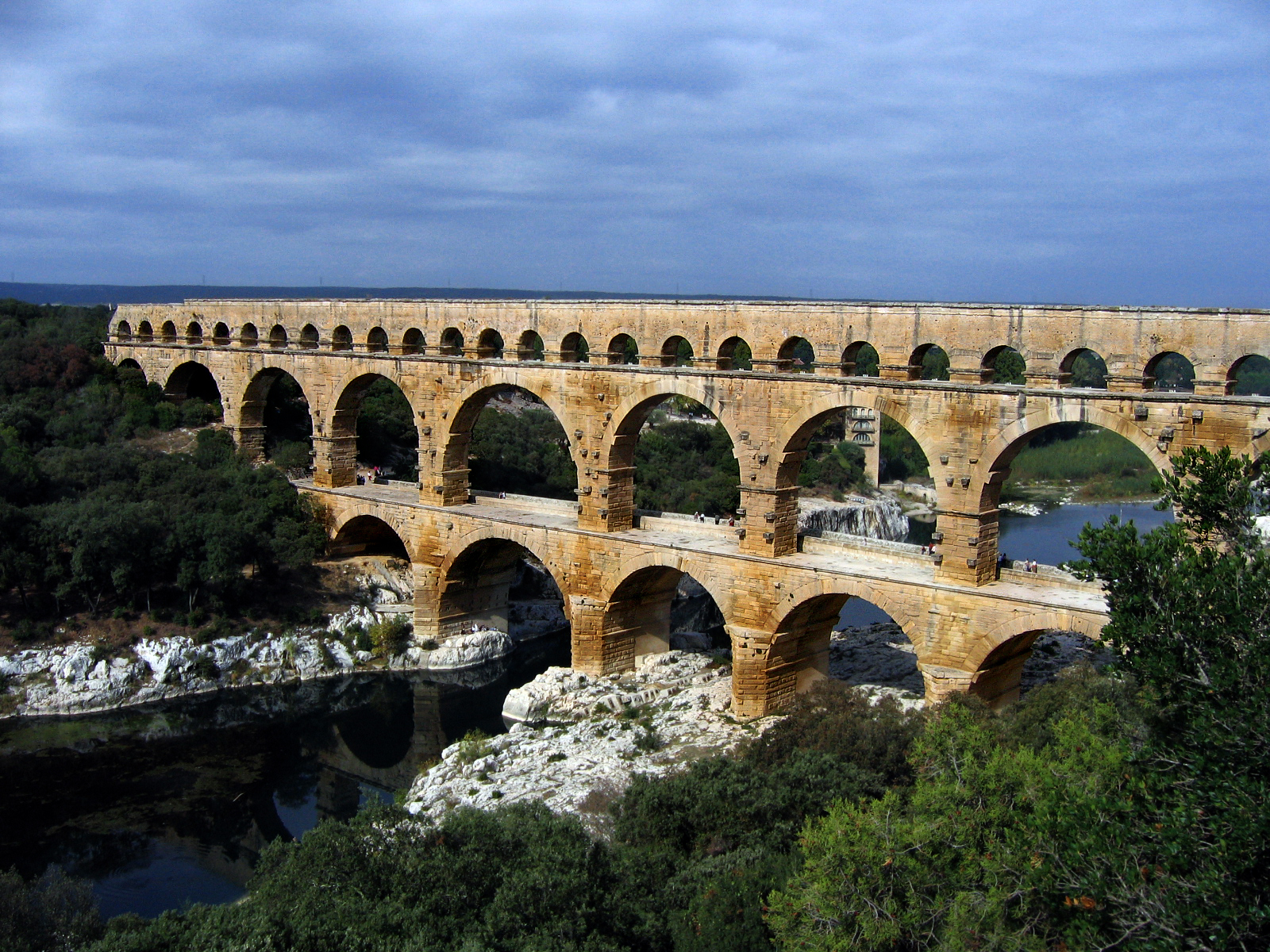
The Romans did not inherit the scientific achievements of the Greeks, but they reached the pinnacle in civil engineering. They used volcanic ash to make concrete, and were skilled at using arch bridge technology to build countless elevated aqueducts, bringing mountain spring water into every city and supplying it to citizens through lead pipes.
In terms of flow, the “tap water” consumed by each Roman was far greater than that of the average modern person. This is because the Romans had no valves and no faucets; water flowed day and night, never still. Residents were charged according to the number of pipes connected to their homes, while more water was diverted into public bathhouses. When water sources were abundant in summer, any remaining water flow was supplied to public fountains; when water was scarce, the fountains were shut off, but bathhouse water was guaranteed priority.
Public toilets were often part of public bathhouses, and they were also grand in scale. During the Roman Empire, the largest bath in Carthage reportedly had 1,600 marble seats in its toilet.
As mentioned earlier, Rome had no valves at all; water flowed day and night, and bathhouses and toilets were no exception. Water conduits were carefully designed; some hot-water pipes passed through walls to create a heating effect, and different rooms provided various bathing styles such as cold, warm, and hot water. They were also usually adjacent to snack shops, brothels, and gyms.
After the fall of the Western Roman Empire, the Church regarded public bathhouses as immoral and decadent. In addition, because many Roman engineering skills were lost, urban life in Latin Western Europe declined, and Rome’s bathhouse culture also fell into decline. But it continued to be transmitted in the Eastern Roman Empire, and what has been handed down to this day has become the “Turkish bath.”
C. The dark Middle Ages
Many studies in the history of science and history of thought have already proved that Europe’s Middle Ages were not so dark, but in terms of toilet culture alone, the Middle Ages were undoubtedly a terrifying era of utter darkness. It was not until after the modern Industrial Revolution that Europeans’ toilet culture gradually improved.
There were no public toilets in medieval Europe, and almost no private toilets either. Noblemen might use chamber pots and have servants empty them, but ordinary people defecated and urinated wherever they pleased and dumped things wherever they pleased. More refined people would relieve themselves on balconies or at the top of stairways.
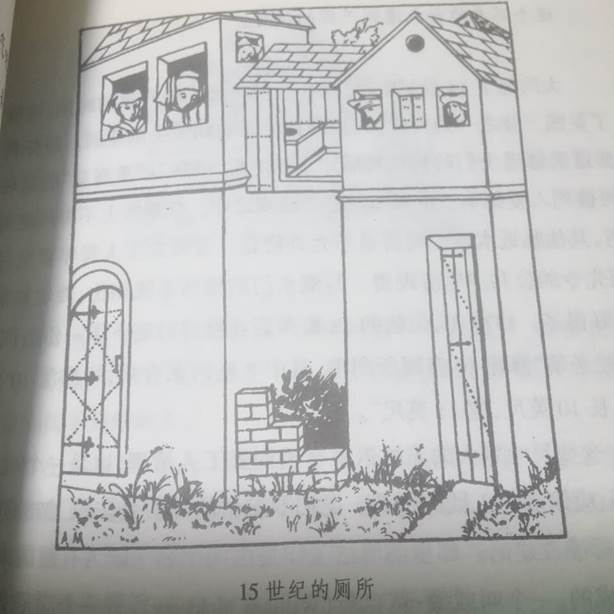
Gradually, some dedicated toilets appeared, called closets, but the handling of excrement remained extremely casual. More refined ordinary households would collect feces in chamber pots and then pour them out the window. At first, this was done anytime and anywhere; by the late Middle Ages and even the early modern period, it became a bit more elegant, and people would generally pour it out at night, shouting “Watch out, water!” to warn unlucky passersby who happened to be walking by at that moment.
Some toilets were built hanging over empty space, with the waste dropping directly to the floor below. There could also be protruding toilets on the side of a castle (for warmth, they were generally built next to the kitchen), with the excrement falling directly into the moat.
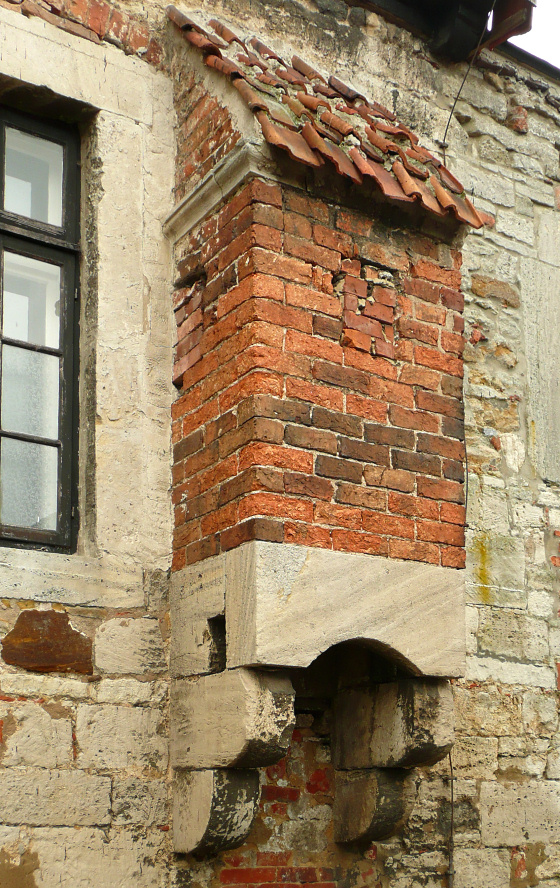
In antiquity, whether a castle or a big city, the “moat” was often a huge dumping ground for garbage. So the reason the moat could defend the city, beyond its physical function, was also that it served as a kind of biological weapon~ China was no exception in this regard. Even today, the boundaries of entire cities are basically surrounded by garbage dumps. Of course, sometimes garbage also weakened city defenses. For example, in the early modern period, Paris once had to raise its walls higher in order to prevent enemy troops from simply marching up to the city wall by stepping on piles of dung.
2. The flush toilet
In the 16th century, Europeans already half-jokingly proposed the idea of the flush toilet. The first truly practical flush toilet was patented in 1775 by the watchmaker Cumming.
The technology of washing waste away with running water has existed since antiquity. The technical contribution of the flush toilet lies, on the one hand, in valve-controlled flushing, and in later improved versions, automatically controlled water tanks; more importantly, it lies in the U-shaped design of the sewer, through which water always remains in the U-shaped pipe so that odors from the sewer cannot come back up, isolating the smell once and for all.
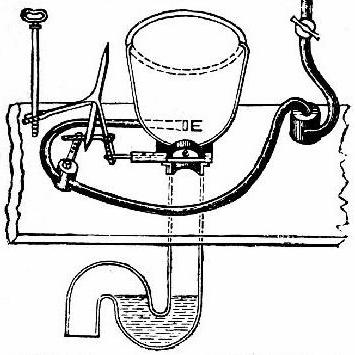

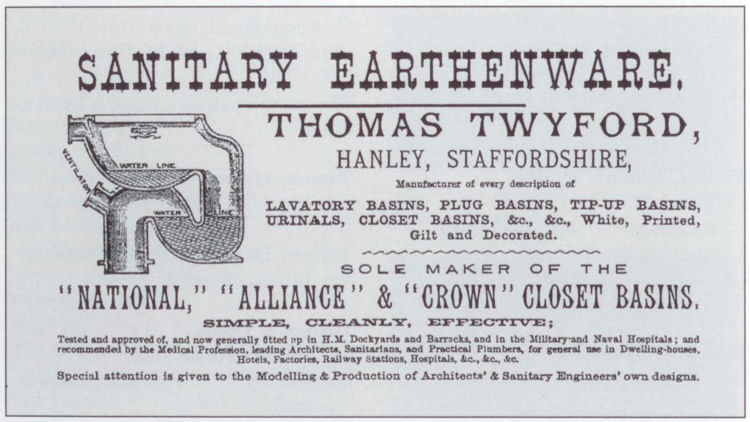
But in the first several decades, the flush toilet did not become popular quickly; it was not until the middle of the 19th century that it became widespread. The marker was the First Great Exhibition of the Industry of All Nations in 1851 (the World Expo), which set up a public toilet at the exhibition site specifically as a display. In total, 827,280 visitors paid one penny to queue up to see it. After the exposition, this exhibit was retained thanks to lobbying by producers and the public’s enthusiasm. With the establishment of more public toilets, the benefits of the flush toilet gradually became known in every household.
3. Drainage systems
At first, flush toilets were not so popular because they required a large amount of water to discharge. Before an advanced public drainage system existed, private estates needed to build larger cesspits to accommodate the daily drainage from flush toilets. Only after an advanced public drainage system was established could flush toilets be accepted by ordinary households.
Even now, the flush toilet is the largest daily domestic water-use item. Statistics show that water use per American resident per day is 68 gallons, including 12.5 for bathing, 15 for the washing machine, 1 for the dishwasher, 18.5 for the flush toilet, and 21 for leaks and others. It is clear that the wastewater produced by the flush toilet is quite considerable.
As the saying goes, “One rat turd spoils a pot of soup.” The flush toilet is a device that uses several pots of soup to flush away one turd, inevitably greatly increasing the volume of waste. So how is feces eventually dealt with?
Rural life can handle waste nearby through pigsties or septic tanks, producing fertilizer, but although these methods are ecological and cyclical, they are extremely slow, occupy a lot of land, and smell terrible; they are impossible to promote in big cities. From ancient times to the present, the method by which big cities solve the problem of feces has always been “to carry it away.”
In 3000 BCE, the Indus Valley civilization at Harappa already had an advanced drainage system: every household had an inlet pipe and a sewage pipe, and the sewage pipes were fed into a huge main conduit large enough for people to walk through, which ultimately discharged into the river.
In ancient large cities there were generally dedicated “street cleaners,” or else, as in India, the task of handling feces was carried out by a special untouchable class outside the four castes. In ancient China, merchants would collect feces, haul it away, and sell it to farmers. A Song-dynasty text records the scene along the rivers near the capital: “There were also boats carrying garbage, manure, and earth, moving away in groups.”
But the countryside was limited after all. As the industrial age became increasingly urbanized and city populations even surpassed rural ones, chemical fertilizers eventually replaced manure, making it impossible for the countryside to process feces in time; so in the end the only option was dumping.
In the early period, it was usually dumped directly into rivers. By the modern era, since both banks of the great rivers were basically lined with big cities, dumping sites were gradually moved farther away. In modern America, for example, people generally looked for a remote deserted island for dumping, or shipped it out to the ocean to dump, and this continued until the second half of the twentieth century. The newest, most “advanced” method is in fact the most primitive one: “dig a pit and bury it.” Of course it still has to go through dehydration and disinfection, but in the end the key is still landfill.
4. The problem of pollution
Whether in ancient or modern times, in China or abroad, once there is a large-city way of life, one must inevitably face the problem of large amounts of waste and garbage being difficult to process in time. Pollution is therefore also something large cities can hardly avoid. For example, the *Book of Sui* records in the biography of Huan Jicai that in the second year of the Kaihuang reign of the Sui dynasty (582), “Han Ying built this city; from then until now it has been nearly eight hundred years, and the waters are all brackish and alkaline, unfit for human habitation.” The reason the ancient capital Chang’an gradually declined in the early modern period has to bear a big share of the blame from environmental pollution.
But the pollution problem did not erupt in a concentrated way until the Industrial Revolution. It was the sharp increase in urban population, together with the sharp increase in garbage and sewage produced by each person.
For example, in the early nineteenth century, London had more than 200,000 large and small cesspits, which flowed into the Thames through rivers hidden beneath the road surface. Thanks to the flush toilet, the streets became cleaner, but more sewage was discharged into the rivers; discharge points were scattered everywhere, and water intakes and discharge points were often separated by only a wall.
The turning point was the “Great Stink” of 1858. At the time, the newspaper *The City Press* reported: “Politeness of language is finished; the Thames has gone foul. Whoever breathes in that stench will never forget it. If he can still live to remember that smell, he may count himself lucky.” The whole city of London was engulfed in the stench. The British Parliament held an emergency session, but halfway through it fled the meeting room because it was too foul… After this event, the plan to build a large-scale drainage system was finally launched.
The large-scale drainage systems of the time initially just carried sewage to places farther from the city center for discharge, and in the end it was still discharged into the river. It was not until the twentieth century that limited harmless treatment was gradually provided, but sewage was still directly dumped into the ocean, and by the late twentieth century the main method had gradually become landfill in wasteland.
IV. Entering the context
Which things that modern people take for granted would have seemed strange to the ancients?
Things like a restroom that does not smell bad, a restroom as a private, personal space; feces being flushed away immediately, disappearing at once from sight… These were strange to people in ancient times.
But the strangeness on the other side is actually this: although modern people make feces recede farther and farther away from themselves, the way feces are ultimately processed is not particularly ingenious.
V. Ancient and modern compared
Modern people’s private living spaces are cleaner, and cities are tidier. But pollution has not disappeared; it has only become more distant and more hidden.
Modern people have stronger biochemical treatment technology, but their way of handling feces is more single-minded: it is just landfilled, no longer recycled.
From the perspective of environmental pollution, the harm of feces may not be so severe, because after all it is naturally degradable. But the problem is that natural degradation requires time and space, and in the modern world we no longer leave nature enough time and space. As a result, even this degradable waste becomes difficult to deal with.
The flush toilet is a temptation that modern civilization makes hard to refuse. Once one gets used to it, it is very hard to return to a pigsty toilet or the environment of the Middle Ages. But the more irreversible a technology is, the more it deserves vigilance, and the more one should always pay attention to the various costs required by this way of life.
Translated from the Chinese original with AI assistance. The original text is authoritative.