Gradually turning my attention to research in the history of technology, the Industrial Revolution is of course a matter of first importance. But just like the Scientific Revolution, this kind of historically crucial period has received very little attention in Chinese scholarship.
The concept of the “Industrial Revolution” is, to be sure, quite a hot topic—mainly in discussions of the so-called Fourth Industrial Revolution, whether present or future. Broadly speaking, the third refers to the information revolution, and the fourth to big data or artificial intelligence. But the real Industrial Revolution, or rather the two Industrial Revolutions, has been studied only very superficially. There are not many translations of Western academic works either. Some of the better ones are mainly from an economic perspective, while studies of the Industrial Revolution from the standpoint of historians of science are truly rare.
I have recently worked on several pieces related to the Industrial Revolution, including lecture notes, academic talks, and scripts for programs, but I still do not have a finished text. Next I should organize them into a popular article and an academic paper. Before that, I will simply sort out one core issue into a short piece here:
I. The Imaginary Kettle

The story of Watt’s “kettle” is a familiar “myth,” one I also heard as a child. There are many versions of this story, but they basically say this: Watt was already full of curiosity as a boy; he noticed how, when a kettle boiled water, the steam lifted the lid, and he began thinking, from which he was inspired by the idea of using steam power.
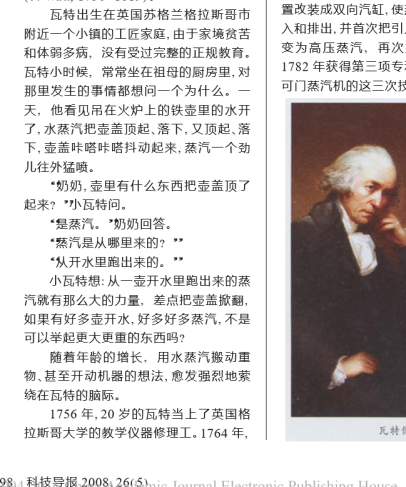
This story is obviously fabricated; it has at least two major loopholes. First, Watt was not the inventor of the steam engine. Similar engines had already been around for decades. Watt did not need to rediscover the power of steam from a kettle; rather, he made minor improvements to the already existing Newcomen steam engine.
Second, neither Watt’s nor Newcomen’s steam engine used the pressure exerted by expanding steam pushing outward; on the contrary, they used the force of steam “pulling back” after condensation—that is, the outside atmospheric pressure did the work because a vacuum was created inside the cylinder. Its principle was completely different from steam lifting a kettle lid.
Like Newton’s apple, Watt’s kettle story is one of many fabricated stories in the history of science. The basic pattern is nothing more than “curiosity—observation—inspiration—discovery,” and what it highlights is the scientist’s extraordinary creative power. Many stories were even fabricated at the outset by the scientists themselves or their relatives, in order to stress their own “priority.” Later generations have indeed, to a greater or lesser extent, been misled by these fabricated stories, overlooking the “shoulders” on which innovation stood, as if those inventions had come directly from an immediate grasp of nature, created out of thin air.
An apple erased Hooke from the history of the discovery of universal gravitation, and a kettle likewise obscured the steam engines of Newcomen and Savery. In fact, whether Newton or Watt, their work was accomplished on the shoulders of their predecessors.
The use of steam power can be traced back as far as Hero of the Hellenistic period, who recorded a device called an “aeolipile,” which used the reactive force of escaping steam to make a hollow copper sphere rotate. Similar devices were later made in the Arab world as well. This is actually closer to the principle of the “kettle lid.” But the steam engines before and after Watt were not developed from Hero’s aeolipile.
At the beginning of the seventeenth century, Torricelli, Boyle, and others had already revealed the power of the “vacuum”; the famous Magdeburg hemispheres experiment also took place during that period. In the seventeenth and eighteenth centuries, science increasingly moved toward the public, and so-called experimental science was initially mainly public performance. The vacuum pump, moreover, was one of the most visually striking instruments. So by the eighteenth century, among the European educated classes, knowledge of atmospheric pressure should already have become common knowledge.
Efforts to use atmospheric pressure in various ways had always existed; the key question was how to create a vacuum. A vacuum pump uses an air pump to create vacuum, which itself consumes mechanical power, so it obviously had little practical meaning to let a vacuum pump then provide power in return. By contrast, the condensation of steam is a much better way to create a vacuum: fill a container with steam and then let it condense, and a vacuum is formed. As for producing the steam, one only needs to burn fuel.
Savery was not the first to make efforts of this kind, to use steam to convert fuel into power. It was just that Savery’s steam pump was the first to be successfully commercialized (patented in 1698), and deployed in coal mines to pump out water. Newcomen’s later steam engine added a piston, producing reciprocating mechanical motion.
Watt’s contribution was neither in how to generate steam, nor in how to use atmospheric pressure to do work, but in how to make steam condense. Watt invented the separate condenser, so that condensation did not need to take place inside the cylinder. Thus the cylinder could remain hot at all times, while the condenser remained cold at all times, greatly reducing wasted energy and improving the efficiency of the Newcomen steam engine by a factor of three to four.
I won’t go into the technical principles in any more detail. To put it simply: Watt’s improvement of the steam engine stood on the shoulders of his predecessors. In theoretical terms, it can be traced back to the discovery of atmospheric pressure; in technical practice, its direct predecessors were Savery and Newcomen. Watt’s innovation was mainly the establishment of the separate condenser.
Therefore, the kettle lid lifted by steam could not, whether in theory or in practice, have been the source of Watt’s steam engine.
II. The Real Kettle
But does that mean Watt’s work had nothing to do with a kettle? Not necessarily.
In fact, the kettle story was not a late invention; it had already circulated as early as the beginning of the nineteenth century. The earliest version was probably relayed by Watt’s son, James Watt Jr. (all three generations of the Watt family were named James Watt—I’m truly speechless), and was said to have been a story told by Watt’s aunt.
Of course, even if this story had been told by Watt himself (like Newton’s apple), that still would not prove it was true. Beyond the question of truth or falsity, what deserves more attention is the variation in the story’s versions as it spread.
When Watt’s son first told the story, he corrected it according to his own understanding[1], believing that what Watt paid attention to was not “the power of steam,” but “the properties of steam.”
According to the research of the historian of science Miller[2], in the early versions of the kettle story, the young Watt was not depicted as observing steam lifting a lid, but as holding a silver spoon near the mouth of the kettle and observing the condensation of steam.
The following two nineteenth-century oil paintings show the two versions of the kettle story:
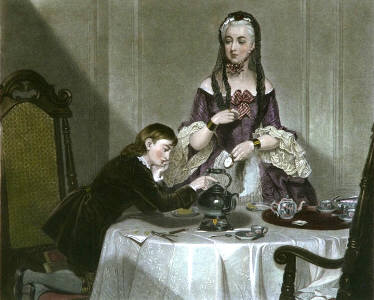

Whatever the truth may be, this condensation version of the story is indeed more reasonable, because this interest does correspond to Watt’s final improvement of the steam engine—the condenser—and at the same time it also fits Watt’s lifelong interests much better.
Miller points out that Watt was never a mechanic (a machinist); in theoretical science, Watt was basically a chemist. Phlogiston chemistry was his enduring research focus, especially the question of the composition of water.
Today we can distinguish chemistry from physics fairly clearly. We classify the three states of water under physics rather than chemistry, but in Watt’s day the boundary was not clear. The vaporization and condensation of water were also seen as reactions of combination or decomposition. In the phlogiston chemistry and caloric theory then in vogue, “heat” was also a substance; the union and separation of heat and water explained the phase changes of water.
Watt had a long-standing interest in water and gases. He published two papers in theoretical science, one on the composition of water and the other discussing “the medicinal value of artificial gases.” The historian of science McLellan认为 that these two papers “were both written in terms of phlogiston chemistry and had no connection whatsoever with his steam technology”[3], but this judgment is clearly far too hasty. In fact, although phlogiston theory was wrong, it may still have offered positive inspiration. We can reasonably imagine that Watt’s long-term interest in phlogiston chemistry led him to pay close attention to the condensation of water vapor, and ultimately enabled him to think of the key step in improving the steam engine—saving heat by improving condensation.
In addition to this aspect of “phlogiston chemistry,” the “kettle” also marks another foundation of Watt’s steam engine, namely “experiment.” As we know, steam engines at that time were enormous. When Watt began his research and design, he could not truly build a real steam engine and then “debug” it; he carried out simulation experiments in the laboratory. And even before Watt’s steam engine was actually put into practical production, Watt already had a firm grasp of how much efficiency it could improve.
In fact, the kettle was precisely the key instrument in Watt’s “chemical” experiments on water. There is evidence proving that Watt indeed used a kettle in his laboratory as a device for generating steam. In the year he improved the steam engine (1765), one page of Watt’s manuscript (below) clearly depicts a small kettle (the surrounding text is roughly talking about how the volume of water vapor changes by about thirty times before and after condensation)
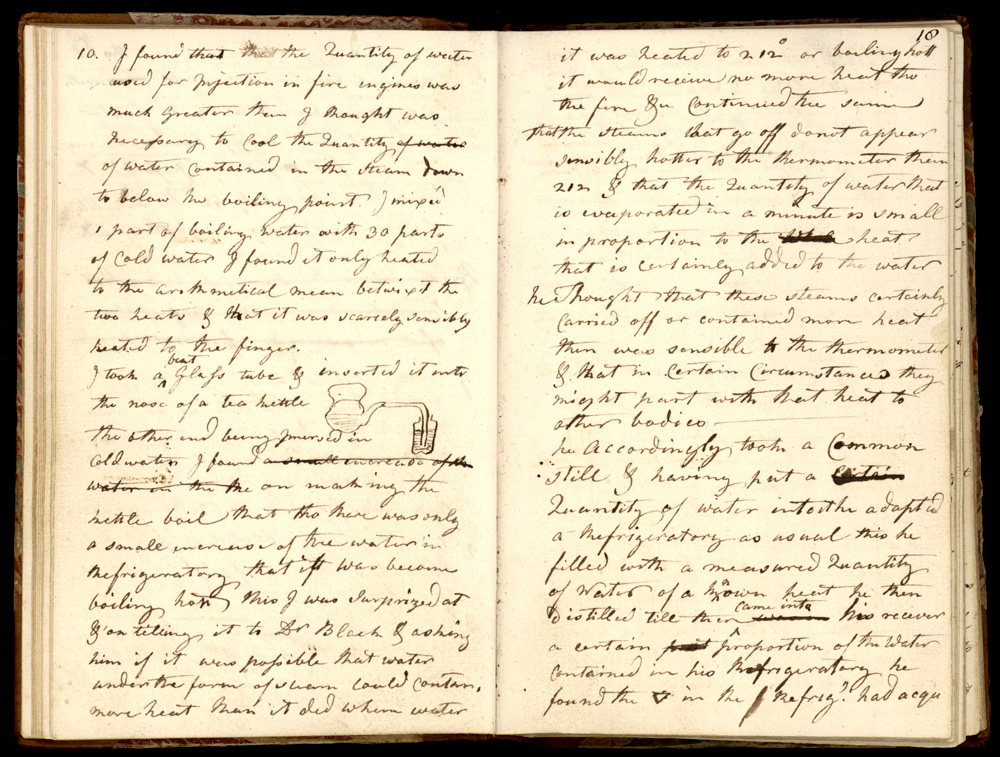
This real kettle did indeed provide inspiration for Watt’s invention of the steam engine, but it had nothing to do with the “lid.”
III. Watt’s Circle of Friends
We have already seen that Watt was not the original inventor of the steam engine; before him there were many steam engines, and alongside him there were in fact many others improving them. But in the end, Watt stood out, and apart from the reasons inherent in the technology itself, this also had to do with Watt’s entrepreneurial mind and entrepreneurial environment.
Watt’s steam engine improved efficiency over Newcomen’s by a factor of four (burning the same amount of coal could pump four times as much water). That efficiency was certainly the highest at the time, but the gap was not so decisive as all that. In fact, there were other improved versions that were also quite good; for example, Smeaton probably increased the efficiency of the Newcomen steam engine to two or even three times.
Watt’s success was inseparable from his “circle of friends.” Before improving the steam engine, Watt opened a workshop at the University of Glasgow (1757), where he worked full-time repairing instruments. At the same time, he maintained contact with many university scholars and formed friendships with them, including the physicist and chemist Black, as well as the famous Adam Smith.
At the University of Glasgow, he also partnered with the architect and businessman John Craig, manufacturing and selling various goods such as musical instruments and toys. This partnership lasted six years. After improving the steam engine, he successively cooperated with Roebuck and Boulton. His cooperation with Craig was unremarkable; his cooperation with Roebuck ended in failure; only his eventual cooperation with Boulton was a great success. But the lessons from the first two business collaborations were clearly not to be ignored.
The cooperation with Roebuck failed mainly because the machining of the piston and cylinder was not up to standard. Roebuck’s large investment ultimately went down the drain; he ended up on the verge of bankruptcy and could not repay his debts, and in the end he even used Watt’s patent to settle his debt to creditors. Fortunately, Roebuck’s creditor Boulton did not let this patent be buried. He continued to partner with Watt, helped lobby the government to extend the patent term, and at the same time provided the best workmanship to manufacture pistons and cylinders that met the requirements, finally enabling Watt’s steam engine to be put into actual production and sale.
Boulton & Watt Company adopted an even better sales strategy: they installed the machines for mine owners free of charge on site, and only after the steam engines were running successfully did they charge rent at a certain ratio according to the fuel saved by the new steam engine compared with the Newcomen steam engine. This sales strategy undoubtedly minimized the reluctance of mine owners to replace their machines, allowing Watt’s steam engine to rapidly displace the Newcomen steam engine’s market share.
It is clear that a brilliant invention does not automatically lead to a successful product. How to transform a design into a product, and an invention into wealth, is also an important link in the process of entrepreneurship and innovation. Of course, considerable economic returns not only let inventors and entrepreneurs make a great deal of money, but also promote the further refinement of technological inventions. Watt and Boulton were continually improving their steam engines, including the sun-and-planet gear linkage, and so on.
Watt maintained close ties with scientists both before and after he became famous. Boulton was himself one of the principal organizers and patrons of the famous scientific society known as the Lunar Society. The society got its name because its members agreed to meet at the time of the full moon, and it aimed at equal exchanges between entrepreneurs and scholars. Its principal members included the celebrated entrepreneurs Boulton and Wedgwood, the scholars Erasmus Darwin (Charles Darwin’s grandfather), Franklin, Priestley, and so on. When Watt came to visit Birmingham at Roebuck’s introduction, before dealing with Boulton he first made his way into the Lunar Society, where he gave talks to William Small and Erasmus Darwin and others. Later, Watt gradually entered the society’s inner circle, took part in its gatherings for many years, and kept in correspondence with other members.
IV. Conclusion
After deconstructing the mythic version of the kettle story, Watt’s historical standing is in no way diminished; he remains a landmark figure of the Industrial Revolution. Like Newton, he was almost a convergence of all the era’s threads—a scientist, craftsman, and merchant all in one; a fusion of several new sciences, including mathematics, mechanics, chemistry, and experimental science; the rise of scientific societies, the development of the patent system, the flourishing of mercantilism, and other social factors all intersecting… In Watt, we can find a miniature of the entire age.
References
Translated from the Chinese original with AI assistance. The original text is authoritative.
Leave a Reply