
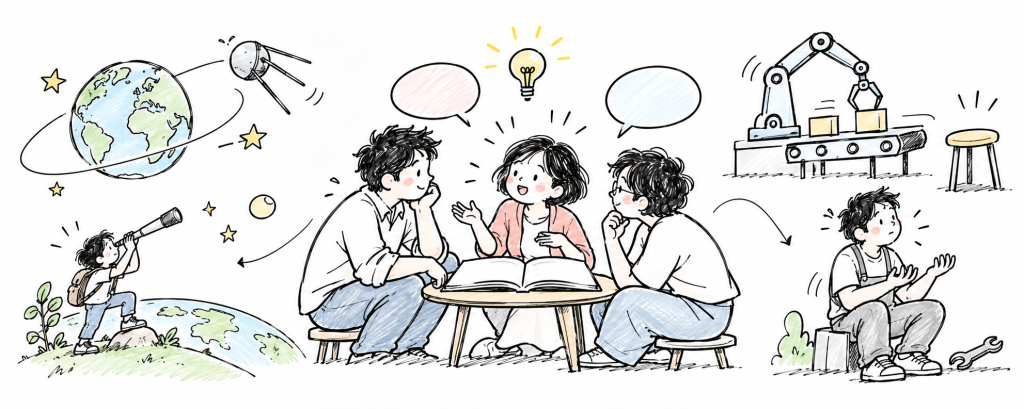
On the evening of October 25, a new round of readings of Arendt’s The Human Condition got underway. Hu Yilin led the reading, using Wang Yinli’s translation (second edition) as the text. That evening we began with the preface Arendt herself wrote, reading the first nine of the twelve paragraphs: from the launch of the artificial satellite in 1957 all the way to the “society of laborers without labor.” The discussion revolved roughly around three questions: Why do human beings want to “escape the earth”? Why has technology, as it becomes capable of doing more and more, turned into a political problem instead? And once human beings have been liberated from labor, what can they still do?
What follows was organized by claude from the live recording, with my revisions. Quotations are from Wang Yinli’s translation; the principal speaker was Hu Yilin, and the other participants are unnamed.
Opening: reading slowly, reading on site
My reading group has been running at Unfinished Bookstore in Singapore for almost two years now (if counted from Beijing, it has already been 12 years). Before this we read Heidegger’s Being and Time, and we’ve more or less finished it; for the second round we switched to The Human Condition. At first I wanted to use the newly published Zhong Shu translation, but then Zhong Shu became embroiled in a plagiarism scandal, and the shop owner, with a bit of what you might call “spiritual fastidiousness,” decided we should still use Wang Yinli’s translation; we are using the second edition revised in 2021.
I had AI analyze these two translations: both are quite good, with no major problems, but there are plenty of small mistakes here and there. In fact, in the future we might as well just use AI translations directly. AI translations are already better than most published translations, though certain key concepts still need human oversight—for example, whether condition should be translated as “境况” or “条件.” I’ve already had AI prepare a reading handout and mark the obvious mistakes in Wang’s translation.
We followed the old rule for reading: read aloud paragraph by paragraph, very slowly, and stop after each paragraph for me to gripe, explain, and joke around, while everyone can chime in at any time without raising a hand. I’ve tried discussing things directly with AI at home, but it still doesn’t really work. The feeling and atmosphere of slow reading on site still cannot, at least for now, be replaced; the reading group also has livestreaming and recordings, but they can’t match the sense of participation in person.
My reading group welcomes readers to join at any time. I try to come every week, but it’s fine if you only come occasionally. Because everyone is not reading as professional scholars, but rather combining the reading with their own lives and feelings, what we read are feelings, associations, and inspirations; even if you come only once in a while, you will still get something out of it.
As for why I chose this book, first, I’ve always liked Arendt; second, this book is highly relevant to the development of technology and to today’s AI explosion.
A philosophical book that is “anti-philosophy”
We didn’t read the preface or introduction; we went straight to the preface Arendt herself wrote. But before we began, I briefly explained the background to the writing of this book. Arendt spent many years as a refugee, drifting through exile to the United States, where she later became a U.S. citizen and wrote this book in English. Zhong Shu’s translation is based on the German text she later wrote herself, which she felt was better, because German was Arendt’s native language and English was only the third language she learned, after German and French. There is some truth to that, though the English text is the original version and has greater scholarly standing.
There is an irony to this book: it is regarded as the representative work of Arendt, that “greatest woman philosopher,” yet by her own understanding, it is an “anti-philosophical” book. In her view, philosophy has gone astray, placing too much emphasis on the contemplative life and forgetting human beings’ real action; this is actually a political book, meant to return from contemplation to political action. Of course, truly classic philosophical books are often anti-philosophical as well: Marx, Kant, and Heidegger were all opposing the philosophy before them.
There are three layers to Arendt’s sources of thought. First is Socratic polis politics. In Arendt’s eyes, Socrates was not a contemplative thinker but an actor, who ultimately died under persecution for political reasons; his student Plato took the path of contemplation, perhaps due to some kind of “traumatic stress” brought on by Socrates’ death. Plato opposed polis politics and pursued the philosopher-king—in fact, some sort of anti-political mode of governance; and after Plato, all of Western philosophy became footnotes to Plato, thus continuing all the way down the wrong path. Second is Marx: Marx, too, is anti-philosophical. He criticized earlier philosophy for standing “on its head,” and emphasized that what matters is changing the world. This is something Arendt inherits, though she criticizes Marx for confusing labor and work. Third is Heidegger: Arendt was his student and lover, inherited his true teaching, and also rebelled against him. Although Heidegger claimed he wanted to bring metaphysics back from its wrong path to factuality, his tone still leaned toward contemplation, and he failed to see that genuine factuality is political.
Of course, after talking about all this background for a long time, it’s actually not necessary to know it. Great philosophical works create their own world; one does not need to read Heidegger or Marx first in order to read Arendt. What philosophers truly interrogate is their own time and condition. Arendt wrote in the 1950s, more than seventy years away from today, yet our condition still overlaps with hers, so we can read our way directly into the text.
One participant said that they were very concerned with the way AI is affecting people’s work: some people are changing the way they work, some are losing their jobs, and some are learning new things, so they felt this theme was very suitable for modern society. I said that this is precisely why I chose this book; in fact, according to Arendt’s classifications, we don’t really have “work” at all now. What the job market is hiring are not workers of work, but laborers. Arendt distinguishes labor, work, and action; in her view, modernity as a whole, including Marx, has confused labor with work. This is the theme of the whole book, and also one of the points at issue.
Artificial satellites: artifacts ascending to the “place of gods”
Rather than saying that this is a book of political philosophy, I would rather say that it is talking about philosophy of technology. The preface begins with an event in the history of science and technology: in 1957, an artificial object was launched into the sky and orbited the earth, following the same law of gravity as the sun, moon, and stars. Arendt says that it was of course not the moon or a star, but for a period of time it dwelt and moved near the heavenly bodies,
this artificial satellite was neither a moon nor a star, nor a heavenly body traveling on a circular orbit, the latter being something destined to exist forever for us mortals, whose lives are limited by the earth. Yet for a period of time, this artificial satellite… seemed to have been temporarily granted permission to join their noble company.
Wang Yinli’s “mortals whose lives are limited by the earth” is not quite accurate. AI suggested translating it as “bound by earthly time.” Earthly does mean “of the earth,” but in fact the reason earthly means “of the earth” is indeed that it first means “of the earth” in the sense of the planet. Here there is a background in the history of Western thought: ancient people divided the world into the sublunary and the supralunary. The sublunary realm, or the realm on earth, was the mortal world, while things above the moon were immortal. What Arendt is saying here is precisely that the artificial satellite, by escaping the “earth,” metaphorically transcends the “mortal world,” acquiring a certain immortality, or even divinity. In the traditional imagination, the sky is the realm of immortals and gods, while the earth is the realm of the mortal; sending an artificial satellite into the sky means that human beings, by their own authority, have sent their creation into the position of the gods.
Arendt goes on to say that the significance of this event is no less than that of any event, atomic fission not excluded; had it not been accompanied by an unpleasant military and political situation, it should have received unreserved applause.
But strangely enough, the applause was not one of victory, nor was it pride and awe at the tremendous power of human beings to control nature (for now, when they looked up from the earth into the sky, they could see something they themselves had made). The immediate reaction at the moment of the event was one of immense relief: at last mankind had “made the first step toward escaping the earth’s bondage over human beings.”
She pointed out that this statement is a direct repetition of the words engraved on the tombstone of a great Russian scientist: “Human beings will not be chained to the earth forever.”
Arendt adds the phrase “looking up at the starry sky” after “awe,” which is really an allusion to Kant: Kant has the famous line that what fills us with profound awe are, first, the starry heavens above us, and second, the moral law within us. But now, in the starry heavens above us, there is not only the stars but also an artificial satellite. This even changes the emotion of “awe” itself.
Arendt is not opposed to the artificial satellite going into orbit, nor does she think human beings should not rejoice at it. What she takes issue with is the strange emotion of the rejoicing: it is not joy, pride, and awe, but rather something like successful flight from danger: “escaping the earth’s bondage over human beings,” as if the earth were a prison, with the flavor of leaving home to strike out on one’s own in order to flee the family of origin.
Is the earth a prison?
Arendt then says that this mood has been common for some time; long ago, this mood was already buried in science fiction, but in the history of human thought it is still relatively new. Christianity had already regarded earthly life as the this-worldly realm that must ultimately be escaped, and philosophers regarded the body as the prison of the soul. “But never in human history has anyone regarded the earth itself as the prison of the human body, or displayed such an urgent desire to relocate from the earth to the moon.” She asks: will modern emancipation and secularization, which began by turning away from “our Father in heaven,” end in a betrayal of the earth, that is, of “the mother of all living things under the sky”?
Plato believed that the body is the prison of the soul, and that only by stepping outside the body can one see the truth; Christianity believed that earthly life is a bondage, and that the soul’s home lies on the far shore. Now this contempt for the body and rejection of earthly life has become, in science news, a celebration of technological development. At root it is still a religious conviction, only magnified: in the past the earth was still Gaia, the mother of life; now even the earth itself has become a bondage.
The modern movements for freedom and emancipation once struggled against theocracy, monarchy, and hierarchy; they fought heaven and earth, only to discover in the end that what they had to resist was actually the earth itself. The narrative of liberating all humankind has moved toward a grotesque conclusion.
One participant raised a question: compared with local struggles and liberation in some particular region, Musk’s idea of making humanity a “multiplanet species” feels like a greater liberation; the bondage of the earth seems greater than those local forms of bondage.
My response was: Arendt, or I, are not denying the artificial satellite or the Mars plan. People can absolutely feel pride and awe at the power of human beings to master nature, and regard moon landings or colonizing Mars as the joy of opening up a new world. The problem is that the logic of calling the earth a prison is flawed—if you can’t even survive on the earth, what can you do on Mars? What exactly have you liberated yourself from? The older logic of colonization at least made sense: the earth is wonderful, but resources are limited, the population keeps growing, the earth is full, so expansion outward is the only option. But now that logic no longer works. Populations in developed countries are shrinking, nobody is having babies, everyone is in a demographic crisis. What is the point of sending people out? The earth is so habitable, and you still think it is binding; then will you really be free on Mars? On Mars, you would not even be free to breathe.
A participant pressed further: originally, humans couldn’t go to Mars and couldn’t breathe there—that is bondage; if one day technology makes that possible, why can’t that count as liberation from bondage, or as a breakthrough?
My response was: Of course environmental limitations can be described as a kind of bondage; that is exactly what the “human condition” to be discussed later refers to. But opening up a new environment is exploration and advance, not necessarily jailbreak. Exploration is not a denial of the old home: the old home is precisely the condition of exploration, the thing that lets you grow up so that you then have the chance to explore. To use an analogy: when a child grows up and wants to leave home to become independent, to strike out on a path their parents never took, that is a good thing; but if the child says, “I’m going to break free from my parents’ bondage,” you would feel that there must be something wrong with that family of origin. Growing up and escaping are two different things. The subtlety lies precisely in this phrase “escaping the earth’s bondage.”
A participant then asked: if the original family can no longer meet a child’s needs for continued growth, can that kind of “can no longer satisfy” be called a constraint?
I said that this is precisely the question of “conditions.” He linked it to the conclusion he had drawn earlier from reading Heidegger: “Freedom is not a right; freedom is a responsibility, a burden you carry, and what you carry is your finitude.” Human capacity comes precisely from finitude; all conditions are finite. Only by acknowledging and carrying one’s own finitude can one move forward and broaden the boundaries. He emphasized again that Arendt is not opposing Musk, but reminding us to scrutinize the civilization narrative we ourselves use: why exactly do we want to go to the heavens?
Let me add that, at present, are narratives like the Mars plan really based on the claim that the Earth can no longer meet humanity’s needs for continued development? What exactly is the need that cannot be met on Earth? Is it that there isn’t enough water to drink, or not enough grain to eat, or that the oil has all been dug up? But those things aren’t on Mars either.
Another participant brought up something Musk had said: that the level of civilization should be tied to how much energy it can use, and the more energy it uses, the more advanced the civilization. He felt this was an extremely one-sided, even “downgraded,” understanding of civilization.
I agreed with this point: how to understand human life is precisely the theme of this book. If linear expansion is treated as progress, yet people’s lives do not change—if originally you were a beast of burden on Earth, and then you go to Mars and remain a beast of burden, what difference is that? The narrative of liberation originally meant that people need not be beasts of burden, that they can break free from the control of totalitarian rulers; yet now it has become a matter of constantly leaving one old environment and entering a new one, as if if one factory becomes unbearable you just switch to another factory. Is that really liberation? If this factory can never be reformed, how can you be sure the next factory will be better?
True liberation means having broader space, more room for choice, and more possibilities for survival. This involves one of Arendt’s key concepts: Wang Yinli translates it as “plurality,” while Zhong Shu renders it as “multiplicity”; the latter is somewhat free in translation, but still apt. Earth has Earth’s way of life, Mars has Mars’s way of life; this factory has one system, that factory another system; then you are able to broaden new spaces of choice—that is progress. But if Earth is a beast-of-burden factory and Mars becomes a sweatshop, that is not progress. So why does humanity want to expand? Because we need to accommodate the plurality of more people, the multiplicity of human beings. If all one wants is for the same way of life to win more living space, then that is in the same lineage as colonialism and even Hitler’s thinking.
“Conditions” or “Circumstances”?
Next, Arendt writes:
The Earth is the very quintessence of the human condition…… The world of artifice we build up separates human existence from all merely animal environment, but life itself is outside this man-made world. Yet now massive scientific efforts are devoted to making life too “artificial,” severing the last tie that makes us belong in the embrace of our natural mother.
The examples she gives include creating life in test tubes and freezing the sperm of “remarkably capable people” to produce supermen; she also speculates that behind the hope of extending human life far beyond the age of one hundred lies the desire to escape the human condition.
None of this is out of date today. At the time, there was a background of eugenics, which was practiced in countries all over the world; later it was abandoned, not because people truly realized it was wrong, but merely because they thought there were problems in implementation. The pursuit of escaping constraints never stopped: life itself was seen as a constraint.
“The Earth is the very quintessence of the human condition”—Wang Yinli’s revised version basically changes the body text’s “circumstances” back to “conditions,” while the book title, by common usage, remains “circumstances”; Zhong Shu, meanwhile, thinks “circumstances” is better. I think both have their reasons. Condition in English is often translated as “conditions,” but what this book means is not logical sufficient conditions, necessary conditions, and the like; it has the sense of environment and situation, but it also carries the meaning of “the prerequisite that makes you become a certain kind of person,” just as we say that a person’s family conditions or physical conditions are good, especially when looking for a partner. “Circumstances,” on the other hand, is closer to environment and situation. All these layers of meaning are present, so translating it as “conditions” is good, and translating it as “circumstances” is also acceptable.
The participant who had just pressed the question about Mars asked again: family conditions and physical conditions can be good or bad and can be compared; but what does “human conditions” refer to? Are some human conditions better than others? Or does it belong to all humankind and therefore cannot be compared?
I replied that human conditions can also be compared. Your belief that humanity’s conditions have improved after colonizing Mars is itself a comparison; saying that we are better than the Middle Ages is also saying that our circumstances, our conditions, are better. Conditions can be large or small: for a specific person, home, technology, and the community of life are all conditions; for humankind, Earth is the condition in the concentrated sense. Conditions have historicity; they are not fixed and unchanging. Humanity has always been trying to change its own conditions and break through finitude.
When technology can do too much, it becomes a political problem
Arendt says,
Scientists tell us they can produce in less than a hundred years a future human being who seems to have the ability to rebel against his own given existence and, if he so desires, can be provided with whatever he himself has made. There is no reason to doubt our ability to effect such a free exchange, just as there is no reason to doubt our present ability to destroy all organic life on earth. The question is only whether we really want to use our new scientific and technical knowledge in this direction, and this question cannot be decided by scientific means; it is the first political question and thus cannot be left to scientists or professional politicians as such.
These statements are extremely prescient: Arendt said “less than a hundred years,” and she was writing in the 1950s; now that time has nearly arrived, and AI is accelerating things further. Cyborgs, brain-computer interfaces, gene editing—these technologies are indeed nearing maturity. You want what kind of body, and you can have what kind of body; add wings, grow a third eye, anything is possible. You can also decide what animals to eliminate, for example by wiping out mosquitoes. But the question that follows is: should everyone get wings and a third eye? Who has the right to have them, and who has the right not to? If we can exterminate mosquitoes, should we? Should we also kill off flies while we’re at it? Once we have the power of life and death in this way, the next question is no longer simply a technological one, but a political one. Some people want mosquitoes gone; others do not. If you get wings and I don’t, then the issue of fairness arises. These conflicts cannot be left to scientists and experts to decide.
Today’s AI is the same: AI is omnipotent, able to do far too many things. AI figures like Dario and Altman are also turning the issue into a matter of governance: who has the right to limit what AI can and cannot do, and they even need to seek endorsement from theologians and popes. Because technology can do too much, what is needed is restraint and negotiation: what should be done, what should not be done, who will impose limits, who will punish…… Arendt, looking at the atomic bomb, satellites, and the arms race after World War II, saw that what appears on the surface to be a struggle over technology is in substance already a political question—how to make an atomic bomb is a matter of science and technology; whether to make one, who can make one, and who will manage it after it is made are all political questions. And this question is even more urgent today. What we need now may not be merely some technology experts who push technological acceleration, but rather politics—political movements, political negotiation.
Slaves of “Knowing How”
In the sixth section, Arendt writes about the internal crisis of the natural sciences: the “truth” of modern science can be demonstrated with mathematical formulas and proven technologically, yet it can no longer be expressed in everyday speech and thought. Schrödinger used “a triangle with round sides” and “a lion with wings” as metaphors for such propositions. She worries that we may never understand—that is, may never be able to think and speak about—the things we are able to do:
If it should turn out to be true that knowledge (in the modern sense of know-how) and thought have definitely parted company, then we would indeed become the helpless slaves, not so much of our machines as of our know-how, helplessly bound to do whatever we are technically able to do, even if it should kill us.
Something that is both a wave and a particle sounds to ordinary people like “a triangle with round sides”; science has already advanced to a point where ordinary people can no longer understand it.
This problem is even more severe today. Back then, the knowledge produced by scientific experts was something ordinary people could not read; today, the knowledge produced by AI is something even scientific experts cannot read, and the structure of the problem is the same. Politics requires human judgment; when there are disagreements, there must be negotiation and compromise. But if ordinary people cannot understand what technology is doing, what consequences and side effects it has, then how can there be negotiation? Arendt speaks from the standpoint of ordinary people: a small number of scientific elites may understand it, but they cannot replace the political participation of ordinary people. Now the problem is even worse: even mathematicians cannot get through mathematics papers. When people cannot understand, they give up and hand it over to technology, letting it keep running, even if it will kill us.
Behind this lies ever-deepening specialization, and traditional political issues are no exception. In the past, monetary policy was nothing more than how many grams of gold were exchanged for how many grams of silver, or how much silver was in a coin; even if it were formulated by Newton, ordinary people could at least more or less understand it. Today’s monetary policy—M0, M1, M2, and so on—ordinary people cannot understand, yet tariffs and monetary policy are fundamentally political issues that concern how people live. So politics too has become a matter for experts, and ordinary people can only leave it to scientists, or so-called economists, and in the end to professional politicians.
Let me add that in Hayek’s acceptance speech after receiving the “The Sveriges Riksbank Prize in Economic Sciences in Memory of Alfred Nobel,” he opposed the banking sector’s creation of this prize. One of his reasons was that it would endow economics with authority and scientize it, packaging a field full of political controversy as objective and professional scientific research, making people believe that complex social governance could yield a scientific conclusion. But this may be precisely the “open conspiracy” behind the central banks’ appropriation of Nobel’s name to add this prize. With this packaging, it becomes reasonable, even righteous, for central banks to insist on a posture of political neutrality—central banks, after all, like the president and parliament, formulate public policy closely related to people’s lives and interests, yet central banks need no election, stand above party conflict, and many of their procedures are no longer open and transparent, on the grounds that they require professionalism.
The attitude of the “big chessboard” crowd is similar: how much can ordinary people understand? They are playing a grand game; all you can do is trust them. Hu Xijin has made such remarks, saying that it is reasonable for him to change his stance frequently according to the wind direction, because he believes that the wisdom at the top must see farther than he does. Once the top speaks, you must believe them, because they are experts one in ten thousand and have the most comprehensive data.
This is not only a Chinese problem. After the 2008 financial crisis, the West quickly saw the rise of the woke movement and Black Lives Matter, because issues like the struggle between men and women, minorities, and Black rights are easy to understand and ordinary people can speak out on them; while Wall Street and monetary policy kept ordinary people out, so politics became a very blunt, very monotonous quarrel: Americans blame China, Chinese blame America.
Let me add that back then, the Occupy Wall Street movement’s slogan was “We are the 99%,” attacking the 1% of privileged elites who controlled everything, caused the financial crisis, escaped punishment, and even continued widening the wealth gap. These slogans were actually easy to understand, so they made quite a stir for a while. But why did the movement eventually fade into silence? If you search for it, the first reason you will see is “lack of clear political demands,” along with a lack of leadership, fragmentation of public opinion, and so on. In fact, it was simply this: they voiced their dissatisfaction, and public opinion said, “If you’re so capable, then you do it yourself—give us a concrete operational plan.” In the end, no one could really step up, and the whole thing dispersed like startled birds and scattered beasts.
Modern politics has turned into a series of complex scientific problems, technical problems, and even engineering problems, while ceasing to be political problems, precisely because these issues are difficult to bring into a public space of negotiation—unless they are simplified into the most direct and most primitive extreme versions. This is exactly the direction in which world politics has been moving in recent years: people welcome various political claims expressed at an elementary-school level of knowledge, as Trump does, while the other side also polarizes into slogans like socialism, “smash the landlords and equalize the wealth.” The public sphere is full of clashes of positions, yet there is still a lack of negotiation.
As AI develops, this trend will become even more obvious: you ask AI, I ask AI, and in the end it becomes “AI governance.” But AI cannot replace people’s embodied judgment. What is good is itself a political question, a plural question; if even disputes over good and bad are handed over to machines, what judgment and freedom do human beings still have?
A participant asked: Arendt says that “knowledge (in the modern sense, ‘know-how’) and thought have permanently gone their separate ways.” Here it seems to involve three things: knowledge in the ancient sense, knowledge in the modern sense, and thought. What are they, respectively?
I explained that “know-how” is just “know how,” as opposed to “know why.” Ancient science asked why: the ground, causes, and essence of the world; modern people want “how,” “just tell me how to do it.” It’s like a microwave oven: press a button and two minutes later the food is heated through, but I don’t know why it can cook food. “Thought,” meanwhile, is something broader: not only knowing how, but also knowing why, being able to understand causes and consequences. What Arendt is talking about is the slave of “know-how.” A slave only needs to know what time the master wants him to do what; he does not need to know why. An assembly line in a factory is the classic example: each person only tightens his own screw, without knowing what the stations above and below him are doing, what the whole line is producing, or even what this screw is for. That is what it means to have no thought; I only know how I “get the job done.”
The participant who had earlier pressed on with the question of Mars said why he had come to read Arendt: he first encountered her “banality of evil” through the history of the Second World War—namely, not thinking, or outsourcing thought. What struck him most just now was that in the past people could still choose whether to think or not to think, whereas now it seems that we are increasingly falling into a state where we cannot think. “Is there any solution to this problem?”
I said: maybe there isn’t. What Arendt is calling for is some kind of revival of civic politics, but it is not really a solution that tells you what to do. At least, though, we can know why, know why our situation is the necessary result of certain conditions; that in itself is already important. Being dead set on finding a fix is itself a know-how logic, as if to say, “You want me to know how to jump out of know-how”—which is ironic. We have to acknowledge that there is no unified, scientific, objective fix. What Arendt emphasizes is diversity: not the pursuit of one unified solution, but each person pursuing the effort to be oneself; only then might society become a little better. There is no once-and-for-all remedy.
During the break, the conversation was still hanging around “the banality of evil.” Some participants felt that in today’s division of labor, their own work is more or less entangled in it too. I said that in modern society, this is more or less unavoidable. In Heidegger’s terms, you have to plead guilty before you can be free: first acknowledge your situation, then do something in that situation that belongs to you, your own creation, leaving behind in the world something you believe to be positive, rather than negating this world and escaping from it altogether. This is actually what Arendt means by work and action: work is leaving your thing in the world, action is leaving your influence with other people. Another participant sighed that it still felt like “an ant trying to stop a chariot with its arm.”
By the way, “the banality of evil” was a notion Arendt proposed only after she finished this book and then attended the Eichmann trial; her earlier breakthrough work was The Origins of Totalitarianism. “The banality of evil” has always been controversial; some people say she was excusing the wicked. I think she is not denying the principal culprit; rather, she is saying that this machine could get moving not because of one person’s achievement, but because the whole machine cooperates. The Origins of Totalitarianism also says that totalitarianism is hollow, that the entire mechanism revolves around a center, and that this center does not even need to be any specific person.
The Place Where Speech Loses Its Power
Arendt continues to emphasize the significance of politics:
Wherever speech comes into danger, affairs become political in essence, for speech makes man into a political being. If we follow the advice so often being urged upon us, namely that we should also adjust our cultural attitude to the current status of scientific achievement, then we will adopt, no matter what the cost, a way of life in which speech no longer has meaning. For today’s science has been forced to adopt a “language” of mathematical symbols; although this symbolic language was originally no more than an abbreviated form of oral statements, the statements it now contains can no longer be translated back into spoken language. Why is it sensible not to trust scientists, as scientists, with political judgment? … Precisely because of the fact that they live in a world in which speech has already lost its power; whatever people do, know, or experience has meaning only to the extent that it can be talked about. Perhaps there are truths beyond speech; perhaps these truths are highly meaningful for the individual, in the sense that he may be anyone so long as he is not a political being. But plural human beings—so far as the people who live and act in this world are concerned—can experience meaning only because they can talk to one another, can understand each other and can make themselves understood.
Talking with one another is the essence of political activity, on the condition that each can understand the other; but scientists have now moved far away from politics. Oppenheimer and Einstein once actively promoted the development of the atomic bomb in the United States, and after the bomb exploded they felt that something was wrong, and in their later years both threw themselves into political activity; Oppenheimer even suffered political persecution. But after the atomic bomb had been built, politicians no longer listened to them. Of course, they did still have political influence in those days; after that, each generation was a little less capable than the one before. Finally, in cases like mad cow disease, scientists, in their capacity as scientists, vouched for “no human-to-human transmission”; such political performance can only be described as ugly. Arendt points out that this trend is not just a matter of the personal character of a few scientists or occasional naïveté; rather, it stems from the fact that in this era the language of science and the language of politics have gone their separate ways. They are experts in the language of mathematical symbols, but in the language of politics they are childish.
It was not like this in antiquity. Even Plato, who valued contemplation, got caught up in politics; he had to go to Syracuse to seek out his philosopher king. Chinese philosophers in antiquity traveled from state to state, selling their political ideas; Mozi studied the image formed by a pinhole camera, like a scientist, and at the same time preached universal love and opposition to offensive war. Back then, the language of knowledge and the language of politics were mutually intelligible. Today, though the languages no longer match, the relationship between modern technology and politics is in fact even tighter. Algorithms, Douyin, cloud computing, surveillance, and the GFW are all key political factors affecting our lives, yet the developers and programmers behind them have no say in the political arena, and no one seriously listens to them speak.
A participant said that there is a structural problem here: even if you do not develop the GFW, someone else will. I said that of course this is a problem of “the banality of evil,” but programmers are not without “merit.” Without Fang Binxing, there would still be a GFW, but it would not have come so fast or been so effective; without Einstein and Oppenheimer, even if the atomic bomb could still have been built, perhaps Japan would already have surrendered. Whether it arrives a few years earlier or later, or in which direction it is realized, makes a huge difference. The internet itself also contains political tension; it could perfectly well have grown into a “Big Brother” model that strengthened central surveillance, along Soviet lines. The American model prevailed, and that too is thanks to those programmers and developers. Whether positively or negatively, they are in fact participants in politics; they simply have no discursive power, and their speech can no longer enter political activity.
Another participant raised a possibility: perhaps Mozi could do science on the one hand and politics on the other because science and politics were not that complex back then; later, as the division of labor became finer and the disciplines more complex, one person could no longer do both.
I said that this is specialization. In antiquity, a craftsman handled an entire set of affairs by himself; nowadays there are only workers, each responsible for the single station right in front of him. Overall efficiency has increased, at the cost of a shared language: I can only say how many screws I tightened; the neighboring station may be doing sheet-metal work, and that has no common language with me. This is the modern human condition. We needn’t rush to say whether it is wrong or right; it just is what it is.
Another participant asked: nowadays many people believe that as long as technology is developed well, the world can be changed and all the problems of social governance can be solved. Where does this idea come from?
I said: this is the mentality of “the slave of the machine.” Historically, the main force pushing for the liberation of slaves was not actually slaves, but intellectuals, the middle class, and those who had been enlightened. Slaves might think that as long as they have food and drink every day, that is enough. Once you get used to being a slave, you will feel that there is nothing wrong with handing the direction of humanity over to machines. So this is a problem of re-enlightenment: Arendt wants us to realize that there are some things that cannot be left unchecked, and that is where human worth lies. But he also says that we need not decide in advance what is right and what is wrong, and we need not denounce the “accelerationists” who advocate letting technology speed ahead unchecked; first let’s talk clearly about the modern human condition, and then see whether Arendt can persuade us.
Some participants said that accelerationists hold that technological development will inevitably bring changes to everyone’s lives, but in the middle they skip over too many links; they are unwilling to think through the logic, or are avoiding the question.
I said that accelerationists would say history has always been like this, but they overlook the fact that alongside technological development in history there have also been struggles, political movements, and human deliberation. Yet the situation accelerationism faces is real: our deliberation can no longer keep up. During the Enlightenment, specialization had already begun, but people’s languages were still mutually intelligible; the ideal of compiling encyclopedias was to enable everyone to access all knowledge. Once the modern education system and factory system arrived, it was different. Technological iteration is becoming faster and faster, while public speech is becoming slower and slower, because each specialized field still has to be drilled through before it can become public deliberation. When a scholar publishes a political or ethical paper in a specialized journal, the review cycle alone takes one or two years, not to mention when it can ever become a public issue. So accelerationists say: if you can’t keep up, then don’t; running after it in a disorderly way will only drag things down. There is reason in that.
When we read philosophy, there is no need to rush to pass judgment. When we read Heidegger before, Heidegger would also acknowledge that the things he criticized had their own validity. Arendt identifies the condition of specialization and the separation of language not in order to denounce it as wrong; specialization is not something that can simply be reversed by flipping a switch. The key is to realize what it means for people’s political activity and way of life, and then to imagine new political forms. The preface is only an opening statement, talking about what kind of era we are in and what kind of problems we face; Arendt enters through the fissure between technology and politics.
A Society of Laborers Without Labor
In the eighth paragraph, Arendt writes about another, more imminent event: automation. Automation will, over the course of a few decades, make factories empty, and liberate human beings from the oldest and most natural burden, namely the shackles of labor and necessity. The desire to be freed from labor is as old as recorded human history; freedom from labor is not new either. In the past it was the most secure privilege of a tiny minority; now technology seems merely to be realizing what every previous age dreamed of but no one could accomplish.
Notice that Wang Yinli’s translation is mistaken here: it renders it as “in a few decades, making factories empty,” putting it in the past tense, whereas it should be future tense. This is one of Arendt’s predictions, and automation only began to rise in the 1940s and 1950s. But from today’s perspective, the future tense she speaks of is already past tense for us: over these last decades, automation really does seem to have been liberating people from labor. In antiquity, aristocrats and free citizens did not labor; slaves and servants did the work. Automation, especially AI, may make everyone into aristocrats, into free people—an ancient dream realized.
But then Arendt says, “all of this is only appearance”:
Modernity has in theory already completed the praise of labor and has in fact led the whole society to become a society of laborers. Thus this desire, like the desire in fairy tales, defeats itself at the very moment it is fulfilled. This society is a society of laborers on the verge of being liberated from the chains of labor, and this society knows of no higher or more meaningful activity that would be worth winning freedom from labor for. … In this society, no political or spiritual aristocracy is left behind to preserve and renew the other capacities of human beings; even presidents, kings, and prime ministers regard their offices as a necessary job in social life, and among intellectuals there remain only solitary individuals who still think of what they do as creation rather than a means of making a living. The prospect before us is a society of laborers without labor, and even the only activity left to them—labor—is gone; indeed, nothing could be worse than this.
As a society of laborers, how can we possibly be freed from labor? The last sentence is also somewhat inaccurate in Wang Yinli’s translation: what is worst is not that “all that is left to people is labor,” but that labor, as the only activity left to them, is gone too, replaced by automation. What is so terrible is precisely that we are finally liberated from labor, yet do not know what human beings can do besides labor. In antiquity, aristocrats, after eating their fill, engaged in politics, and also in science and creation; some craftsmen made a sculpture not because they had taken a commission to earn money, but because they simply wanted to make it. These higher pursuits are treated as the dregs of aristocracy and hierarchy in the modern society of laborers, and swept away in one stroke. Labor has become the most glorious, and also the only, way of existing; human value lies in being a laborer, whether one performs mental labor or manual labor. If we really were freed from labor—if I do not work for money, then would I still work? The whole operating system of society, its values, and its cultural habits all take labor as the measure of value. For such a society to say, “At last we are liberated from labor,” is not good news.
He connected this to today: once AI has replaced these jobs, what are people supposed to do? What is human value? Our value as a resource is already lower than computing power; human labor is no longer a resource, so what should it become? People may just turn into couch potatoes, lying there scrolling Douyin. Arendt later says that the laborer society becomes a consumer society, with everyone as a consumer. In his view, such consumers have no higher aspirations, nothing more than “drifting along until death.” Automation seems to be liberating us, but we have not truly been liberated, because what shackles us is not actually that concrete labor, but labor as an idea, as a standard. There are still the final three paragraphs of the preface left, so I decided to leave a tail for next time and shift into discussion. ## Discussion: Will a society of creators arrive automatically? One participant asked: after Arendt wrote this book, did the human condition get better? I said: first of all, the human condition is not a matter of good or bad, because the standard of good and bad is itself part of the human condition; Arendt is not preaching morality or sighing that the world has gone bad, but speaking of a destiny, a persistent trend. By my own standards, all in all it has not become better. But in some respects it really has improved: modernity has continuously liberated people from animal labor, from the “fate of oxen and horses”; famines are less common, wars have relatively speaking also seemed somewhat better, and severe events like the Nazi concentration camps have at least not happened again in these past decades. Arendt herself was a refugee, nearly sent to a concentration camp, wandering in hardship. And we live in a relatively stable environment. If one insists on saying our situation has become worse, that does sound a bit like taking potshots from a comfortable position. But “getting worse” is in fact Arendt’s own prophecy as well. What Arendt stresses is precisely not those matters of food, clothing, and safety. She also expected automation to liberate people from labor, and by ancient or modern standards that is good news; but what she wants to emphasize is that behind this good thing, the key problem has never been solved. Today our society, politics, way of life, way of communication, and way of organization still have not escaped the paradigm of the laborer society; the crises of the industrial age that Arendt criticized still seem to exist, while AI has brought new predicaments. With wolves in front and tigers behind, the situation may be more severe, more dangerous, so that is what “getting worse” means. Of course, “where there is danger, there is also salvation”; danger is also an opportunity to build new forms of human organization. Solving food and clothing, solving necessity, is of course a good thing, but what Arendt wants to discuss is: after that, where is human society headed? This participant disagreed, thinking this was Arendt’s “limitation”: she could not see the conditions needed for a transition from a laborer society to a “society of creators,” and so she worried about the future. Once AI frees our productive capacity, our time, and our thought, per-capita output will rise, and naturally everyone will begin to create more—for instance, small discussion gatherings like today’s might also produce good things. Was she worried because she simply failed to see this? I said: it’s not that she failed to see it, but that her judgment was different. Arendt believed such a world would not arrive automatically; even if it did arrive, it would require political action. Many contemporary people of insight and many political movements are themselves influenced by thinkers of Arendt’s generation. This formulation, “from a laborer society to a society of creators,” can also be traced back to Arendt: she distinguished labor from work, and what she calls work is close to creation. And to say this out loud—say, “we want to enter a society of creators”—is itself a political act, and a powerful one at that: only when people hear it will they begin to move in that direction, to support and respect creators. Not just Arendt—anyone who says such a thing is contributing to this turn; if no one clearly explains the difference between creation and labor, society will not change on its own. And that participant objected to “we need to think it through, and only then will we respect it.” She invoked Maslow’s hierarchy of needs: as more and more people solve the problems of food and clothing, they will pursue higher-level goals and naturally come to respect creators. Facts have already proven that this is not so: when the laborer society reaches its so-called higher stage, it turns into a consumer society, not a society of creators. People’s needs become lying on the sofa scrolling Douyin and watching TV. And those things may all be automatically generated by AI in the future. Even Maslow did not say that once lower-level needs are satisfied, people will automatically pursue higher-level needs; higher needs also have different modes of satisfaction and different social structures. So-called self-realization is itself a political activity: city-state politics is precisely about letting the self manifest in the world, realizing one’s own value and radiance. How to make society more suitable for each person’s self-realization is a matter of social organization, social structure, communication, and politics. Another participant gave an example: before AI appeared, there were already many content creators on Instagram; are they a society of creators, or merely entertainment? The participant who had asked earlier picked up the thread and said that we still have not entered a society of creators; many people becoming influencers on Douyin are also doing so to make a living. And as Hu Yilin said, once the level of social production rises, we may also head toward a consumer society rather than a society of creators, so there are multiple choices before us. The question is whether, at this crossroads, we can enter a more meaningful society. I said that Arendt is calling for action, opposing merely sitting in the study and imagining, brooding. “Speaking out” itself is already a kind of action. Even advocating accelerationism, or advocating that society will automatically become a society of creators, is a political proposition: some people think we need to encourage and push, others think letting things take their course is enough. Even if you think letting things take their course is enough, that we just sit at home and wait, waiting for productive forces to develop, that too is a political proposition. No political proposition becomes true automatically, just as North Korea will not automatically become a capitalist society. What Arendt wants to revive is not some particular political proposition, but political life as such: the very first proposition to be made is precisely that “discussing these questions itself is meaningful.” Another participant pressed further: “Is speaking really useful?” If saying it cannot affect anything anyway, will it ultimately become “I’ll earn enough money and then use money to influence others,” that is, the whole effective altruism package? In this participant’s view, that package has a lot of problems too. I said that Arendt’s key point is to return to Greek city-state life: doing politics is not because it is useful, but because of the need for self-realization. The self is never a soul floating in cosmic emptiness, unrelated to others; it is a social, historical, living existence. To realize oneself is to act, to speak, to express. Expression itself is meaning; whether it succeeds, whether it changes policy, that is an external measure. What changes first is other people: you speak, others hear it, and your words remain in the world, stirring ripples in others, even if others oppose you. When we all believe that speech has power, then speech really will have power. That participant then asked: isn’t this like a retreat, defining the process itself as meaningful when you cannot attain the result? I said: yes, you can say it that way too; it depends on your state of mind. But the Greeks were exactly like this: city-states went to war for honor, not for plunder; once they won, they went home, and did not annex the other side. In Homeric epic, the highest honor is to surpass others with one’s own hands and feet. What they pursued was not efficiency, not the possession of resources, but self-realization, honor. Of course, you can also say this is “grapevine bitterness,” or A-Q spirit, and I can’t really refute that, because today pragmatist and utilitarian thinking is extremely strong, extremely domineering; this can also be seen as an escape from the narrative of utilitarianism. ## Discussion: From the bread factory to “poor diversity” We may imagine that once productive forces become vastly abundant, society will naturally turn toward a society of creators. But what counts as sufficiently abundant? In developed countries, food and clothing have long since ceased to be a problem; famine is a distribution problem, not a production problem. In a certain sense, food and clothing were basically achieved in the fifties and sixties already; today’s food-industrial system is even more overabundant, and famines in the few remaining regions are all distribution problems rather than production problems. Not only Arendt, but Stiegler also said that the laborer society is organized according to the logic of productive forces, not according to the logic of satisfying necessary needs. Human basic needs are limited: one loaf of bread a day is better than half a loaf, two are better than one, but if you are given twenty loaves a day, that is not necessarily better than two—you cannot eat them. But the desires of producers are infinite: if the bread factory produces two hundred loaves, that is certainly better than twenty. Once the market is saturated, we move on to producing more advanced bread, to creating demand: fashion gets you changing ten or twenty sets of clothes a year, not because your need for warmth has not been satisfied, but because if you do not change them you become “old-fashioned” and “out of date”; a phone can perfectly well be used for ten years, but once a new version comes out, you have to change. All creativity is spent on creating new needs. Of course this too is a kind of work, a kind of creation, a kind of self-realization—yet it is a “misdirected self-realization”: is this the creation we truly want, or an endless cycle aimed at capital appreciation? One participant added: producers can take care of more and more consumers; by the internet era, a team of a few people making videos can face a huge audience. Even if we count production as creation, creation is concentrated in the hands of very few people, while more people are merely consuming. I agreed, exactly so. Even those who create new demand are only a tiny minority; the majority are still on the assembly line. Creating new demand is actually creating new assembly lines, so that unemployed laborers have work to do and go to the next factory, rather than being told “you no longer need to labor, go create.” So creation is forever a game for a tiny number of people, and in fact it is gradually being replaced by AI, while labor remains humanity’s fate. Productive forces turn into money, money turns into productive forces; this inertia is endless, so society will not automatically get better. That participant then asked: then, creation that does not require consumers—is that itself still worth pursuing? I said: everyone should be able to create; creation ought to have an independent meaning. Right now, creation is measured by productive power and wealth effects; innovation and entrepreneurship have become the creation of market value. This one-way creation is endless, and it actually keeps reinforcing the laborer society, because entrepreneurs who are bosses are after all only a minority, and what they provide are more and more labor positions. Another participant raised a question: creation is always social; there has to be someone to receive it, maybe their time, attention, or financial capacity. If everyone goes off to create, who will receive it? That may not necessarily be a good society either. I replied: of course people can receive one another; this is precisely why Arendt insists on plurality and diversity: what you create I cannot create, what I create you cannot create, each person is unique. We have differences, so we can exchange, admire one another, respect one another. If we are only competing in market value, then everyone is homogeneous and monotonous; if what we pursue is making the world richer, then the more different people there are, creating according to their own traits and styles, the better, and people can receive what is different from themselves. A participant followed this up by saying that this is no longer pursuing a single unified standard, such as being more popular, bigger, and stronger, but pursuing one’s own uniqueness. Then someone asked further: but the reason Arendt is important is because the concepts she created have been “consumed” by so many people; today we are also consuming Arendt here. If we set consumers aside, how do we judge that her creation is important? I said that here “consumption” is already a figurative extension. What we are doing here is reading and discussing, and yet we have actually named these activities “consumption”—that itself is the result of the consumer society being so domineering. We accept Arendt’s ideas not for traffic, but for each person’s self-realization and self-growth. Each person has their own reading; a thousand readers have a thousand Hamlets—do we call that consuming Hamlet? This is actually communication, a political activity, human speech. One participant asked: in recent years, with the rise of AI and layoffs at major tech firms, people seem to be reflecting more on life and on technology; from his observations over these years, is that the case? Will the development of AI make people reflect more on technology? I said: this is certainly an opportunity. Philosophers of technology have long been talking about these issues; it’s just that they have always been very niche and marginal. Now even major AI companies are hiring philosophers and talking with theologians. Even if there is a bit of crowd-pleasing showmanship in that, it reflects the fact that this era really is concerned with these questions, because the impact of technology on us is simply too great. Another participant said that some people also say, “I’ve already entered an era of just getting through the days; I no longer care about the meaning of life.” I said that most people have always been like this; in ancient times there were not so many philosophers either. There are certainly more people now who pay attention to philosophy than in the past. Besides, this “era of getting through the days” is itself a philosophical insight, an expression of helplessness toward the times, toward one’s situation. Lying flat is a philosophy, and lying flat is also a political movement—otherwise why would it be banned?One participant then added that if one really can manage to live life well, that is also a creation of one’s own meaning—isn’t that also a kind of creator society? Hu Yilin said the key lies in saying it out loud: if a person lies there silently, that is not a political act; what makes it political is expressing “we’re just lying flat” or “all we can do is live our lives.” This expression itself is what is political.
Finally, one participant returned to an earlier topic: current political movements tend toward simplification—for example, “Black lives matter.” How would Arendt view this kind of simplified political movement? Is this a kind of consumerism?
Hu Yilin said that, in a certain sense, politics has been turned into consumerism, flattened out. Arendt would not address this issue directly, but the reasoning is the same: the core of politics is human plurality. “Black Lives Matter” and DEI are also talking about plurality; first and foremost, this is a positive affirmation: even in this age, people still care about politics, still care about plurality. The negative side is that this kind of plurality is relatively impoverished. What Arendt was concerned with was humanity’s fate in the face of technology; true plurality lies in diverse ways of living, diverse viewpoints and ideas, diverse forms of creation and aesthetics when using technology. But the plurality emphasized today falls on distinctions of skin color and the like; such distinctions can also be made among animals, and are a kind of “impoverished plurality.”
By the time the discussion reached this point, it was already ten o’clock in the evening. The first Arendt reading group session came to an end.
Translated from the Chinese original with AI assistance. The original text is authoritative.