My daughter is already four and a half. I never “show off my kid” in public spaces, but I can take the experience of raising her and talk about some general questions; this is the “Philosophy of Childrearing” series.
Actually, many of my views did not change before and after I started raising a child. Of course, before having a baby I could not have guessed that I would spoil her so much, but many of the principles and approaches to childrearing were already settled in my mind long ago. Today, in our first installment, we’re going to talk about the most fundamental guiding principle: reasoning with children.
Introduction (handmade)
Reasoning with children does not mean setting emotions aside, and still less does it mean putting on a stern face and communicating with them in a cold, official way. As the saying goes, “instruct by reason, move by affection”; emotion and reason have always complemented each other. The opposite of reasoning is violence and deception, including hitting, scolding, lying, and rage, and so on.
Some people say that children know nothing at all, so how can you reason with them? But if you don’t reason, then what do you do? Since children know nothing at all, does that mean you can scold them? Can you deceive them? Precisely because children know nothing at all, and cannot even understand joke-like deception, there is even more reason to speak to them properly and reason things out with them.
From when should we begin reasoning with children? From birth. A newborn certainly understands nothing, but she can sense the frequency and rhythm of adults’ speech, and will begin to like the sound of her father’s and mother’s voices, so we can talk to her more. It’s nothing more than describing to the child what is happening: Daddy’s hugging you, time for milk, let’s lie down on the bed… things like that.
From this moment on, we are already reasoning, even though there is not yet any complex “because… therefore…”. But faithfully describing things as they are is precisely the first step in reasoning. We should not call black white and white black, pointing at Mom and saying Dad, pointing at the cradle and saying chair—newborns certainly don’t understand, but talking nonsense brings no benefit whatsoever.
Once the child begins to understand some instructions, of course it becomes even more necessary to reason with her. For example: “You can’t take the knife, because knives are dangerous; if you cut your hand, it will hurt.” Teaching this honestly is better than making up nonsense like, “You can’t take the knife, because if you do, the Big Bad Wolf will eat you.” Admittedly, at the time she may not understand what it means to cut her hand, and may not know what the Big Bad Wolf is either. Children infer the emotional coloring of words from the tone in which they are spoken, so as long as you say it in a normal tone, “cutting your hand” and “the Big Bad Wolf” will have the same effect. And once the child grows up and learns what the Big Bad Wolf is all about, if she happens to remember what you said before, then the more lies you told, the more she will doubt your authority and the harder she will be to teach. A child’s memory can sometimes be long, and the nonsense you blurt out may stay with her for a very long time.
Of course, you absolutely should not educate children through hitting and scolding. When a child reaches out to grab a knife, the parent must of course stop her firmly, but this kind of stopping has a clear purpose; it is not punitive. If I have already moved the knife away, but still hold the child’s hand tightly and refuse to let go, so that she must remember the pain, then that is not reasoning with her—that is hitting and scolding.
The distinction between “stopping” and “punishing” should be clear to us adults; in fact, children should also be able to feel the difference. Stopping, in the final analysis, is protection. Adults can use their physical advantage to protect children, but they should not use it to suppress them.
Aside from stopping dangerous behavior, sometimes there are things that must be done, and parents also need to use firm methods to require them—for example, eating, drinking, defecating, urinating, and sleeping. When a child refuses to go to sleep, sometimes I also have to press her down onto the bed firmly. But in this kind of non-emergency situation, I usually reason with the child first and make an agreement. For example, I’ll say, “Little kids all need to sleep at night,” or “How about we sleep at 10 p.m.?” Sometimes the child bargains: “Sleep at 10:10!” Usually I agree to her proposal: “If you start stalling then, Daddy will have to grab you.” Then when the agreed-upon time arrives and I go to call her, she usually agrees; if she still stalls, then I use coercive means.
This kind of coercive means is obviously not punishment or hitting and scolding either, but it still needs to be used carefully—especially by avoiding any admixture of ferocity, resentment, impatience, or other nasty emotions. In fact, it is perfectly normal for a child this young to lack self-control; am I, the adult, really without self-control too? Most of the time I just tickle her and, laughing and joking, press her into bed. Of course, sometimes I pretend to be stern; even then, I make sure I am seriously reasoning with her, not scolding her.
Being able to make a child obedient through reasoning is, of course, best. But if one must resort to firm measures to prevent danger or compel compliance, then one should all the more explain the reasons to the child: why this cannot be done, why that must be done. The child must be made to know that such firmness does not come from parental caprice, but from reason—she will certainly not understand now, but she will understand. And even more crucially, we ourselves already understand. Reasoning with a child is first and foremost reasoning for our own ears; the process of reasoning restrains our own caprice. If there is something I cannot even explain clearly to a child, that means the thing itself is unreasonable and should never have been demanded of the child in the first place.
There can be many emotions in treating a child, but precisely when using firm measures, one should stay the calmest and must not mix in anger, because such anger is necessarily “displaced anger”; the child is the wrong target for the venting. The reason is simple: the child is not at “fault.” Scolding is directed at wrongdoing, but the child does not yet have the ability to take responsibility for herself, nor a mature free will—how could she possibly be in the wrong? A child’s behavior is either rooted in nature, in which case it is like a coin landing heads or tails: both are natural outcomes, and you cannot say that a coin landing tails-up is wrong; or else it is not rooted in nature, but in acquired learning. Then where can the child have learned it from? Hasn’t it all been absorbed from her parents through constant exposure and example? In that case, it is the parents themselves who are at fault—how can you blame the child? If she learned it from kindergarten, then the kindergarten should be blamed, which makes it all the more necessary to reason with the child, set an example, and, if need be, change kindergartens and correct it in time. In a child’s early years, parents have almost absolute power over her, and with so much time to teach by word and deed, they can correct deviations at any moment. If one waits until the child grows up and has an independent will, and she still refuses to learn properly, then the parents still have no right to resent the child; the responsibility still lies with themselves.
Everything above is text I made by hand. Below, I also chatted with ChatGPT for a while; it raised some challenging questions and objections, and after I responded, GPT then organized some text:
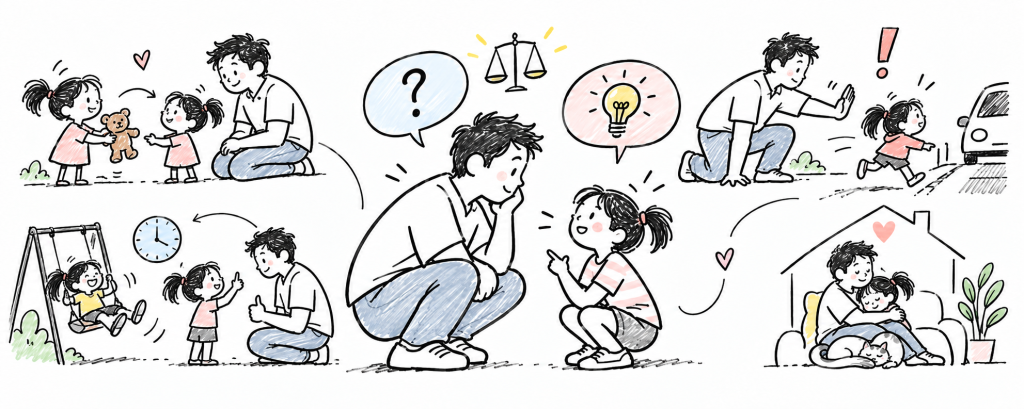
What is called reasoning with children can simply mean wrapping adult commands in a gentler package. The parents have already settled on the conclusion; they are merely trying, in a way that avoids hitting or scolding, to get the child to accept it. Or it can have a stricter meaning: every member of the family must explain their reasons as fully as possible, and every member may also be corrected by better reasons. Parents are not the masters of reason; they are merely people who bear more responsibility and have more experience than children. Since they demand that children obey reason, they themselves must also obey it.
These two kinds of “reasoning” may look similar on the surface, yet behind them lie completely different parent-child relationships.
One can forcibly stop harm, but one cannot forcibly produce remorse
First, let us imagine a fictional scenario: a four- or five-year-old child snatches another child’s toy, refuses to return it, and refuses to say “sorry.” What should the parents do?
The toy must of course be returned. Snatching something from someone infringes on them, and the parents have the responsibility to stop it immediately; if necessary, they can absolutely take the toy straight back from the child’s hands. Anything that might put the child herself in danger, or might cause harm to others, cannot be left until the child “figures it out later.”
But returning the toy and saying “sorry” are not two things of exactly the same nature.
Continuing to possess someone else’s toy is itself a continuation of the harm; saying one fewer “sorry” does not cause any new direct harm. An apology only truly has moral meaning once the child has some understanding of what happened and has realized why the other child is upset. Forcing her to immediately say the three correct words can at most prove that she knows what the adults want to hear; it cannot prove that she has already felt remorse.
Therefore, the parents may first apologize on the child’s behalf, and may also first return the toy, but that cannot be the end of the matter. The parents’ apology is an assumption of the guardian’s responsibility, not a permanent exemption of the child’s responsibility. When they get home, they still need to recall the incident, discuss it, and even be a little tireless in “nagging.” If the other child is a classmate from kindergarten whom they see often, then the child can be made to face the matter again the next day: apologize face to face, draw a picture, write an apology card, or come up with some other way to repair the relationship.
This approach is not completely without coercion. The child may not want to bring it up again, but the parents require her to remember and discuss it; she may want to forget the matter, but the parents require her to face it again. But this coercion is not meant to make her suffer, much less to use suffering to repay wrongdoing. Rather, it is meant to help her gradually understand: the consequences of one’s actions do not disappear from one’s own responsibility simply because the adults have already cleaned up after them.
So educational consequences should ideally be directly related to the behavior. If you snatched something, you must return it; if you made a mess, you must clean it up; if you harmed a relationship, you must try to repair it. As for punishments unrelated to the original behavior—such as canceling dessert or confiscating toys for a week—they often only teach the child that “making a mistake will be met with revenge from the adults,” and may not help her understand what exactly was wrong.
This also constitutes the first boundary in parent-child education:
Parents may forcibly stop danger and harm, but they cannot manufacture a correct inner disposition through command.
Reasoning with children is not the same as monopolizing reason as parents
However, even without hitting or scolding, parents may still turn “reasoning” into another form of one-way control.
In many cases, what adults call reasoning is really just that they already have the answer and are trying hard to persuade the child. The child may ask questions and express emotions, but the conclusion must return to the position the parents had already predetermined. In that case, reason is still just a tool in the parents’ hands; the difference from a command is merely that the tone is gentler and the process longer.
True reasoning should allow for another possibility: parents can be wrong too.
For example, a child pushes another child. Taken only at the final action, pushing someone is certainly wrong. But if the child can explain that the other child first snatched her things, that she already asked for them back, and that the other child still refused, then the whole matter cannot simply be reduced to “you pushed someone, so you alone must apologize.” Pushing is still not a good way to solve the problem, but the other child may also bear responsibility; a reasonable conclusion might be that both sides apologize to each other, rather than making the party who struck last—and happens also to be easier for adults to control—take all the blame alone.
If the parents initially saw only that the child pushed someone, and later realized they had misjudged the situation, then the parents should also apologize to the child. Age does not automatically make one’s judgment correct, and the status of guardian does not exempt parents from having to accept correction from facts and reasons.
In this sense, reason does indeed have a certain “compulsory” force; one could even say it is the most rigid kind of compulsion. But the source of this compulsion is not the parents, but reason itself. Once a reason is valid, it constrains not only the child, but the parents as well. A child cannot arbitrarily hurt others simply because she is young, and parents cannot, simply because they are older, refuse to admit they are wrong after they have been proven wrong.
Of course, parent-child relations are not completely equal. Parents possess more information, bear responsibility for safety and the arrangements of life, and must also make final decisions at many moments. But the two sides are at least equal in one respect: anyone can make mistakes, and any reason put forward by anyone should be subject to testing.
A four-year-old child usually cannot yet produce a logically complete argument, and will often even come up with some hastily invented “specious reasoning.” But that does not mean her reasons are meaningless. So long as there is no danger or harm involved, parents can absolutely encourage her to argue back and haggle, and may even occasionally accept a bit of reasoning that is not entirely rigorous.
For what she is practicing is not only how to get the right answer, but also how to state reasons, how to defend her own wishes, how to discover that rules can be discussed, and how to recognize that parents are not some natural force one can only obey.
Keeping an agreement does not mean forbidding renegotiation
The playground is a very typical scene.
The child is having fun and does not want to go home, so she can only keep saying, “I want to keep playing.” This sentence does not stop being a reason just because it is simple. She has not yet had enough fun, and at the moment cannot bear to leave—these feelings, of course, should be taken seriously. It is just that a reason being worth considering does not mean it must inevitably outweigh all other reasons.
If the parents have no urgent arrangements, then playing a little longer is usually harmless. One can propose another ten minutes; the child asks for twenty, and in the end they compromise on fifteen. Such bargaining does not destroy education; on the contrary, it allows the child to practice how to fight for what she wants and how to yield, while also letting her know that her wishes are not inherently invalid.
The safer approach is to make an agreement in advance, before going out, about what time to play until. Once the child agrees and then goes, when the time comes she should, in principle, leave. What must be taught here is keeping an agreement: what was said before affects what happens later; one cannot simply, because one does not feel like it at the moment, pretend the agreement never existed.
But keeping an agreement does not mean renegotiation is forever impossible. At five o’clock, the child can still ask to play ten more minutes; she can state reasons, and she can also offer a bit of specious reasoning. The parents may agree, or they may refuse. What truly needs to be avoided is the child unilaterally invalidating the agreement simply by continued crying and refusing to leave.
Mature social life originally includes both of these capacities at once: promises are not scraps of paper, but promises are also not eternally unalterable edicts. A person must be able both to keep agreements and to propose amendments; both to dare to press for what one wants and to be prepared to accept failure in negotiation.
Of course, if a four-year-old child agreed before entering the playground that she would “leave at five,” that does not mean she has already, like an adult signing a contract, fully foreseen her own excitement and reluctance an hour later. She does not yet possess a stable sense of time or the ability to regulate emotion. Therefore, parents can directly tell her, “We agreed on five o’clock, so we can’t dawdle.” They can also clearly say, “It is wrong to go back on your word.” But there is no need to truly blame her in one’s heart, as though she were already an adult who should be morally condemned for breaking a promise.
Young children are not yet moral subjects who can be fully held accountable. What education does is precisely guide them gradually toward becoming such subjects.
This means that one can make clear judgments about behavior, while still preserving ample leniency toward the child herself. Saying “not keeping an agreement is wrong” does not mean defining her as “a person who does not keep her word”; insisting on taking her away does not mean the parents need to be angry or seek revenge.
Some popular parenting phrases like to translate all parental understanding into elaborate sentences, for example: “I know it’s hard for you to stop right now, but we agreed before, so we still have to go today.” Such words are not necessarily wrong, but they often sound more like a standard answer spoken to adults, and may not be suitable for a four-year-old.
For the child, “We agreed on five o’clock, so we can’t dawdle” is actually simpler and clearer. The parents’ understanding of her immaturity does not have to become a statement about emotions every time. A gentle tone, an unstrained expression, a willingness to let her bargain for five more minutes, and patient communication even while she is crying and making a fuss—all of this itself expresses understanding.
This principle can be summed up in one sentence:
Explain the reasoning clearly, and treat the child with leniency.
If the parents genuinely encounter an emergency and must leave immediately, then in the end they can only forcibly take the child away. But the parents should still explain the reason as candidly as possible. Even if the child cannot fully understand, she should be made to feel: we must leave now because a reason has arisen in reality that has to be obeyed, not because the adults suddenly felt like it, or simply wanted to display authority.
If an emergency causes the parents to violate a prior agreement, apologizing to the child is not absurd either. An apology is not an admission that the decision to “leave” was wrong; rather, it is an acknowledgment that the child did in fact suffer a loss because of a change on the parents’ side.
Reason does not exclude habit and emotion
Emphasizing reason can easily lead people to think that the goal of education is to cultivate a child who performs logical calculations at every moment, as though moral life were composed only of a series of clear principles, while habit and emotion were things that must be overcome by reason.
This understanding is itself far too narrow.
From Aristotle’s notion that habit forms virtue, to the Confucian cultivation of temperament through ritual and daily practice, habit has never been merely a low-grade substitute for morality. Many truly stable traits do not arise because people re-derive principles anew before each action, but because reason has already entered daily life and become a natural response and tendency.
How parents thank a waiter, how they return borrowed things, how they speak about people who are not present, how they handle their own mistakes—all of this is continuously educating the child. The child does not necessarily first understand the abstract definitions of “respect,” “honesty,” and “keeping one’s word,” and only then decide to follow them; more often, she first learns from the parents’ actions, tone, and way of life what kind of behavior is natural and worth imitating.
Thus habit and reason are not contradictory. Good habits can be seen as reason embodied in daily life. Conversely, “reason” that remains only in words and never restrains the speaker himself is, rather, suspicious.
If parents demand that their child be honest, yet they themselves often manipulate her with lies; demand that the child keep her word, yet never explain when their own plans change; demand that the child respect others, yet refuse to listen to the child because they are older, then what the child truly learns will not be honesty, keeping promises, or respect, but another, more hidden rule:
Those with power can call their own convenience “reason.”
Emotion is likewise not the opposite of reason.
The child says, “I’m unhappy, so I don’t want to go,” and that is a reason. It may not be enough to determine the final action, but it cannot be treated as meaningless caprice simply because it contains emotion. The parents having important arrangements is a reason; the child not wanting to leave is also a reason. To speak reason is not to eliminate emotion, but to acknowledge the weight of different feelings in a concrete situation, and then judge which reasons matter more and whether there is still room for compromise.
Fostering compassion can likewise be both emotional education and reasoning. When a child sees someone fall down and laughs because the movement looks funny, the parents can ask her: “If you fell down and someone laughed at you, would you be unhappy?” This is both a kind of perspective-taking inference and an awakening of feelings linked to another person’s pain. Reason and sympathy are not two successive steps; they often jointly constitute our understanding of a thing.
However, not everything worth cultivating needs to be summed up as a single “should” or “should not.”
Sharing is like that. There is no unconditional principle called “not sharing is wrong.” A child of course has the right to refuse with respect to her own things; sharing always depends on the object, the relationship, and the concrete situation. Parents are better off using example, games, and everyday interaction to let the child experience the joy brought by exchanging toys, playing together, and giving to others.
The pleasure of sharing is not a norm, yet it can become the source of a generous temperament.
Pleasure is not a norm, and education is not merely about adding more norms.
What the child ultimately needs to form is not only the ability to “not do wrong,” but also an interest in a certain way of life: being willing to cooperate, enjoying friendliness, being able to sympathize with others, and also being willing to give without harming herself.
Parents can only honestly teach the values they themselves believe in
At this point, another common question arises: if parents influence their children according to their own values and preferences, are they not “shaping the child into the way they want”?
This question seems to assume the existence of a value-neutral education. As long as parents do not follow their own preferences, they can supposedly raise children according to some objective, neutral standard. But if parents do not base themselves on the values they truly identify with, then what should they base themselves on? The opinions of experts, the habits of the majority in society, some tradition, or a standard issued by an authority?
Choosing to obey these things is, in itself, still a value judgment.
Good parents should first be free and independent people, and only then parents and educators. A free and independent person should of course form his or her own moral preferences, and should also have the confidence to uphold them. Teaching the child what one genuinely recognizes and is willing to practice oneself is precisely more honest than pretending to be value-neutral.
Parents educating their children according to their own values does not mean demanding that the child become a copy of themselves. For respecting difference and respecting another person’s independence can themselves be part of the parents’ own values.
Father and mother are two independent people, and their judgments will not be completely the same; the child may in the future form views that differ from the parents’ as well. There is no need for the family to disguise itself as an educational institution speaking with one uniform voice. The child seeing how the parents express disagreement, how they argue, how they compromise, and how they admit they were wrong after discovering their own mistake—this itself is already very important education.
Whether the values parents teach are honest can be tested by a simple standard: do they first constrain the parents themselves?
If so-called reason only appears when demanding things of the child, but immediately ceases to function once it is the parents’ turn to bear the cost, then it is not reason at all, but merely the clothing power puts on to dress itself up.
Seriousness does not mean anger
Speaking reason does not mean that parents can only ever speak softly, or that they must maintain the same gentle expression in every situation.
When a child is about to rush into the road, climb dangerous equipment, or hurt someone else, it is absolutely necessary to shout and stop her. Parents can also pull a stern face, and seriously demand that she stop and listen to what they have to say. Tone, volume, and facial expression are all part of communication to begin with, and especially for small children, they can directly signal how serious a matter is.
But seriousness is not the same as anger.
Seriousness conveys: “This is dangerous, and it cannot continue.” Anger, however, often conveys: “You’ve made me furious, and now you must bear my emotions.” The former is parents fulfilling their responsibility; the latter very easily turns the child into the target of emotional venting.
A child should not become the object of a parent’s anger. Rather than discussing how to “appropriately display anger” in front of children, it is better first to adjust one’s understanding of children’s behavior. Toddler impulsiveness, repetition, and lack of self-control are, after all, part of being a toddler. If parents always interpret these things as insults directed at themselves, they will very easily take an immature person and treat them as though they were a deliberately provocative adult.
Of course, not everyone can remain emotionally stable at all times. It is a reality that parents will occasionally be angry, sad, or even lose control. The issue is not to demand that parents become emotionless saints; it is that emotional expression must have boundaries.
First, one must not take out one’s anger on the wrong person. Whatever event caused the emotion is the only thing that should be discussed; one must not expand from “what you just did wrong” into “you’re always like this,” must not dredge up years of old grievances, and certainly must not bring out “I’ve worked so hard to raise you” in order to manufacture in the child a generalized debt to the parents. Still less should work pressure, marital conflict, and life’s frustrations—things that had nothing to do with the child in the first place—be dumped onto the child.
Second, one must repair the relationship once calm has returned. Parents can acknowledge that they just now were too loud, spoke too harshly, or truly lost control of their emotions. Admitting fault to a child does not destroy parental authority; on the contrary, it proves that the principles parents proclaim really do apply to everyone. Once the child has corrected herself, parents should also promptly restore normal, positive emotional responses, and not keep their faces cold, turning a single mistake into a long emotional punishment.
Even more importantly, one must not bully the weak and fear the strong.
Some adults claim that “once my temper flares up, I simply can’t control myself,” but such loss of control is often highly selective as to its target. In front of a boss, a client, a police officer, or someone stronger than himself, he can suddenly exercise control; in front of a spouse and children, however, he declares that he cannot restrain himself.
It is worth making a pointed comparison: if his boss slapped him across the face, how would he express his anger? If a four-year-old child’s small hand struck him once, how would he respond?
If he is obsequious in the first case but flies into a rage in front of the child, then the problem is not merely loss of control. It is that he knows the child is weak, dependent on him, and unable to strike back, and thus allows himself to lose control in front of the child. Anger that can be controlled only in front of the weak is, in essence, an exploitation of power differences, and does not deserve to be beautified as authenticity or frankness.
The more capable one is of hurting the other person, the more obligation one has to restrain oneself.
The endpoint of reasoning with children is not to raise an obedient child
If parents insist on reasoning with their children, what exactly do they ultimately hope to obtain?
Not a child who understands commands better and is therefore more obedient, but a person who gradually becomes capable of independent judgment, and no longer automatically obeys simply because the other party holds an authoritative status.
When children are young, parents’ views inevitably have an authoritative character. Parents know more information, bear responsibility for care, safety, and the arrangements of life, and they also have to make decisions for the child in many situations that cannot wait. But this authority is not a permanent property that parents possess; it is a kind of delegated responsibility while the child has not yet acquired independent capacity.
The purpose of education is to make this delegation gradually no longer necessary.
This means not only that the child will not need to obey her parents in the future, but also that she should not abandon her own judgment merely because someone is a teacher, an expert, a leader, or one of the majority. An opinion is worth accepting because it makes sense, not because it comes from authority.
But not obeying authority does not mean refusing to listen to others. An independent person should still respect the views of others, cherish family affection and friendship, and also be willing to continue reasoning with those whose views differ from her own.
After a child becomes an adult, parents of course may still firmly oppose her choices, and may also express the bottom line of their own principles. Respecting independence does not require parents to withdraw their views, still less does it require them to pretend to agree. The only difference is that at this point these opinions no longer have the nature of commands.
Parents can say: “I think your choice is wrong.”
But they can no longer say: “Because I am your parent, you must do as I say.”
An adult child has the right to make her own choices, and must also bear responsibility for them. She may even use the reasoning ability her parents taught her from childhood, and eventually arrive at an answer her parents do not like. If parents only allow the child to independently reach the same conclusion as themselves, then that is still not true independence.
And yet, family affection and the relationship with a stranger are ultimately different.
If a stranger insists on taking a road I do not approve of and ends up hitting a wall, perhaps all they will get is a “serves you right.” But a child can still return to her parents’ side. Parents may maintain their original opposition, and may believe that facts have indeed proved the child wrong, but they are still willing, within their means, to provide emotional and material support and help her stand up again.
This is not to help an adult child evade responsibility, nor is it to use support as a way of expressing approval. Rather, it is to distinguish disagreement over views from the relationship itself:
I may not approve of your choice, but I will not on that account revoke your right to come home.
Therefore, reasoning with children has never been merely a matter of choosing a gentler method of discipline. It means establishing a special family order: harm must be stopped, and relationships need to be repaired; agreements should be kept, but they may also be renegotiated; emotions may constitute reasons, but they can never become an excuse for hurting the weak; parents may transmit their own values, but they must first be bound by those values themselves; parents possess temporary decision-making power, but they cannot monopolize correctness.
What the child ultimately learns should not be how to guess what her parents want her to say, but how to present reasons, listen to reasons, admit mistakes, bear consequences, and also how to rebut her parents when she truly has good reason.
By then, parental authority can slowly withdraw from the stage. What remains is not obedience, but a person who has already become capable of living independently and still is willing to return and reason with her parents; and parents who, even if they disagree with her, are still willing to leave a lamp on for her.
Translated from the Chinese original with AI assistance. The original text is authoritative.
Leave a Reply