
Published in China Science Daily (2025-05-30, p. 4, Culture). The original draft title was “How to Protect Childhood in the Digital Age”; this is a reprint of the published version.
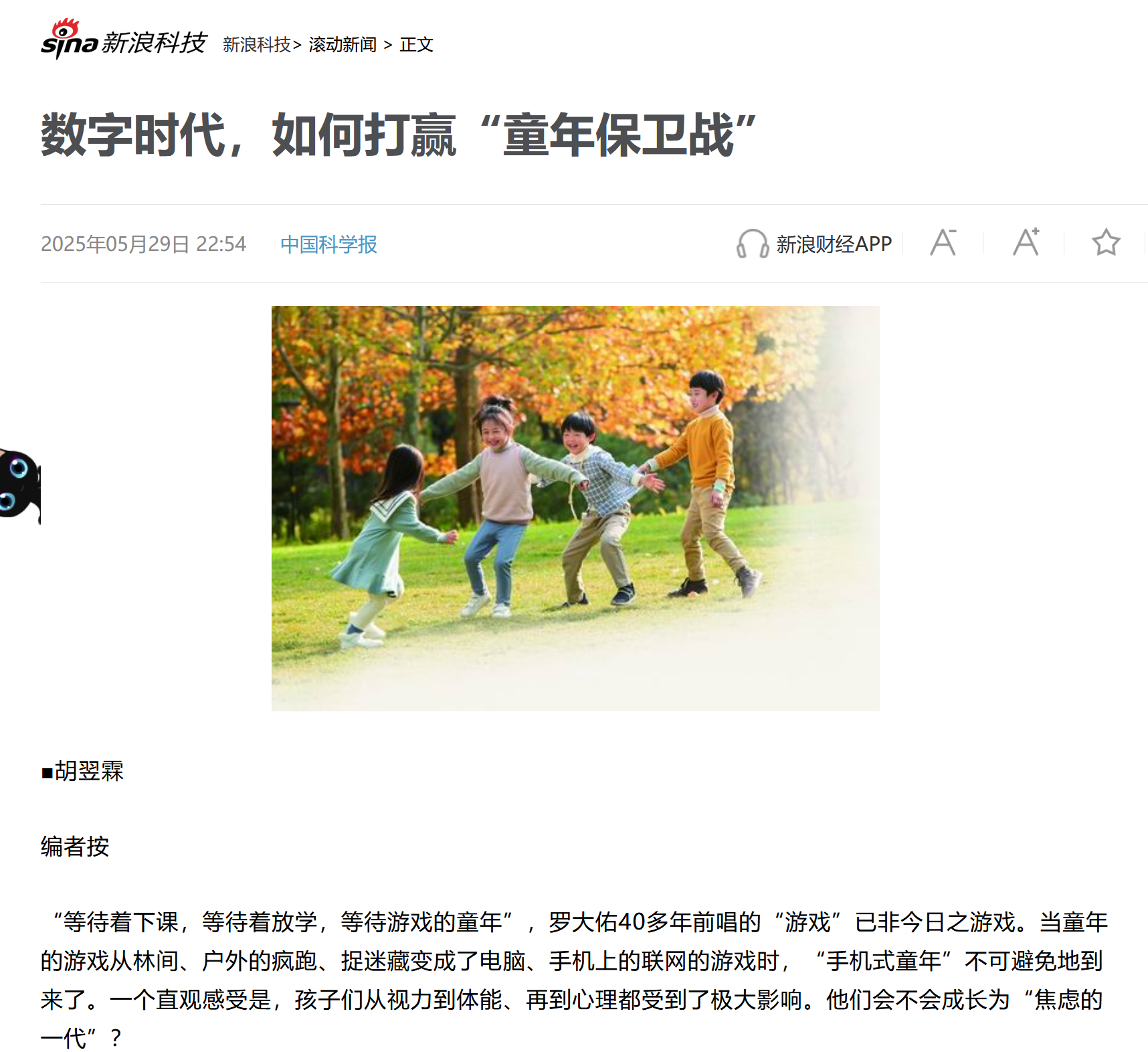
International Children’s Day on June 1 is approaching. The holiday was initiated by the Soviet Union, originally to commemorate the children persecuted in the Lidice massacre of June 1942; later it became “International Day for the Protection of Children,” aimed at protecting children’s rights to survival, health care, and education, and at opposing the hiring of child labor.
As for the right to survival and the right to health care, adults ought to have those too. What is truly special about children is their right to learn, or rather their right to education. Adults of course can also engage in lifelong learning, but they no longer need special protection in that respect; for children, however, the learning environment needs to be protected by society as a whole. Modern society must create a good learning environment for children and prohibit child labor and other forms of abuse.
Niel Postman’s The Disappearance of Childhood (often regarded as a companion volume to the more famous Amusing Ourselves to Death) is a classic work on the modern condition of children. Postman’s insight came from his distinctive perspective on intellectual history and media history. He pointed out that “childhood” is a historical concept: it is a product of the print age, did not exist in antiquity, and is about to disappear in the electronic age.
The “battle to defend childhood” in the industrial age
—the tug-of-war between school and factory
Postman believed that printing created “childhood” because print shaped a specific environment for “learning,” in which the extent to which one had undergone adequate training in reading and writing widened the gap between children and adults. Postman called this the “knowledge gap.”
Of course, there are many points in Postman’s argument that deserve debate. For example, he understood “knowledge” too narrowly, emphasizing only paper-based knowledge carried by print while ignoring other forms of knowledge, such as bodily skills and social knowledge (etiquette, ethics, and so on). In fact, in ancient cultures, the broader knowledge gap formed by bodily ability and social relations likewise shaped corresponding concepts of “children,” which is why from ancient tribes to ancient dynasties there were rituals similar to “coming-of-age ceremonies.”
Still, Postman was right to reveal the historical nature of the matter: even if we argue that ancient cultures also had “childhood,” we must acknowledge that as modes of learning change, the idea of “childhood” and children’s social situation change as well.
In a certain sense, the elevation of “paper knowledge” and the devaluation of bodily skills is itself a historically conditioned tendency. In antiquity, it was popular only in countries with a civil-service system such as China, and of course this also depended on ancient China’s papermaking and printing technologies. In the West, meanwhile, the spread of Gutenberg’s printing press and the subsequent Scientific Revolution greatly enhanced the status of paper knowledge. By the time of the Industrial Revolution, paper knowledge was further strengthened, while bodily skills depreciated: factory workshops did not need many experienced master craftsmen; instead, they needed large numbers of workers who could adapt to foolproof, mechanical operations. In the emerging industrial production process, the bodily difference between women and children was no longer especially significant.
Many profit-driven factory owners would rather hire the cheapest child laborers than experienced old craftsmen. For example, in the 1830s, about 50 percent of workers in Britain’s textile industry were children. Child workers were paid far less than adult men—at the lowest point, even only one-sixth as much as adults—but the work was harder, with working hours as long as 18 hours a day, and they often performed dangerous tasks—for instance, using their small size to crawl into running textile machines to clear out cotton lint. Ironically, factory owners at the time advertised their large-scale hiring of children as a form of “social welfare,” because without these “kind deeds,” unemployed or impoverished families would have been unable to make ends meet.
So in the industrial age, aside from wartime, peacetime also required a “battle to defend childhood.” Specifically, the crisis of childhood lay mainly in the tug-of-war between school and factory. The new environment raised the difficulty of learning while lowering the threshold for work, and society in turn had to keep children confined within school so as to prevent them from entering the adult world too early.
But many children, once grown, still had to enter the factory, and most of the paper knowledge they had painfully studied for more than ten years in school could not be put to use. If that is the case, why not let them enter the factory early and “take the shorter route”?
One reason is that we try, as far as possible, to protect the “possibilities” of children fairly. If compulsory education were not enforced, poor families would always be more inclined to send their children to work as early as possible—as in the early days of the Industrial Revolution. But if that happened, workers’ children would remain workers forever, and society would inevitably become rigid.
Learning means infinite possibilities. Of course, many possibilities are abandoned after only a tentative try, which is exactly why learning in childhood always seems “useless.” But if one has never had the chance to encounter these bodies of knowledge, how can one determine that one is not suited to those paths? So before everyone learns how to give up, they must first learn how to read the options that life presents. That is the highest mission of compulsory education—to cultivate in every child the vision and ability to decide on the choices of their own life.
The “battle to defend childhood” in the electronic age
—the contest between school and television
By the time of the “electronic age” in Postman’s account, the crisis of childhood had changed. Compulsory education had long since taken root in people’s hearts; at least in highly industrialized developed countries, child labor was no longer a widespread problem. But in Postman’s view, childhood had instead become precarious, because the new enemy was stronger still—the crisis of childhood changed from a struggle between school and factory into a struggle between school and television.
Postman believed that television was replacing school as children’s “first classroom,” but unlike orderly, well-structured schooling, television is not divided by grade level; television programs always try to cater to a general audience of men, women, the young, and the old alike. More importantly, unlike paper knowledge, which emphasizes logic and coherence, the information conveyed by television is fragmented and emotional. Postman said: “In school, two powerful technologies compete uncompromisingly for control of the student’s mind. One side is the world of printed words, whose emphasis is logic, sequence, history, exposition, objectivity, detachment, and discipline; the other is the world of television, which relies on images, stories, vivid realism, simultaneity, closeness, immediate gratification, and rapid emotional response.”
Here, however, Postman’s attitude is still open to question, because he regarded the emotionalization of life as a disaster. But for a sound personality, abstraction and reality, objectivity and subjectivity, discipline and laxity, reason and emotion—these opposed elements are not either-or; they should complement one another and remain in balance. If television rescues children from an excessively rationalized school life, that may not be a bad thing.
Moreover, television’s suitability for men, women, the young, and the old alike made it replace the fireplace as the “focal point” of family life. For children, watching television often became a family social activity; through television, children found common topics to share with relatives or friends, enriching their social world.
Of course, the key lies in “balance,” and this may well have been Postman’s own concern. In his early breakthrough work Teaching as a Subversive Activity (1969), Postman in fact advocated that educators embrace new media more proactively. But in Teaching as a Conserving Activity (1979), written ten years later, Postman made a notable turn, advocating that educators resist the erosion brought by new media. In that book he introduced an ecological perspective and argued that we should “protect tradition in an environment of innovation, and promote innovation in a society bound by tradition.”
So in the electronic age, it is not that the secularization, entertainment, and emotionalization brought by television are bad in themselves; rather, they disrupt the balance and weaken the power of schools. Therefore, the educational system formed since the industrial age must keep pace with the times and continuously make new responses to changes in the times and environment.
The “battle to defend childhood” in the digital age
—schools struggle to resist the internet
Today, the environment of the times has undergone another drastic transformation. Television has already become an obsolete medium, so in the new environment of the digital age dominated by the internet and smartphones, what new crises does childhood face?
First, many of the features of television that Postman warned about have not disappeared in today’s online media; on the contrary, they are even more pronounced—for example, fragmentation, emotionalization, and anti-intellectualism. And with the help of smartphones, the influence of new media can slip in anywhere and everywhere, making it even harder for parents and schools to control.
Second, the internet economy blurs the boundary between producers and consumers and removes the threshold for children’s participation. On social media, a new phenomenon has even appeared: “digital child labor,” that is, children may become stars in “self-media” from the day they are born. For example, American boy Ryan Kaji was able at age 9 to earn over 100 million yuan a year through a self-media channel. But even worse are many children from lower social strata: although they do not make much money, their parents still bring them onto self-media platforms. On short-video platforms we can find countless monetized children’s accounts, many of which even use soft-core sexual content as a selling point.
Moreover, smartphones are no longer the focal point of family life in the way television once was. In the digital age, family life has long since lost any focal point at all. Husbands and wives do not need to fight over the remote; instead, they can lie in the same bed yet dream different dreams, each scrolling their own phone; every child can immerse themselves in their own world. The mass of customized media information makes it hard to form shared memory, and instead intensifies social division. If the emotional character of television mainly served to generate resonance, then the emotional character of the internet tends more toward inciting antagonism.
In addition, the development of AI is upending the meaning of “learning,” because AI has already learned how to “learn.” Not only are human bodily skills being depreciated, paper knowledge is also rapidly losing value. Many mental tasks are being replaced by machines, whereas bodily skills and social relations are harder for machines to replace. People have discovered that school education does not always increase their room for choice; “graduation means unemployment” is becoming increasingly common.
In the struggle between school and factory, school won; in the struggle between school and television, the balance could roughly be maintained; but in the struggle between school and the internet, school is collapsing.
To defend childhood,is to defend humanity’s possibilities
But I believe it is too early to say that “childhood is dead.”
On the one hand, school education is being reformed. When making a living and finding a job are no longer the main tasks of school education, education can instead return to its true nature—returning to the goal of cultivating a full and healthy body and mind. Schooling need not be centered only on paper knowledge, nor need it rely only on logic and discipline to prevail; on the contrary, emotional education can also become part of school teaching, nurturing temperament, cultivating sensibility, and forming character—tasks that can be shared by families and schools alike.
Postman believed that in the print age “reading became an antisocial act,” and therefore school was antisocial; for a child to be in school meant postponing entry into society. Various emotionalized domains such as television, family, and society were tied together in opposition to the rationalized school. But in the digital world, the opposition has changed—the opposition between school and society has become an opposition between the lifeworld and the digital world, or between life and algorithms. So in the new environment, we may need new alliances: school can ally with family and society, joining forces to create a balance against the digital world.
In Postman’s view, children are defined as adults in deficit: children are “not-yet-adult,” “non-rational,” and become children because of their lack of literacy, logical ability, and knowledge. Scholars had long since criticized this kind of “male-chauvinist” arrogance on Postman’s part. For example, in his book devoted specifically to criticizing Postman, Growing Up with Electronic Media, David Buckingham emphasized that “children and young people are both in a ‘pioneering’ position in the current development of electronic media.”
Unlike the “knowledge gap” of the print era, in the digital age the “digital gap” between children and adults, or the digital generation gap, is a reverse gap; that is to say, in adapting to digital technology, children have the advantage over adults. Because adults’ ways of life tend to become stable, they are more inclined to regard new technologies as useful tools, but find it difficult to see them as toys that enrich the pleasures of life and to explore the possibilities they contain.
Digital technology certainly carries the risk of trapping people in information cocoons and illusory worlds, but compared with typical industrial technology, it offers a greater chance of liberating people from monotonous, tedious, repetitive mechanized labor and rediscovering the richness of the world.
In the industrial age, as Marx and other scholars have criticized, humanity faced the crisis of alienation: healthy reason was alienated into “instrumental reason,” and people were turned into “beasts of burden,” “resources,” “gears.” Once everyone reached adulthood, it was as if they were already set in place, assigned to a workstation in the social machine, running along a fixed track and endlessly producing labor power. If it were not for the balancing effect of electronic media, this highly rational, abstract, and orderly way of life would have driven people crazy long ago.
Children’s perspective, by contrast, is naturally infused with a non-utilitarian quality: they approach technology with the attitude of a toy rather than a tool, opening themselves toward possibilities rather than certainties. In this sense, if children can be allowed to participate more actively in the frontier practices of technological development, perhaps humanity’s future life will become richer and more colorful.
In addition, children are friendly both to technology and to nature, and in children we can always see the freshest vitality. This vitality is different from the labor power of “beasts of burden”; rather, it is manifested as interest in and enthusiasm for the world as a whole.
AI may be able to replace human beings in doing all kinds of work, but it can never replace human beings in enjoying life. To enjoy life, we need both to learn knowledge so as to identify the possibilities of life, and to possess abundant emotional strength, so that we can be moved by all kinds of beautiful things. Many adults, after being “beaten down” by society, lose the ability to be “moved,” and cannot even muster the enthusiasm to play games; but when they begin raising children, or simply watch children at play, their passion for life very likely reignites.
In short, I believe and hope that in the digital age, childhood will not disappear; on the contrary, it will become a key force for confronting the crises of the age — to defend childhood is to defend humanity’s possibilities.
Translated from the Chinese original with AI assistance. The original text is authoritative.