
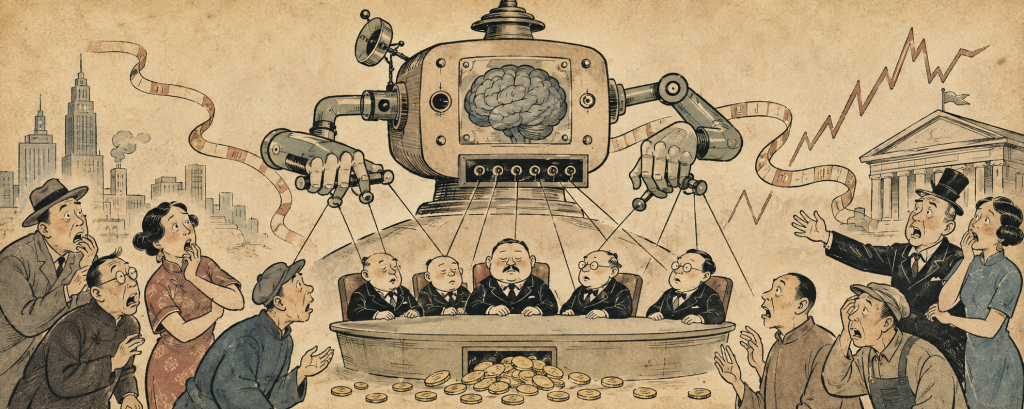
At the Jackson Hole Economic Policy Symposium in August 2026, Princeton University economist Markus Brunnermeier proposed a future that would make central banks uneasy: AI agents in financial markets may understand central banks faster and more deeply than humans do.
These agents can simultaneously analyze macro data, policy documents, historical decisions, officials’ speeches, and market reactions, inferring the policy function of the central bank from all of it; human central banks, by contrast, may not even be able to understand the market behavior formed collectively by countless AI agents. Brunnermeier called this situation “asymmetric understanding,” and on that basis imagined that central banks might in the future have to retreat from fine-grained discretion to simpler, harsher rules, or even reconsider the steadily increasing policy transparency of the past several decades.
But the free scholar Hu Yilin thinks this worry asks the question the wrong way around.
If AI can not only understand central banks faster than ordinary investors, but even process economic information more comprehensively than central bank officials, then what really needs explaining is not how central banks can avoid being read by AI, but why human officials should still monopolize monetary policy.
If all the things central banks say can be understood by AI faster than by humans, then why not just let AI do the talking? Why still grant this tiny handful of people the authority at the top of the world?
This is not a complete policy design for creating an “AI Federal Reserve.” Hu Yilin is first and foremost a Bitcoin supporter. He fundamentally opposes fiat-currency monopoly, and also opposes the continuous regulation of money supply and interest rates by central institutions. In his ultimate view, money should be freely chosen by the market just like any other commodity; the best monetary policy is no monetary policy.
But he is willing to temporarily accept the premises of central-bank supporters: suppose the macroeconomy really does need a central institution to continuously adjust policy according to inflation, employment, credit, and market changes. Even so, it cannot be assumed without argument that a dozen or so officials are necessarily better suited than AI to do this job.
Why should the “free market” take its cue from a tiny handful of people?
Modern central banking has an extremely paradoxical appearance.
On the one hand, the global economy is called a market economy. Entrepreneurs are supposed to judge demand by prices, investors are supposed to bear risks themselves, and market participants are supposed to discover information through dispersed transactions.
On the other hand, investors, entrepreneurs, and governments across the world must keep their eyes fixed on a few central bank officials. They study interest-rate decisions, meeting minutes, and changes in wording; they judge whether a given committee member is more “hawkish” or more “dovish”; they analyze the chair’s tone, pauses, and even facial expressions at press conferences. A few sentences may change global asset prices, corporate financing costs, and the housing burden of countless families.
“Investors around the world, and even entrepreneurs, are watching a tiny group of people at the Federal Reserve, and every move they make, every frown and every smile, can shake the entire global market,” Hu Yilin says. “And yet we call such a global market a free market. Isn’t that ridiculous?”
Central banks usually explain this power as professional governance. The U.S. Congress sets the Federal Reserve the dual goals of price stability and maximum employment, while granting it operational independence; the Fed’s own explanation is that independence can reduce short-term political pressure, make decisions more focused on the long term, and ground them in data and analysis. (Federal Reserve System)
But legal authorization can explain only where central bank power comes from; it cannot prove that the current system is eternally reasonable, still less prove that central bank officials are naturally superior to other possible decision-making mechanisms in cognitive capacity.
If monetary policy essentially depends on data processing, model comparison, risk forecasting, and scenario simulation, then AI clearly poses a direct challenge to the epistemic authority of experts. It can handle far more information than the human brain can contain, compare large numbers of economic models, and it will not change its conclusions because of personal reputation, career prospects, personality conflicts, or momentary emotions.
Hu Yilin does not ask us to first prove that some off-the-shelf model is already capable of independently managing the dollar. What he raises is a more basic question of burden of proof: in the past, people took it for granted that an expert committee should make the decision, and merely demanded that any new system prove itself nearly perfect; after the emergence of AI, that assumption no longer holds. Human central banks must also prove that they are smarter, more stable, more transparent than AI, or at least more trustworthy.
“The irony is that we seem to be the ones who should first apply these requirements to human beings.”
If AI cannot rank values for the whole public, can central-bank experts?
Those who oppose AI decision-making will first point out that monetary policy is not a matter of pure calculation.
If lowering inflation requires raising unemployment, and maintaining employment may continue to drive up prices; if bailing out financial markets can reduce a short-term recession but will push up asset prices and widen the gap between rich and poor, then policymakers must make trade-offs between different interests. AI can calculate consequences, but it has no authority to decide which consequence is more worthy of pursuit.
Hu Yilin accepts this premise, but then immediately asks:
“AI has no right to perform value ranking, but do a tiny number of central bank experts have the right to rank values on behalf of the whole public?”
The Federal Reserve in particular emphasizes that it is independent of the president and of short-term political pressure. Hu Yilin does not therefore argue that the president should directly decide every rate hike or rate cut. He mentions the president only in order to compare political representation: after all, the president receives authorization through a nationwide election, and his or her value orientation at least reflects voter choice to some extent; central bank officials cannot merely because they have credentials in economics claim that they are naturally more legitimate in making trade-offs among employment, prices, asset prices, and wealth distribution.
Monetary policy directly set by the president could be terrible, but that cannot in turn prove that decisions made by an independent expert committee are necessarily better.
In the second-best system Hu Yilin imagines, value goals and technical execution should be separated. Society determines the rough goals and weights through some open, democratically legitimate procedure; AI then selects the monetary policy most consistent with those goals based on data and forecasts.
This does not mean the president can order the system to “pump liquidity” before an election. Political organs can only change the value weights and the authorization framework, not directly specify every interest-rate move.
Hu Yilin is not trying to design a complete system here. What he wants to reveal is that the current central banks are already performing value ranking; they just often hide value choices behind the four words “professional judgment.” The arrival of AI makes this mixture impossible to avoid for the first time: if value judgments must obtain political authorization, then experts cannot monopolize them; if concrete execution is mainly a matter of calculation, then experts may not have any advantage over AI.
The human mind is not a simple rule, but the hardest black box to audit
Another common objection is that AI models are too complex and opaque to be entrusted with public power.
Hu Yilin thinks this comparison imagines human decision-making as far too simple.
Real-world monetary policy is not a matter of plugging a few data points into a public formula. A committee member’s economic beliefs, historical experience, risk appetite, personality, concerns about reputation, and fear of taking responsibility all enter into the decision. Alliances, compromises, and mutual persuasion within the meeting also change the final outcome.
What the market calls “predicting the Fed” is, to a large extent, just trying to read people’s minds.
“No matter how much big-data computation AI does, it can’t match the complexity of reading people’s minds. So letting AI make the call is already a simplification of the rules. I believe it is still worth simplifying further, until monetary policy itself is abolished; but AI replacing human minds is definitely the first step in simplification.”
Large models can of course also be very complex. But the model’s data, parameters, versions, outputs, and historical performance can at least be recorded. Different researchers can reproduce tests, propose competing models, and trace whether a given policy change came from changes in data, parameter adjustments, or a reset of objectives.
Human psychological activity, however, is very hard to leave behind similarly clear traces. An official can produce a seemingly complete set of reasons after the meeting, but the public has difficulty knowing whether those reasons were the true cause of the decision or merely a post hoc rationalization.
Therefore, the transparency Hu Yilin speaks of does not mean every ordinary person must be able to read all the models. The issuance mechanism of modern fiat currency, bank balance sheets, and the relationships among M0, M1, and M2 are not knowledge that most people could fully master in the first place.
What he advocates is establishing transparency by reference to academic practice: papers, data, model assumptions, and methods should all be open for inspection, and the professional community should be able to test, refute, and reproduce them. The public does not need to personally understand every formula, but it must be allowed to challenge official models through different researchers, and complexity must not be turned into a reason to refuse audit.
Hu Yilin believes this kind of debate is at least more like a rational discussion than the political theater currently revolving around central bank officials. Previously, U.S. President Trump repeatedly publicly insulted then-Fed Chair Powell, calling him “stupid” and “too late,” while demanding large interest-rate cuts. (Reuters)
“If you move public debate into the scientific realm, even if it’s not necessarily more objective and rational, at least it can be a bit more decent!”
Politics will not disappear because of this. Which data the model adopts and how it sets its objectives may still involve value judgments. But those judgments can be written down, fixed in place, and subjected to challenge, rather than continuing to hide in the unpredictable minds of a few officials.
Before asking AI to take responsibility, first ask who took responsibility in 2008
“If AI makes a wrong decision, who is responsible?” is often regarded as the hardest question for an AI central bank to answer.
Hu Yilin believes the most ironic thing about this question is that it presupposes that the current central bank system already has a real and effective mechanism of individual accountability. The 2008 financial crisis dealt a heavy blow to the global economy, causing massive unemployment, bankruptcies, and housing losses. During the crisis, the U.S. government and the Federal Reserve bailed out large financial institutions on the grounds of preventing systemic collapse; the total amount of federal assistance authorized for AIG alone reached $182.3 billion. The GAO later acknowledged that while this intervention avoided disorderly failures, it also sparked major controversy over whether the government had taken on too much risk and whether AIG should have been allowed to enter bankruptcy proceedings. (U.S. Government Accountability Office) The public bore the long-term consequences of the crisis and the bailout policies. Most large financial institutions were able to continue operating, asset prices recovered under subsequent loose policies, but the wealth gap became even more central to social controversy. Against this background, Hu Yilin rejects an easy comparison: as if human officials would be held responsible for major mistakes, while AI would be the one to create an accountability vacuum.This challenge is not an argument that after every economic downturn someone in office must be sent to prison. On the contrary, Hu Yilin believes that when complex public policy produces undesirable results, that does not necessarily mean a scapegoat must be manufactured. As long as the AI is entrusted through a democratic process, the model operates according to public authorization, no one tampers with the data, conceals conflicts of interest, secretly changes the objectives, or continues to use the system while knowing it has failed, then a policy failure by itself does not necessarily require assigning personal responsibility. Democratic elections likewise do not guarantee success every time. Voters elect a president who advocates reform, and if the reform later fails, one cannot simply infer from the poor outcome that the president committed a crime. What should be pursued is fraud, abuse of power, and violations of procedure, not the forced attribution of complex social consequences to one particular person. But precisely for that reason, one also cannot use “AI cannot bear responsibility like a human” as a pretext to preserve the status quo. Hu Yilin’s counterquestion is: what responsibility do existing human officials actually bear that AI cannot bear? “Since there has never really been any accountability anyway, what difference would introducing AI make?” AI does not need to be fashioned into a personal subject capable of apologizing, resigning, or going to jail. As long as the authorization process is legitimate and the operation is transparent, society should collectively bear the consequences of its own choice of such a system.When have Federal Reserve officials ever been held accountable? The 2008 financial crisis affected far more than just hundreds of millions of people—so what happened? Was there even one Federal Reserve or SEC official held accountable for inadequate supervision or negligence? Was there even one?
The market understanding the rules is not the problem; the problem is that central banks can be blackmailed by financial giants
Brunnermeier is also worried that when AI can precisely infer a central bank’s reaction function, financial institutions may actively create pressure, forcing the central bank to rescue the market. Hu Yilin believes that this phenomenon is likewise not a new problem brought about by AI. Markets have always adjusted their behavior around laws, tax rates, trade agreements, and regulatory rules. Businesses more accurately understanding policy, and investors pricing policy in ahead of time, is already part of how markets work. “What exactly is so bad about the market trading ahead based on these rules? Making better use of the rules is precisely what good merchants are good at—what’s so strange about that?” If a policy rule becomes ineffective once the market understands it, the problem is not necessarily that the market knows too much; it may be that the rule itself is not good enough. Especially in the so-called “too big to fail” situation, large financial institutions have long learned to pressure human officials: if a bailout is refused, payment disruptions, credit freezes, and financial-system collapse may follow. Human officials, due to conflicts of interest, public pressure, and fear of bearing responsibility for disaster, are not necessarily any better than AI at resisting such blackmail. Hu Yilin believes that what really needs to be abolished is not policy transparency, but the central bank’s power to provide exceptional bailouts to specific institutions. “The government should be thinking about how to rescue the public after a large financial institution goes bankrupt, and never about how to stop a large financial institution from going bankrupt.” Banks do in fact perform part of an infrastructure function. Account records cannot be lost, basic payment and settlement systems cannot suddenly shut down, and the deposit insurance already promised to small depositors must be honored. Therefore, the government can establish temporary receivership mechanisms similar to those used when public-service companies such as water and electricity providers go bankrupt. But protecting the ledger and the payment network does not mean protecting the original financial institution. Shareholders can be wiped out, management can lose control, and the institution can be split up, sold, or liquidated. Large deposits, claims, and investments beyond the insurance limit may also suffer losses, because these are precisely the risks market participants ought to bear when choosing financial institutions. What the government needs to protect is ordinary people’s daily lives and financial infrastructure, not a bank’s brand, stock price, or management positions. As long as this boundary is made clear, large institutions can no longer use “if you don’t save me, the whole society will collapse together” to win special treatment. Good rules should not fear being understood by the market, and they should certainly not rely on central bank officials making ad hoc decisions about who deserves to be saved.AI is not the central bank’s savior, but its revealing mirror
Hu Yilin does not believe that existing central banks really have the courage to hand core monetary power over to AI. Therefore, the “AI central bank” is, for now, first and foremost a thought experiment. But this thought experiment has a particularly destructive force. If monetary policy really is a scientific task accomplished through data, models, and prediction, then as AI capabilities improve, it becomes increasingly difficult to defend the monopoly of decision-making by a small group of human experts. If monetary policy cannot be entrusted to AI because it contains irreducible value choices, distributional conflicts of interest, and political judgment, then the central bank also should not continue to conceal the political power it in fact exercises under the name of “technological neutrality.” Whichever answer one chooses, it will weaken the mysterious status of the current expert central bank. The path Hu Yilin envisions has several stages: first replace the un-auditable human whims of a few officials with AI; then replace the single model with multiple, competitive, decentralized AIs; and finally let the market itself replace all monetary policymakers, while challenging fiat currency monopoly with free currencies such as Bitcoin. He even believes that sufficiently intelligent AI may not necessarily become a better central planner. It may also recognize earlier than the human officials defending the current system that the complexity of the economy is not a reason to strengthen central control, but a reason to abolish it. “Rather than hoping for human self-revolution, I would rather believe that AI is more revolutionary.” An AI central bank may well improve the fiat-currency system, thereby extending the life of central banks. But in Hu Yilin’s view, that is no reason to reject improvement. A system that ought eventually to be abolished does not need to be deliberately handed over to more capricious, less transparent human beings to manage before it is abolished.The former conclusion points to the ultimate goal: abolish the central bank, abolish the fiat-currency monopoly, and return money to free choice. The latter conclusion, however, is aimed at the realistically second-best option: if society temporarily insists on central control, then at the very least it should require human officials to prove why they are smarter, more reliable, and more transparent than AI, rather than letting expert status itself become the reason for power. Hu Yilin acknowledges that the current central banking system has usually gone through legal and democratic procedures. But democratic authorization is never permanent authorization. Movements such as Occupy Wall Street after the financial crisis have already expressed public dissatisfaction with the existing financial order; what is truly lacking is a sufficiently clear alternative capable of competing with the old system. “I first call for thoroughly overturning the old financial system with Bitcoin, and second, I support using AI to improve things within the old framework. The former is the final solution, and the latter is the entry point for inspiring and attracting broader public support for reform. Proposing these views and discussing them is itself an effort to influence public opinion—that is the mission of intellectuals.” The Jackson Hole paper is worried that AI may make the market understand the central bank better than the central bank understands itself. But the question Hu Yilin raises is far sharper: **When AI can already process more data, compare more models, and reduce more personal caprice than central bank officials, why is it AI that needs to be scrutinized, rather than that small group of people who already hold global monetary power yet almost never pay a personal price for failure?**I support two conclusions at once: first, it is best not to intervene; second, since intervention is necessary, it should be done by AI.
Translated from the Chinese original with AI assistance. The original text is authoritative.