
下 week starting next week, the “History of Science” class will move to Jiao Ba 306
In the last class, we went from primitive humans to the four great ancient civilizations. We mentioned that human history is, in a sense, the history of technology; no human culture is cut off from technology. Where there is technology, there is also “knowledge,” and every culture passes on its own knowledge. By the time we get to the ancient civilizations of Babylonia and Egypt, people’s knowledge and skills had already reached a very high level.
But I still regard ancient Greece as the origin of “science.” That is to say, the “science” I mean here is different from ordinary technological achievements, and not merely the sum total of various kinds of knowledge. In more colloquial philosophical terms, “science” also implies a distinctive “worldview” and “methodology.” Of course, the worldview and methodology of science have never been uniformly fixed, so more accurately, “science” signifies a certain style or tendency in how one conducts oneself in the world. We believe that the “character” of science took shape first in ancient Greece.
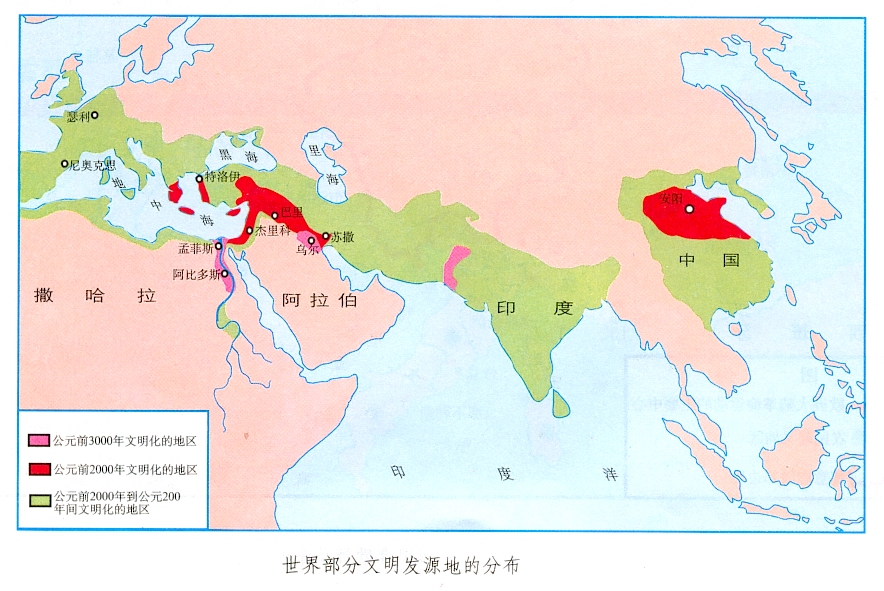
Ancient Greece was a secondary civilization. It did not, like the four great ancient civilizations, develop natively out of the earliest agricultural settlements; rather, it lay within the sphere of influence radiating from the civilizations of Mesopotamia and Egypt, and from the very beginning it developed under the influence of other civilizations.
A secondary civilization does not mean a short history. In fact, in terms of antiquity, ancient Greece was no less venerable than China. The Bronze Age culture of the Aegean region can be traced back at least to 3000 BCE. Around 2000 BCE, Crete had already formed cities centered on large palaces, which means that by then a certain structurally complex centralized society had already taken shape; this is the so-called Minoan civilization. By the fifteenth century BCE, the Greek-speaking Mycenaeans from the Greek mainland had conquered Crete, and the merged Minoan-Mycenaean culture became the first high point of Greek civilization. Linear A and Linear B appeared successively. But after about 1200 BCE, for reasons unknown, Mycenaean civilization suddenly declined. Remains from this period are scarce, the complex centralized society disappeared, and the only written materials from the Dark Age are the famous Homeric epics. These two epics are generally believed to have taken shape from the end of the Dark Age to the beginning of the Archaic period. The Trojan War recounted in the epics may have occurred at the beginning of the Dark Age, but to what extent the Homeric epics can be regarded as historical material remains highly controversial.
Only around 800 BCE did Greek civilization undergo a phoenix-like rebirth. The new Greek culture formed a distinctive social organization based on the polis, or city-state; the first recorded Olympic Games began at that time, and the Greek alphabet, derived from the Phoenician alphabet, also came into use.
The Phoenician alphabet is the prototype of nearly all Western alphabets, and the major improvement of the Greek alphabet over Phoenician was the addition of vowel letters. The Phoenician alphabet (including the later Arabic alphabet) is a consonantal script, that is, it records only consonants and not vowels. Imagine what happens if you remove the vowels from English—for example, science becomes scnc, history becomes hstr. Moreover, ancient writing often had no obvious spaces. To read such an alphabetic script, just like reading pictographs, one had to infer from context. The Greek vowel-based script, however, made it possible for “words” to stand free of situation for the first time. The Greek way of analyzing and abstract thinking perhaps also benefited from this.
From 800 BCE to 480 BCE—generally marked by the expulsion of Athens’ last tyrant—is called the Archaic period, named after its artistic style. From 480 BCE to the death of Alexander the Great in 323 BCE is called the Classical period of Greece, the most flourishing period of Greek civilization, when Greek science, art, and democratic politics all reached their most brilliant heights.
After Alexander the Great’s eastern campaign and his early death, Greek culture expanded eastward and eventually dissolved into various cultures. This is the so-called Hellenistic period, which we will leave for the next class.
Bronze Age (approximately 3000 BCE–1200 BCE) (Crete, Linear A: 1800 BCE to 1450 BCE)
Dark Age (approximately 1200 BCE–800 BCE) (Homeric epics)
Archaic period (approximately 800 BCE–480 BCE) (Greek alphabet, Olympic Games: 776 BCE)
Classical period (480 BCE–323 BCE)
Hellenistic period (323 BCE–30 BCE)
Compared with ancient China, the most brilliant period of Greek civilization roughly corresponds to the Spring and Autumn and Warring States periods in China, when the Hundred Schools of Thought contended. It seems that Eastern and Western civilizations started from the same starting line. But a radically different style was evident from the very beginning. The focus of the Hundred Schools of Thought in China lay more in bringing peace to the state and governing the country, whereas what the Greek philosophers disputed was natural philosophy. From then on, scholarship in East and West took different paths, and the eventual rise of natural science in the West was by no means accidental. As for the question of Chinese science, after we finish the Greek section, we may insert a special topic to discuss it.
Xia dynasty (approximately 2100 BCE–approximately 1600 BCE) (Erlitou site, earliest bronze artifacts)
Shang (approximately 1600 BCE–1100 BCE)
Western Zhou (approximately 1100 BCE–771 BCE)
Spring and Autumn and Warring States (770 BCE–221 BCE)
 Linear B
The scope of Greek civilization was far broader than that of today’s Hellenic Republic. Its cultural centers were mainly clustered around the Aegean Sea—that is, the Greek mainland, Crete, and Asia Minor (the coastal region of western Turkey today)—but its colonies were distributed along the shores of the entire Mediterranean and Black Seas. Clearly, unlike other ancient agricultural civilizations supported by great river basins, Greek civilization was a commercial civilization supported by the sea.
The Greek mainland is mostly hilly terrain, with less than 30 percent suitable for cultivation, and the land is poor; grain production could not sustain self-sufficiency. Therefore the Greeks needed to “import” grain from Western Asia and North Africa. They mainly grew olives and grapes, and exported olive oil and wine.
Before Alexander the Great, what we call Greek civilization never formed a unified centralized empire; it always took the form of small states with “a few people and little land,” organized as city-states. The largest city-states, such as Athens and Sparta, may have reached populations of several hundred thousand at their peak, but generally speaking, small city-states had only a few thousand people. Of course there were various alliances among city-states, large and small, but inexplicable wars were even more common.

What was a typical Greek city-state like? We can glimpse it through a negative description. A Greek named Pausanias once complained about the city of Panopeus, saying that it was ridiculous: “It is hard for us to find such a city where there is no town hall, no gymnasium, no theater, no marketplace (agora), no springs collected together and flowing into a spring house” (“The Greeks and Greek Civilization,” 102 [51]). This sentence already points to several basic elements of a typical Greek city-state.
The town hall was the place where public affairs were deliberated. In a democratic city-state, every free citizen had the right to take part in political discussion. Of course, it was not like modern democracy with universal suffrage and voting and all that; the Greeks did have voting, but many times decisions were made by acclamation or by lot, and there was no strict formal procedure. But the key to democracy is not that everyone can vote; it is that everyone can fully express themselves.
The ancient Greek marketplace was not simply a place to buy and sell things. It generally referred to an open square where people could hawk or purchase goods, but more often they could wander around, and whether they met people they knew or did not know, they could chit-chat; there was also always someone gathering a crowd to deliver a speech, spreading or peddling his learning.
The Greek character was basically that of people who had eaten their fill and had nothing better to do. This is recorded even in the Bible: in Acts, when Paul went to Athens to preach, it says, “All the Athenians and the foreigners who lived there spent their time doing nothing but talking about and listening to the latest ideas.” (Acts 17:21)
The Greek gymnasium was the most distinctive. The Greeks were an intensely sports-loving people, and almost every Greek free citizen had to undergo systematic athletic training from childhood. The gymnasium was of course an indispensable public space in every city-state. The word Gymnasium (gymnós) originally meant “naked”; Greek men generally trained and competed in the nude, face-to-face, full of homoerotic energy… Yes, homoerotic energy. The Greeks were extremely devoted to male homosexuality; the so-called Platonic love refers to purely spiritual male homosexuality, more or less the meaning of boys’ love.

Clearly, the Greeks’ diligence in physical training was not merely for health and defense of the homeland. The Greeks were a people who loved games and were passionate about competition. Horse racing, boat racing, running, wrestling, dance competitions, speech contests, debate contests, and so on—the Greek life-world was filled with all sorts of competitions.
Of course, the most important and most widespread among them were the various athletic contests represented by the Olympic Games. The Olympics even became a reference point for Greek chronology—for example, “the third year of the thirtieth Olympiad.” For a Greek culture composed of many city-states with different customs, only athletic competition could gather the passion of the whole people. During the Olympic period, the city-states would spontaneously cease fighting, not because the Olympics symbolized peace or anything like that, but simply because the Greeks did not want to miss this supreme contest. In fact, Greek wars were often not fought in order to seize territory; rather, like athletic contests, they were fought for the glory of victory. That is why the Greek city-states so often ended up fighting one another inexplicably: they fought simply for the sake of fighting. Slaves were not allowed on the battlefield; only free citizens were worthy of the glory of war. What the Olympics represented was not peace, but a higher level of contention, so lower-level contention had to make way for the highest contention.
It can be said that this boyish character—loving play, combat, and victory—which is concentrated most vividly in the Olympic Games, is the cultural spirit of the Greeks. What the Greeks called “virtue” meant “excellence,” and thus wisdom, courage, justice, and moderation all belonged to the sphere of virtue. The “excellence” pursued by the ancient Greeks was simple and straightforward: as Homer sang, “always to be first, to outdo others”; “no glory can surpass that of a living man gaining victory with his own hands and feet.”
One can imagine that the spirit of play is precisely the source of Greek freedom. First, the player does not seek utility, but gains inner joy in the game; second, the player respects fair rules, because if one defeats a weaker opponent by relying on extra power, one cannot obtain the joy of victory or the honor of the strong. Only by defeating an equally strong opponent under fair conditions can one display one’s excellence.
Speech and debate are also forms of competition, and relying on authority cannot display one’s excellence; only by laying out a reasoned and well-founded argument oneself can one make the opponent willingly submit. This too is probably one of the reasons why the Greeks valued reason and logic so highly.
Science and democracy were both born in this cultural soil that revered competition. Of course, science, which reveres contemplation and quiet observation, gradually moved away from this lively and combative style, but the spirit of competition never completely disappeared. Modern scientists, too, are enthusiastic about competing with their peers, and they will vie with one another for the honor of priority. Rather than imagining scientists as aloof old men at peace with the world, it is better to think of them as curious and combative big boys (do not accuse me of belittling women; in fact, from ancient Greece to the present, the main line of the scientific tradition has indeed been male-dominated, and a feminist model of science remains to be further explored).
 Fragment recording the names of Olympic champions
The Greeks take life as a game, all the serious things in life as a game, religion and the gods as a game, politics and the state as a game, philosophy and truth as a game.
——Hippolyte Taine
The influence of sports culture on science is not only spiritual, but also institutional. Around 385 BCE, Plato established the Academy in Athens, outside the city walls; it can be said to be the prototype of Western higher education institutions. The place name Academy commemorated a general of the same name, but Plato obviously did not set up his school on top of a tombstone. Plato’s Academy, and Aristotle’s Lyceum, were in many cases developed out of gymnasiums. Of course, there were exceptions: the Stoic school originally got its name because it taught under the colonnade in the Greek agora (stoa in Greek).
Compared with ordinary public spaces, a gymnasium was already in itself a kind of institution for training and educating the young, with a ready-made “student body” and established educational habits. So the sophists first of all worked their way into such institutions, where they preached and peddled their learning to young men in the lounge, and the young men were also happy to take part in these intellectual games in the intervals between physical exercise. Later on, philosophers naturally established their own schools here as well.
The so-called sophists, also known as eristic debaters, made their living by selling debating skills, including logic, rhetoric, and also a store of knowledge. Such professional teachers were obviously needed by a Greek culture that delighted in conversation and disputation. But Socrates tried to draw a clear line between himself and the sophists, styling himself a lover of wisdom (philosopher), and holding that he pursued wisdom, longed for wisdom, but did not claim to possess wisdom, much less peddle it. To pursue wisdom is like pursuing one’s beloved: “one may admire from afar but not toy with.” Socrates believed he had no real knowledge; the only knowledge worth mentioning was that he knew how ignorant he was. Then he spent all day wandering around looking for people to argue with, exposing those who thought themselves wise as in fact even more ignorant. He bothered many people, and “abducted” many young men as well; Plato was one of them. He studied under Socrates and wrote dialogues with Socrates as the protagonist, producing the first great classic in the history of Western philosophy. We shall sort these figures out a little later.
In our modern schools, physical education has become a side diversion alongside scientific instruction, whereas in ancient Greece the situation was exactly reversed: “science” was initially only a side diversion in physical schools. In fact, the word school in its present sense already meant leisure or free time in ancient Greece. It was not until after Plato, as the model of the academy gradually spread and as the classical Greek age that exalted athletics slowly came to an end, that science gradually replaced sport in status. The transformation from a physical school to a school proper perhaps hints at the dawn of a new culture. From then on, the main content of civic education shifted from training the body to developing intelligence. The purpose of education changed from bodily fitness to making the soul sound.

Whether in the physical school or the academy, Greek civic education was not intended to cultivate practical skills for making a living, but only to pursue excellence or to play intellectual games.
Besides basic grammar, rhetoric, and logic, the foundational subjects for the cultivation of the soul were the “mathematical” sciences, and only at the highest stage could one come into contact with philosophy. In ancient Greece, mathematics included four subjects: arithmetic (the theory of numbers), geometry, astronomy, and music (harmony). Notice that all of these are useless forms of learning. Arithmetic did not teach bookkeeping skills; it discussed number-theoretic problems such as odd and even numbers, prime numbers, square numbers, and so on. This discipline remains to this day one of the noblest and most useless of disciplines. Geometry was not concerned with whether π = 3.14 or 3.25; it only cared that π was a fixed value. What it studied was proof rather than measurement. The shift from Egyptian surveying to Greek geometry was a qualitative leap. The Greeks’ estimates of π may not even have been as accurate as those of the ancient Babylonians, but Greek mathematics stood alone, unprecedented before or after.
Legend has it that there was a sign at the entrance to Plato’s Academy reading “Let no one ignorant of geometry enter here.” Whether this legend is true or false, it is enough to show how highly Greek scholars valued mathematics. But the Greeks’ esteem for mathematics was completely different from the modern reason for saying, “Master math, physics, and chemistry, and you’ll have nothing to fear wherever you go.” In modern eyes, mathematics is the most basic tool: whatever specific research one undertakes, one needs to use mathematical tools. But in ancient Greece, mathematics was not nearly so useful, and what Greek scholars valued precisely was its uselessness. Legend has it that one of Euclid’s students (ca. 330 BCE–275 BCE) asked him what good there was in studying mathematics, and Euclid immediately took out three copper coins and gave them to him: you’ve gotten your good out of it, now get lost. Whether this story is true or false, only among the Greeks could such a story arise. The Greeks distinguished useless knowledge from practical skills, and took pride in uselessness while regarding usefulness as something to be ashamed of—an old tradition still partly preserved among modern mathematicians.
Wu Guosheng likens mathematics classes to the Greek “moral education” class: the purpose of mathematical education is not to enable students to master some skill, but to lead them to appreciate the preciousness of freedom and the allure of truth. Mathematical education does not inculcate any specious dogmas; rather, it shows students self-evident and eternal things, thereby inspiring them to believe in the power of their own reason and to yearn for immortal truth. Only by taking one’s eyes off the utilitarian real world and turning toward the world of pure ideas is it possible to become “a noble person, a pure person, a person who has escaped low tastes.”
The Greek tradition of scientific education continued. In the Middle Ages, the four mathematical sciences, together with grammar, rhetoric, and logic, were collectively called the “seven liberal arts” and became compulsory subjects in basic cultural education. Although in the Middle Ages the depth of these disciplines had all been greatly reduced, the so-called liberal arts still meant learning for freedom rather than for utility.

Earlier we talked about the social background and educational tradition of Greek science; the keyword was “freedom.” Freedom stands opposed to “utility.” In sport, freedom appears as the game spirit of relying on oneself to win; in scholarship, it appears as relying on oneself to pursue useless truth.
Next we will talk about the conceptual dimension, namely, “the discovery of nature.”
When we speak of “nature” today, we often think of such notions as “the great outdoors” or “the natural world,” as though nature were simply the entire external world; how, then, does such a world need to be discovered? But in fact the concept of “nature” is highly distinctive, and basically it is the Greeks’ achievement.
Ancient China never formed the concept of “nature.” The phrase “the Way follows nature” should be read character by character, meaning “self—so.” This actually comes close to the original meaning of the word nature in Greek, namely, the sense still preserved in the English word nature today: “essence,” or “character.”
In his Physics—which really ought to be translated as Natural Studies, since phisis is the Greek word for nature—Aristotle offered a conceptual analysis of “nature.” He pointed out that nature means “the essence of things that have within themselves the source of motion.” What does that mean? It means that the cause of a thing’s motion and change lies within the thing itself. Thus we distinguish natural objects from artificial ones. For example, a tree is natural, because the reason why it grows into a tree is already contained within it when it is still a sapling or a seed; the tree grows out of itself. But a table is not natural, because the reason it becomes a table is not due to itself, but to the carpenter and the customer. It is the carpenter’s labor and the customer’s need that determine that the table becomes this or that way; the cause of its change lies outside itself.
So the first meaning of “the discovery of nature” is the opening up of a domain of “internality”: scholars held that at least some things have causes that can be sought within themselves, and that is what nature is.
But it is not enough merely to speak of the nature within things themselves; the key is that this nature must also be something that can be understood and grasped. In its original sense, “essence” perhaps referred more to “willfulness,” to acting on one’s own and speaking on one’s own. For instance, I cannot make a cotton quilt out of stone, nor can I make a sculpture out of cotton—this is where I encounter the “nature” of those materials. As the saying goes, “The Way that can be spoken of is not the constant Way.” To say that things have a nature does not necessarily mean believing that nature is constant and determinate. But for Greek philosophers, the nature of things could be understood and grasped by human beings. So the second meaning of “the discovery of nature” is that the “nature” of things is visible and knowable.
The “natural world” and “natural laws” in the minds of us moderns are products of “the discovery of nature,” and not every culture can understand such concepts. For example, ancient China spoke of sympathetic interaction between Heaven and humanity, and of the unity of Heaven and humanity; it never divided humanity and Heaven into two separate domains. The Chinese “Heaven” has always been “willful,” unpredictable in its joy and anger, whereas the Greek “Heaven” is constant and unchanging. This also led to two radically different kinds of astronomy, which we will discuss in the next class.
So the earliest Greek philosophers were called “natural philosophers,” and this referred not only to the object of their research but also to their method of research.
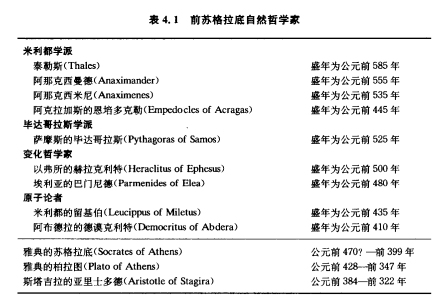
The first philosopher, Thales, held that all things arise from water. Anaximander, of the Milesian school, believed that the arche was something called the “indefinite”; Anaximenes held that air was the arche. Pythagoras said that all things are number; Heraclitus said that all things are fire…
Most of the writings of the philosophers before Socrates have been lost, and we know their thought only through Aristotle’s quotations and a few fragments, so we do not know exactly how they argued for the propositions they advanced. But at least we can sense that they tried to seek the principles of all things within things themselves, rather than attributing causes to the action of gods or other external wills. Their behavior in the face of solar eclipses also differed from that of ordinary people. They did not think an eclipse was some mood of Heaven or some omen. Anaximander thought an eclipse occurred because the apertures in the ring of heavenly fire were blocked, while Heraclitus thought the sun was like a bowl filled with fire, and when its open side faced away from us an eclipse formed. Of course, these explanations are now seen as wrong, but they clearly reflect a distinctive intellectual tendency.
 The World History of Science and Technology
As for Thales, there are also some anecdotes. It is said that he liked to gaze at the starry sky, and one day he was walking along while looking up at the heavens and, not paying attention, fell into a ditch. The maid beside him laughed at him: you can’t even see the road beneath your feet, so what are you staring at the sky for? This story is a kind of counter-mockery, and the object of mockery is the maid who could not understand the philosopher’s interests. The philosopher is focused on useless truth and disdainful of practical problems; the maid cannot understand because she does not understand freedom.
There is another story saying that in one year Thales, through observations of celestial phenomena, predicted that the next year would bring an olive harvest, so he stockpiled olive presses in advance and later sold them at high prices, making a great deal of money. Then he told others: I was not doing it to make money; I was just proving that if philosophers want to make money, they can do it in an instant. They simply do not go out to make money in their daily lives not because they cannot, but because they are not interested.
These two legends may not be very trustworthy, but they do indeed reflect the image of the “philosopher” as imagined at the time.
The impulses of pursuing nature and pursuing freedom are internally consistent, because “nature” is nothing other than free things, and “freedom” is in turn man’s “nature.” Aristotle said: “Clearly, we do not seek wisdom for the sake of any other benefit; for man is free by nature, living for his own sake and not for another’s, so we recognize philosophy as the only free art and explore it deeply, for it is the only art established for the sake of art itself. … The desire to know is human nature.”

But the free pursuit of knowledge of nature is logically somewhat paradoxical. Parmenides was the first to raise this question. He pointed out that “change” is impossible. We said earlier that a seed grows into a tree; this is a natural change. But how can a seed become a tree? A seed is a seed, a tree is a tree. If the seed is the tree, then there is no change; if the seed is not the tree, then the seed is gone and the tree appears—this is not called change but replacement, since something that did not originally exist has simply emerged. Parmenides said that what is, is; what is not, is not. In Greek, the word “being” is the nominalization of the copula, that is, being. To put Parmenides’ proposition in plain language: “what is, is; what is not, is not.” If it is both and not both, would that not be a paradox?
Parmenides’ student Zeno then added something further. What he argued was that translational motion is impossible—this is the famous Zeno paradox. The Zeno paradox has four propositions, and their general meaning is much the same. For example, if you want to run to the finish line, you must first run to the middle; if you want to run to the middle, you must first run to the halfway point of the halfway point; then you must first run to the halfway point of the halfway point of the halfway point… In this way, before you can run out, you need an endless set of prerequisites, so you cannot run even an inch.
Some people say, “If I just walk two steps in practice, doesn’t that refute Zeno?” Clearly Zeno was not so stupid as to be unaware that he himself could walk. What, then, is the point of these paradoxes? It is to highlight the opposition between reason and the senses. We know that the sensory world often deceives us: we see a chopstick bent in a glass of water, but it is actually not bent; we see one line longer than another, but they are actually the same length; we see a stripe as white-gold, when in fact it is blue-black… We have many experiences of sensory error, but pure reason does not err: 1+1=2, the 3-4-5 right triangle, these theoretical propositions are more reliable than the sensory world. So if the senses tell me there is motion, but reason tells me the world is motionless, then reason is what we should heed.
Parmenides’ and Zeno’s thought was in fact remarkably ahead of its time. Even by the time of Einstein, he too said that time is a stubborn illusion. The world of modern physics is motionless and unchanging.
To a certain extent, Plato accepted Parmenides’ line of thought. He strictly distinguished the real world from the world of ideas. This “idea,” though it is the same word as today’s idea, does not mean some wish-fulfillment, some fanciful thing in the human mind; hence some people also translate it as form or archetype. It is the model of ever-changing real things. Real things are vastly different from one another: they are in motion, perishable, and imperfect, whereas the world of ideas is motionless, eternal, and perfect. Science is supposed to study the eternal world of ideas, not the noisy, chaotic real world.
Aristotle tried to put things right. A large portion of his natural philosophy is devoted to responding to Zeno’s problems. I won’t go into the philosophical details here.
Plato also proposed a paradox of his own: he said learning is impossible. Plato asked: how can the person seeking knowledge know that what he has obtained is truly knowledge? If he already knows what true knowledge is, then he does not need to learn. If he does not know at all what true knowledge is, then he cannot learn either.
We have already said that knowledge in the Greek mind was free: knowledge reveals itself, without relying on others or authority; the desire for knowledge arises from nature, not from whether it serves some other utilitarian goal. Therefore, no matter how great a teacher’s authority may be, he cannot pour knowledge into students. So how does the student know that what the teacher says is knowledge? By what knowledge does he judge who is speaking knowledgeably?
Plato’s answer is: yes, indeed, knowledge cannot actually be learned; knowledge is not anything merely spoken by a teacher.
In Plato’s view, those who want to become doctors should go learn from doctors, and those who want to become shoemakers may go learn from shoemakers. But those who seek wisdom and virtue should not go learn from the sophists, those who claim to be “teachers of virtue.” What the sophists teach is only the art of eristic argument, whereas knowledge cannot be transmitted like a craft.
Plato believed that what is called acquiring knowledge is actually recollecting what the soul already knew in a previous life. And the person who teaches knowledge is not like a craftsman handing down a skill to be imitated; rather, he is inspiring, guiding, and awakening another person’s own recollection.
In order to prove that knowledge can be “awakened,” Plato brought in an uneducated slave boy. Through a series of patient prompts, Plato “led” this child slave to the recognition that a square constructed on the diagonal of a square as its side is twice the original square.
Clearly, the sentence “a square constructed on the diagonal of a square as its side is twice the original square” is itself not knowledge either. If it were, Plato would only need to teach the child slave to repeat this sentence. And the series of drawings and deductions Plato used to guide and inspire him is not the knowledge the child slave was ultimately awakened to either; rather, it belongs to another dimension of “practical knowledge,” namely, knowing how to select wise means so that truth can be exhibited. The key is not the means of inspiration, but the geometric truth that is ultimately displayed. This truth, quietly contemplated and tacitly grasped, is neither Plato’s patient deduction nor the child slave’s verbal repetition, but something the child slave himself comes to know from within. True knowledge is the inexpressible thing behind propositions and procedures. Some people with no real insight can still parrot the same words or draw the same figures through mimicry, but they have not learned the knowledge.
Plato’s story of leading the child slave is sometimes misused to expound the universality of truth. In the modern mind, mathematics is a universal knowledge: according to the same set of mechanical rules, everyone can carry out the same deductions. But for the Greeks, this whole deductive process was only a “demonstration technique” for truth, not truth itself; and truth itself was something incommunicable and unrepeatable, something that had to be obtained through the independent individual’s own inner intuitive experience (recollection).

There was quite a bit of time after class today, so I left a period for discussion. The students were not very active; only three of them spoke up voluntarily. One student from the history department helped me add an important dimension, namely the slaveholding social structure of the Greeks. It was precisely because a large number of slaves and foreigners handled various practical matters of subsistence that a small group of Greek free citizens could be so leisurely.
Supplementary Reading
Lloyd: Early Greek Science
Collingwood: The Idea of Nature
Hamilton: The Greek Spirit
Pierre Hadot: The Veil of Isis
Translated from the Chinese original with AI assistance. The original text is authoritative.