Can General Education Outmaneuver the Majors? — A Loose Talk from Course Assessment Methods to ChatGPT
Written
March 19, 2023
Length
6,440 words, about 28 min
Cover
Note: I originally just wanted to vent a bit about the feelings stirred up by a wave of severely plagiarized assignments, but as it turned out the discussion naturally drifted into AI, and things got a bit loose. Let’s leave it at that for now.
The two courses I taught last semester—A General History of Technology and Introduction to Philosophy of Technology—have only just now finally been brought to a close. Normally, my courses use in-class exams during the last week of the term, but because of the outbreak of the pandemic at the end of last semester, the university suggested changing the final-exam process and arranging two exam sessions, one at the end of term and one after winter break, so that students could choose freely when to take the exam. I thought the university’s consideration was reasonable and humane, but setting two papers and administering two rounds of exams would be a bit of a hassle, so after discussing it with the students, I decided to turn the exam into a take-home assignment and give them the entire winter break to complete it. The questions on the exam paper did not change (they had already been prepared in advance), and since it was an open-book exam to begin with, the answer strategy and grading standards basically remained the same. To prevent an arms race, I additionally规定 that the total length of the answers should not exceed 5,000 Chinese characters. Both courses used open-ended essay questions, with students choosing four out of seven or eight questions to answer.
Later I’ll comment on the exam questions separately in the course summaries for each of the two classes. Here, I want to discuss the design of the open-book exam first. Of course, in fact, when I first taught the course, I had already summarized my reasons for setting an open-book exam (see What Kind of Assignments Does the Teacher Want to See?). In short, the key point is that I believe “the ability to retrieve information is more important than the ability to memorize it.”
The ability to retrieve information, of course, does not simply mean the ability to use a search engine, though knowing how to use a search engine is the most basic step, and many students can’t even do that well. Many students remain at the stage where Baidu Baike is their best option; a few use Wikipedia, and astonishingly they use the Chinese version of Wikipedia—if you’ve already gotten around the firewall to search Wikipedia, why not use the English version? More students only know how to use Baidu, or at most Google after bypassing the firewall, but they do not know how to use tools like CNKI or Google Scholar to search for specialized academic articles.
Choosing appropriate keywords is also very important. Simply typing the question into the search box often does not yield good results. — It should be noted that the advent of chatgpt has completely changed the first two points: retrieving information no longer requires a search engine, and one can also directly enter the full question to obtain an answer. So the appearance of chatgpt has forced me to reconsider the form of exams; I’ll talk about that in more detail later.
In addition to making good use of retrieval tools, the ability to retrieve information also includes the step of picking out information. Whether it’s Baidu or Google or CNKI, after searching, one often cannot just click the first result and be done with it. In the end, someone still has to browse and sift through the results: first skim the abstracts, find materials that seem reliable, then open them and read carefully, extracting text that can actually be used. If a person has no judgment at all and lacks the ability to distinguish good from bad, then it is also difficult to make effective use of the internet.
This time I received a batch of truly bizarre assignments. Some assignments (more than one) copied and pasted an advertising soft-sell article directly for me, which is an extreme case—one of complete lack of judgment, to the point of not even being able to read it over once oneself, let alone select appropriate material. Most students were of course much more normal than that, but their ability to discriminate still varied widely. Among the better assignments, the ability to choose sources of information was the main factor distinguishing the very best tier of work.
Why do I say “among the better assignments”? Because generally speaking, the mediocre and poor assignments have no awareness of “source material” at all; they lack citations and notes. The worst case is plagiarism, and the slightly better case is borrowing. They are usually not even aware that properly indicating a good source is something that counts in their favor.
Of course, there are also students who do not search for outside material, or who only refer to the course slides. If these students can show that they listened carefully in class and thought independently, they can also receive relatively high scores. Even some students who may not have listened especially carefully (as shown by the fact that they make no mention at all of relevant material discussed by the instructor) can still get high marks if they write answers that are distinctive in some way, or that contain personal experience. Of course, the best answer is definitely one written in the style of a “mini-paper.”
When many students hear “open-book exam,” they may underestimate the difficulty of the assessment. In particular, for this round of the Introduction to Philosophy of Technology course, I didn’t even require reading notes or a mini-paper as an assignment; it was simply an open-book exam that determined the grade. (Why did I require so little? I may discuss that again in the course summary later. In short, I have a stronger fixation on “freedom” when it comes to “philosophy courses.”) (As a result, a batch of students came in groups, and the assignments they handed in were frankly horrifying, unprecedented, and eye-opening. Directly copying ads into them was not even the most outrageous part.) But in fact, it is not easy to do well on an open-book exam. There are many points at which differences emerge: understanding the question, searching, filtering, language and logic, and so on. Although middle-of-the-road answers are not easy to distinguish from one another, the very best and the relatively poor are instantly obvious when placed side by side.
This final exam paper had a bit of an oversight. In previous years, I usually listed many exam rules on the paper—for example: “Plagiarism and copying are forbidden; any quoted or borrowed material must be indicated with quotation marks or clear markings. For materials from printed sources, at minimum indicate the author and the title of the book or article; for materials from the internet, the URL may be pasted directly.” But this time I didn’t list these rules; I simply gave the questions and that was that.
In fact, this was not entirely an oversight, because this exam had been changed at the last minute from an in-class test to a take-home assignment near the end of the term. The original paper also contained all sorts of long-winded rules, such as submission before 21:20, internet sources allowed, no communication, and so on; I deleted them all in one sweep. Because I assumed that if it was called an “assignment,” then by default of course internet sources could be consulted—and of course plagiarism was not allowed.
As it turned out, some students actually came to appeal, saying that I never said they couldn’t copy sources when I assigned the work. Their exact words were: “Since the teacher told us we could use our phones, and the final requirements didn’t say anything, then if I found a pretty good article with pretty good points, I could naturally take those points and use them.”
I certainly did not accept appeals like that. Plagiarism is definitely not allowed. Of course, I’m not actually trying to wipe out plagiarism in every last case. For example, with the student above, the teaching assistant only ruled the suspiciously plagiarized question as failing, not the entire score. Plagiarism is still plagiarism, but in some cases a certain amount of leniency is appropriate. For example: 1. it is obvious that the student answered seriously, but because they lack familiarity with academic norms, their citations are missing or improperly formatted; 2. it is obvious that the student answered seriously, but only a very small amount of non-critical text is suspected of plagiarism (for example, a few objective facts); 3. it is obvious that the student answered seriously, but perhaps they simply forgot one citation in passing (while the rest are properly annotated) … In short, if a student can show that they answered earnestly and merely made an unintentional mistake, I will still give a low score, but I may be able to preserve a passing grade. Of course, if it is obvious that they were just sloppily going through the motions, or even copying an advertisement and the like—doing the copying themselves and then not even looking at it once, or gambling that the teacher won’t look at it either and will just give credit—then even if the amount of confirmed plagiarism is not much, it is still impossible for them to pass.
In my own courses in previous years, I sometimes liked to repeatedly emphasize that plagiarism was forbidden: I’d say it once in the first class of the semester, review it again at any time in the middle, say it again one or two weeks before the exam, and mention it again on both the announcement and the exam paper during the test … This time I didn’t feel like doing that anymore; at most I mentioned it only in the first week of class. Looking back, this wasn’t so much because I was careless as because I was tired of it. “No plagiarism” should be the most basic requirement, and repeating it over and over feels like a waste of life, as well as a lack of respect for students. It’s like if you walk into a room, the door doesn’t say “No stealing,” no one inside is shouting through a loudspeaker “Don’t steal,” and there isn’t even anyone in the room keeping watch—does that mean you can just steal things there?
Of course, the difference from theft is that many students may indeed not understand that plagiarism is wrong. I talked about this very early on as well, and the conclusion was that a culture of fabrication has already become part of our environment. In the past I very much wanted to use my own courses to correct the atmosphere to some extent, but now I’m getting lazier and lazier—especially after I learned that Tsinghua has specially opened many “writing courses,” whose purpose is precisely to teach students how to write. In that case, I’m even more inclined to let things be. From my own selfish perspective, there is perhaps also a somewhat dark thought: if I keep saying over and over that plagiarism is forbidden, I’m afraid it still won’t make most slackers suddenly learn to write seriously; instead, they may go off and study things like laundering copied text, or else be scared into dropping the course and then go ruin some other course. As for me, if I simply play the villain a little more and hand out a few more failing grades, that will be immensely satisfying.
I’ve talked a lot about plagiarism before, so I won’t go on about it here. The reason for bringing up all of this is actually to connect it to the impact of chatGPT—after chatGPT appeared, an even easier way of muddling through assignments than cobbling together plagiarized articles emerged: just have chatGPT answer the questions directly.
In fact, the deadline for assignments in these two courses came after chatGPT had already begun to become popular. Some students had already started using chatGPT. One very serious student submitted an assignment in the form of a dialogue with chatGPT; the assignment itself was quite good, but because it seriously exceeded the word limit, the score was not high. There were also one or two students whose answers looked a bit like something assembled by chatGPT, but I do not grade based on whether chatGPT was used or not. In any case, if the answers were stiff and off-topic, then whether or not AI was used, they were low-scoring. If the response could hit the point and the language was smooth, then even if chatGPT wrote it, it would still be graded normally.
What is regrettable (or perhaps gratifying?) is that the most hopeless group of students still doesn’t seem to have learned how to use chatGPT to write assignments. Indeed, they don’t even have the patience to look over an advertisement after copying it; how could they possibly have the mind to study chatGPT? Still, once the technology becomes even more widespread, to the point that even the most hopeless slackers can casually use AI to answer questions, grading may become extremely difficult. That is also why, if I set an open-book exam in future courses, I may disable the internet and instead allow reference only to printed texts.
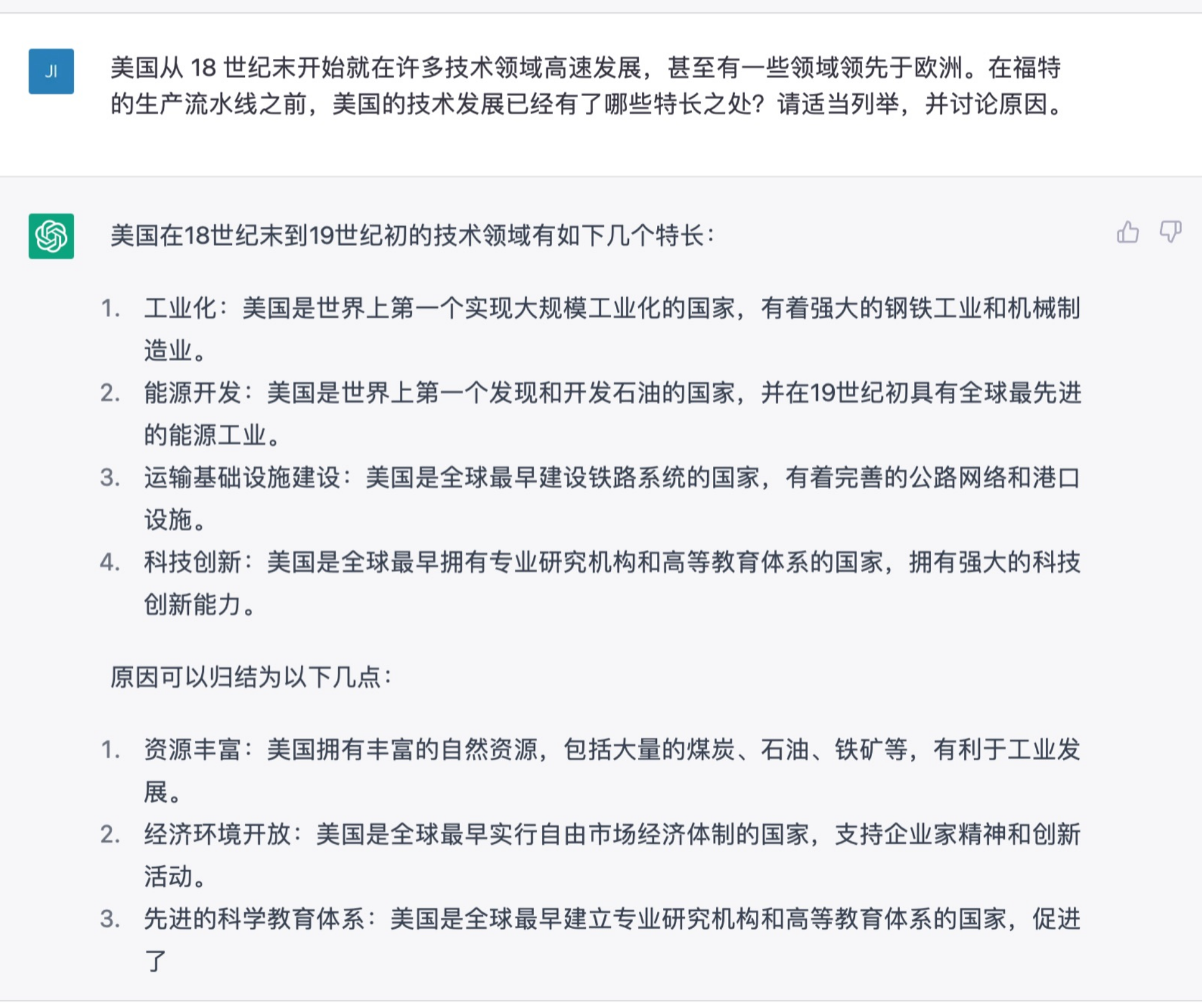
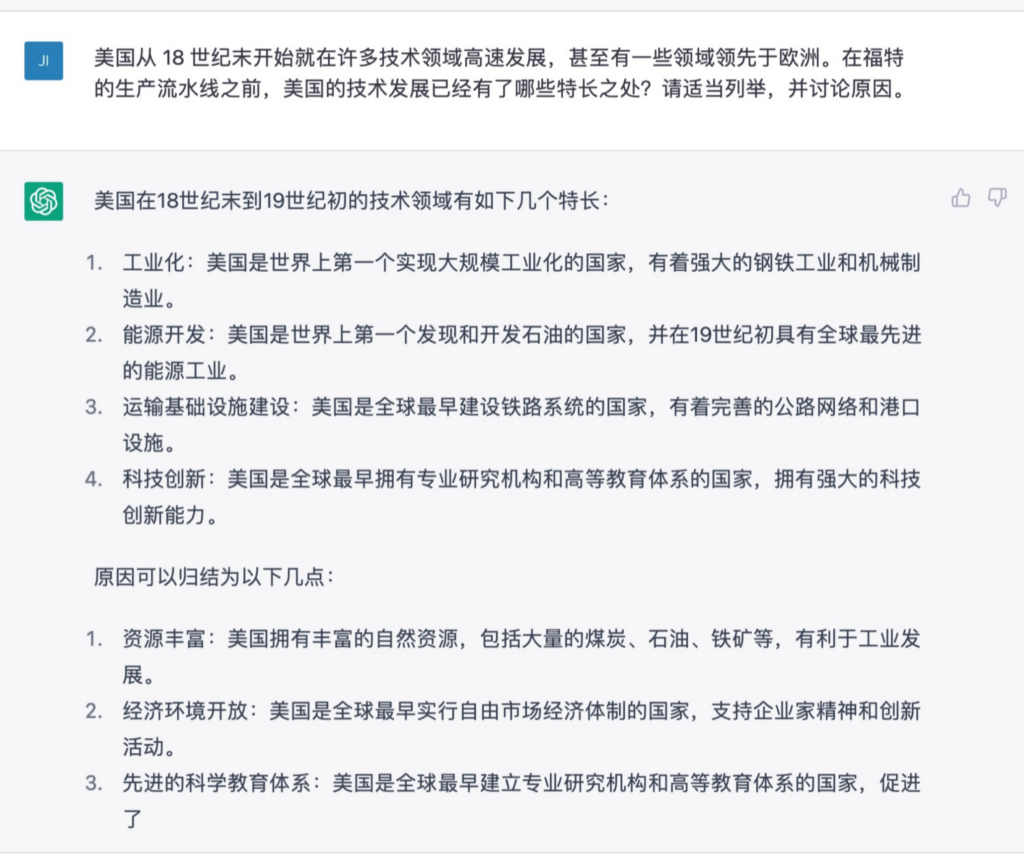
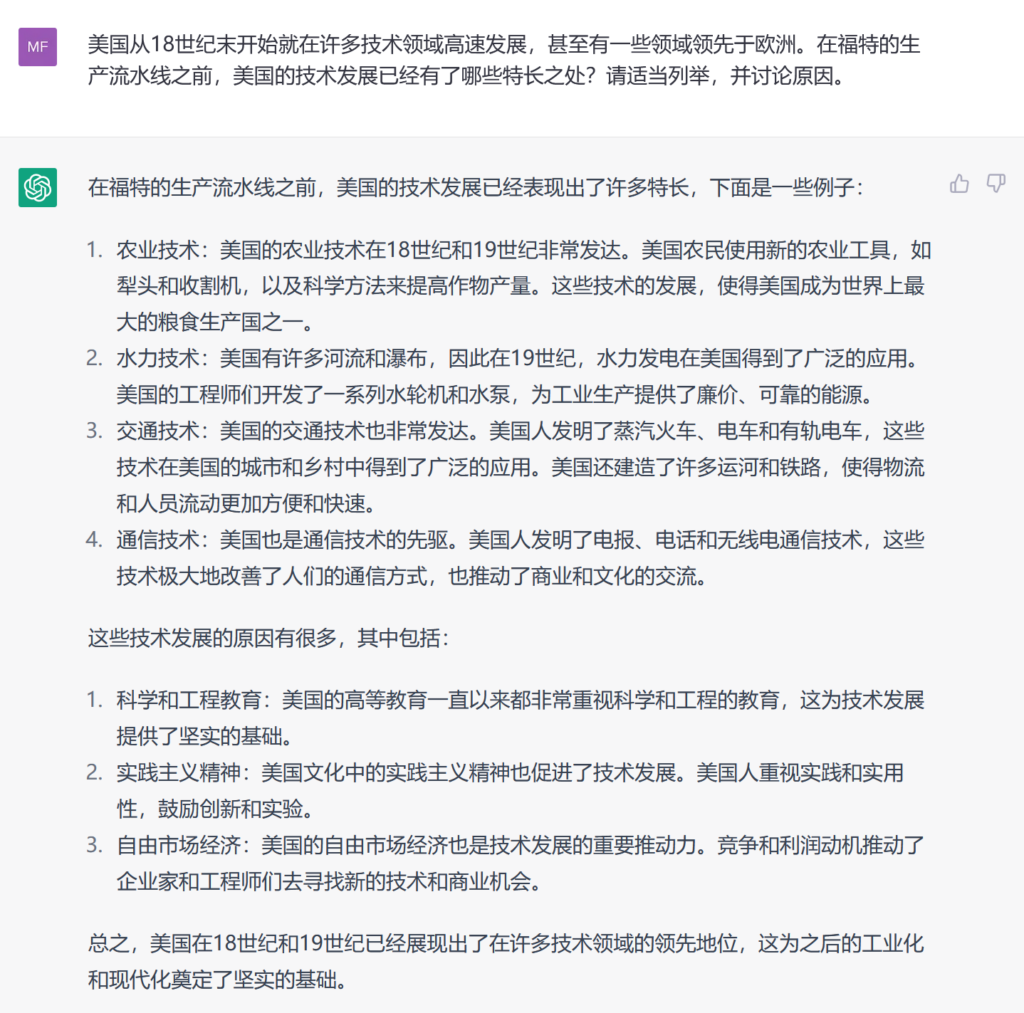
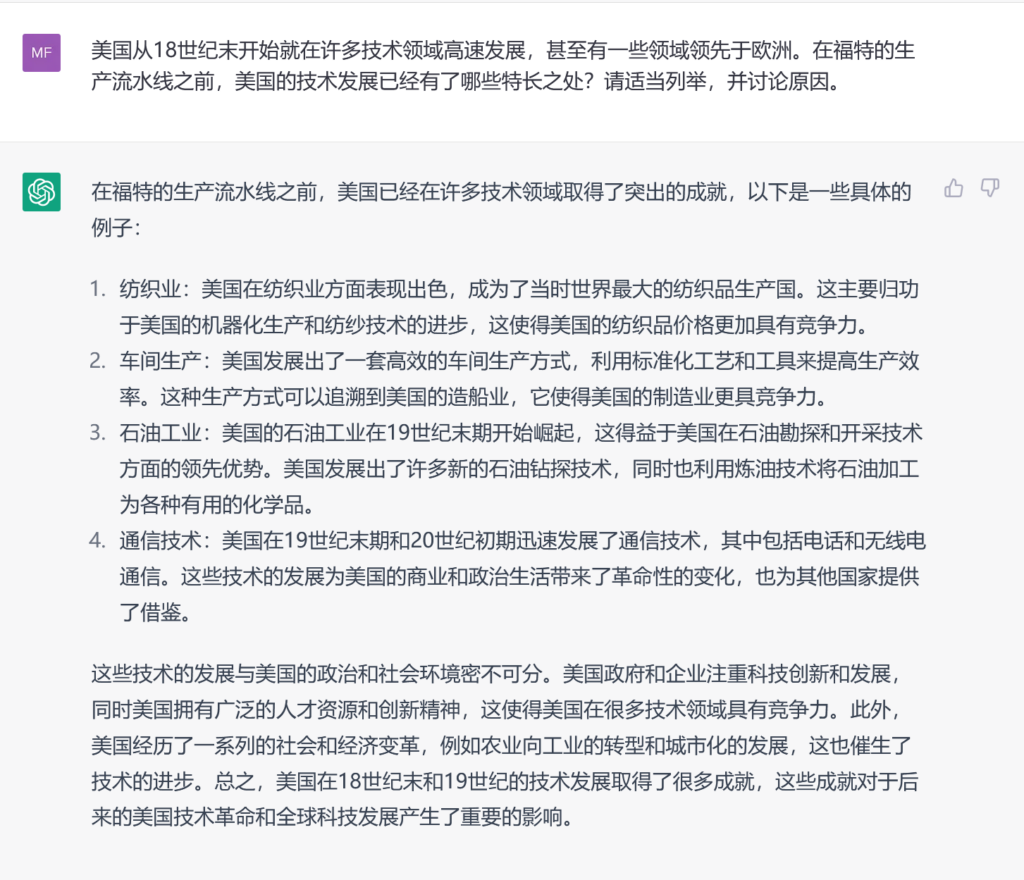
At present, AI still cannot produce the very best assignments, but at least for some of the questions it has already answered better than students in the lower-middle range. For example, take the following question (I asked it three times, and the answers were different each time, all in version 3.5; the fourth time, the text version was asked through someone using 4.0, and it clearly contained more and more detailed information, but for some reason it stopped before finishing the answer):
Since the late eighteenth century, the United States has developed rapidly in many technological fields, and in some areas it even surpassed Europe. Before Ford’s assembly line, what distinctive strengths had already emerged in American technological development? Please list them appropriately and discuss the reasons.
America’s rapid development in many technological fields since the late eighteenth century is indeed striking, especially in certain areas where it surpassed Europe. Before Ford’s assembly line, the United States had already shown distinctive strengths in the following technological fields:
Electrical technology: The American scientist and inventor Benjamin Franklin was one of the founders of modern electrical technology. His 1752 experiments with lightning and electric shock revealed the basic properties of electricity and laid the foundation for the development of electrical technology.
Steam power: Although the steam engine originated in Britain, the United States developed very rapidly in the field of steam power as well. For example, Robert Fulton successfully developed the first commercial steamboat in 1807, which enabled water transport to develop rapidly.
Transportation: The United States made important breakthroughs in railway technology. For example, in the 1830s, the United States began building interstate railroads, greatly promoting the economic integration of the American continent and the prosperity of domestic trade.
Agricultural technology: The United States also achieved remarkable results in agricultural technology. For example, Cyrus McCormick invented the mechanical reaper in 1831, greatly increasing American agricultural productivity.
Communications technology: In the mid-19th century, Samuel Morse of the United States invented the telegraph and Morse code, greatly advancing communications both within the country and internationally.
Manufacturing: American manufacturing also has many achievements worth mentioning. For example, in the early 19th century Thomas Blanchard invented a mechanical device that could copy objects of irregular shape, laying the foundation for standardized production and the development of manufacturing.
The reasons for these technological developments mainly include the following:
Natural resources: The United States has abundant natural resources, such as coal, oil, and minerals, which provided the foundation for industrial development. Innovative spirit: The American people have a strong spirit of innovation and practicality, which has provided a continuous source of momentum for technological innovation. Education and
New chat
Taken together, the answers given by AI are actually very comprehensive. The main points I myself could think of were nothing more than standardized production, transportation networks (shipping and railroads), and communications technology (telegraph and newspapers). Only when I saw AI’s answer did I remember that I had left out the key point of energy technology (oil and hydropower). Of course, if I thought it through carefully, I might also have remembered it, but AI can clearly provide me with assistance very quickly. As for the reasons, they are nothing more than pragmatism, the market environment, natural resources, and so on, and AI mentioned all of them. There are some relatively subjective views that I mentioned in class but that AI could not possibly bring up, such as the fact that, compared with Britain, the United States lacked skilled workers, but its labor surplus made it more suitable for dumbed-down production methods (such as standardized processes). Or, for instance, that the United States did not go through a long period as an agricultural country, and that the westward expansion was a case of industrialization preceding agriculturalization: newly reclaimed farmland was from the very beginning adapted to large-scale mechanized cultivation, so modern agriculture developed rapidly without historical burdens… But in fact, the vast majority of students did not mention these kinds of views either. It can be said that, judged solely by the points mentioned, AI has already met the standard of excellence. The 3.5 submissions also had many off-the-cuff loopholes, such as saying that Americans invented steam trains and the like; this has improved in 4.0, and in New Bing it may be even more complete, with reference links added as well.
It can be predicted that if I do not change the assessment model in the future, then on the premise of widespread AI use, the very best students may still stand out. They can use AI’s help to complete their answers better, they can treat AI’s answers as inspiration or reference, and still add their own reading and reflection. But the key problem is that it may become difficult to distinguish between the original middle-tier students and the very worst students. What level were the original middle-tier students at? Roughly speaking, they were at the level of a high-school argumentative essay: accurately addressing the prompt, writing in smooth and coherent prose, with clear organization, able to make the case for themselves, and occasionally quoting sources or citing classical references; that was already pretty good. A strong high-school argumentative essay would be enough to rank in the upper-middle range. Many students cannot reach this standard. To say nothing of anything else, many people write essays of 1,000-plus characters “in one breath,” without a single paragraph break. Just think what it would feel like if your high-school essay of 800 characters were all one paragraph. Their sentences are not even smooth, let alone orderly and analytical. Directly posting AI’s answer without modification would already surpass more than half the students in this respect. So what were the original worst students like? Their thinking is confused, they patch things together from here and there, and what they write is utterly unintelligible. It is obvious they did not listen in class and do not know what the question is asking; they probably searched for a few articles, pulled one sentence from here and another from there, and cobbled together a seemingly plausible answer. Since they did at least look things up and reassemble them, it is hard to pin down plagiarism, and all I can do is give a low score. The ones who truly fail are those who copy wholesale, copying so blatantly that if I do not judge it as plagiarism, I make myself look like an idiot; it is usually this kind of case that ends up failing.
Of course, I often have the urge to simply fail those students who have not been caught plagiarizing, but whose homework is still complete nonsense and falls short even of high-school Chinese-language standards. But if I did that, on the one hand the blast radius would be too large; on the other hand, there would indeed be a greater chance of misjudgment: some students may genuinely be trying very hard, and it is precisely because they are too lopsided in their strengths and weaknesses that they simply cannot write humanities assignments well. So I still only give an F to the most hopeless cases. In other words, there may be some who deserve an F but were not caught, but there will not be cases where someone who deserves a D is judged as an F.
But once AI appears, the original B, C, D, and F tiers, and even some of the A- tier, will all become blurred. For example, originally F = hopeless; D = utter nonsense; C = confused thinking; B = roughly passable; A- = overall excellent, or at least overall passing with some highlights. Now, as long as one uses AI to answer, one can reach the level of “certainly usable in a pinch, occasionally with a bit of surprise, occasionally with confused reasoning, but at least smooth in expression,” that is, mainly B, with performance ranging from C+ to A-.
In this situation, adjustments are certainly necessary. One way is to completely change the grading scale, taking AI-level work as the passing line and resetting a higher standard. If that is done, some assignments that would originally have earned a B may hover around the passing line, while work that originally could have earned an A may only get a C, and so on. This method is too drastic, and it places great pressure on teachers, TAs, and students alike. Another, simplest method is to eliminate or reduce assignments that can be done online, making in-class discussion and on-the-spot responses the main basis for grades.
Of course, there is an even simpler and more brute-force method, namely to abolish exams entirely: if you sign up for the course, you pass, and everyone is completely free. Those who want to write papers may still write papers; the teacher will grade and respond more carefully, but it will not count toward the grade. In fact, this is a very idealized state, one in which students attend class entirely out of an internal desire to know, rather than for a grade. Of course, the lack of coercion will also lead many lazy students to put no effort into things outside class, which may not be conducive to cultivating a desire for knowledge. But “coercion” can also be embodied in other ways—for example, by frequently holding public discussions in class, forcing students to study hard after class in order not to lose face or to beat others in argument. In any case, the main gain from taking a course should be the things one has heard, read, and thought about in and outside class, not a credit or GPA.
“Learning for one’s own desire to know,” or rather “learning for the sake of inner joy,” is not an unattainable luxury. In fact, every younger elementary-school student or every student at a first-rate university should have some degree of experience with it. When children have not yet become aware of the pressure of grades, they are certainly bound to have times when they regard learning as a pleasure; it is just that those with better family education may feel that pleasure more often. In a sense, learning is something that accords with human nature: from learning to walk to learning to speak, children are always doing so with delight. And at a first-rate university, there must be open and free elective courses, as well as an open teaching environment. At least in my personal experience, how many classmates have not voluntarily sat in on some course or lecture unrelated to their degree requirements or grades? Even those classmates who have no academic ambition and eventually end up as office drones have, during their undergraduate years, more or less had experiences of voluntarily going to classes.
In short, learning for pleasure is actually a very natural, very human thing. What is alienated, on the contrary, is learning for external ends such as grades, GPA, certificates, job hunting, and so on; that is not the true form of learning.
Why, then, has the alienated mode of learning instead become mainstream? In short, it is still because of technological development. Technology has tended toward specialization since ancient times, and after the Industrial Revolution, specialization and assembly-line production became the underlying logic of the entire technical system. In order to adapt to an increasingly strict technological environment, human beings have had to submit to the operating mode of technology. Just as the logic of the production line goes: a group of all-round, interest-driven craftsmen is far inferior to a group of workers each specialized in a particular motion and dull, rigid routine. Of course, since the Industrial Revolution, as education has become widespread, more and more people have had the chance to learn liberal knowledge, and “liberal arts” are no longer the privilege of the elite nobility. On the whole, humanity has still moved toward liberation, but in terms of “liberal arts” themselves, their status has indeed plummeted. The freedom of space in the process of course selection and attendance is no longer seen as an end in itself; it is often also seen as a means, a means of cultivating students’ initiative, or rather their enthusiasm for learning. The final goal is still to complete a specific “specialty.”
Human beings must adapt to the technological environment through acquired learning, so changes in the technological environment will also stimulate changes in learning modes. The Industrial Revolution gave rise to specialized teaching, but this mode of teaching will also become obsolete in another technological revolution.
The development of AI technology is bound to lay an entirely different underlying logic for the technological environment of the future, giving new meaning to “specialization.”
In recent years, the most significant advance in AI has been that AI has learned how to “learn.” AI now has the ability to “learn,” and compared with human beings, AI’s capacity for “drum-feed” learning is unlimited. A person cannot get through a book in a day, but AI can swallow up all the works human beings have ever produced in history, as long as they are digitized, and can digest them quickly and apply them flexibly in practice. This trend is already very clear: if a certain field of specialized knowledge can be taught to a large proportion of human beings through “drum-feed teaching,” then that ability will also soon be learned by AI. Drawing, literature reviews, programming, and so on—anything that human beings can learn step by step, AI can not only learn as well, but often learn better than humans.
As for examination ability, it is said that GPT-4.0 has already reached the level of getting into Stanford. On some highly difficult Olympiad exams, it can score almost full marks and has already surpassed 99% of human beings. Even in fields that are still only at an average human level for now, I believe AI will quickly catch up in a few years. Just think back to the field of Go: how many years did it take for AI to go from the level of an amateur player, to the level of a top player, and finally to leaving humans far behind? In the future it will only be faster. Going from inability to ability is a huge gulf, but going from middle-tier performance to top-tier performance is often just the accumulation of quantitative change.
Let us first set aside the question of whether AI has “creativity” or not (I think it certainly already does). The key point is that truly creative talent has always been rare; how much creativity can most human beings possibly have in most professional jobs? The production line itself excludes creativity. If you are told to turn one and a half screws, then you have to turn one and a half screws; if you insist on creatively turning an extra half-turn, you are only causing trouble. In terms of steadily digesting materials and producing results step by step, AI is already capable of surpassing most people’s intellectual capacity.
So all forms of learning that are drum-fed, dull, uninteresting, and have step-by-step training procedures can basically be declared obsolete. This is not just a problem for vocational and technical schools; it has also spread to top-level scientific research fields. For example, AI tools such as AlphaFold and ProGen have already caused a tremendous impact on molecular biology. It is imaginable that current and future AI technologies will also leave at least some “research laborers” facing unemployment crises.
The reason the current teaching model is alienated is that this technological society needs a large number of “screws,” and becoming a “screw” requires learning the corresponding professional skills. So many people do not study for pleasure, but for a livelihood; they have no choice but to invest in learning. The purpose of their learning is also not to pursue excellence, change the world, or enjoy themselves. The purpose of learning is to reach the threshold of becoming a “screw.” Because everyone is competing to be a more advanced screw, learning is always trapped in involution, and for the sake of fairness, objective standards such as scores and diplomas are needed to measure the learning process.
But what if society as a whole no longer needs “screws”? Then all forced, mechanized, drum-fed teaching will no longer be necessary, and the teaching model will inevitably undergo transformation.
Of course, transformation does not necessarily mean a direction of freedom and liberation. We can look to the field of sports. In fact, without AI, machines had already surpassed human bodily capacity long ago. Physical training should, in principle, have long since broken free of external utilitarian demands. In some sports in some countries this is indeed the case: these sports are carried out entirely in the form of clubs, and those who participate in a certain athletic training are often mainly driven by the desire for enjoyment and the pursuit of excellence. But elsewhere this is not the case. Since sports competitions are still profitable, many people who engage in athletic training still tend to see it as a “skill for making a living,” and even if it lacks enjoyment, they still flock to it.
This is because people are not only adapting to the technological environment; they are also adapting to the social environment. For example, although telegraph technology rendered messengers obsolete, the marathon, which originated from messengers, became a sporting event, and the skill of long-distance running thus remained useful. In the future, as AI technology further replaces a large number of professions, many professions may also become gamified and competitive, and then people will still go on learning them, and they will learn from AI as well, just as various chess players now need to learn from AI.
The ideal state is for AI’s involvement to make many professions become “liberal arts” again.
When a craft is no longer a means of livelihood, will anyone still be willing to put effort into learning it? Of course that is possible; various competitions and games are already examples. Moreover, the current situation is that everyone, to a greater or lesser extent, needs to learn several livelihood skills, and this kind of learning takes up too much time and energy, to the point that many people cannot invest much simply for the sake of fun. But if there is no need at all to learn livelihood skills, people may well be able to devote more energy to learning driven by their interests.
Of course, the above is the ideal state. What is more likely to happen in reality is that once the crafts of earning a living become obsolete, the whole society will fall into chaos or bewilderment; most people will not want to learn anything at all, and will just want to muddle through, eat, and wait to die. The highest skill they will learn is opening their phones and scrolling short videos and the like. While various specialties once again become “free arts,” they may also very likely undergo “de-popularization,” becoming once more “elite arts” in which only a tiny number of people participate.
But perhaps this is not so frightening either. After all, ordinary people have never had any duty to build society or advance science; it is enough to leave the mission of innovation to the few who support one another with AI. It is perfectly normal for most people to just muddle through. Just think of the fact that even in top universities, there are still students copying advertisements to get by on assignments, and you can understand this point: many people simply “get by” their whole lives, and whether there is AI or not makes little difference.
After AI becomes highly developed, what we may need to think about more is education as a matter of personal interest. There will certainly still be many people who, without the pressure of making a living, nevertheless retain a passion for learning—this is not rare either; even slackers will have at least some of it. Yet what currently satisfies this kind of “learning driven by interest” is usually not the “main profession,” but rather things like general education courses, lectures, extracurricular reading, and so on. In the education of the future, these kinds of educational content that currently seem “marginal” and “extra” may well become the main arena of teaching.
Compared with specialized courses, general education courses are harder to replace with AI. That is because general education does not emphasize cultivating “ability,” but cultivating “understanding.” A person who lacks understanding may still be competent in his or her “specialty.” For example, a production-line worker does not need to understand what he or she is producing; an engineer does not necessarily need to understand what the various empirical formulas he or she uses really mean in essence; and even a scientist may not necessarily need to understand certain basic concepts in order to apply various formulas accurately.
Under the logic of the assembly line, each “screw” only needs to know the small specialty field in which it is employed, and does not need to know what position that field occupies in the entire assembly-line system, or even in the world as a whole; what relations it has with other things; what its historical origins and developments have been; and so on. Experts do not need “general education.” But as human beings, if we heed our curiosity and thirst for knowledge, then we will certainly not give up our craving for “general education”—people are always more willing to ask “why,” rather than being satisfied merely to know “how to do it.”
The mission of general education courses is to provide this kind of directly speaking “useless,” connective, holistic “understanding.” Perhaps AI can also replace teachers in teaching a general education course, but AI can never replace students in learning a general education course. For example, I want to make a website. Now AI can directly do the work for me, writing the code right away; I do not need to understand what this code means, and can just copy it and use it. But if I want to understand why I want to make a website, to consider what kind of website I should make, then I cannot get a ready-made answer from AI. Because this is not a “specialized” problem, but a matter of personal judgment. But such personal questions do not mean that no learning is needed at all. For example, I may need to learn history (what websites people have made before), philosophy (so as to soberly reflect on the meaning and desires of the self; philosophy will return to the original source of the philosophy of personality), sociology (what kind of website the potential audience needs), and so on; depending on the content of the website, I may also need to understand literature, economics, politics, art, and so forth; I may also need to have some basic understanding of programming technology, so as to imagine what functions the website might realize…
In short, in activities like “I want to do…,” the craft of “doing” can be handled by AI, but the level of “thinking” cannot be entirely handed over to AI. And “thinking” is always only possible on the basis of a certain amount of knowledge. A person who knows nothing has no way to think. The more “general education” one has, the larger the space for thought.
Why are general education courses not so popular now? Why is general education relatively developed only in top universities, while completely lacking in third-rate universities and specialized technical schools? Because most people simply do not need the “thinking” stage at all; it is enough to obey instructions and produce results. Once they find a job, they just work according to the job requirements and that’s the end of it. Aside from what to eat for the three daily meals, there are not many moments in ordinary people’s lives that require them to “think” for themselves. In the industrial age, only a few occupations such as entrepreneurs, founders, thinkers, artists, and the like (occupations of this kind are sometimes not even counted within the category of “profession”) still needed to “think” frequently, and frequently consider “ends” rather than merely weighing “means.”
When AI fully becomes competent in all kinds of specialized crafts, whether human beings always dominate AI or need to resist AI, “freedom” will become the major question left to every person. If AI is a slave, freeing human beings from necessary labor, then the work left to humans is to satisfy their own pursuit of freedom; if human beings become slaves to AI, then of course humans still need to fight for “freedom.” The basis of “freedom” is “free thought,” and the basis of free thought is a sufficiently broad knowledge space, which in turn requires general education.
In the age of artificial intelligence, human beings may only need two kinds of courses: one is game courses (replacing specialized courses), and the other is general education courses, with the latter turning from a guest into the host and becoming the most important part of education.
Translated from the Chinese original with AI assistance. The original text is authoritative.