
This article was published in China Book Review. For reprints, please contact the magazine. Citation format as follows: Hu Yilin.The Value of NFT from the Perspective of The Philosophy of Money[J]. China Book Review, 2022(12):7-17
Introduction: Simmel’s The Philosophy of Money elaborates a relativist version of Kantian transcendental philosophy, explaining the origin of value through “distanciation” and the formation of objectivity through exchange activity. Simmel criticizes the modern monetary economy for inverting means and ends, severing property possession from the freedom of the subject. Seen from Simmel’s perspective, cryptocurrencies or NFTs, supported by blockchain, seem to contain certain opportunities to help people reshape their values, prompting them to recall the relativity and subjectivity of value, and to discover individuality within possession, awakening people from the bewilderment of modernity.
Keywords: Simmel, the philosophy of money, NFT
I. The Transcendental Philosophy of Value
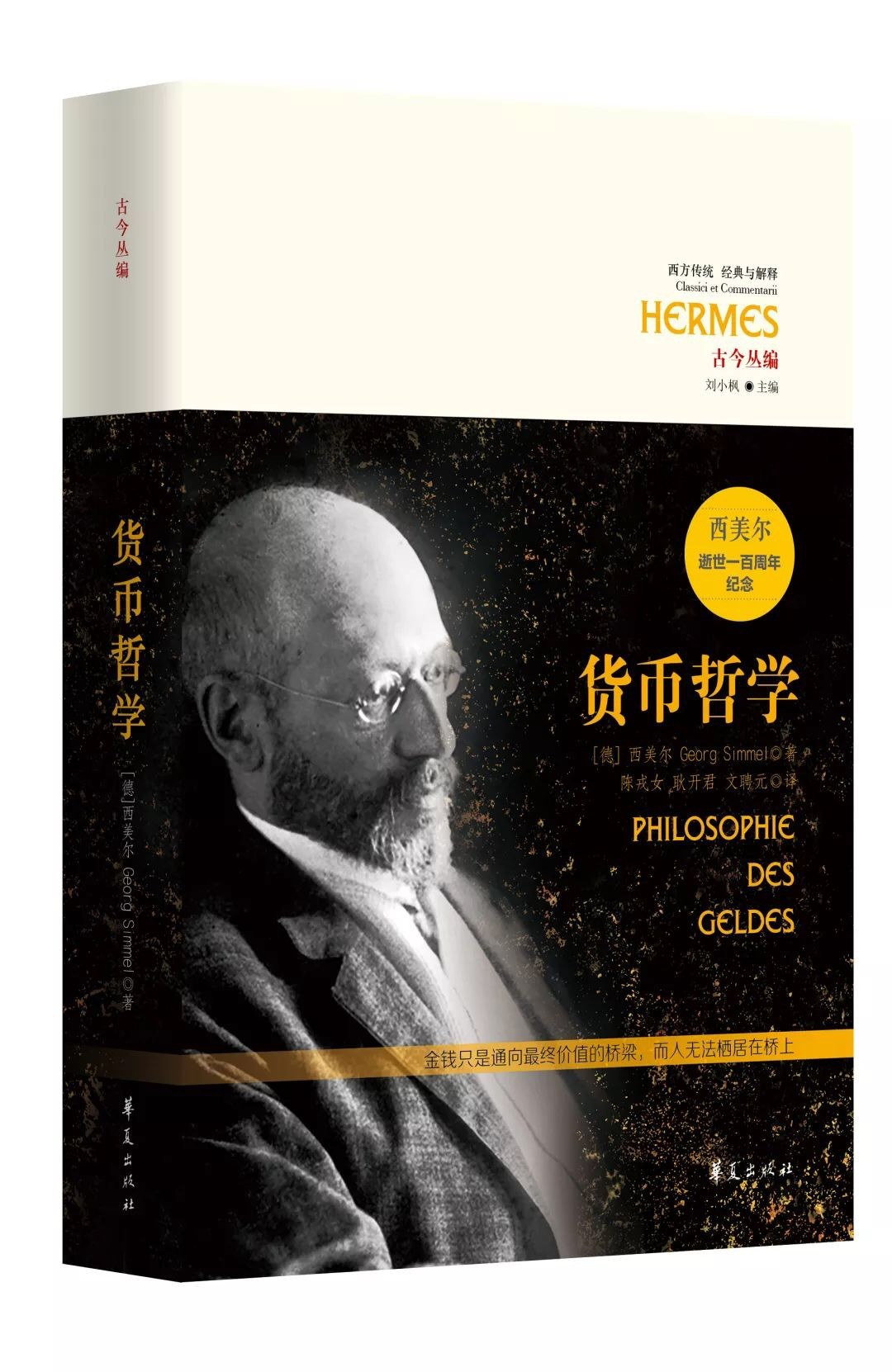
The Philosophy of Money[1] is Simmel’s (Georg Simmel, 1858–1918) representative work. This strange and fascinating book, published in 1900, remains a classic in the field of “philosophy of money” to this day, and can even offer inspiration for the question of the value of virtual currency or NFTs. Yet the book is not easy to read, because in essence it is a weighty philosophical treatise in a classical style. Its aim is not to analyze the problem of money itself, but to take money as a point of departure and discuss the deepest and most ultimate philosophical questions. As “Frischeisen-Kohler believes, The Philosophy of Money does indeed concern the psychological and sociological dimensions of the formation and development of the monetary economy: ‘But its ultimate goal is much higher; as Simmel himself says, its ultimate goal is to use external economic events as material for investigating the ultimate value of human nature and its significance.’”[2] Karl Joel believed that “for Simmel, money is by no means merely money, but a symbol of the world”[2]. Bryan Turner believed that what Simmel was “committed to developing is the phenomenology of ‘money’ as a medium of experience in human social reality… The Philosophy of Money is a classic study of the roots of modernity and modern consciousness.”[3]
What is called “modern consciousness” does not refer to modern people’s consciousness about money, but to modern people’s consciousness about human nature and the world. The monetary economy is, on the one hand, the externalized manifestation of modern consciousness; on the other hand, it also forms a certain root of modern consciousness. The monetary economy and modern consciousness mutually shape and mutually realize one another.
Simmel regards money—this historical, material, and political-economic thing—as the source of consciousness and ideas; this is where he differs from classical philosophy. For Immanuel Kant, transcendentality is usually tied to a priori-ness—transcendental refers to the preconditions that make experience possible, the basic forms of consciousness and knowledge. Kant believed that the transcendental conditions of consciousness are humanity’s innate capacities, such as the spatiality and temporality of the senses.
Simmel inherits the style of Kantian transcendental philosophy, namely, the quest for the “conditions that make experience possible,” but such conditions need not be internal and fixed; they may also be external and historical. The thought of the late French philosopher Bernard Stiegler can provide support for Simmel. Stiegler reengages the transcendental question and points out that the forms of cognition as transcendental conditions are not eternal things suspended in midair, but are rooted in the technical world as “tertiary retention”[4]; the medium of memory carries the forms of memory. Human cognitive capacities are not fully formed at birth. When people learn and cognize this world postnatally, they acquire these forms from external technical media and complete their own cognitive capacities, and the modes of cognition shaped by different external environments are different—for example, writing technology changes the way people think concepts, and recording technology changes the way people appreciate music. These external technical environments in turn shape people’s forms of cognition. Money is no exception: it is the externalization of value concepts, and it also determines the way people cognize value.
If “forms of cognition” are what is called “transcendental,” then the actual development of these technical worlds is in turn the experiential source of the transcendental. Simmel seeks both the “transcendental conditions of experience” and the “experiential roots of the transcendental.” He says: “Many things that were previously regarded as transcendental were later recognized as empirical and historical structures. On the one hand, we have the task of seeking, in every phenomenon, beyond the content supplied by sensory impressions, the eternal transcendental principles through which content is formed. But on the other hand, the maxim tells us that we should try to trace each individual transcendental back to its roots in experience.”[1]51
Simmel opens by introducing Kant’s transcendental philosophy. He first sets “value” in correspondence with “being.”[1]4 Kant is concerned with how cognition of being is possible, investigating experience of being, whereas Simmel here wants to focus on “how value is possible,” asking after the need for value; he believes these two questions have the same structure:
“Just as Kant has already said: the possibility of experience is the possibility of the object of experience—for to have experience means that our consciousness creates objects out of sensory impressions. In the same way, the possibility of need is the possibility of the object of need. The object thus comes into being, its properties being bestowed through separation from the subject, which at the same time establishes it and seeks to conquer it by its desire; for us, this is value.”[1]10
Kant’s philosophy synthesizes the earlier rationalism and empiricism: the former holds that the foundation of knowledge lies in the subject (the cogito), while the latter holds that the subject is a blank slate and that the foundation of knowledge lies in the object. Kant, however, believes that knowledge is based neither on subject nor on object, but on the forms of cognition through which the subject constructs the object. Similarly, Simmel holds that value does not originate from either end, subject or object: “it can be obtained neither from the subject nor from the object… it lies between us and the object.”[1]11
II. Value Derives from Distance
Value is formed in the way subject and object separate from one another and put distance between themselves. “The object stands opposed to the subject as something desired, and can be attained only through the overcoming of distance, obstacles, and difficulties.”[1]10
Simmel continues Kant’s doctrine of the “thing-in-itself,” believing that human beings cannot attain knowledge of things as they are in themselves. So-called “reality” is not from the outset a pure object; it is rather a certain undifferentiated state of subject and object[1]7. The opposition between subject and object is produced by “distanciation.” When, in this chaotic world, we encounter various “blockages,” while also longing to overcome them, “distance” comes into being, and the subject and object separated by distance each become manifest and can be known. Simmel says: “Reality undergoes a distortion under our consciousness, and this distortion is indeed a barrier between us and our immediate existence in reality, but at the same time it is also the precondition for knowing and representing reality.”[1]385
In Heidegger’s (Martin Heidegger) words, “distanciation” is “de-severance” (Ent-fernen), that is, becoming near through “making distant.” Heidegger says: “Removing something in order to have it at a distance is only a particular and practical kind of de-severance. De-severance means the vanishing of distance, that is, making something distant so that it becomes near. Dasein is essentially de-severing; as the entity that it is, it lets what is at hand from time immemorial be encountered at close quarters.”[5] For example, the glasses on the bridge of one’s nose are not the object of knowledge; only when one takes the glasses away and examines them do they become a near object. Dust that cannot be seen or touched, even when right before one’s eyes, does not count as an object of knowledge; only when it is placed on a glass plate and observed through a complex combination of lenses does it become an object of knowledge.
In simple terms, only by finding an appropriate mode of “distanciation” can the object stand before the subject to be known and pursued. This distance is sometimes merely spatial distance, and sometimes appropriate technical equipment, media platforms, and so on.
As for “value,” “distanciation” must come about through “exchange,” or what one might call “economic activity.” Simmel says:
“As an economic activity that is also a distancing (through labor, renunciation, sacrifice), it simultaneously overcomes distance. The purpose of establishing distance is to overcome it; the desire, effort, and sacrifice that separate us from the object likewise lead us toward it. In practice, distancing and nearing are two complementary concepts, each presupposing the other; they are two sides of our relation to the object, which we call, subjectively, our need and, objectively, its value. In order to desire it once again, we must make the object a little more distant from us.”[1]17
Heidegger and Simmel both advocate this dialectic in which “distance and nearness define each other.” At first hearing, that may seem abstruse and obscure, but in terms of economic activity, we are in fact already quite used to it. In the age when human beings ate raw flesh and drank from the bounty of heaven and earth, water and food would not be regarded as valuable commodities. Only when human beings, through building, make themselves spatially farther from sources of water does water come to be seen as something valuable; only when human beings, through cultivation, make themselves temporally farther from food does grain come to be seen as something valuable. Apart from these needs that animals also have, most human needs are created by ourselves. Raw food can also stave off hunger, but people insist on inventing all kinds of cooking methods and seasonings, making the preparation of ingredients more laborious and cumbersome, and then inventing all kinds of implements that save these cumbersome processes. The reason those labor-saving implements have value is that these labors are additionally established by us.
The reason human life becomes ever richer is precisely that human beings are best at “making trouble” for themselves. The survival of other animals consists mainly in confronting the various obstacles bestowed by nature, whereas human beings are different: in addition to coping with nature, increasingly more energy and creativity are spent on creating new obstacles for themselves and then overcoming them.
In Simmel’s view, “distance” is something more basic than subject and object. The object can be known only through distance, and the subject can know itself only within distance. If a person could do anything without the slightest hindrance, if words instantly became law and thoughts immediately came true, then from where would he form his desires and ideals? Thus the creation and overcoming of “distance” not only affect the human way of knowing the external world, but also determine human self-knowledge. A person’s self-positioning and self-understanding, his planning and expectations for the future, his understanding of the meaning of life and work—all of these are related to the various distances that human beings create.
III. The Relativism of Value
We can see that “distance” is not an unchanging and absolute existence. Under different historical circumstances and different interpersonal relations, the “distance” each person must face and overcome is different.
“Distance” is neither absolutely objective nor completely subjective. The physical-space distance from one’s place of residence to a water source may perhaps have an objective measurement, but in terms of value, the “distance” between residents and the water source also depends on people’s urgent desire for clean water, on how transportation is used, on forms of interpersonal cooperation and organization, and so on.
In fact, if cognition of value had no subjectivity, “exchange” would be impossible; but if there were no objectivity at all, then the “market” would also be impossible to form.
For example, if Zhang San exchanged one cow with Li Si for ten sheep, then for Zhang San, ten sheep are certainly worth more than one cow; whereas in Li Si’s eyes, the opposite is true, and this one cow is more valuable. The two sides’ judgments of value are not the same; each person exchanges for something more valuable relative to himself, and only then can the exchange take place.
But on the other hand, exchange behavior is universal: although people have different understandings of the value of various things, in the general activity of exchange a public measure gradually takes shape. Li Si is willing to trade ten sheep for one ox, Wang Wu is willing to trade eleven sheep for one ox… If more and more participants join in, and if communication among them becomes increasingly full, then comparisons of value will gradually acquire a certain public character. Thus, as exchange activities rooted in subjective differences are universally carried out, there eventually emerges an “objective” scale of value.
Simmel says: “The fact that one object must be exchanged for another indicates that it is not only of value for me, but that this value is independent of me, that is to say, of value also for another person. This equation: objectivity = universal validity for the subject, has found its clearest proof in economic value.”[1]23
Following Simmel’s line of thought, the above interpretation of the “formation of objectivity” is not limited to the problem of value; the objectivity of scientific knowledge is in fact also produced through some kind of “knowledge market.” The sociology of scientific knowledge (SSK), which arose in the second half of the twentieth century, provides Simmel with corroboration. For example, some historians of science directly use terms such as “trading zones”[6] to describe the phenomenon of modern early scientific knowledge being rapidly exchanged between scholars and craftsmen.
What we are mainly discussing here is still economic activity. With the universalization of exchange, “money” naturally appeared. Money initially was nothing more than the most popular, most universal, and most widely recognized kind of exchange object in countless acts of exchange. Usually, too, it was the easiest thing to standardize and quantify. These recognized, universal, standard, and quantifiable exchange objects then began to become the public measure of exchange. Barter gave way to exchange between commodities and money, while neutral money itself was decontextualized and depersonalized. Some people do not like sheep, some do not like oxen, but no one does not like money. The intervention of money obscured the personal subjective preferences and actual situations involved in exchange activities, greatly promoting the objectification of value.
In short, objectivity comes from subjectivity: every exchange activity arising from subjective likes and dislikes is gathered together in the market, forming what looks like an objective scale of value. Rather than the other way around, where every thing must first possess some absolutely objective inherent value before exchange can take place.
This idea sounds like “relativism,” and Simmel does not deny it. But he emphasizes that this relativism is not a negative “anything goes” attitude; rather, it is positive, a serious pursuit of truth. He writes:
“Relativity is not a weakened supplementary determination in relation to a concept of truth that is otherwise independent; it is a fundamental characteristic of truth itself. Relativity is the mode in which representation becomes truth, just as it is the mode in which an object of demand becomes value. Relativity does not mean that truth is discounted; on the contrary, it is a positive fulfillment of, and bringing into effect of, the concept of truth. It is not despite relativity, but precisely because of relativity, that truth is valid.”[1]53
“Truth is relative” does not mean that truth is discounted; it means precisely that “truth is accessible, attainable, and to be sought.” Truth as imagined by absolutists is unreachable, because human capacities are always limited: no one can guarantee absolutely precise observation, no one can command absolutely complete information, so no one has absolute authority to declare that absolute truth is in his hands. The result is that what is called truth becomes nothing more than some ethereal “belief,” or a title awarded to the winner, but not anything real that can function in life.
For positive relativism, however, truth is not something far away beyond the horizon; it is always something that exists relatively in the present. The reliability of truth is not built upon some fanciful fulcrum, but upon a universal network of interactions.
Absolutism and nihilism are only one step apart, because absolutism ties the certainty and unity of the world to an immovable iron plate, so that once a little flaw appears in this imagined solid plate, the absolutist’s faith tends toward collapse. By contrast, the relativist’s world is a decentralized network, where scattered damage and tangles do not hinder the certainty of the whole world. Simmel says: “Only the naïvely childish insistence on an absolute viewpoint places relativism in such a position [the loss of reliability]. But in fact… only by dissolving and melting down all those independent existences that are as solid as iron into interaction can we attain the functional unity of all the elements of the cosmos, where the meaning of any one element affects any other element.”[1]55
IV. The Loss of Modern Monetary Economy
Money pushes forward the absolutization of value by “sublimating the relativity of things”[1]57. This is not an event that happens in one fell swoop; people’s notions of value change along with the development of the monetary economy. Of course, people always hope to pursue universalization, just as people always like the market to become larger, more inclusive, and richer. But in the development of money and markets, subjectivity and individuality are sometimes forgotten or distorted, to the point that people risk falling into bewilderment and alienation.
So what are the characteristics of the modern monetary economy? Simmel says: “For value consciousness, the degree to which money is absolutized depends on the important transformation of economic interest from primitive production to industrial enterprise. The difference between modern people and the ancient Greeks in their attitude toward money is largely because in antiquity money was used only for consumption, whereas in modern times money fundamentally serves production.”[1]162
The distinction between consumption and production here seems puzzling. The key lies in the fact that ancient money was a kind of “purest tool”[1]140; it was not an end in itself, but what one spent in order to obtain goods was the end. “There is no more unmistakable symbol of the world’s absolute dynamic character than money. The meaning of money lies in being spent; when money stands still, according to its peculiar value and significance it ceases to be money.”[1]419
But in the modern conception, money becomes “capital,” the purpose of capital is production, and the purpose of production in turn is to earn more capital. “Money making money” forms a cycle, so much so that what object is produced is actually not important; the capitalist’s aim is not to produce some particular commodity, but whatever is produced, as long as it makes money, that will do. Thus money mutates from the “purest tool” into the “purest end.” But because of money’s neutral, objective character, this “end” strips away all subjectivity and individuality,
and when this kind of end prevails, people’s real, personal, subjective wishes and pursuits “disappear from our consciousness.”[1]161
When a person’s concrete activities of creation, conception, management, and labor are all measured by “how much money he makes,” when a person’s ideals of becoming a general, a scholar, an explorer, and so on are all reduced to “what is his market value,” then the person is bound to lose himself.
Modern monetary economy, besides money itself, has also monetized all kinds of “relations.” In antiquity, any kind of “relation” always existed within the actual limits of capacity. Simmel says: “The possession of an object with special characteristics—which will signify more than any abstract theory of property rights—cannot be directly attached to every person as if from the outside; rather, it exists in the interaction between the powers or qualities of the subject and the powers or qualities of the object.”[1]232
For example, if I have a ton of soybeans, this means that they are stored somewhere in reality; I can use them to feed pigs, cook, or sow seeds, and so on. But under the modern financial system, I may “own” a ton of soybeans through some abstract certificates; I have never seen this ton of soybeans, and I cannot use it to stir-fry dishes. Indeed, it may even be a completely neutral “standardized futures” contract, with no real pile of soybeans at all corresponding to it, and even when the futures are “delivered,” they will not be selectively picked out in reality.
This kind of “abstract possession” is a feature of the modern monetary economy, and the only ability such possession grants the possessor is the ability to “sell for money,” with no relation to any individual’s spatiotemporal position or actual capacities.
In this relation, one can only see in what one “possesses” a completely neutral, utterly impersonal “price tag,” and cannot find the existence of the “self.” And in Simmel’s view, possession is a necessary step in the formation of the self. “Who I am” is always defined by “what I have,” and the boundary of “freedom” is nothing more than how far I can extend the self through various external relations: “Only in the essence of the objects already possessed does freedom discover its own limits.”[1]248.
Simmel says: “Freedom is the clear formation of the self in the possession of things. … The self is surrounded by all its ‘possessions’ as though by a region or territory; in possessions, the disposition and character of the self obtain an intuitively tangible reality. Possessions form the extension of the self; the self is merely the core within them.”[1]246
Marx once said: “The object of labor is the objectification of the life of the human species: man not only intellectually doubles himself, as in consciousness, but actively, really doubles himself, and thus contemplates himself in a world he has created.”[7] This is also saying something similar: through labor and creation, human beings extend themselves in external things, and thereby are able to confirm their own capacities and limits in those things.
Modern monetary economy, however, through monetization, has infinitely expanded—and at the same time infinitely collapsed—people’s capacity to possess external things. When the relation of possession is able to expand without limit, unconstrained by individual personality or ability, human greed also “expands without limit”[1]179. For example, however greedy a glutton may be, he cannot eat infinitely for 24 hours straight; his desire to possess food is limited by his personal capacity, and thus does not expand without limit. But a greedy money-seeker, by contrast, can in principle make money infinitely for 24 hours straight, because the desire for money or for any other abstract object of possession is unbounded: more is always better, with no end in sight. Simmel believes that money, this “goal without conditions,” “has fitted modern life with a wheel that can never stop turning, making the machine of life into a kind of ‘perpetual motion machine,’ and from this there arises the agitation and restless frenzy so common in modern life.”[8]
V. Blockchain Reshapes Values
If Simmel had lived into the late twentieth or early twenty-first century, perhaps he would have been even more desperate. For the trend toward digitization, objectification, and abstraction of money has become even more pronounced; money has long since detached itself from actual paper and become thoroughly an abstract number.
So how would Simmel view the cryptocurrencies that emerged after the birth of blockchain in 2009, and the NFT (non-fungible token) built on blockchain technology after 2017?
Perhaps they are a further continuation of the overall trend, and cryptocurrency seems to have become even more digital and abstract. But perhaps we can also find a turning point in these new things.
Supporters believe that the core significance of blockchain lies in “decentralization”; and so-called decentralization is not discussed only in the sense of network security, but also carries anti-authoritarian, anti-foundationalist, and anti-absolutist implications. Early supporters of Bitcoin often invoked Friedrich August von Hayek’s theory of “private money”[9] to defend themselves. The point is that whether Bitcoin counts as “money” does not need to be uniformly certified by the state or any official institution; anyone can issue or recognize money. Anything mutually recognized in private-to-private exchange activities can be money.
Such money of course does not fit the contemporary definition of “legal tender,” but in a certain sense it precisely returns to the origin of money, bringing the idea of money back into subjectivity and concrete exchange activities.
The popularity of Bitcoin and later cryptocurrencies such as Ethereum also does not rely on any fixed standard or authoritative recognition, but rather retraces the “history of money,” beginning with the exchange activities of a small number of people and spreading consensus, eventually forming some relatively objective scale of value. In fact, the most popular NFT markets today internationally, such as Opensea, already commonly use ether, rather than legal tender, as the basis for pricing.
If cryptocurrencies make people recall the origin of money, then NFT perhaps makes people return to the origin of “ownership.”
NFT can be understood as a kind of “certificate of possession”: by possessing a certain NFT, one marks a certain ownership relation or claim-right certificate.
An NFT may correspond to a certain membership status, a certain piece of game equipment, a certain contractual certificate, and so on; possessing these NFTs means possessing certain actual powers. Of course, at present the most popular NFTs are mainly just digital pictures. But even if it is only a tiny image, possessing this NFT is not merely a completely abstract relation. Although the digital image itself is made up of abstract numbers, the “possession” relation to it is precisely not necessarily abstract, but concrete.
NFTs are non-fungible; generally speaking, each NFT exists in only one copy, with no duplicate in the world. NFTs in the same series may have some relatively shared recognition of value, but in actual transactions the presence of subjectivity has never been concealed. An image that looks utterly unremarkable to many people may, if it meets a particularly fond buyer, also sell for a high price.
Of course, it seems that at present the purpose for which most people buy NFTs is still to buy low and sell high in order to “make money,” but as I said earlier, “money becoming a pure end” is obviously not a cultural consequence caused by blockchain; it is a feature of modernity as a whole. Even if blockchain can provide a turning point, it cannot do so overnight. What is more worth noting is that more and more people are buying NFTs not for the sake of (or at least not only for the sake of) reselling them for money, but in order to “display the self.” Profile-picture NFTs are currently the hottest type. Such NFTs are generally a series of several thousand or ten thousand pictures suitable for use as avatars; each picture is unique, but as a whole they share certain cultural or stylistic features.
After buying profile-picture NFTs, many people set them as the avatars for their social media accounts. Twitter has even already provided an official verification service to identify legitimate NFT avatars, thereby distinguishing them from images downloaded with a right-click.
Displaying an NFT avatar is not merely a kind of flaunting of “I have money,” but also a manifestation of one’s aesthetic taste, cultural identity, and social relations. For example, there is the punk culture of Cryptopunk, the bored attitude of BAYC, the free spirit of Mfer, the anime style of Azuki, and so on. In a certain sense, NFT has restored the primordial meaning of “possession,” making it possible to “express the self through possession.”
Of course, in the world of the internet, people have long liked to display themselves by setting personalized avatars. In fact, many people are addicted to the internet precisely because they cannot find a sense of belonging for the self in the real world, and hope to find self-identification in the online world.
What is the difference between casually downloading an image to use as an avatar and buying an NFT to use as an avatar? Many skeptics believe that if I want to possess a digital image, I can simply “right-click—save as”; why bother paying a high price to buy the corresponding NFT?
This seemingly unnecessary process of minting and purchasing an NFT can be understood as an artificial “distance-ization,” creating a distance that still needs to be overcome, and thereby nurturing new value.
This object, additionally “distance-ized” by blockchain technology, is a different thing from an image saved as an afterthought. It is like the original of an oil painting and a copy: if one is only using the eyes to appreciate them, perhaps there is no difference between them, but the original, because it is rare and hard to obtain, may therefore have higher value. Possessing an NFT and downloading an image may look exactly the same to the naked eye, but because the NFT is difficult to obtain, it may be widely recognized as having higher value.
Distance-ization greatly raises the threshold for obtaining an NFT. For example, the number of Cryptopunk holders will never exceed 10,000; this series of avatars is artificially kept within limits and cannot spread indefinitely until everyone has one. This limitation may promote personalization and diversity. For example, people think the “internet celebrity face” looks good, so they may all go for cosmetic surgery or Photoshop to make themselves into a universal internet celebrity face; this is the characteristic of mass culture drifting with the current. But if BAYC becomes the trend, then it is also impossible for everyone to follow suit; more styles and cultures will continue to be introduced without cease.
In short, we see that cryptocurrencies or NFTs supported by blockchain seem to contain certain opportunities for helping people reshape their values, prompting people to recall the relativity and subjectivity of value, and to discover their own individuality through possession, awakening people from the perplexity of modernity. Of course, this may be overly idealized, but in any case, blockchain technology is still in the ascendant, and the future trend is far from settled. We can always strive to think it through and uncover the possibilities latent within it.
Hu Yilin, Department of History of Science, Tsinghua University.
Funded project: National Social Science Fund of China project “A History of Technology and Philosophy of Technology Study of Blockchain” (20CZX012)
References
[1] [Ger.] Simmel. The Philosophy of Money [M]. Trans. Chen Rongnü, Geng Kaijun, Wen Pinyuan. Beijing: Huaxia Publishing House, 2007.
[2] [U.S.] Fresepy. On Simmel’s The Philosophy of Money [A]. In Simmel, Money, Gender, Modern Life Style [M]. Trans. Gu Renming. Shanghai: Xuelin Publishing House, 2000: 200.
[3] Chen Rongnü. Translator’s Introduction to The Philosophy of Money [A]. In Simmel, The Philosophy of Money [M]. Trans. Chen Rongnü, Geng Kaijun, Wen Pinyuan. Beijing: Huaxia Publishing House, 2007: 4.
[4] [Fr.] Stiegler. Technics and Time III [M]. Trans. Fang Erping. Beijing: Yilin Press, 2012.
[5] [Ger.] Heidegger. Being and Time [M]. Trans. Chen Jiaying, Wang Qingjie. Shanghai: Life·Reading·New Knowledge Tri-Color Bookstore, 2006: 122.
[6] Long, Pamela O., Openness, Secrecy, Authorship: Technical Arts and the Culture of Knowledge from Antiquity to the Renaissance [M], Baltimore: The Johns Hopkins University Press, 2001.
[7] [Ger.] Marx. Economic and Philosophic Manuscripts of 1844 [M]. Edited and translated by the Compilation Bureau for the Works of Marx, Engels, Lenin, and Stalin of the Central Committee of the Communist Party of China. Beijing: People’s Publishing House, 2000: 58.
[8] [Ger.] Simmel. Money, Gender, Modern Life Style [M]. Trans. Gu Renming. Shanghai: Xuelin Publishing House, 2000: 12.
[9] [Brit.] Hayek. Denationalisation of Money [M]. Trans. Yao Zhongqiu. Beijing: New Star Press, 2007.
Translated from the Chinese original with AI assistance. The original text is authoritative.