
This article was published in Science News (2022-08-10, p. 4, General, under the title “Augmented Reality Does Not Necessarily Mean Augmented Rationality”), while the title in the WeChat public-account version was changed again to “Holographic Teleportation, Human-Machine Symbiosis? Communication Technology: There Is No Best, Nor Can One Speak of Better.”
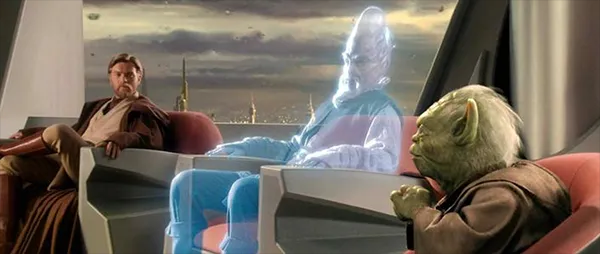
Recently, students at Western University used Microsoft’s Hololens to achieve the world’s first “international holographic teleportation.” In the press release issued by Western University, the opening lines already mention the science-fiction scenes of Star Wars and Star Trek, where people far away on another planet can also attend a meeting in the form of holographic images.
But this news item seems a bit calculated to attract attention; the所谓的 “first” actually refers to the first “international” teleportation. In fact, the news item itself already mentions that as early as October 2021, NASA had sent a doctor’s holographic projection to the International Space Station. This most recent instance merely marks the first time such an act has “crossed international borders”; sending something from the United States to Canada does not seem any more remarkable than sending it from the United States to a space station.
So is this really the first cross-border interaction via holographic image in history? That depends on how you define “holographic image.” In fact, there was already a news item during the Beijing Winter Olympics: “The black technology of Star Wars comes true: cloud-based holographic communication transmits ‘real people’ across space,” which reported that IOC President Bach and Alibaba CEO Zhang Yong were “teleported” to the news center, achieving an encounter across time and space.
The holographic projection at the Winter Olympics did not use AR (augmented reality) technology; it was still a meeting conducted via a flat display, merely with enhanced clarity, immediacy, and interactivity. In this sense, the three-dimensional image provided by Microsoft Hololens ought to be a bit more vivid (though perhaps at a lower resolution). In any case, present-day communication methods are still a long way from the embodied presence of being there in person; at the very least, touch has not yet been integrated.
From telephone calls to television broadcasts, from the internet to smartphones, humanity’s remote-interaction technologies have continued to develop, and the ultimate ideal of these technologies seems to be to make the experience of remote interaction the same as that of face-to-face interaction. Related news reports also tout the idea that new holographic interaction technologies will become mainstream, enabling people to interact remotely as if they were “talking face to face.”
It is worth noting that the trend of “increasingly approaching face-to-face conversation” is only one side of the development of communication technology, and by no means the only direction. For “face-to-face conversation” itself may not be the only ideal form of interaction.
In fact, in advanced communication environments, many people do not like face-to-face conversation. Some would rather read text messages than send voice messages, would rather send voice messages than make phone calls, and would rather make phone calls than talk face to face. Some believe written communication is more precise and efficient; some feel that audio-video calls or face-to-face conversation require immediate feedback, thereby compressing the space for thought; some are introverted or simply dislike reading people’s expressions; some just can’t be bothered to dress up and sit up straight, so they avoid showing their face…
In short, in many contexts, a relatively “incomplete,” simplified mode of communication may be more popular than a more “holographic,” more fully sensory mode of communication.
Licklider was a pioneer of computer networks. When he was in charge of ARPA’s Information Processing Techniques Office in 1963, he proposed the idea of the “intergalactic network,” laying the groundwork for what would later become ARPANET. Licklider was a psychologist, and it was precisely while studying interpersonal communication that he conceived the idea of “network communication.” In his 1960 article “Man-Computer Symbiosis,” Licklider argued that in the future “communication via machine will be more effective than face-to-face communication between people.”
Communicating through machines, on the one hand, can strip away the unnecessary and simplify matters, filtering out the overly emotional factors present in face-to-face communication and making communication more rational; on the other hand, it can strengthen human rational capacity with the aid of computers, which Licklider called “intelligence amplification.”
It is not hard to imagine how computers might “amplify intelligence” in the process of communication. For example, when I need to provide evidence for a certain viewpoint, I can quickly retrieve relevant materials and data through the computer; for example, when the other person uses certain technical terms or concepts, the computer can immediately provide me with annotations.
If Hololens’ “holographic teleportation” represents a direction in communication technology development oriented toward “augmented reality,” then Licklider’s “man-computer symbiosis” represents a direction oriented toward “augmented rationality.” These two directions are not necessarily contradictory, but neither do they always coincide.
We have already seen that interaction modes such as “short videos” seem to be “weakening rationality.” People are becoming increasingly accustomed to information input that is rapid, immediate, and sensory-stimulating, while suppressing the ability for critical reading and calm reflection. More and more people would rather spend extra time watching a long-winded video explanation than bother to carefully read even a microblog text of more than 100 characters, let alone settle down to read an article of several thousand characters. Watching a streamer in a video speak at length with great emotion and force for several thousand characters, and reading an article of several thousand characters— which one is more “holographic”? But which one is more “rational”?
I am not saying that the pursuit of “augmented reality” is wrong. The key is that we should recognize the multiplicity of goals—holography is not the ultimate ideal of communication technology. Of course, on the other hand, overemphasizing “augmented rationality” is not necessarily correct either. The point is that all communication technology serves nothing but “communication,” and ultimately, what is human “communication” for in the first place? Sometimes communication serves rational goals, such as sharing knowledge and distinguishing among theories; but at other times, communication serves affective goals, such as maintaining relationships and comforting one another.
Communication itself is complex and plural. From gestures and language to symbols and writing, human beings have, since ancient times, continuously used new technologies to enrich the forms of communication. We do not need to designate any one particular form of communication as the most ideal or most perfect form. What we have always needed is richer, rather than more ideal, forms of communication. Language did not replace gestures, and writing did not replace language. The same goes for new technologies such as computers, the internet, VR, and AR: we can look forward to their continuously enriching human life and sociality, without necessarily concluding that they provide a better way of communicating.

Translated from the Chinese original with AI assistance. The original text is authoritative.