
I had a sudden awakening around the end of last year and the beginning of this year, and embraced new concepts like the metaverse, NFT, and Web3. But there is still one new concept about which I have always been somewhat reserved: DAO.
DAO stands for “decentralized autonomous organization.” In fact, it is also an old concept. I remember that when I first got into Bitcoin, Babite seemed to be planning to do DAO (or something similar), and I also witnessed the The DAO incident that later led to the Ethereum fork.
My view has actually remained fairly consistent: I think DAO is a good concept, but the ways it is commonly implemented in the market are not quite right; as for what exactly should be done, I have not yet figured it out. Until recently, though, I finally had some thoughts on the matter.
In fact, in my article on January 14, I already mentioned that DAO might be used to build organizations similar to Sci-Hub, promoting open sharing while remaining outside national jurisdiction. And on February 23, I wrote on Weibo:
“So-called decentralists appeared in early-19th-century France; yet it was Britain, the United States, Germany, Japan, and so on that led the development of industry and commerce in the 19th and 20th centuries. Great entrepreneurs, from Edison and Ford to Gates and Jobs, were all autocratic and arbitrary; I have never heard of any decentralized organization that led innovation. DAO is very meaningful, but I think it is mainly useful for NGOs and similar organizations, and is unnecessary for fields of pioneering innovation.”
And my Weibo post of June 2 said:
“The board of directors of a traditional company is already some kind of representative voting governance mechanism. If DAO wants to do representative democracy, the best it can achieve is nothing more than an online board of directors. Current DAO is nowhere near the direct democracy of the Greek city-states. The spirit of the Greek city-state is not voting, but the town hall and the agora. Some DAOs now have a bit of the feel of an agora, but they would do best to set aside the voting mechanism for the time being”
My view is that DAO is not suited to being a “company” structure, especially not a startup structure. Startups need to expand into the market quickly and decisively, competing ruthlessly alongside other enterprises, with the strong prevailing and the weak eliminated. The “decentralization” of the free market is reflected in this: the environment allows countless companies and countless entrepreneurs to compete together, and no company naturally enjoys a monopoly position. At the level of market competition, there is no single plan and no referee taking the field, and that is what “decentralization” means. And the basic unit of market competition is the company or enterprise, not the individual, so within a company, putting efficiency first is only natural.
Whether from the level of blockchain technology or from the level of political institutions, “decentralization” generally means sacrificing efficiency in exchange for freedom. Even if we can believe that once freedom and efficiency reach a certain balance, decentralized governance can be more efficient than most forms of despotism, as long as it cannot surpass the best despotism, then it is still not suitable for companies. Ninety-nine despotic enterprises are inferior to a decentralized organization; as long as there is one enlightened despotism that performs better, then it is despotic enterprises that will ultimately prevail. That is the cruelty of the market. Of course, once a startup grows and achieves a certain market position, corporate governance will tend toward democratization in order to stabilize development, but an outstanding CEO is still the center of decision-making.
These views have basically not changed to this day, but I have figured out one issue: I do not need to get hung up on choices like “DAO is not suitable for companies but more suitable for NGOs,” because DAO may create new organizational forms. These new organizational forms are neither “companies” nor “NGOs” nor any other traditional form of association. DAO is DAO; we should step outside traditional frameworks and think about the operation and significance of DAO.
A company is a profit-seeking organization, while an NGO is public-interest oriented and non-profit. But is the boundary between profit and non-profit necessarily clear-cut?
Of course, public-interest actions should not be driven primarily by profit-seeking. Human beings are a species with morality and honor; actions driven by higher aspirations beyond interests are noble. And once too much concern for interests is mixed into an action, many public-interest causes instead become difficult to advance.
However, there is no absolute divide between work that makes money and actions that serve the public good. Many things done for profit are also beneficial to the public good; moreover, some people engage in certain money-making undertakings because they are driven by the public good—for example, companies like Google, where many projects are propelled by the ideal of “changing the world.” Whether or not these company cultures are hypocritical, at least some of the people actually doing the work are indeed driven in part by public-spirited aims. Such aims make tedious work seem more meaningful and more rewarding.
On the other hand, some public-interest projects also require a certain return of benefits, especially many public-interest actions that need long-term, stable professional personnel and resource investment. It is difficult to build a stable and sustainable public-interest organization on enthusiasm alone. In addition, many entrepreneurs are also happy to do charity, because charitable causes can bring fame to a company, increase visibility and reputation, and indirectly bring returns to the enterprise.
There are also many actions with multiple aims. For example, buying a welfare lottery ticket is, on the one hand, about getting rich overnight (a profit-seeking behavior), on the other hand, about seeking thrills and taking a gamble (an entertainment behavior), and on yet another level, it also supports welfare causes to some extent (a public-interest behavior). What many people think is simply: if I get rich, great; if I don’t win, I’ll just treat it as a donation. One cannot say that this sense of public-spiritedness is entirely hypocritical; the human heart is, by nature, a complicated and rich thing.
Since human action does not have such rigid boundaries, why must organizations strictly distinguish between for-profit and non-profit? Is it possible to兼顾 both?
The emergence of NFT has provided some possibilities. The craze for NFT going mainstream began with art auctions, and artists quickly discovered the advantages of NFT. Traditionally, once a painting had been sold, it could no longer bring any benefit to the artist. No matter how high a price the work was speculated to among other collectors, the artist himself received no share of the profits. But if a work is sold in the form of an NFT, then even if it is initially sold cheaply, as long as it is eventually sold at a high price, the artist can also obtain a share from the transaction. That is to say, the artist can still remain indifferent to immediate gains when creating, yet in the long run can enjoy the dividends associated with the work.
So-called everything can be NFTed: what can be minted into an NFT is not just paintings. Any kind of creation or action, as long as it is digitally recorded, can be minted into an NFT, and thus freely traded and circulated, becoming a “collectible.”
If actions and events can become “collectibles,” then will anyone pay for them? Certainly there will be. Many collectibles today are not valuable because of artistic achievement, but because of the “history” attached to them. A pen, a piece of cloth—so long as they participated in some major historical process, they too can become “collectibles.” Then we can also imagine that when we NFT-ify a certain action, if that action truly has long-term significance, then this commemorative NFT may become a high-value collectible. Thus, people who have done meaningful things may ultimately reap wealth value commensurate with that significance.
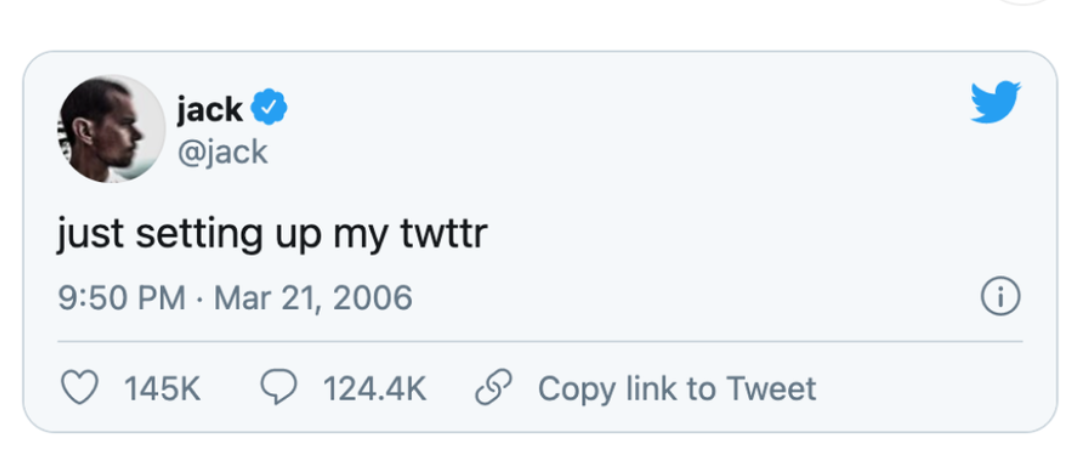
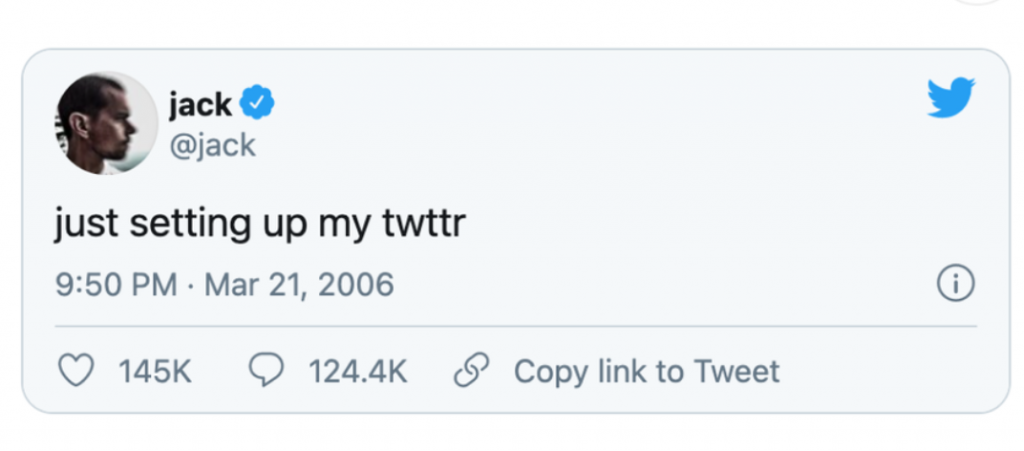
The founder of Twitter turned the first tweet into an NFT for auction and sold it at a high price. This has already proved that if there is a clear collectible target, people are willing to collect “a meaningful action.”
The person who bought “the first tweet” tried to auction it off a year later at an even higher price, only for it to go unsold. But this does not prove that such collectibles are invalid. I believe that if he were willing to accept a lower but still considerable offer, he would certainly be able to sell this collectible quickly.
In short, NFT provides a certain possibility of “value return,” allowing people to reap long-term benefits through one-off actions that were not deliberately profit-seeking at the time.
In my view, one reason why NFTs like “the first tweet,” as “records of behavior,” have not become wildly popular is that no norms and patterns have been established. For example, stamp collecting has its stamp-collecting circle, jade has its jade conventions, collectibles have their collectibles玩法… Once a collectible forms a “category,” gathers a cultural circle with some shared consensus, and establishes certain rules and patterns, and then collectors begin to prop one another up, only then will this kind of collectible truly enter the mainstream and become sought after.
A worthwhile “record of behavior” cannot just be whatever anyone casually says it is. The release of a tweet was an event witnessed by internet users around the world, but the various meaningful things done by more people do not necessarily have such a good environment for authentication. So someone needs to create that environment, providing authentication, compilation, packaging, and minting for event records, and forming some consensus-based formats, rules, and玩法.
Who should do these things? In fact, precedent can be found in history: the “historiographer,” especially the “historiographer” of ancient China. The actions of emperors and generals are recorded by official history, while the important deeds of ordinary people are also recorded by genealogies and local gazetteers. Although historical records in ancient China could not provide material wealth to the people involved, they provided a more important value of belief—“posthumous fame.” I often say that “historiographer culture” is the most distinctive cultural inheritance of China, and history is the true religion of the Chinese people.
Attention to “name” is no exception in either ancient or modern times, in China or abroad. Yet through its developed historiographical tradition, ancient China provided an institutionalized and ritualized mechanism for preserving one’s name, which is unique in the world.
Of course, the ancient historiographer system was centralized, and its structure and tempo cannot adapt to the Web3 era. But is it possible to revive some kind of “decentralized historiographer organization”? That may well be an undertaking that could be realized through DAO.
We can use NFT to turn “name” into a relatively immovable “permanent asset,” turn “deeds/achievements” into tradable “collectibles,” and then build consensus so that people may obtain long-term dividends from “name” and “achievement.” In this way, one completes a kind of return of value—“the more meaningful things you do, the more wealth you can obtain.” But not by directly and quickly earning wealth; rather, it is achieved through such a chain as “doing things → leaving a reputation → entering the historical record → speculating on collectibles → returning dividends.” And in this chain, what one needs to directly pursue when doing things is reputation rather than profit; as long as one cherishes one’s name and conducts oneself decently, that is enough. This avoids the corruption of one’s motives by excessive profit-seeking. The latter three steps can then be entrusted to DAO.
Translated from the Chinese original with AI assistance. The original text is authoritative.