
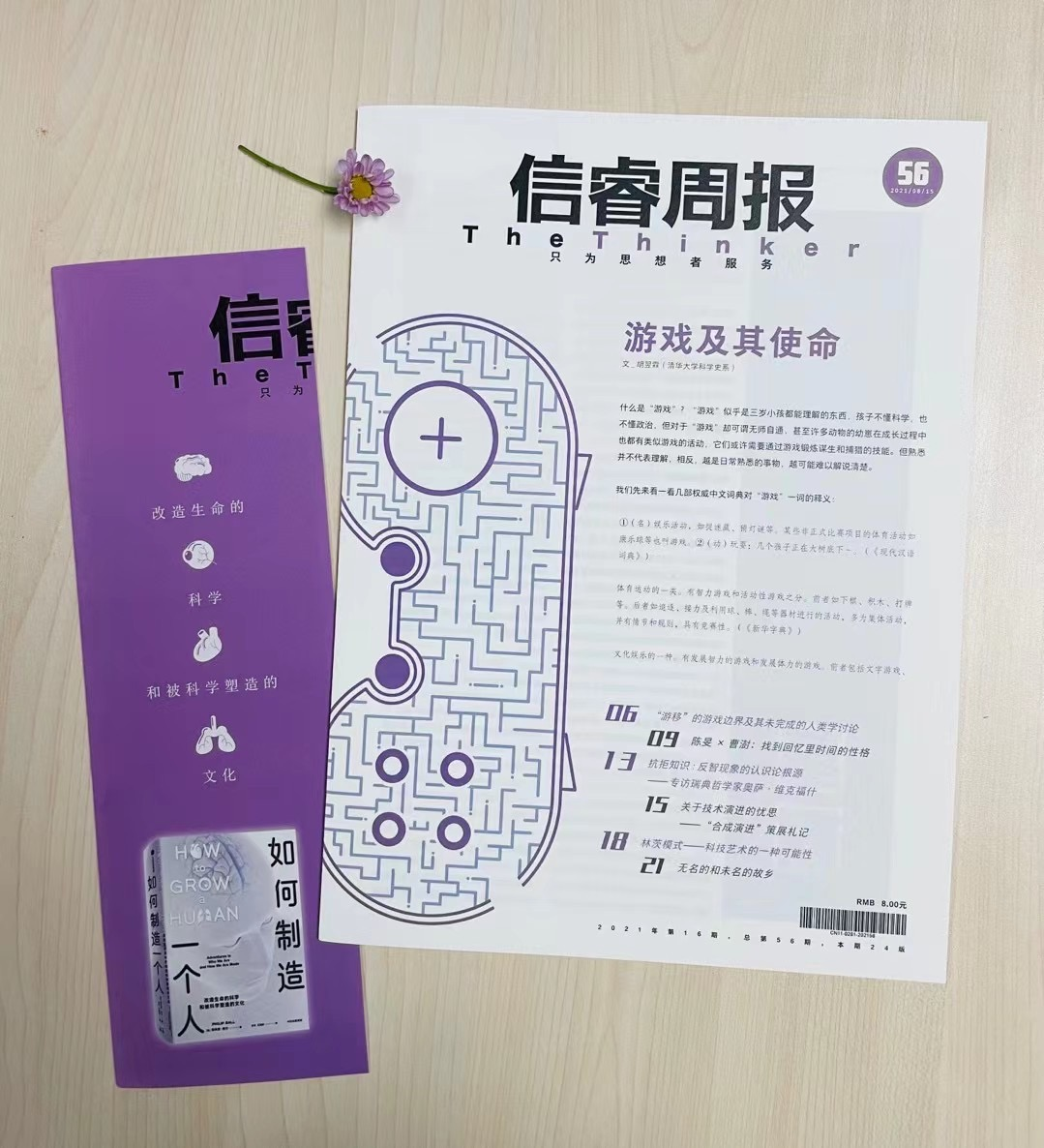
This piece was originally published as the cover article in The Intellectual Weekly, and was slightly revised at the time of publication; here I am posting the original draft. It was written before the “opium theory,” so its appearance now is actually rather apt. But by the time I was writing it, I had already consciously trimmed back many of the directions the discussion might have taken, and it felt like I hadn’t written it with enough freedom. I had originally planned to revise it again and submit it for the phenomenology and philosophy of technology conference, but the conference was postponed because of the pandemic, so I never went back to it. I’ll repost it here for now.
1. How Do We Define Games? — An Ambiguous Entry
What is a “game”? “Game” seems like something even a three-year-old can understand. Children may not understand science, and they may not understand politics, but when it comes to “games,” they seem to know them innately, without instruction. Many animal cubs, too, engage in game-like activities as they grow up; perhaps they need to use play to develop the skills needed for survival and hunting.
But familiarity does not mean understanding; on the contrary, the more ordinary and familiar a thing is, the harder it may be to explain clearly.
Let us first look at how several authoritative Chinese dictionaries define the word “游戏”:
Modern Chinese Dictionary: “(1) (noun) recreational activities, such as hide-and-seek and lantern riddles. Some unofficial sporting events, such as roller ball, are also called games. (2) (verb) to play: several children are playing under the big tree.”
Xinhua Dictionary: “A category of sport. It is divided into intellectual games and activity games. The former includes chess, building blocks, card games, etc. The latter includes pursuits, relay races, and activities using equipment such as balls, bats, and ropes; these are mostly group activities, with plots and rules, and are competitive.”
Cihai: “A form of cultural recreation. There are games that develop intelligence and games that develop physical strength. The former include word games, picture games, number games, etc., commonly known as intellectual games. The latter include activity games (such as hide-and-seek, carrying relays, etc.) and non-competitive sporting activities (such as roller ball, etc.). In addition, there are video games and online games, etc.”
In these three definitions, recreational activities and sport are roughly the shared keywords, but the relative importance of the two is not consistent. The Dictionary treats recreation as primary; the Dictionary of Chinese Language places sport first and emphasizes “competitiveness”; and Cihai, while nominally classifying games under recreation as well, places greater emphasis on their positive role in “developing intelligence and physical strength,” and stresses “non-competitiveness.”
We can see that these three definitions, at first glance, seem more or less the same, but on closer inspection they diverge greatly. More importantly, none of them really matches the way we actually use the word “game” today. When, in today’s context, we say that so-and-so “likes playing games,” we are rarely referring to someone obsessed with roller ball; more often, we mean that he likes “video games.” And “video games” are mentioned only in passing in Cihai, and as an “atypical” case that is hard to fit under the binary division of intellectual games and physical games.
Likewise, when we speak of “recreational activities,” we are usually talking about singing, dancing, film and television, variety shows, and the like. When we call someone an “entertainment star,” we usually do not mean a game player. When we speak of “sport,” we are usually talking about running, swimming, playing ball, and so on; we also rarely mean games by it, even though e-sports have long been listed as the 99th sport in our country. But when I say someone is an “athlete,” I usually do not mean an e-sports competitor. In short, whether games are placed under recreation or under sport, they are “atypical.”
The above analysis is in a Chinese context. In English, “游戏” roughly corresponds to two words: play and game. Their semantic range is broader than that of the Chinese “游戏.” For instance, play can also mean to fiddle with, to play an instrument, and to act; game can also mean strategy, competition, tournament, and so on. But the basic definitions are much the same: participating in some kind of “sport or recreation.”
Whether in Chinese or in Western languages, this ambiguous, blurred, and atypical character embodied by the concept of “game” may be no accident—this “atypicality” is precisely the “typical” feature of games.
2. Defining by Game — Wittgenstein’s Theory of Language Games
It is difficult for us to give games an exact definition—perhaps it was precisely this that inspired Wittgenstein. He discovered that this phenomenon does not mean our understanding of “games” is flawed; rather, it means our understanding of “definition” is flawed.
The early Wittgenstein, represented by the Tractatus Logico-Philosophicus, tried to understand language and its relation to the world on the basis of logic, saying clearly what can be said and remaining silent about what cannot be said. In the later philosophy represented by Philosophical Investigations, “game” replaced “logic” as the starting point for understanding language; this is the famous theory of “language games.”
Logical “definitions” often imagine a concept as a domain with fixed boundaries, and then either separate this domain out from a larger one, or assemble it from several smaller domains. For example, “games are recreational activities with competitiveness” defines games by starting from a broader concept; or “games include intellectual games and physical games” defines games by assembling a set of sub-concepts. But we have already seen that these definitions do not really match the intention and attitude with which we actually use the word “game.”
For the early Wittgenstein, this gap between delimitation and usage was probably a matter of usage gone wrong, which is why we need logic to regulate our language; but in the later Wittgenstein, perhaps after six years as a primary school teacher he simply gave up on the cure, or perhaps he was inspired by the rich variety of children’s games. In any case, he no longer regarded actual everyday use of language as something that needed correction. He realized that, compared with defining words by words, only actual use truly grasps the word. He said: “From how he uses the defined word it will show how he ‘understands’ the definition.”[1]
Wittgenstein takes “games” as the典型 example. First, “games” include many categories, such as “board games, ball games, wrestling games, and so on.” So what do they have in common? Wittgenstein says we cannot simply assume that, because they are all called games, they must share some common feature—“for if you look, you won’t see something that is common to all, but similarities, kinship…”[2]
These sub-concepts, on the one hand, do not share a common essence; on the other hand, they are not pieced together by airtight boundaries. We cannot exhaust the various uses of the word game, nor can we precisely circumscribe the boundaries of games—“What is still a game and what is no longer a game? Can you say where the boundary is? No. You can draw a boundary: precisely because none was drawn before. (Yet you have always used the word ‘game’ without feeling any inconvenience.)”[3]
Wittgenstein uses “family resemblance” to characterize this phenomenon: the things a concept can denote are like the members of a large family, linked by a web of kinship, but not necessarily sharing any clearly identifiable common feature. A boundary can be drawn between “family” and “outsider,” but such a boundary is not rigorous, nor fixed.
But isn’t this ambiguity a defect of everyday language? Logical positivists, including the early Wittgenstein, thought exactly that: they wanted to transform language and redesign a set of rules with rigorous structure and clear boundaries on the basis of mathematical logic. But Wittgenstein abandoned this ideal, and the key was that he had a new understanding of language and its rules—language is not a mapping of the world’s essential structure; the essence of language is “game.”
What do grammar and logical rules mean for language? They are to language what rules are to games. Games always have rules and boundaries, but games are not fixed by ready-made rules; people often “change the rules while playing.”[4] Some games have relatively fixed and strict rules, while others are relatively open and ambiguous, but whether rules are strict or open, their point is to make the game more fun. Rules serve the game, not the other way around.
Wittgenstein did not completely deny the act of “giving a precise definition with clear boundaries,” but this act itself is nothing more than a kind of “game.” This is not to say that activities such as mathematics and logic should no longer pursue precision, but only that the rigorous rules embedded in these activities are no more lofty or unique than games such as chess.
“Language games,” like other games, are not absolute existences floating free of real space and time; they are human actions, part of the human lifeworld. Wittgenstein said: “The term ‘language game’ is meant to bring into prominence the fact that speaking a language is part of an activity, or of a form of life.”[5]
3. Games Sublimate Life — Huizinga on “Homo Ludens”
Wittgenstein dissolved the special status of language, but in a certain sense “game” acquired a kind of transcendent status. On the one hand, games are of course also a kind of behavior or form of life, but on the other hand, they seem to occupy a foundational position: we understand other activities precisely through “games.”
Can we interpret games through other activities instead? Of course we can. For example, some biologists understand play as a kind of learning behavior: games in childhood help humans and animals develop cognition and train skills. Psychologists may understand play as a way of relieving stress and venting desire; reducing pressure through play can prevent other kinds of out-of-control behavior.
But these interpretations do not cancel games’ special status. On the one hand, the academic activity of competing to propose such interpretations can itself be understood as a kind of “game”; on the other hand, these interpretations all evade one of the most important features of games—interiority. This feature is not exclusive to games, nor do all games display it, but “interiority” may be the most distinctive trait of the game family.
The most classic work in game studies is undoubtedly the Dutch scholar Huizinga’s Homo Ludens. Huizinga argued that “game” is not a subordinate part of human culture, but an inherent component of culture; in a certain sense, play is the foundation of all culture. Huizinga first opposed interpreting games in biological or psychological terms. He pointed out that “their starting-point is always the assumption that play has some biological purpose, or that it serves some need that is not play. … To all these explanations one and the same objection may be made: ‘Granted all that, what is the actual fun of playing?’”[6]
What Huizinga is talking about is exactly what I mean by “interiority”: the “fun” of games is embedded within the game activity itself, and “fun” itself constitutes the purpose of the game. Games can have purposes beyond fun—learning, fitness, socializing, honor, making money, and so on can all be purposes of games—but all these external purposes are optional. Only if the internal fun is lost does the activity cease to be called a game; a game that has lost its interiority will degenerate into work or labor.
Whether as amusement and leisure leaning toward entertainment, or as competitive games leaning toward sport, games all possess this feature of “interiority.” This is also why we are more willing to classify “informal” competitions as games. For formal competitions often introduce external purposes such as trophies, points, and prize money.
“Inwardness” also explains the unique status of play as a human activity. For other activities usually have external ends. Studying is for finding a job; finding a job is for earning money; earning money is for supporting a family; supporting a family is for enabling one’s children to study… Perhaps only the two animal functions of eating and sex, as well as the merely vegetal function of simply staying alive, do not need to be propped up by any external purpose.
If one probes human activities through external ends, one either falls into an infinite regress or sinks into base instinct; “play” offers a transcendent possibility, freeing human beings from mechanical circulation. Huizinga believes that play brings human beings into the “spiritual” realm beyond material pursuits, and that the self-consciousness of play proves that human beings are not machines or mere beasts.
Huizinga discusses the relation between play and law, play and war, play and knowledge, play and religion, play and art, and so on. He believes that play is the foundation of human culture: it is embedded in all kinds of human activities and enables the meanings of these activities to be sublimated.
For example, a war fought purely for conquest or spoils is barbaric; yet from the outset the great ancient civilizations did not regard war as merely a means to victory, but also pursued all sorts of honors and rites within war itself. Or take scientific knowledge: it certainly has practical value, but at its source science emphasizes the inwardness of “knowing for the sake of knowing,” enjoying the intrinsic pleasure of inquiry, transcending utilitarian ends, and thus allowing Greek science to flourish. As Aristotle said, science originates in “wonder and leisure”[7], perhaps with the addition of the uniquely ancient Greek tradition of free debate. These three conditions happen to be precisely the features of play—leisure and competition driven by intrinsic pleasure.
What Huizinga elevates is less the game activities of chess, sports, and the like than the “element of play” in fields such as science and art. As for those contemporary activities that are called games, Huizinga, by contrast, does not think much of them. He believed that the widespread popularity of games like bridge, which are “wily and calculating,” only showed the debasement of play; and that sporting events carried out in the name of game had become excessively specialized and scientized, thereby likewise reflecting the decline of the play spirit.[8]
Play is the source of culture, and therefore the elements of play are embedded in every field of culture: “Without the play-element, no true civilization is possible”[9]. But as history advances, the play elements in many fields are disappearing. Huizinga’s Homo Ludens was written on the eve of World War II, and he had already noticed the decline of the play spirit. And in the second half of the twentieth century, the prosperity of the game industry could not prove a revival of the play spirit; on the contrary, the prominence of the game industry may well have been the result of play elements being “crowded out.” To understand the present state of play, we need to examine the “modernization” of play from a historical perspective.
4. The Standardization Trend of Modern Games
Wittgenstein did not go on to elaborate the meaning of “game”; it seems that “what is a game” was not a problem. He merely relied on people’s tacit understanding of games to explain questions such as “what is language,” “what is definition,” and “what is mathematics.”
Wittgenstein explained the complexity of the concept of game only by “family resemblance,” but he seems not to have noticed that a family becomes a family not merely because of the similarities among its members, or rather, that such similarity is an effect rather than a cause. What makes a family a family is, first of all, its “history”: the family’s boundaries evolve with historical change, and members who look utterly different belong to the same household because of a shared inheritance or common origin. Second, the boundaries of the family are often defined by “outsiders”; under external pressure, a family may become more cohesive and its identity boundaries clearer, whereas without external pressure it is more likely to split from within. Of course, changes in external pressure are themselves a historical process.
Studying concepts through historical retrospection rather than logical analysis is precisely what Foucault called “genealogy” or “family history.” Genealogy traces backward from the present and pays more attention to “ruptures” than to continuity. Huizinga’s observation that the nineteenth century was a period in which many play elements disappeared is no accident. The entire process of modernization after the Industrial Revolution marked a major rupture in the history of human culture.
Critics usually call the various features that followed this rupture “modernity.” Few people completely deny the prosperity and progress of the modern world, but many critics place greater emphasis on the “cost” paid by human civilization in the course of modernization; the decline of some traditional spiritual and cultural forms may perhaps bring deeper crises to human civilization.
The prosperity of the game industry and the loss of the play spirit are a typical contradiction of modernity.
We note that although “play” has a long history, and even exists in the animal world, it is only modern people who regard play as a relatively clearly bounded specialized domain. For instance, in ancient times people played Go, guessed lantern riddles, improvised wine games, and gambled on pai gow, but they rarely subsumed these activities under a single category.
The modern specialized concept of games is to a large extent a product of the industrial age. Of course, the toy industry is a direct consequence of industrialization: industrialization brought delicate, complex, and inexpensive toys into countless households. But industrialization’s promotion of play was more on the spiritual level; first of all, the ideas of standardization and normalization influenced the development of games.
In 1795 France adopted the “metric” system of weights and measures; in 1797 Maudslay invented the modern machine tool that supported standardized production, and later his apprentice Whitworth helped bring about Britain’s first thread standard; in 1801 Whitney delivered a speech to the U.S. Congress on the idea of interchangeable parts…
This is not to say that before the “metric” system people had no standards of measurement; on the contrary, people had many standards, but these standards were often local, variable, and ambiguous. In the late eighteenth to nineteenth centuries, people increasingly and consciously established precise standards or norms that transcended regions in all trades and professions. This trend may have been influenced by modern science’s attitude of precise quantification, or it may have reflected the demands of mass production in modern technology. In any case, this trend also affected the development of games.
For example, in 1851 the first international chess tournament was held in London. By the end of the nineteenth century, chess tournaments and magazines had become abundant, and many rules—including whether White or Black moved first—gradually stabilized.
In 1848, the first written rules of modern football, the Cambridge Rules, were published; in 1862, the Football Association was founded in England, which fixed and unified the rules of football.
The standardization of rules promoted the professionalization of competition; conversely, professionalized competition also pushed forward the standardization of rules. By the second half of the twentieth century, with the development of electronic computers, the rules of games became ever more systematic and precise. What I am referring to here is not only video games based on electronic computers; traditional board and card games were likewise affected by industrial and electronic technology. A typical example is the “tabletop games” represented by Sanguosha, a kind of tabletop game with a tight, procedural, and data-driven rule system. Although in terms of material substrate Sanguosha does not use any technology that emerged after the Industrial Age—a set of such cards could already have been made in the age of papermaking—this kind of game did not become popular until the late twentieth century, and especially after the twenty-first century began. This suggests that although these games are ancient in terms of material technology, they are entirely new in terms of spiritual orientation.
The trend toward standardization is precisely what Huizinga resisted: play becomes “wily and calculating,” and competitive games become overly specialized and scientized. But perhaps we need not be too pessimistic; free, childlike play and professionalized, standardized play are not necessarily contradictory. We see that the precise rules of Sanguosha are often freely altered in actual play, and that unrestrained street football has not been dissolved by professional football competition.
5. Work and Leisure — Why Must We Insist on the Eight-Hour Workday?
The industrial age’s impact on play is also reflected in the way it shaped play’s opposite: study and work.
We regard play as a form of leisure, and leisure or amusement is in turn seen by us as an escape from study or work. But this opposition is not ancient.
In ancient times, study and work themselves were opposed to each other. In ancient China, the scholar was distinguished from the laborer; scholars had the right to “not distinguish the four limbs, not be diligent in the five grains, and not listen to the affairs beyond the window with both ears.” In the ancient West, learning such as arithmetic, geometry, astronomy, and music were called the “liberal arts,” the preserve of the leisured class; those who studied these noble disciplines consciously drew a line between themselves and those who earned their living through labor.
Where was leisure for ancient people? Leisure was embedded in every aspect of life. The leisured classes need hardly be mentioned; ordinary laborers, though busy making a living, were by no means entirely without free time, and peasants could even have long stretches of off-season leisure.
In the industrial age, relying on steam engines and railways, the modern factory system was established, and the “working class” emerged. The “work” of the industrial age was neither the mere toil of slaves nor the kind of work that ancient day laborers or craftsmen could arrange at their own discretion. Modern “work” is professionalized and standardized: workers must complete specified actions at specified times and in specified places.
After university reforms in the eighteenth and nineteenth centuries and the institutionalization of primary and secondary education, study and research also became a “profession,” a kind of “work.”
Study and work were no longer special activities for a few individuals, but the “normal” way of life that everyone had to go through. Thus, the time outside them became a gap awaiting filling.
More importantly, “work” under the modern mechanized industrial system is, as Marx said, “alienated.” Put plainly, alienation means that when workers are at work, they increasingly feel that they are not persons at all—workers are more like beasts of burden who merely sell their labor, or machines that merely respond to commands, and anything but people with likes, dislikes, and thoughts. Ancient artisans could see their own shadow in their works—this is my work, it embodies my skill and aesthetics. But modern workers may not even be able to see their own “work,” and the “products” manufactured by the factory never belong to the workers from beginning to end. Workers can neither enjoy the pleasure of creation in their labor nor gain a sense of accomplishment after work. All they receive is money, and thus all they can hope for is that after labor, money will be used to purchase happiness.
Marx said: “Labor is external to the worker, i.e. it does not belong to his essential being; that he therefore does not affirm himself in his work, but denies himself, feels no contentment but unhappiness, does not develop freely his physical and mental energy but mortifies his body and ruins his mind. The worker therefore only feels himself outside his work, and in his work feels outside himself. He is at home when he is not working, and when he is working he is not at home.”[10]
“The result is that man (the worker) feels himself to be freely active only in his animal functions—eating, drinking, procreating, or at most in his dwelling and dress, etc., and in his human functions he feels himself to be nothing but an animal. What is animal becomes human, and what is human becomes animal.” [11]
In Marx’s ideal communist society, people would no longer work for money, but would be able to work freely. But Marx also knew that under the conditions of production at that stage, the operating mode of the factory system could not yet be broken. So Marx actively threw himself into the movement for workers’ “leisure.” As early as 1866, in the “Instructions for the Delegates of the Provisional Central Council on Certain Questions,” written by Marx for the General Congress of the First International, he explicitly supported the eight-hour workday. The proposal for the eight-hour workday came from earlier utopian socialists, with the slogan “eight hours’ labor, eight hours’ leisure, eight hours’ rest.” The Chicago general strike of May 1, 1886 ultimately brought about the implementation of this system, and Engels designated this date as International Labor Day.
Ironically, the eight-hour workday is now virtually meaningless in some countries that claim to follow Marxism; 996 has become the norm of work, and if a company can pay enough overtime wages, it is already considered conscientious. But Marx had long pointed out that labor becomes alienated not because too little money is paid, but precisely because only money is paid. No matter how much overtime pay is given, it cannot give labor any inwardness.
Why must we guarantee eight hours of “leisure” time? Marx’s Instructions makes it very clear: “It is necessary not only for the restoration of the health and strength of the working class, which is the backbone of every nation, but also for ensuring that workers have the opportunity to develop intellectually, engage in social activities, and participate in social and political activities.[12]”
As we can see, safeguarding leisure time is not about letting workers spend a few more hours as couch potatoes; it is about giving them more room to develop themselves freely. Eight hours of sleep meets the requirements of human animal instinct, and eight hours of work is a compromise with the industrial age. Only those eight hours of leisure can allow one to recover the self, to freely տնօրiate one’s own time, and to freely choose one’s own goals.
What is tragic is not only the loss of these eight hours of leisure time; even more fatal is the fact that, with the rise of the entertainment industry, modern people’s leisure time has long since been occupied by all kinds of impoverished but刺激ing entertainment products, leaving less and less room for the reading, social activities, and political activities Marx spoke of.
The only thing worth celebrating is that we still have games. Although the game industry has likewise undergone modernization and likewise undergone alienation, if a game is to be fun, it must always leave room for human “freedom.” The mission of modern games is not merely to fill people’s leisure time; more importantly, games can briefly lift people out of the cycle of utility, allowing them to experience anew the possibility of freedom.
Recommended reading: Huizinga, Homo Ludens, trans. Fu Cunliang, Peking University Press, 2014
One of the most classic works in game studies is undoubtedly the Dutch scholar Huizinga’s Homo Ludens. Huizinga believed that “play” is not some subsidiary part of human culture, but an inherent component of culture itself. He discusses the relations between play and law, play and war, play and knowledge, play and religion, play and art, and so on. He believed that the elements of play are embedded in all kinds of human activities, and that they enable the significance of these activities to be sublimated.
Recommended game: Baba Is You
This is a philosophical game: first of all, it is metaphysics; you have to figure out the meaning of “is” before you can go on playing. Once you have entered metaphysics, you move into dialectics, continuously challenging your prejudices and fixed patterns of thought, just like Socrates. At the same time, it also has something of mathematical logic about it: you need to define a number of axioms before carrying out deductions. Finally, it is hermeneutic, requiring you to cycle again and again between stepping back to see the whole and delving into the details
[1] Wittgenstein: Philosophical Investigations, §29, trans. Chen Jiaying.
[2] Wittgenstein: Philosophical Investigations, §66, trans. Chen Jiaying.
[3] Wittgenstein: Philosophical Investigations, §68, trans. Chen Jiaying.
[4] Wittgenstein: Philosophical Investigations, §83, trans. Chen Jiaying.
[5] Wittgenstein: Philosophical Investigations, §23, trans. Chen Jiaying.
[6] Huizinga, Homo Ludens, trans. Fu Cunliang, Peking University Press, 2014, p. 2.
[7] Aristotle: Metaphysics, §2, trans. Miao Litian.
[8] Huizinga, Homo Ludens, trans. Fu Cunliang, Peking University Press, 2014, p. 289
[9] Huizinga, Homo Ludens, trans. Fu Cunliang, Peking University Press, 2014, p. 302.
[10] Marx: Economic and Philosophic Manuscripts of 1844, edited and translated by the Compilation and Translation Bureau of the Central Committee of the Communist Party of China for the Works of Marx, Engels, Lenin, and Stalin, People’s Publishing House, 2018, p. 50.
[11] Marx: Economic and Philosophic Manuscripts of 1844, edited and translated by the Compilation and Translation Bureau of the Central Committee of the Communist Party of China for the Works of Marx, Engels, Lenin, and Stalin, People’s Publishing House, 2018, p. 51.
[12] Complete Works of Marx and Engels (Volume 16), People’s Publishing House, p. 216.
Translated from the Chinese original with AI assistance. The original text is authoritative.