
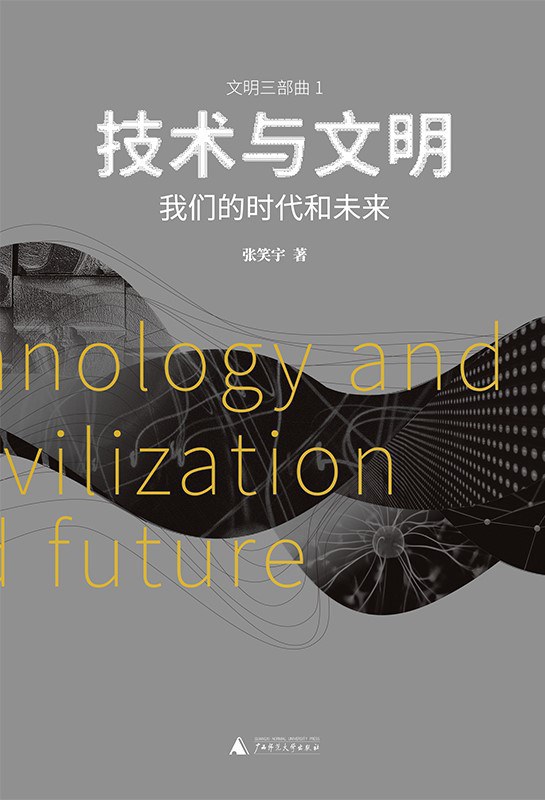
Earlier, China Science Daily recommended Zhang Xiaoyu’s book Technology and Civilization, and interviewed me for a few comments. Today I suddenly remembered this, looked it up, and found that the interview had already been used. See China Science Daily (2021-06-17, Section 5, Culture Weekly). The published piece was assembled from excerpts of my written interview responses, integrated with the introduction to Zhang Xiaoyu’s book. Overall it was organized fairly well, but from the standpoint of my own expression, it was chopped up too much. Below I am posting my original answers, which are much richer in content and also more complete.
Zhang Xiaoyu’s book is of course a good one, and I recommend it warmly. Naturally I hope that someday I or Teacher Wu can write a better substitute, but works on the history of technology with the kind of interdisciplinary breadth and wide horizons that Zhang Xiaoyu has are certainly better in greater abundance.
Hu Yilin (Associate Professor, Department of History of Science, Tsinghua University)
1.What is the position of the history of technology in the history of world development? Usually, what kinds of interpretive space or perspectives are there for the history of technology?
The first sentence of the blurb on the jacket of Zhang Xiaoyu’s Technology and Civilization reads: “Historians can only wait until major events have occurred before recording them, but technology has long planted the clues as to when and in what form major events will happen.”
I think this sentence says it well. In a certain sense, the history of technology is “ahead of” what we might call the “history of events” in the ordinary sense. The occurrence of all kinds of historical events requires some kind of “stage,” and technology determines how these “stages” are built. Before the “actors” go onstage and the “plot” unfolds, the stage has already been “set.” We do not deny the role played in human history by the crucial decisions made by key figures, but these “roles” are not the entirety of the “great drama.” Roles always need to appear in a specific context, with specific props, at a specific time. And those “stages” that make the appearance of the “protagonists” possible do not emerge out of nowhere, nor are they fixed once and for all. What the history of technology chiefly examines is precisely the origins and development of these “stages.”
Of course, technology has multiple modes of existence across the entire “stage.” Broadly speaking, in the great historical drama, everything other than “human beings” can be included under the category of “technology.” According to the way they present themselves, they can probably be divided into focal point, background, random intrusion, and the invisible, and so on.
For instance, the costumes and weapons on the actors’ bodies appear together with the actors at the center of the spotlight, so even traditional historians will not ignore them. Gunpowder, railways, battleships and artillery, atomic bombs, and so on—these are also very important in traditional historical narratives. But in such narratives, they are often still treated as appendages to the protagonists and the important events (people and their political activities) that are the real focus of attention.
Or take the tables and chairs, roads, and everyday settings behind the actors. They are always there, but they often go unnoticed, only coming into view when one analyzes them carefully. After all, actors do not float in a vacuum; all their actions have corresponding “ground on which to stand.” This ground makes events possible—for example, military conquest always requires weapons and equipment, and the spread of knowledge always requires channels of communication. In traditional historical narratives, these “background” elements also occasionally make an appearance, but they are usually regarded as passive factors, and their active, formative side is less often noticed. For example, we may say that Qin was militaristic and placed great emphasis on warfare, so it actively prepared all kinds of weapons; but we rarely discuss how, conversely, the innovation of particular weapons promoted the development of Qin’s military system and mobilization mechanisms.
There are also some things that are usually part of the “background” as well, but have nothing much to do with the “main plot,” and even seem somewhat out of place. For example, the steam engine in the first century CE, the Antikythera mechanism, and so on. These things, highly marginal at the time, may have planted the clues for a plot that would not unfold until hundreds or even thousands of years later.
Finally, there are some technical elements that simply do not appear within the field of vision of the ordinary audience—that is, historians. These are the so-called “backstage”: behind every historical drama lie the silent labors of countless unnamed and faceless people. For many things, there is even little historical material to go on, but from various traces of events we can infer, more or less, the existence of the “backstage” and the complexity of its operations.
From the analogies above, one can see the multiple perspectives of the “history of technology”: it is, in effect, a matter of examining the tools and equipment accompanying various events; examining the foundations and background on which various events stand; examining the technological logic that drives various events behind the scenes, and so on. It should be noted that for any particular technology, there can simultaneously be multiple perspectives. Take, for example, the “crossbow trigger mechanism” technology of the Warring States period: it was itself a highly conspicuous invention, it was also a tool and background of warfare, and it also provided the underlying logic of military and political institutions.
2.As a scholar studying the history of science and technology, how do you view political philosophers who take technology as an important variable and place it into the narrative of the history of human civilization, integrating it deeply with political, economic, military, religious, and other variables? Is this a new perspective and method for studying the history of science and technology?
First, I am not very fond of the word “variable.” Only quantitative analysis talks about constants and variables; and history, much of the time, cannot even really be called qualitative research. What it provides is not a rigorous research report, but a “narrative,” a “story.” So I prefer to speak of “elements” or “roles.” Technology is an important element or role in historical narrative.
Second, I am not very fond of the word “science and technology.” The fusion of science and technology is something that only happened beginning in the nineteenth century; in fact, even today this fusion is not completely thorough. The degree of integration between science and technology may not even be as great as that between technology and the economy, or technology and politics. If one insists on saying “science and technology,” then why not say “economi-tech,” “socio-tech,” or “politico-tech”? I think the term “science and technology” is misleading, especially when we are dealing with the history of technology before the eighteenth century; science and technology should not be confused with one another. So below I will simply speak of the question of the “history of technology.”
From the development of the discipline of the history of technology in the West, this perspective is of course by no means novel. Zhang Xiaoyu’s book is called Technology and Civilization, but that title already existed at least eighty-plus years ago. One of the founding fathers of the history of technology was the American scholar Lewis Mumford; his 1934 book Technics and Civilization is an immortal classic, still impossible to tire of even after repeated reading (Zhang Xiaoyu also cites this book). The Society for the History of Technology in the United States was founded in the 1950s, and its official journal is called Technology and Culture. From the society’s very beginning, many important historians of technology came from backgrounds in economics or economic history; by the 1970s and 1980s there were also more with backgrounds in political science and sociology, including backgrounds in philosophy and theology as well. French work in the history of technology also developed in the 1950s, and what is distinctive about France is that more people came from backgrounds in anthropology and philosophy. One could say that this “integrative” vision is the norm in the international field of the history of technology. It is only in China that the discipline of the history of technology is relatively isolated. Many scholars come from engineering or Chinese history backgrounds, and often have closer exchanges with overseas sinologists than with foreign historians of technology.
Zhang Xiaoyu’s perspective seems novel in China, and this very fact proves that the development of the discipline of the history of technology in China is still relatively backward. I hope that more scholars from philosophy, political science, economics, sociology, anthropology, and other fields will pay more attention to the history of technology, and I also hope that domestic historians of technology will pay greater attention to the rich achievements in the international field of the history of technology since Mumford.
3. After the pandemic, what kind of view of the history of science and technology do ordinary people need, or rather, how should we see the relationship between technology and society? In your view, as researchers, how can we carry out the narrative of the history of science and technology so that these histories themselves can better bring their power into play?
First, “ordinary people” do not necessarily lack a historical mission. “Ordinary people” are those who have not left their names in the “great historical drama,” but their choices and actions may nonetheless leave traces. Of course, many actions will be submerged by “the tide of history,” but as Zhang Xiaoyu mentioned, over a longer historical span, an advantage of 0.13 percent may ultimately change the general course of history.
So for ordinary people, a view of the history of technology first means being able to see that ordinary people have the power to change history. In traditional historical narratives centered on heroic figures or kings, nobles, generals, and ministers, we seldom see the role of “ordinary people,” but from the perspective of the history of technology, we are more likely to see our own power.
Whether one is a hero, an expert, or an ordinary person, every choice each person makes has meaning. Human beings are not machines; we have emotions, ideals, convictions, and aesthetic sense. Our choices are always based on complex and diverse reasons. When we realize that our choices have historical significance, we may at least subject our choices to one more layer of scrutiny.
Second, once ordinary people understand the history of technology, they are more likely to abandon the traditional doctrine of “technological neutrality”—that is, the idea that technology is “merely technology” and has nothing to do with politics, ethics, society, or other humanistic domains or value standards. People generally think that weapons can kill people or save people, and that good and evil, right and wrong, always depend on the person using the technology. This view cannot be said to be wrong, but it is always too simplistic. Take, for example, the crossbow trigger mechanism Zhang Xiaoyu mentions. He believes that the crossbow trigger mechanism promoted unification, but not simply because the crossbow, as a weapon, was more powerful and thus conducive to conquest. Rather, he sees how the standardized production and large-scale deployment of the crossbow trigger mechanism mutually reinforced particular political institutions and propelled the process of unification. This shows that the significance of weapons should not be judged only by whether they are powerful as tools for killing; one must also look at their impact on politics, society, and other dimensions.
Technology will always become outdated, but this way of viewing technology has not become outdated. Today, when we discuss chip technology, 5G technology, aerospace technology, and so on, we still cannot do without dimensions such as politics and economics.
Finally, as ordinary people, perhaps we are not so concerned with the fate of the country and the world, but rather more concerned with ourselves and our families. At this level as well, the history of technology can offer much inspiration. The history of technology and the philosophy of technology help us discover the mutually shaping relationship between technology and human nature.
4. There is another question. In fact, many of the cases discussed in this book are about negative results brought about by a mismatch between technology and civilization. So in today’s era of rapid technological breakthroughs, how exactly can our society maintain a relationship of integration, or mutual reinforcement, between technology and the higher demands of human civilization?
I feel that this book is in fact saying more about the positive role of technology in civilization, whereas in the present day the relationship between technology and civilization really does need to be viewed more cautiously. You mentioned that today there are “rapid technological breakthroughs,” and this “rapid” part is extremely important. We notice that technological innovation pushes forward other domains of human civilization. But in ancient times, this process of push was often very slow; more often than not, technological development merely left behind “clues,” and only after hundreds of years of gestation and development would it ultimately reveal a significant impact. Over those hundreds of years, several generations of people would spend their whole lives slowly adapting to new things and gradually effecting change—there was a need both to improve technology little by little and to alter, little by little, political institutions, economic models, ethical concepts, and other fields so that they could mutually adapt with the new technology.
But today, the speed of technological iteration is no longer measured in hundreds of years. A new technology often needs only several decades to complete the whole cycle from birth to obsolescence, yet human lifespans are instead becoming longer, and the speed of generational turnover among human beings is instead slowing down. This means that where once perhaps ten generations had to successively adapt to one new technology, today one generation has to adapt to ten new technologies. Of course, the wisdom accumulated in human fields such as political science and ethics is also growing, but its pace of development is far slower than the pace of accelerated technological innovation. This situation is destined to leave human beings increasingly overwhelmed in the face of technology, while political systems and social structures can only continue to absorb the shocks of new technologies and are increasingly unable to initiate responses proactively. When our mainstream view of the history of technology still regards technology as the passive and subsidiary side, the actual situation is that human society has already become a subsidiary of technology.
Zhang Xiaoyu mentions the convergence of these two forces, technology and society, but this convergence is destined to be unbalanced. No matter what the original relationship between technology and society was, as technology develops at an accelerating pace, balance is destined to be repeatedly disrupted. In the era we live in, the imbalance between technological innovation and social development has become the norm.
But in this situation, humanity is by no means helpless. For although technology’s power is great, it is ultimately blind, whereas the power of human society can be marshaled consciously and purposefully. Take the helmsman: his strength at the wrist is negligible compared with that of the ship, yet he may still determine the ship’s direction. In any case, if people are to grasp their situation, and even take the initiative, in the face of technology racing ahead, they must first “understand technology”; and this is precisely where the history of science and the philosophy of technology can offer inspiration.
Translated from the Chinese original with AI assistance. The original text is authoritative.