
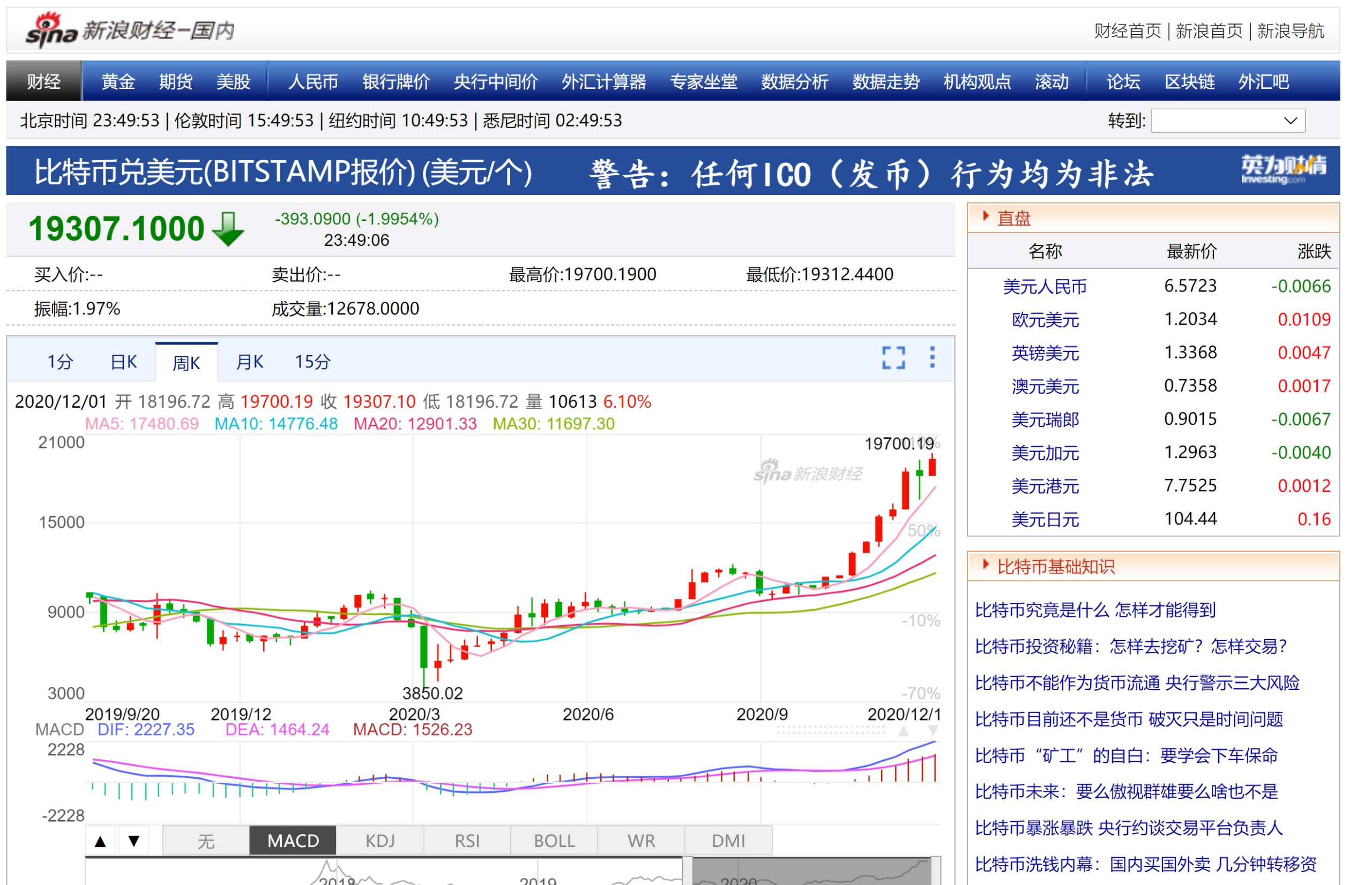
Today the dollar price of bitcoin broke its historical high, surpassing 19,800 dollars. In the renminbi market, however, it has not yet surpassed its historical high, but that does not really matter, because the trend in recent years has been for the renminbi market to shrink dramatically, with the dollar market once again taking the lead in the bitcoin industry.
The last time I wrote “Commemorating Bitcoin’s New High” was on January 5, 2017. Back then I was still calculating in renminbi; it had broken through 8,000 yuan, and I was in the midst of seeking a position at Tsinghua.
My first bitcoin-related article was on April 19, 2013. At that time bitcoin was 719 yuan, having just fallen from above 1,600 yuan, and it was only a few days after my initial attempt to buy in. I was writing my doctoral dissertation then. (Everyone should note that although I entered early and my entry price was low, because I was at the time an economically dependent student and shoved all my scholarship money into it, my principal was not much to begin with, so I am not a bitcoin big shot now either.)
From April ’13 to January ’17, and from January ’17 to December ’20, it was roughly four years each time. Bitcoin takes four years as one major cycle. This was never a secret, because bitcoin’s issuance mechanism halves every four years, so on a four-year macro cycle, bitcoin actually has little suspense.
People always like to ask: why did bitcoin go up? Of course we can find some reasons—for example, in 2013 it was triggered by the Cyprus debt crisis; the rise in 2017 was because Chinese aunties entered the market; this year it is because Wall Street institutions represented by Grayscale have entered the market.
But in my view, these events are nothing more than some “fillers.” If this thing had not filled the gap, something else would have. In the larger trend, there is no reason for the rise; it simply means the time has come. Breaking a new high will happen either now or later; there has to be some point in time, after all.
Four years, in terms of investing, already count as “long term.” I have always suggested that if you do not care about short-term gains, but instead have a “long-range vision” of at least four or five years, then you can buy some bitcoin at any time. Yes, even now it is not too late.
Many people, when they hear that I bought bitcoin as early as 2013, praise me a bit—usually saying I have a good head on my shoulders, that I’m smart, far-sighted, and so on. Very few people will plainly say to me: you were just lucky. But in fact, what they are basically thinking is: it just happened to be luck. Why do I say that? The way to judge is very simple. Sometimes the other person says: you got in early. I’ll reply: it’s not too late to buy now. Then they laugh: how could that be? It’s already too high now; you’re the impressive one, and so on. (Of course, there are also some people who respond with “I don’t understand,” or who are too lazy to study it. I admire that kind of response—it’s rather free and easy. Of course, if such people then turn around and buy A-shares, I still have to look down on them.)
But I myself have actually been buying all along. Not only did I buy in 2013 and 2014, I was still making occasional purchases in 2017 and 2018. In fact, the extra renminbi I have put in after I started working already adds up to more than what I used to buy my initial batch of bitcoin during my doctoral years, but the additional bitcoin amounts to only a small fraction. Even if it is almost negligible relative to my total wealth, there’s no reason not to buy it if I’m buying anyway. Before I bought a house, I had to find somewhere to store my savings regardless; if I didn’t buy bitcoin, was I supposed to buy A-shares instead?
Getting into bitcoin in 2013 really does not necessarily require any great wisdom. Many people were lucky enough to enter right then. I myself belong to the moderately lucky; back then I was not economically independent, so I had very little capital I could decide on my own. The wisdom lies in the judgment of bitcoin’s long-term trend, and that judgment has not been limited to 2013—it has remained unchanged right up to today. If my judgment in 2013 was wisdom, then my judgment this year is wisdom too. Yet those who flatter me for my wisdom often scoff at my judgment this year; that only proves they were in substance merely giving me polite praise for being lucky.
So someone may ask: when does my judgment that “bitcoin can be bought at any time” actually stop being valid? My answer is that it will not stop in the foreseeable future, but the nature of this judgment will change.
At first, of course, it is a kind of venture investment or angel investment, but after the start-up phase, for a long period of time, bitcoin is a very safe “long-term investment”; and then at some later point, bitcoin becomes an ordinary “savings” behavior.
In bitcoin’s first two years, from 2009 to 2010, and at most with 2011 added in, buying bitcoin was risky, because this project really could have failed. In the beginning, bitcoin was nothing more than an experimental project of a small circle of enthusiasts, with the main participants expanding from a mailing list to a forum, but remaining relatively unified and of one mind. In bitcoin’s case, being relatively united is precisely what makes failure possible, because they could very well have unanimously agreed to terminate the experiment, scrap it and start over, or build something else from scratch.
Satoshi Nakamoto’s withdrawal marked bitcoin’s gradual maturation. The last post he made on the forum was on December 12, 2010. At that time he expressed a position of low-profile development, believing that WikiLeaks should not accept bitcoin donations, because prematurely thrusting the newborn bitcoin into the center of the storm might cause it to die young.
But after that, Satoshi Nakamoto disappeared. Whatever his motives, his withdrawal was beneficial to the community’s development. There had always been people who wanted to promote bitcoin’s use in black-market industries, and there were also people who did not want that. As bitcoin developed, the community’s divisions multiplied—such as whether to support GPU mining, whether to support ASIC mining, whether to strengthen anonymity, whether to increase block capacity, and so on. These divisions would no longer be settled by a single word from Satoshi Nakamoto; even if he returned, he would still be unable to break through the diversification of participants’ interests.
Since Satoshi Nakamoto stepped away, at least by 2011 and 2012, bitcoin could no longer be shut down by any small faction. Because the community is not unified and interests are diversified, that very fact becomes the guarantee of continued existence. It is like the way computer networks could still have been strangled in the 1960s, but today no one can shut down the internet.
When I entered the market in 2013, I often heard one saying: bitcoin’s future is either to go to zero or to infinity. Those old hands who came through 2011 still kept a “go to zero” option in their hearts, but by then I already understood very clearly that “go to zero” was impossible, so there could only be one answer: infinity.
Why can bitcoin’s exchange rate against fiat currencies grow without limit? Simple: because its total supply is finite, while the economic development of the world’s people is infinite, and the total amount of fiat currency issued by countries is infinite. Infinite divided by finite equals infinite—that is an extremely simple math problem. As soon as I am certain that bitcoin’s total supply is finite, I can immediately understand why buying bitcoin at any time is right.
Of course, if you think bitcoin’s total supply is not finite, you can read the article I wrote, “The Ontological Basis of ‘Scarcity Makes Value’—And, Incidentally, Why Bitcoin Is Valuable.” One must acknowledge that this finitude is conditional and historical, but I am certain that these conditions hold.
Of course, I am not the only one who understands the principle that “infinite divided by finite equals infinite,” so since 2013, one slogan often heard in bitcoin circles has been “to da moon,” which in Chinese would probably mean something like “rise to the sky.” But in fact, having no ceiling does not mean it can rise all the way to the moon. Because the “infinite” we speak of is potential infinity rather than actual infinity, real growth requires time. This kind of growth will not be especially fast, because although bitcoin’s total supply is finite, it reaches that total through round after round of new issuance. Each round is four years; in the first four years, half of the total supply is issued; in the second four years, half of that half; in the third four years, half of that half of that half; and so on. So in fact, within the first 12 years, bitcoin’s actual rate of expansion is greater than the inflation rate of most fiat currencies.
Therefore, at this stage, bitcoin’s growth is more like a “pyramid scheme,” completely dependent on the growth of participants and the injection of funds. So at this stage, bitcoin’s growth often appears schizophrenic: it often surges wildly like a pyramid scheme, yet cannot continue; but after crashing back, it will always slowly rise again.
So, at this stage, bitcoin satisfies two kinds of investment demand at once: one is the speculator who values dramatic ups and downs and wants to get rich quickly, and the other is the long-term investor who thinks in terms of several four-year cycles. I, of course, am the latter. As long as one does not focus on short-term rises and falls, bitcoin has already entered a stable path of growth that cannot go to zero. But the former type of people are very happy too: they can enjoy the thrill of becoming rich overnight, and they can also feel the regret of losing a million.
This stage does have an endpoint, roughly around the fifth to sixth four-year cycle. After that point, we enter what a certain major figure in the crypto world called “the Eternal Bull Market.” The hallmark is when the rate of new bitcoin issuance falls below the inflation rate of the dollar. After that, bitcoin’s total supply tends toward stability while the dollar continues to grow. Then, as everyone knows, the result of dividing a continuously increasing quantity by a quantity that tends toward stability must be a continuously increasing value. This simple mathematical principle explains the essence of the “Eternal Bull Market”: bitcoin’s eternal bull market is, in fact, fiat currency’s “eternal bear market.” Because everyone acknowledges that fiat currency is always depreciating, and many people even believe this is an irreplaceable advantage of fiat currency over bitcoin.
Of course, for this simple division to be meaningful, certain conditions are also required—namely, that bitcoin’s participants remain at a certain number rather than steadily shrinking. But compared with the previous stage, the appreciation of bitcoin’s exchange rate no longer depends on an increase in participants.
Of course, a new-issuance rate lower than the inflation rate is only a symbolic marker; it does not represent a substantive turning point, and how the market will actually fluctuate is hard to predict. It is like when we say world history has entered the “Industrial Age” or the “Information Age.” That is a major event, and one can also find some emblematic events to serve as dividing lines, but the people actually living through those years would not feel a particularly obvious marker of transition.
In the next stage, people’s conception of measuring bitcoin will generally change. Of course, I have already taken the initiative to change my own conception now, but in the future this change will become the norm, something taken for granted. It is like how, in Copernican times, the idea that the earth moves had already appeared but was rare; after Newton, it became commonplace.
What kind of conception? It is the idea of measuring prices in bitcoin. That is why I have been speaking all along about the bitcoin-dollar price or “exchange ratio,” because bitcoin and the dollar stand in a mutual, reciprocal relation of measurement: we can price bitcoin in dollars, and we can also price everything else in bitcoin.
Perhaps you want to ask: since pricing is relative, what is the difference between taking the dollar as the standard and taking bitcoin as the standard? There is a huge difference. It is like the difference between the Copernican system and the Tychonic system—they are mathematically equivalent and equivalent in predicting astronomical phenomena, but Tycho insisted physically that the earth does not move. The movement of the earth would not shake the mathematical calculations of astronomy, but it would shake physics and even an entire system including ethics and more. Once people begin to think in bitcoin terms and to measure their investments and trades with it, the upheaval it will inevitably cause in the realm of ideas will be enormous. The content of this conceptual revolution is what my future two years of research into the so-called “blockchain philosophy” will gradually work out.
Of course, conceptual revolutions are always ahead of their time among a small number of revolutionaries, but lag behind among the masses. Newton’s worldview did not truly take deep root in people’s minds until about a hundred years after Newton.
So I am not all that fond of the concept of the “Eternal Bull Market.” It is not because the phrase is too exaggerated, but because its scope is not broad enough. It only describes this stage in terms of the exchange-rate market, without pointing to bitcoin’s all-round impact on the lifeworld and on production. I would rather say: “the age of bitcoin” is about to arrive.
Translated from the Chinese original with AI assistance. The original text is authoritative.