
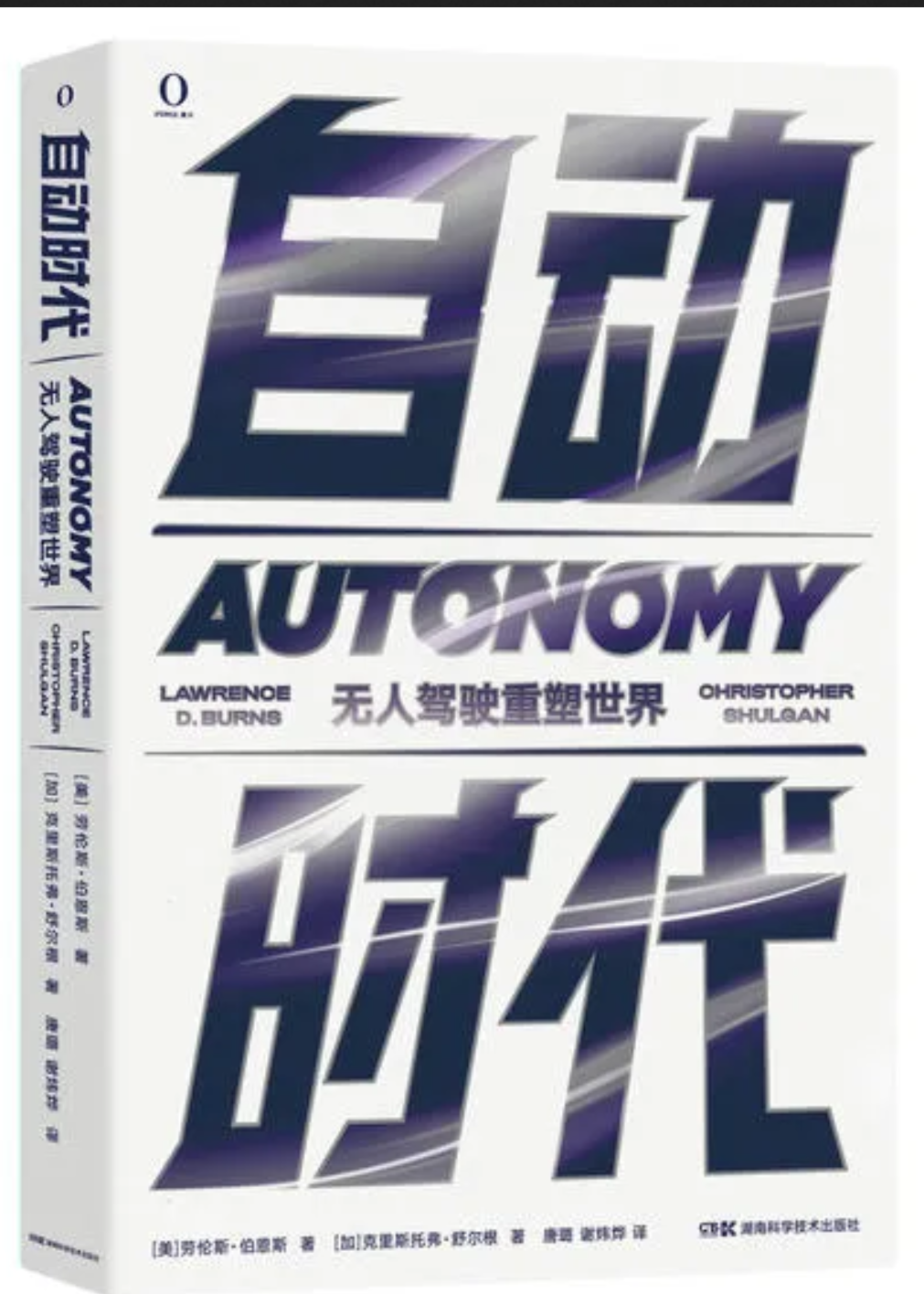
This article was published in Sai Xiansheng. The title was “Can driverless cars change the world, just as automobiles once did?” In fact, I did not read this book very closely; the article was mainly written on the basis of inspirations from a cursory reading, and around my own thoughts on the relevant issues.
The automobile, invented and popularized from the late nineteenth century to the early twentieth, can be said to be one of the most important, or most emblematic, inventions of modern industrial society. The automobile industry brought together a series of the most cutting-edge industrial technologies of the time—steel, materials, petroleum, chemicals, and so on—thus driving the entire industrial chain. At the same time, the automobile industry also brought the new mode of production, the assembly line, into full bloom. On the other hand, automobiles redefined transportation, reshaped the face of the “city,” and drove the modernization of human lifestyles and forms of interaction. The automobile became a symbol of the “new era,” and the slogan “To get rich, first build roads” implied that the affluent life of modernization depended to a great extent on the automobile and its highways.
At the turn from the twentieth to the twenty-first century, the cutting-edge technologies of today are no longer oil refining and internal combustion engines, but electronics, the Internet, big data, artificial intelligence, the sharing economy, and so on; and “electric vehicles + driverless cars” is precisely the convergence point of these new technologies. So can driverless technology, like the automobile a century ago, once again become the model representative of a new mode of production and way of life, redefining transportation and the city?
The title of The Automated Age—Driverless Cars Reshaping the World, translated and introduced by Hunan Science and Technology Press, declares precisely this view—that the ongoing driverless revolution will, like the automobile industry a hundred years ago, reshape the world and lead a new era.
Of course, driverless technology has not yet produced a killer product that has spread as rapidly and widely as Ford’s Model T in those days, and it has not truly entered every household. If that is the case, isn’t it a bit too early for us to probe into the development history of driverless cars now? Not at all. The author believes that one of the major ills of the automobile industry is precisely that it developed too fast—especially after World War II, when automobiles and their supporting transportation systems spread rapidly around the globe, and both cities and villages were remade around the automobile, leaving no room for other options. The automobile industry demanded the transformation of lifestyles, and the new lifestyle in turn demanded more automobiles. Ever-expanding demand masked defects and drawbacks; before people had time to think about the future of the automobile, they were already living in the automobile age.
And today, as crises such as urban congestion, resource shortages, and environmental pollution grow increasingly severe, the automobile’s inefficiency, unsafety, and high energy consumption have become ever more apparent. The author believes that it is time to reassess the automobile industry.
The first author, Burns, was formerly vice president in charge of research and development at General Motors, and in recent years has been responsible for Google’s driverless car project. He tells the story of the research and development of driverless technology from a first-person perspective. This book is neither a professional technical work nor a typical popular science book; rather, it is documentary literature in the form of a memoir. Its pages are full of personal experiences and feelings, all kinds of industry gossip, as well as comments and reflections on the industry and on the entire “era.” Since driverless cars are a revolution that has not yet been fully realized, the author does not offer a clear conclusion. Rather than trying to define the future, he is more focused on reflecting on the present.
The author believes that driverless cars will redefine the automobile industry and social life, so his perspective is never confined to one link within the industrial system or one aspect of life, but points to the entire industrial mode and mode of life.
Viewed from the angles of automobile configuration, human-machine relations, technological breakthroughs, technological implementation, and technological dissemination, driverless technology is highly representative. In this sense, the author’s personal experiences and gossip actually have the significance of “seeing the leopard through a bamboo tube,” reflecting in fact the forms of connection among scientific research, industry, commerce, and the public in the new era.
The author also offers many reflections on the difficulties and challenges encountered by driverless technology. For example, many people believe that since driverless cars have not yet achieved full autonomy, it would be better first to develop “driver-assistance systems,” turning on the intelligent system only when the road is smooth, and handing control back to the driver when complex situations arise. But the author explicitly opposes this compromise solution. He believes that in actual application scenarios, once a driver discovers that the machine can handle most situations, he will obviously not remain tense at all times in order to respond promptly to emergencies; rather, he is more likely to relax, making it even harder to cope with sudden situations.
If “driverless” is viewed as a gradual process of improvement, then compromise and transitional solutions are worth supporting; but if it is viewed as a comprehensive revolutionary process, then we can indeed forgo compromise and go straight to the point.
Take the replacement of horse-drawn carriages by automobiles as an example. When automobiles had just been invented, it was obvious that most regions were in fact not suitable for them: many narrow country lanes, and towns with only weeds and no gas stations, were not suitable for cars, but were more suitable for horse-drawn carriages. So should we design a two-in-one piece of equipment combining horse and automobile? On smooth roads it would be driven by an engine, and on rough terrain it could be pulled by horses—wouldn’t such a compatible solution be excellent?
But in fact such a compatible solution did not develop, because where automobiles were not suited, people’s response was not to call the horses back, but to rebuild the roads.
The popularity of automobiles depended not only on powerful engines, but also on the development of a whole supporting environment, including roads, gas stations, traffic regulations, and so on.
Likewise, to deal with the complex road conditions that driverless cars find difficult to handle, besides further improving artificial intelligence, the most direct method is actually crude and simple: change the road conditions. If automobiles performed poorly in an environment made up of stables and dirt roads, the problem was not the automobile, but the environment. Similarly, if driverless cars perform poorly in traffic conditions where cutting in and wrong-way driving are common, that may not prove that driverless technology is no good; rather, it may precisely prove its revolutionary demand to reshape the world.
Therefore, if we regard driverless cars as a revolutionary new technology, then in addition to advancing research and development in artificial intelligence, we must pay more attention to other related supporting facilities, the transportation system, habits of life, ethical regulations, and so on.
So perhaps you may object: is driverless technology really that important? Is it worth reshaping the entire world around this technology? That depends on whether the author’s account can move you.
Translated from the Chinese original with AI assistance. The original text is authoritative.