
Bitcoin is about to undergo its third “halving.” There has already been far too much discussion about Bitcoin halving for me to say anything terribly new, but precisely because there has been so much discussion, it may all seem dizzying to outsiders. So here I’ll try to answer, in a concise way, a few basic questions about Bitcoin halving. If you know nothing at all about Bitcoin, you might start by reading my “Bitcoin: A Popular Introduction.”
1.What——What is halving?
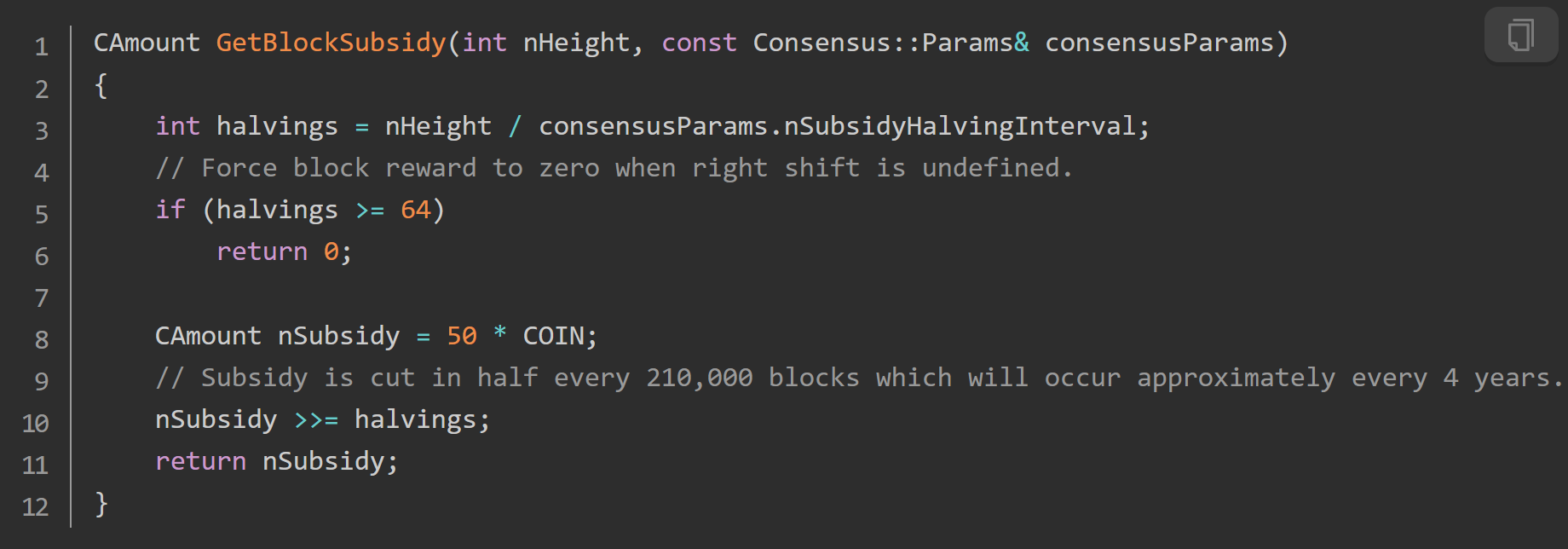
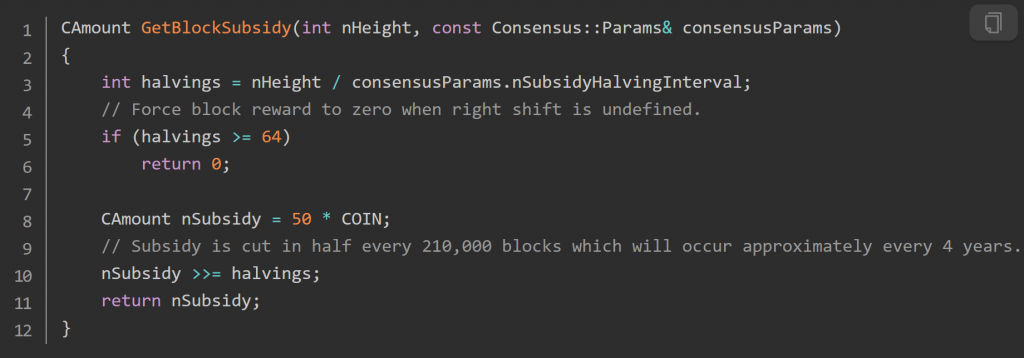
“Halving” is a basic part of Bitcoin’s issuance mechanism. Every time Bitcoin produces 210,000 blocks, or roughly every four years, the block reward is “halved” once. Since going online in January 2009, Bitcoin has undergone two halvings, in November 2012 and July 2016; this time is the third.
2.Which——What exactly is halved?
The new-coin reward in each block is halved. A Bitcoin “block” can be understood as a ledger package made roughly every ten minutes, recording Bitcoin transactions around the world over a given period. The work of packaging blocks is what is commonly called Bitcoin “mining”; mining means competing with computing power to seize the right to keep the accounts. Whoever wins the accounting right for a given block can receive a certain amount of Bitcoin as a reward.
The rewards miners get from blocks consist of two parts: first, the fees for all transactions in that block; second, newly minted coins. The new-coin reward keeps halving over time, becoming smaller and smaller, but mining can still be incentivized by fees.
3.Who——Who carried out the halving?
The “halving” rule was already built in when Satoshi Nakamoto released Bitcoin’s source code. It has since had bugs fixed, but the basic rules have not changed. Bitcoin is, in essence, a decentralized public accounting system, and the halving rule is one of the most central components of that rule system. So rather than saying that Satoshi Nakamoto controlled the halving, it is better to say that this rule system itself automatically performed the halving when preset conditions were triggered.
4.When——When does the halving happen?
It happens every 210,000 blocks. From block 0 to block 210,000, the new-coin reward is 50 per block; from block 210,000 to block 420,000, the reward is 25 per block; and so on. Since each block takes about ten minutes, the halving occurs roughly every four years. But this so-called ten minutes per block is the result of dynamic adjustment. Blocks are produced by the winner of the computing-power race; the stronger the computing power of miners across the network, the faster blocks are produced. According to the rules, however, every 2,016 blocks the difficulty is readjusted based on the time previously taken, so that each block stays as close as possible to ten minutes. So in practice, because Bitcoin keeps developing rapidly, the average time per block is always less than ten minutes, and the actual time between halvings is therefore also slightly less than four years.
5.Why——Why halve?
Why halve? First, halving is the way Bitcoin’s total supply is controlled. Apart from the decentralized mechanism, the key difference between Bitcoin and traditional money is that the quantity of traditional money can be increased arbitrarily, without limit, whereas Bitcoin’s total supply is convergent, bounded, and finite. Of course, many people therefore think Bitcoin can never become a good currency; that question would take a long time to argue out. But whether good or bad, if we want a currency whose total supply is “convergent,” who can do that? Support it or oppose it, Bitcoin at least successfully designed such a mechanism for limiting total supply, and that in itself is a miracle.
Another question is: since the total supply is set to be convergent, why issue the coins gradually through a halving mechanism, rather than issuing all the Bitcoin at once from the very beginning? This is simply to attract participants. Earlier participants always have an advantage; that fact itself can attract people to join early. But if the first batch of participants occupies too much, it will naturally dampen the enthusiasm of those who come after. Issuing new coins in a gradually diminishing way is a balance between pioneers and successors, and between fairness and incentive. Judging from Bitcoin’s steadily expanding influence over more than ten years, this balance has been maintained rather well.
6.Bonus question: how will the halving market move?
Many people actually do not care about the questions above, and only care about how the “halving market” will move. Bitcoin halving affects the market on two levels: one psychological, the other physical. The psychological effect lies in the fact that the halving moment is predictable; everyone is waiting for this time, and both gamblers and market makers are working around this point, so the market around the halving can never be too dull. But the psychological “positive” effect brought by halving should be released in advance; what is called “when good news is fully digested, it turns into bad news” means that the psychological halving rally is over the moment the halving actually occurs.
But the second level is physical: after the halving, the supply of new coins on the market truly becomes smaller. This effect cannot be released in advance; instead, it gradually reshapes the market environment. A portion of the stable daily sell orders has to be cut in half. With everything else unchanged, this naturally helps push the market upward. But this is a slow, long-term process, not something that shows up immediately on the day of the halving.
In addition, this halving has one rather symbolic point: after this halving, Bitcoin’s “inflation rate” will fall below 2%. That is to say, not only at the level of the “limit,” but also in terms of the actual increment of issuance, it will truly become a “deflationary currency.” In this sense, with everything else unchanged, even if only fiat currency inflates, Bitcoin’s relative price should also tend to rise. But that too is a long-term effect. In fact, “everything else unchanged” is impossible; what ultimately affects Bitcoin’s future is still changes in the external environment. But as for the event of “halving” itself, it is of course positive in the long run.
Translated from the Chinese original with AI assistance. The original text is authoritative.