
This is the second essay in my epidemic reflections; with tensions high these days, please be cautious in sharing it with friends.
During the epidemic, every day I have seen many things that make one feel awful. What grieved me most, in fact, was the study on Shuanghuanglian released by the Shanghai branch of the Chinese Academy of Sciences and the Wuhan Institute of Virology. Of course, as Teacher Tiansong says, one must “beware of scientists,” because scientists, like people in any trade, can be just as good or just as bad; but they wield powers greater than those of many other trades, while people in other trades are less wary of them and place more trust in them, so once they turn bad, the results are often the worst imaginable.
Though I had my reservations, I have always believed that even if scientists are bad, there is still some minimum requirement of intelligence involved; they still ought not to be capable of things too childish, too foolish. But when I saw the Shuanghuanglian study, I realized that I was, after all, still too naive. Among scientists there are not only bad people; the lower limit of their wrongdoing is by no means any more refined than that of hoodlums or thugs.
Recently another rumor has also been circulating, namely that the virus causing Wuhan pneumonia leaked from scientific experiments at the Wuhan Institute of Virology. When I first heard this claim, of course I dismissed it with scorn; however you think about it, such a thing could not possibly be. But after Shuanghuanglian, I was shaken, because since they can produce such an astonishing act of calling a deer a horse and brazenly talking nonsense with their eyes wide open, then losing a few experimental bats in some absurd mishap may not be something they would necessarily be incapable of either. Which is more absurd: confirming in one night that Shuanghuanglian is effective, or losing a few experimental bats? I found it very hard to tell.
Still, I am inclined to think that this virus did not originate in a laboratory, because nature itself already possesses this power.
Faced with suspicion, Shi Zhengli of the Wuhan Institute of Virology staked her life on the claim that the virus has nothing to do with the laboratory, but is instead “nature’s punishment of humanity’s uncivilized way of life.” What she said has some merit, but viruses do not only punish “uncivilized habits of life”; they likewise punish “civilized habits of life” themselves. For example, what is called “civilization” took shape with sedentary life supported by agricultural technology, and domesticated livestock became the breeding ground for the evolution of all sorts of viruses and the medium for their spread. Anyone who has read the famous Guns, Germs, and Steel knows that the exchange of human civilizations has always been accompanied by the spread of viruses.
Viruses do not do politics. Whatever the way of life, viruses will, on their own, evolve and mutate, and at any time invade human civilization. Higher technology, of course, strengthens our power to fight viruses in many respects, but in other respects it also strengthens the power of viruses—for instance, denser concentrations of people and faster transportation can in fact intensify the spread of viruses.
Human beings take pride in the rapid development of technology, especially in this age of constant change, when new technologies iterate endlessly and emerge in profusion. But evolutionary speed is likewise a specialty of viruses.
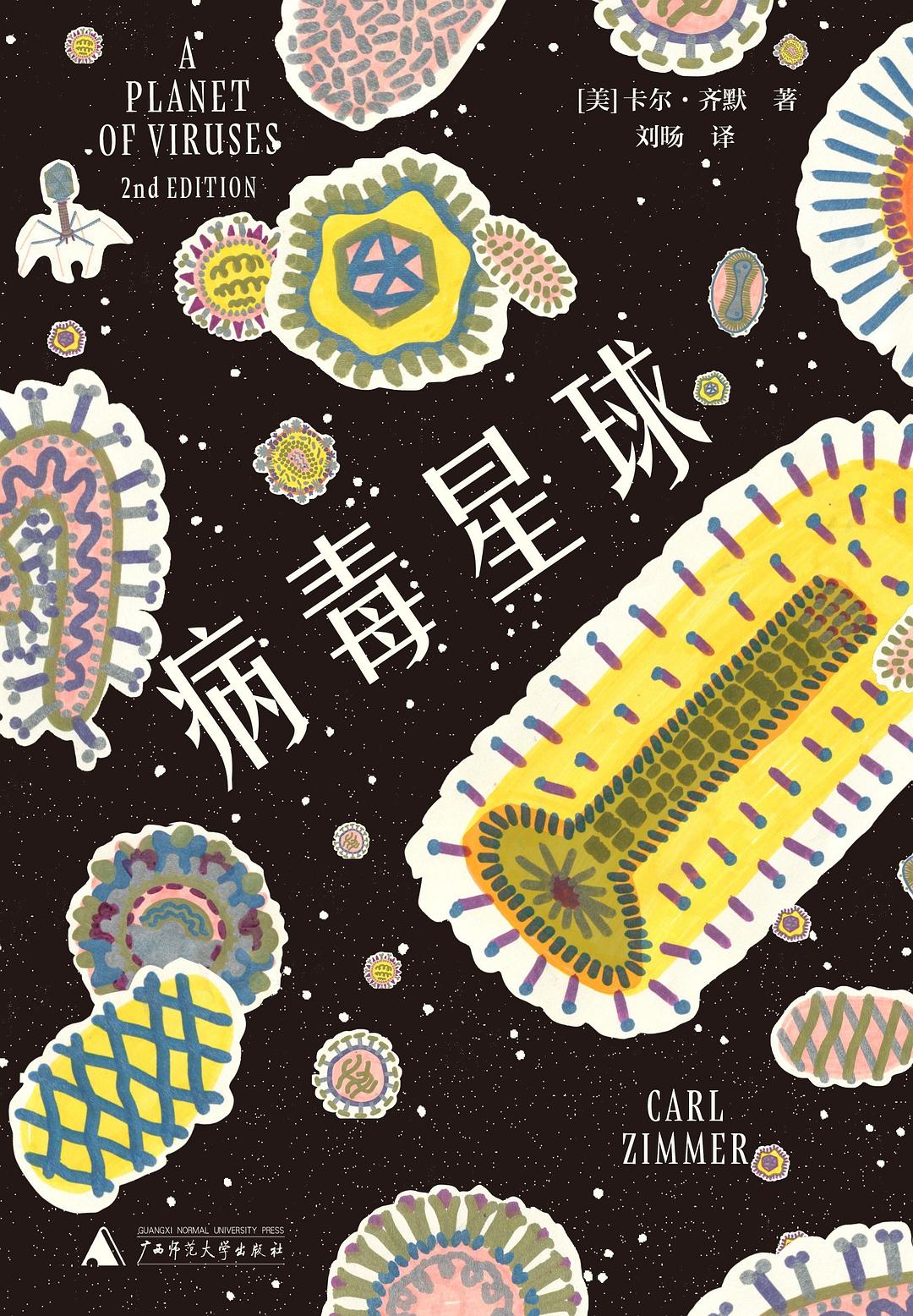
When ordinary organisms reproduce by copying DNA, there is an enzyme specifically responsible for error correction, ensuring the stability of the genome, but viruses have no error-correction mechanism, and so they mutate very quickly. Once there is a 1.0, there will soon be 2.0, 3.0, and so on without end. For example, I read in Virus Planet that HIV (AIDS) did not appear all at once, but had already made 13 jumps from white-nosed monkeys, chimpanzees, and gorillas to human beings. Some versions were more pathogenic, while others were more transmissible.
Before mutated viruses begin spreading among humans, they hide in animals and evolve silently, including both wild animals and livestock. Livestock live closer to human habitats, so viral exchange is more frequent; wild animals, because they possess richer diversity, may bring something even more complex and unpredictable once the virus spreads from them.
Viruses are everywhere: deep underground, in the Sahara Desert, and in the waters beneath the Antarctic ice sheet, viruses exist. In the genetic material of many species, including human beings, a considerable share comes from the contribution of viruses. By comparison, the viruses that cause disease in humans are only a tiny minority. We may have the ability to wipe out humanity on this planet, but we cannot eliminate all viruses. Human civilization must compromise and coexist with viruses.
Viruses are not nature’s punishment for civilization or uncivilization; viruses are simply part of nature, they are there, and that is all. Civilized life will encounter viruses, and barbaric life will encounter viruses too. Nature follows its own course; it does not argue reason with us.
But sometimes, “nature’s punishment” is not entirely empty talk. To see “nature” as some anthropomorphic being, as something with “character,” with “temper,” as some living being called “Gaia,” does indeed express certain truths.
Human beings always understand all things starting from themselves; in a certain sense, the “principles of all things” are also projections of human rational capacity. If nature has “reason,” then does she also have “temper”?
“Character” and “temper” seem irrational, but they are not altogether elusive either. “Temper” is a kind of understandable irrationality. “She’s just stubborn-tempered; her heart is in the right place, so please be understanding.” “He knows her temper best.” Even a “thoroughly unreasonable” temper has a certain intelligibility. If we begin from “temper” rather than “law,” and read nature accordingly, sorting through all things, that may also be a kind of knowledge different from modern science.
A “fit of temper” has both unexpectedness and suddenness, while also possessing a certain stability and consistency. To understand some particular temper of nature is different from understanding some particular law of nature: the latter offers a precise, determinate prediction, whereas the former, though it also offers a kind of “expectation,” remains relatively ambiguous.
What unifies various laws is a theoretical system, whereas what unifies various tempers is “character.” If we can only regard “nature” as a system made up of laws, then talk of “following nature” or “revering nature” is meaningless. But if we regard nature as some kind of organic body with character (Gaia?), then “following” and “revering” nature’s temperament becomes something with real substance.
The perspective that sees nature as a “rigid system of laws” is effective, but it is often effective only in experimental settings with strictly controlled boundary conditions. Because modern people continually transform their surroundings through technology, civilized cities increasingly resemble orderly laboratories, and thus more and more people fall into the illusion that “everything is under control.” Yet in any case, human technology, or rather human capacity for “control,” is always limited. And nature, from time to time, reveals its wild face through viruses and disasters.
In the previous essay I said that disasters terrify people precisely because of this feeling of “loss of control.” But if, from the outset, we do not regard nature as a compliant slave, but instead as an other with an independent character, and engage with it in multiple ways, then perhaps we will also become increasingly adept at grasping nature’s temperament.
Such a way of grasping is, of course, not modern science, but neither is it pseudoscience, because it need not compete for the name of science. How each person becomes good at sensing and understanding the character of the other is part of each person’s own character; understanding others is also self-shaping. Just as each person’s character is not merely a system of laws, understanding the character of nature can be part of modern character formation, a kind of ethical course.
Translated from the Chinese original with AI assistance. The original text is authoritative.