
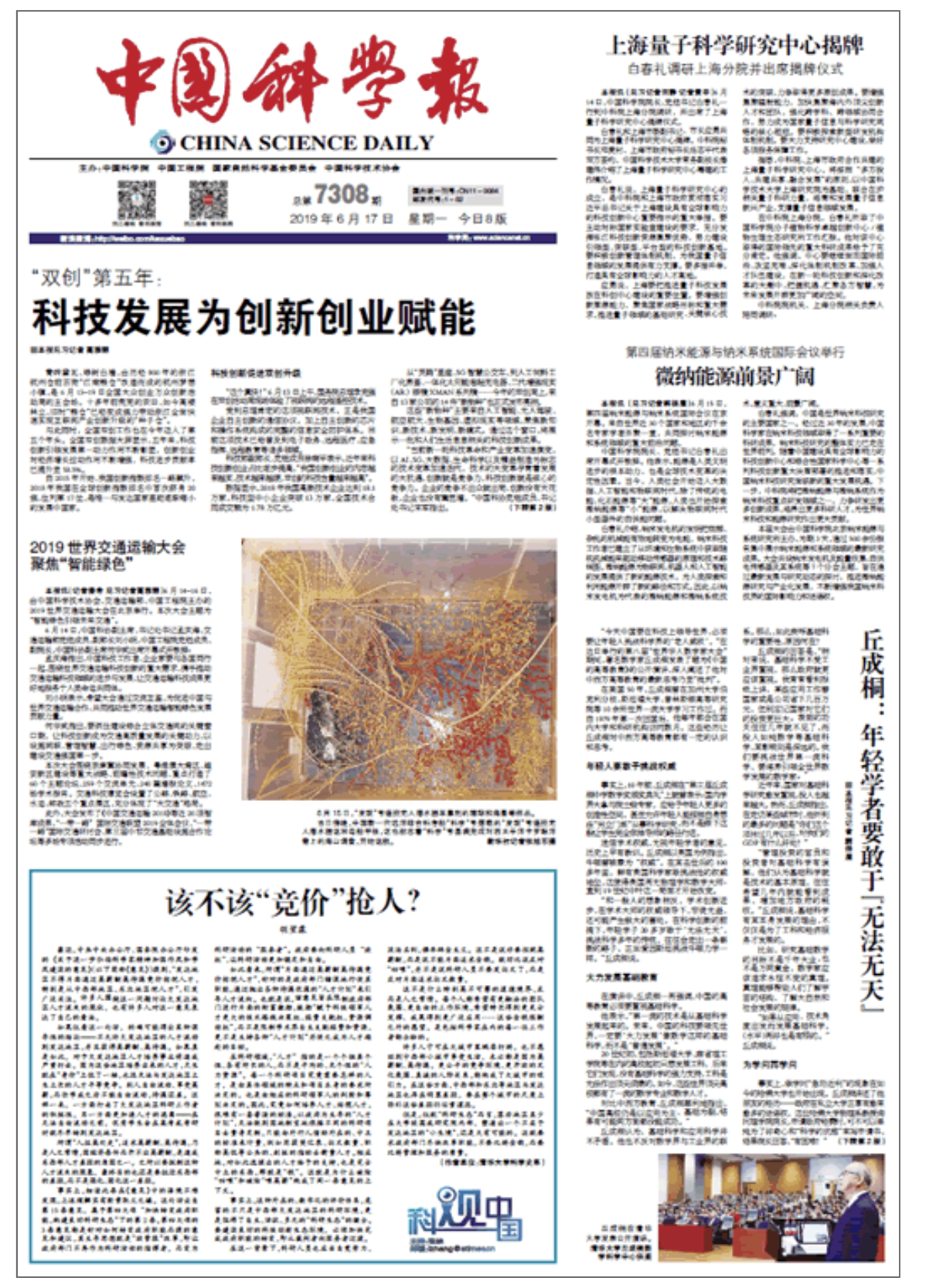
Published in Chinese Science News (2019-06-17, p. 1, Top News); some edits were made at the time of publication. The original draft is posted here.
This article is a kind of forcibly optimistic reading. In fact, I am quite worried: even if it really is a demand made of the government, in the end the government will probably not change much, and it will still be carried out as a matter of disciplining intellectuals. But, how should I put it? If everyone interprets things in a more positive direction, the world will become a little better too.
Recently, the General Office of the CPC Central Committee and the General Office of the State Council issued the “Opinions on Further Promoting the Spirit of Scientists and Strengthening Work Style and Academic Integrity,” putting forward 20 opinions in six major categories, which has sparked attention and discussion.
What has drawn the most attention is probably this sentence: “Developed regions must not, by means of high salaries and generous treatment, single-mindedly poach talent, especially from the central and western regions and the northeastern regions.” Many people have discussed, around this issue, the current state of talent loss in less-developed regions; many others have expressed concern and skepticism about this opinion.
Indeed, if one looks only at this sentence, one may indeed arrive at a misleading conclusion—namely, that talent is not allowed to flow from less-developed regions to developed ones, and that high salaries and generous treatment must be provided.
If that were really the case, it would deal a serious blow to the entire cause of talent cultivation in less-developed regions, because the talent these regions train is, by nature, already one notch lower in “market value,” and can never compete on equal terms with talent born and raised in developed regions. Others may move freely and enjoy high salaries, while after you have finished your studies you may not move freely, and your treatment is still worse.
The result is that, on the one hand, it dampens the enthusiasm of scientific researchers in less-developed regions, and on the other hand, it further accelerates the flight of talent—before they are unable to move freely, outstanding students will already have transferred to developed regions as early as the graduate entrance exam or the college entrance exam.
As the saying goes, “people go where the grass is greener.” The pursuit of high salaries and generous treatment is only human. Being unable to offer high salaries because of economic conditions is one of the reasons for the talent gap between the east and the west. The reason we want to curb the loss of talent in the end is still to narrow the gap between the eastern and western regions, not to further strengthen and solidify that gap.
However, the above interpretation may not be the original meaning of this “opinion.” In fact, we cannot take things out of context, but should place this sentence back into the context of the entire “Opinions” for examination.
This sentence comes from Article 15, under the fourth major category: “IV. Accelerate the transformation of government functions and build a sound research ecology,” and it is the second item under that heading.
The fourth major category contains three opinions in all. Article 14 emphasizes that government departments should “advocate professionalism and reduce micromanagement and direct intervention in scientific research activities.” Article 15 says that we should “properly play the role of evaluation and guidance … drastically reduce assessments, reviews, and awards, and eliminate the tendency to value only papers, only titles, only degrees, and only awards ….” Article 16 says to “greatly lighten the burden on scientific researchers. … reduce red tape, and not keep adding layers of demands….”
Obviously, these opinions are all aimed at how to transform government functions, and the guiding idea is the so-called reform of “delegating power, streamlining administration, and improving services,” so that government departments no longer act as commanders of scientific research activities, but instead become “service providers” for scientific research. The government should “devolve power” to researchers and make scientific research more stable and freer.
So the sentence appended at the end of Article 15 about “not using high salaries to poach talent” should not be understood as a way of controlling research talent; rather, on the contrary, it should be understood from the perspective of the government devolving power and improving the research ecology.
Seen in this light, the so-called one-sided poaching of talent through high salaries is aimed at the government departments’ improper exercise of their functions, using various lucrative “talent programs” to guide the flow of talent. That is why, in the sentence before “poaching talent,” the text speaks of avoiding redundant support and preventing “hats” from flying everywhere.
In other words, the gist of the opinion is to restrict government departments from carrying out one-sided wealth incentives, not to restrict the academic world of science and research from independently allocating funds and resources. Article 14 explicitly emphasizes the need to “grant leading science and technology talents greater decision-making power over technical routes, greater power over fund allocation, and greater power over resource mobilization.”
Since funds and resources are to be devolved more to researchers’ own control, it should no longer be the government’s role to take the lead in rolling out one after another high-paying “program” to attract talent. The beginning of Article 15 clearly points to “research projects,” while the end points to “talent programs.” The point is nothing more than this: all kinds of concrete research projects, led by the leaders in the research field, should replace various government-run “talent programs” and become the destination toward which talent gravitates.
In the research field, “talent” refers to individuals with their own personalities and their own special strengths, not to average, impersonal “human resources.” Exactly what kind of talent each research project requires is determined by the characteristics of the specific field and the demands of the project itself, and also by the judgment and planning of the corresponding research leaders. Therefore, how talent should be cultivated and recruited is hard to standardize with a universally applicable set of criteria. Government-led “talent programs” cannot adapt measures to local conditions or tailor standards for talent according to different research projects. The result can only be that outsiders use external, neutral standards for measurement—for example, using awards records, the number of papers, or the level of one’s title as public, rigid indicators to assess talent. Correspondingly, the support that can be given to the talent selected in this way is also entirely neutral: that is, “money.”
If “talent programs” are led by the government rather than by research experts, and cannot penetrate into specific research projects and the individualized characteristics of talent, then they can only evaluate by numbers (publication counts), and can only motivate by numbers (salary). That is why “breaking the four onlys” and “breaking the sole criterion of high salaries” constitute the context of the same opinion.
And this external, numerical evaluation system harms not only the research environment in the less-developed central and western regions; it also obstructs the improvement of an autonomous, lively, and diverse “research ecology.” And to build a sound ecological environment, we must speed up the transformation of government functions, moving from judge to service provider.
Under this background, researchers should also consciously strive to be indifferent to fame and profit and abandon money worship (Article 7). This does not mean that one must refuse high salaries, but rather that one must not pursue money in a “one-sided” way. It is like opposing the “four onlys”: this does not mean that researchers should stop publishing papers, but rather that one should oppose the one-sided pursuit of paper quantity.
This is not some especially lofty moral realm; rather, it is simply human nature. Everyone hopes for a more harmonious team atmosphere, a freer working environment, hopes that one’s strengths can be brought into fuller play, hopes that one’s achievements can be applied more widely…. These wishes beyond monetary compensation are cherished by every worker, including scientific researchers. Many people would rather squeeze and struggle in a big city than return to a small city in the central or western regions to enjoy life; this is not necessarily all because of high salaries and generous treatment. A fairer competitive environment, a more open cultural atmosphere, and more sincere human relationships all constitute the attraction of big cities. In these respects, there is also a clear gap between regions such as the central and western areas and the northeast, and the developed regions. To make up for these gaps on the scale of an entire city remains a long road. But, insofar as the “research ecology” is concerned, lagging regions can at least, within university campuses or research institutes, create a “microhabitat” no worse than that of the developed regions; this is entirely possible. That requires government departments to reform their functions as soon as possible, not to compete with money, but to compete with the quality of management and service
Translated from the Chinese original with AI assistance. The original text is authoritative.