
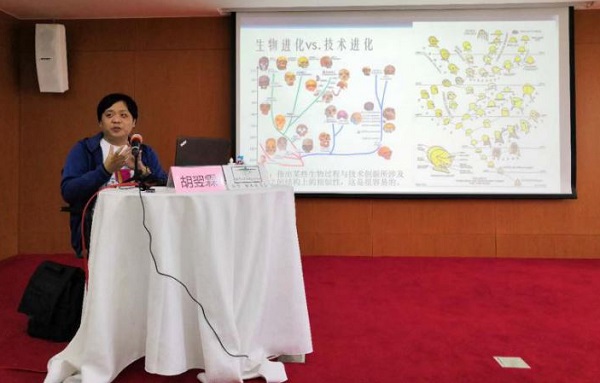
Last week I went to give a lecture at 新华·知本读书会. Both Book City Magazine and Pengpai’s book-reading crowd published records of it, and both were arranged quite well. Here I’m reposting the transcript from The Paper (authorized). Pengpai’s arrangement reconstructed my line of thought better, and the clickbait title also captured the essence.
My originally planned lecture title was “Humans and Technology in Evolution: Parasitism or Symbiosis,” and I actually wanted to focus mainly on the cyborg direction. But during preparation I found that cyborgs are really not so easy to talk about, so I toned down the subtitle. Thus the title revised by Pengpai—“Technology Also Needs a ‘Diversity Preserve,’ to Keep Endangered Technologies and Ideas Alive”—is in fact more accurate.
The transcript was organized by Han Yixiao; editor in charge: Zang Jixian; proofreader: Luan Meng. Full text reprinted below:
Our age is saturated with all kinds of technological products, as well as settled opinions about technology. On the one hand, globalization has turned technological creations that once belonged to one or a few particular cultural circles into a universal spectacle; each person has been “thrown” into a similar technological field, and dependence on technology is growing day by day. On the other hand, people’s understanding of technology is also open to much discussion: some worship technology’s omnipotence and technological determinism, while others regard technology as something wholly unrelated, or even hostile, to human cultural products and the humanistic spirit. All of this stems from insufficient understanding of the “big questions” concerning the essence of technology and the relation between humans and technology. We urgently need thought that goes back to fundamentals.
Recently, the seventy-first session of the Xinhua·Zhiben Reading Club, hosted by Book City magazine, invited Hu Yilin, assistant professor in the Department of History of Science at Tsinghua University and doctoral supervisor, who, starting from an examination and comparison of evolution theory and the history of technology, brought us a thought-provoking set of insights.
Question Posed: the Analogy between Technological Progress and Biological Evolution
Hu Yilin begins from an analogy that has long been alive in technology studies: biological evolution (which some scholars think would be more properly translated as “evolution theory”) and technological development. Scholars had long ago noticed the similarity between changes in technology across different eras and the biological world. This line of thought is concentrated in the explorations of two academic luminaries: Darwin discovered that the changes in machines across different eras are extremely close to the gradual development of organs; Marx pointed out in Capital that learning the methods of inquiry in the history of natural technology helps people grasp the history of the formation of the productive organs of social humans. All of this is an attempt to use the perspective of natural evolution to help understand the historical pattern of technological development.
This kind of “research paradigm” has been accepted by academia, and on the basis of comparing the details of the two, it has drawn quite a few convincing conclusions. For instance, the development of medieval helmets has a structural similarity to the evolutionary process of the human skull. But such an analogical research method of course also deserves further reflection and questioning. First, what are the characteristics of biological evolution? Can they be matched to technology? If these questions are not clear, then this analogy is nothing more than a hollow and superficial “finding similarities.” Second, what insights can these analogies give us? If one merely points out similarities, then researchers will be unable to make reasonable predictions and suggestions about the future development of technology, thereby losing the practical and future-oriented significance of research.
In Hu Yilin’s view, faced with these challenges, we need to turn back and gain a deeper understanding of the content of the thing being analogized—the theory describing biological evolution. He summarizes the core propositions of evolution theory as follows:
1. Species are not fixed and unchanging;
2. All organisms have a common ancestor;
3. The evolutionary process is primarily gradual;
4. Species multiply;
5. Natural selection. This is also where Darwin’s innovation lies.
(from Ernst Mayr’s What Evolution Is)
Can these five features correspond one by one to technological development? Hu Yilin points out that, apart from the first point, the other four features all face some objections:
Objection 1: With regard to feature 2, various different types of technology seem to have independent evolutionary trajectories, rather than a common origin.
Objection 2: With regard to feature 3, some popular science books on technology portray “inspiration” as playing an important role in technological improvement. Doesn’t that mean technological development is discontinuous and jumpy?
Objection 3: With regard to feature 4, descriptions of biological evolution have basic units (species/genes), so what is the unit of evolution?
Objection 4: With regard to feature 5, many people understand natural selection as nature selecting species—so who selects technology?
These objections contain a certain misunderstanding of evolution theory, but they also prompt us to think more deeply about interpretations of technology. Hu Yilin analyzes and responds to them one by one.
Problem Analysis: Responses to the Four Objections
First, the response to feature 2 is: all technologies share a common origin. This is because the origin of technology is the origin of human beings. Although there is still debate over the biological definition of humans, core features such as upright walking and tool-making are recognized by the vast majority of people. From a Marxist point of view, it was precisely technological activities such as using and making tools that made humans.
We can look at this more concretely. Upright walking, while freeing the hands, also brought side effects such as changes in the structure of the female pelvis and difficult childbirth. Compared with other mammals, human infants are extremely frail; the famous premature-birth hypothesis also comes from this. Human children are completely helpless in early childhood and must go through a long adolescence before reaching sexual maturity; humans also uniquely exhibit the “grandmother” phenomenon, in which after menopause and the loss of reproductive ability, there remains a long lifespan. All these behaviors that consume grain yet cannot reproduce DNA seem uneconomical. Yet these “shortcomings” are the result of long natural selection! Undoubtedly, these traits must have given us advantages in the course of evolution.
Over the long course of history, our ancestors had already vaguely sensed the contradiction between human frailty and strength coexisting. The contemporary French philosopher Stiegler seized on this point and reinterpreted the Greek myth: Epimetheus, in distributing talents among the different species, made a mistake that left humans “innately deficient,” while Prometheus enabled human survival by stealing fire. Hu Yilin proposes that here there is already a metaphor of the “grandmother advantage”: human beings’ long childhood and old age are periods for learning and transmitting technology, during which the experiences and insights of the older generation are passed down to the younger generation, enabling technologies such as fire to be transmitted across generations. This kind of common origin between the species of humans and technology is a trait formed in the long course of evolution.
Second, the response to objection 2 is: sudden progress or “invention” in the history of technology has a gradual character. Invention is the product of its historical environment. Kevin Kelly’s “inevitability,” Simon’s “trend,” and so on are all elaborations of this view that “the times make heroes.” The ahistorical leap in the phrase “if the apple had not fallen on his head” is a result exaggerated by later generations. In the history of science and technology, cases such as sunspots, oxygen, the telegraph, and the steam engine repeatedly reveal to us gradual clues in the process of development. Hu Yilin focused especially on Watt’s improvements to the steam engine: Newcomen had already designed the most primitive device for using a heat engine; only, in the original setup, heating and cooling were both applied to the same chamber, resulting in severe energy dissipation and relatively low efficiency. Watt’s improvement was to add a condenser on the basis of Newcomen’s design, thereby increasing efficiency, while the other parts followed the old system. In addition, the telegraph, airplane, and so on, when first created, were often invented repeatedly by multiple researchers far apart from one another, which also reflects a certain inevitability in technological development.
But this does not mean that technology can never experience a situation of “sudden arrival”: historically, there have indeed been technologies that developed gradually but were rapidly transplanted into another environment, much like “species invasion” in biology. During the age of the Great Geographic Discoveries, transcontinental migration and overproliferation of organisms led to the extinction of native flora and fauna in places such as Australia and to ecological destruction; similarly, the diffusion of technologies originating in particular cultures can also rapidly affect the culture and society of the place into which they are introduced. Gunpowder entered Europe and “blew the knightly class to pieces”; the compass propelled the coming of the Age of Great Voyages; the latter then carried European technologies to all parts of the world. Matches changed the reproductive customs of African tribes, the widespread use of the rifle drove out bow-and-arrow culture, and writing introduced among the Celtic peoples led to the collapse of the Druids, that oral-culture class.
Third, the response to objection 3 is: technology may be more appropriately likened to organs rather than species. Hu Yilin first points out that the question of the unit of technology is indeed a long-debated difficult problem. If one likens technology to species, one encounters some difficulties: species are isolated from one another, whereas different technologies can merge, as in the manufacture of engines and mobile phones.
An alternative is to appeal to symbiogenesis theory: this biological theory holds that chloroplasts, mitochondria, and other important components of today’s plant and animal cells were once ingested parts. After being engulfed, they reproduced together with the original cell, each assuming its own function. Another example is the influence of gut flora on the host: the human intestine contains many kinds of probiotic bacteria; herbivores’ ability to digest grass depends heavily on their gut flora. This approach holds that the relation between humans and technology is similar to the relation between host and parasite, presenting a relationship of symbiosis and parasitism. However, as was pointed out in the response to objection 1, technology needs humans, and humans also need technology. This raises a question: who is parasitizing whom, exactly? From our intuition, it seems of course that technology parasitizes humans. Without humans, there would be no technological development or revitalization to speak of. However, Hu Yilin also reminds us that while people enjoy the convenience brought by technology, technology is continuously weakening humans, “replacing bodily functions”; perhaps one day humans will have to become parasites in the world of technological creations, just as in a cyborg-like scene. Thus, technology does not seem very much like a parasite.
Hu Yilin then discussed another idea: technology is not a species, but something more like an organ. In the budding stage of technology, various technologies had not yet differentiated in detail, just as the earliest stone tools had multiple functions at once: this is similar to jellyfish cells, which have not yet developed specialized digestive, circulatory, or respiratory systems and are more versatile than the cells of higher animals. In his view, this analogy can avoid the problems of the species theory and is also more in line with Darwin’s and Marx’s original intentions.
Finally, the response to objection 4 is: this very way of asking the question is problematic; the problem comes from misunderstanding the concept of natural selection. Natural selection is not some active subject called “nature,” or some “God,” doing the selecting. If one must assign a subject to natural selection, one can say that it is the environment doing the selecting; its more accurate meaning is adapting to the environment in order to survive. At the same time, the environment is not fixed and unchanging either; while it “selects” various organisms, it is also shaped by them, and is dynamic and relative.
Hu Yilin added here some common misunderstandings of evolution theory: whenever evolution theory is mentioned, people reflexively think of phrases like “cruel nature” and “the weak are prey to the strong.” One common logical error can be summarized as:
1. In nature, the strong survive and the weak perish, the fit survive, and the weak are prey to the strong;
2. Therefore, behaviors such as cooperation and trust do not have a basis in nature.
In fact, evolution theory begins from existing patterns of biological behavior and studies the reasons these patterns have managed to survive across the long river of history. Therefore, one should not deny behaviors such as cooperation, trust, dedication, and sacrifice on the basis of an assumed survival competition in which “either you die or I die”; rather, one should start from modern biology’s recognition of the widespread peaceful phenomena among organisms, revise the original theory, and explore the possibility that the peaceful are the ones who survive. Hu Yilin mentioned that such “zero-sum game” competition is often limited to species occupying the same ecological niche.
Likewise, competition and elimination among technologies are not as fierce as commonly imagined, so long as they do not occupy the same ecological niche. Printed books replaced handwritten books, but film did not eliminate the novel; sound film eliminated silent film, but television did not eliminate radio, because the former occupy the same ecological niche, whereas the scenarios to which the latter apply do not completely overlap.
Another common mode of elimination should be attributed to changes in the environment. For example, mammals replaced dinosaurs’ dominant position not because dinosaurs’ flesh was eaten by apes, but because of changes in the climatic environment from the Mesozoic to the Cenozoic era: automobiles have basically replaced horse-drawn carriages not because cars were “more convenient” from the very beginning, but because gasoline stations, repair shops, asphalt roads, and other car-friendly usage environments were gradually established.

Prospects of the Question: Technology’s Contemporary Crisis, and How Humans Should “Select” Technology
As mentioned above, the surrounding environment and the development of technology interact with each other. Human social culture, as part of the technological environment, also exerts a considerable influence on technological development.
Through a historical example from The World of Glass, Hu Yilin shows how aesthetics originating in different cultures influenced the course of technological development. Ancient China loved jade, while Roman civilization was devoted to crystal. Thus, divergences arose in the aesthetics of glassware. Because of admiration for jade, ancient Chinese glassware had jade-imitation features such as high lead and barium content and opacity, and ultimately lost the art of glassmaking, with porcelain becoming dominant; the West, by contrast, adhered to the creed that “the highest-value glass is colorless and transparent,” and continued to uphold and improve glass technology. A thousand years later, the Scientific Revolution had a great demand for scientific instruments made of glass, and glassmaking technology also played its important role in driving history forward.
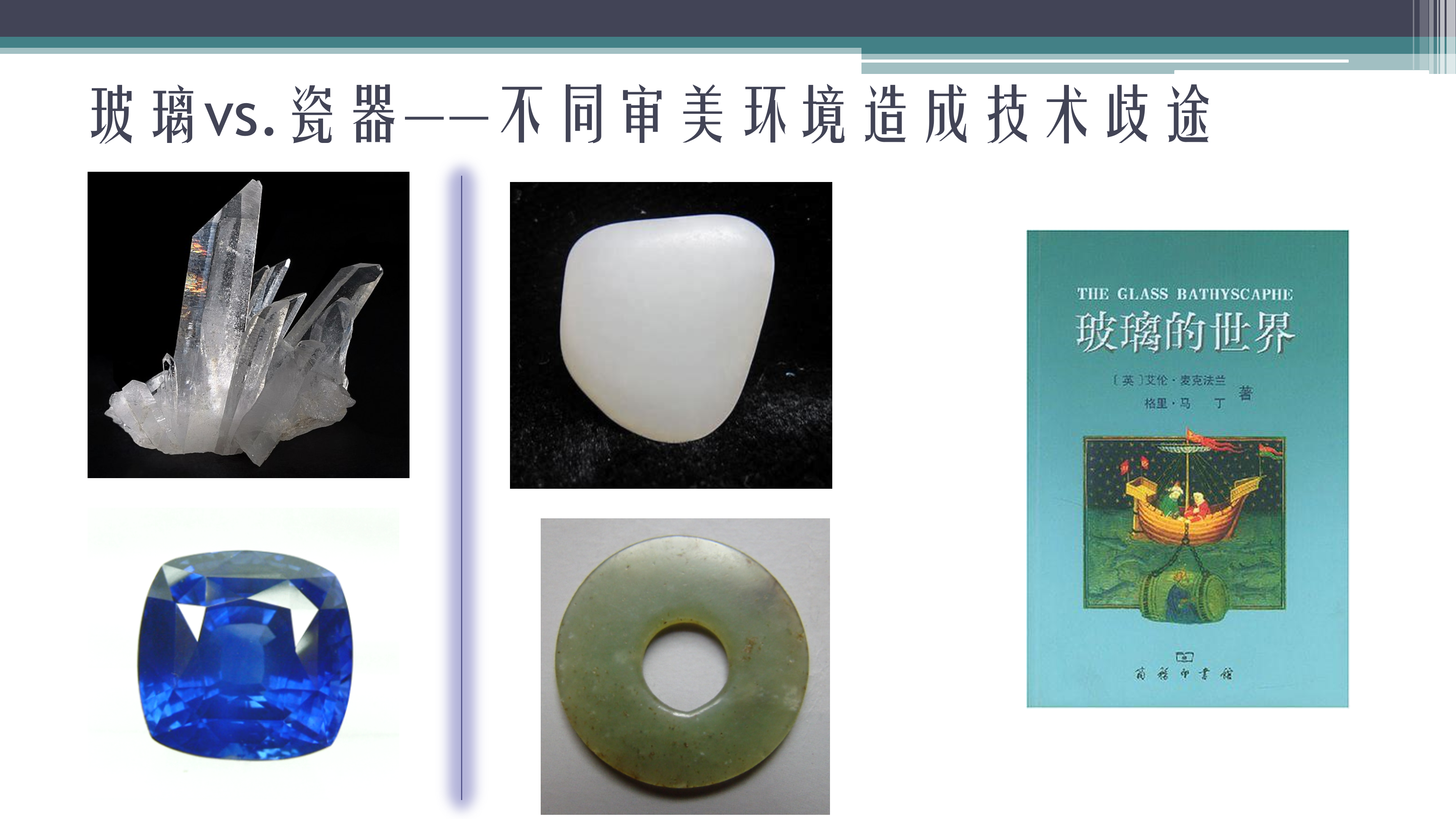

Obviously, the relationship here between glass and the Scientific Revolution was contingent. In both East and West, the glass artisans and consumers of that time had no idea of the potential that transparent glass would hold a thousand years later. At the same time, in that era, glass containers and ceramic containers occupied extremely similar ecological niches: their uses were almost identical and rather limited, so to develop one “technology tree” meant missing the other. Fortunately, the diversity of different cultural spheres and the relatively isolated geographical conditions preserved both technological possibilities at once, and they have come down to us today.
Yet will such good fortune always accompany humankind? Hu Yilin reminds us that in today’s globalized world, technological diversity faces a major crisis. The crisis is manifested mainly in two respects. First, universal technologies suppress local ones. Because universal technologies are often more fully developed, underdeveloped local technologies have no chance to fight back. Second, the short-sightedness of technological evaluation standards leads to an extreme abundance on the surface and a suppression of possibilities beneath it: any technology that cannot quickly bring returns is rapidly eliminated or cast aside; on the surface, every surviving technology seems very powerful, but this is at the cost of suppressing a great many technologies that do not yield short-term benefits.
If we allow this situation to continue unchecked, then the world’s technological landscape in our future will be quite flat, singular, and lacking in foresight: the room for evolution or trial and error will be lost, and there will no longer be a Europe to preserve glassmaking technology. History has not lacked similar lessons. The book *Collapse* warns us with the example of Easter Island: the local inhabitants developed highly advanced stone-statue techniques, and this in turn triggered environmental destruction. Because there were no corresponding governance technologies on the island, and because it was isolated from the outside world, it ultimately ended in cultural collapse.
Do we have the confidence to declare that the Earth is not an Easter Island on a cosmic scale?
So what can we do? Hu Yilin suggests two kinds of “protection”: first, protect cultural diversity and encourage different technologies to be chosen on the basis of different aesthetic and ethical values; second, protect technological diversity by establishing technological “nature reserves” to safeguard endangered technologies, ideas, and ways of life, so that past technologies can be “reactivated” when needed.
In my view, protecting technological and cultural diversity requires us to genuinely avoid an overly convergent way of thinking; in the age of globalization, we should not be bound by immediate utilitarian gain, but rather seek the preservation and development of technology and civilization. As Hu Yilin points out: “Human beings and technology have been inventing and fulfilling one another from the very beginning… The key to thinking about where humankind is headed lies in how we understand the historical relationship between humans and technology.” Where is technology headed? How will humans and technology continue to shape one another? The choices we make now will, as part of the “environment” of technology, write the aspirations and choices of our generation toward a future that is either dim or full of vitality.
Translated from the Chinese original with AI assistance. The original text is authoritative.