
An impromptu submission to Jiemian; I finished writing it at noon and it went up in the afternoon~
The recent Zhai Tianlin incident made “CNKI” and its plagiarism-checking technology quite the sensation. Netizens spontaneously helped run plagiarism checks on Zhai Tianlin’s paper and found the rate of duplication to be as high as 40%, causing his image as a top student to collapse.
I’m not particularly interested in Zhai Tianlin’s image crisis; I’m more inclined to hitch a ride on the hot topic and talk about my own views on plagiarism-checking technology for theses.
Plagiarism checking has been popular for many years now. I have always taken a critical and wary attitude toward it, but helplessly, this technology has only grown more and more popular. Last semester, Tsinghua University also began a trial service providing every teacher with plagiarism-checking for course assignments. As a course instructor, I tried it myself, and I felt even more uneasy about this trend.
The key point is that when evaluating a certain technology, there are two standards: one is a local, immediate standard; the other is a global, long-term standard.
On the local scale, we can assess a technology’s utility. For instance, if the purpose of technology A is B, then first we look at whether B is actually something we need, and then we look at whether using A can effectively accomplish B. Here, we can say that the purpose of plagiarism-checking technology is to catch plagiarism; we do indeed need to catch plagiarism, and plagiarism checking can indeed help us catch it. Seen this way, we seem to have every reason to affirm that plagiarism-checking technology is effective.
But a local purpose and a long-term impact are two different things. As people increasingly rely on a certain technology, the cultural orientation and organizational structure of the entire society may change. For example, for an individual knight, a musket can strengthen his power, but for the knightly class as a whole, the spread of muskets tolled its death knell.
Take Zhai Tianlin as an example: of course plagiarism-checking technology helps quickly determine the source of his plagiarism. But in this incident we also saw how widespread plagiarism checking has already become. So many onlookers, with nothing better to do, just clicked a few buttons and could easily start one round of plagiarism checking after another, at very low cost.
When any random university student knows how to run a plagiarism check, the global consequences of plagiarism-checking technology begin to emerge.
I don’t want to sound alarmist, but the most fitting example is the “melamine” in milk powder from some years back.
Why was “melamine” added to milk powder? This chemical could neither improve the taste of milk nor enhance its appearance—how could anyone think of adding such a thing to milk powder? The answer is simple: to get around protein testing. When dairy farmers delivered milk to the milk collection station, in order to ensure the milk was not watered down, the station used an advanced technology to test the protein content of the milk. Melamine had no other benefit; its only use was to slip past this protein-testing stage so that watering down the milk would not be discovered.
We can see that protein-testing technology was obviously effective at first. Yet once all the dairy farmers also understood this step, and did everything possible to “get past” it, the effect of this technology changed in character. It was originally meant to check for watering down, but in the end it led not only to watered-down milk, but to poison mixed into the milk as well.
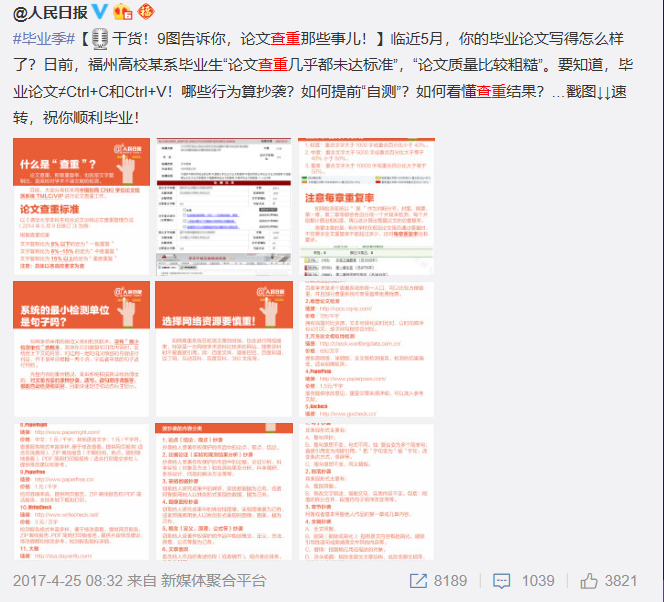
Plagiarism-checking technology is the same. When every ordinary university student can understand this checking technology, or even try it out at will, the situation becomes completely different. “Getting past plagiarism checking” has become a must-have skill for every university student. Even the official Weibo account of People’s Daily once openly popularized the knowledge and tools of “self-checking for plagiarism.” Once detection technology becomes this openly available, we should re-evaluate its effect.
“Self-checking for plagiarism” is an absurd concept, just like popularizing the method of “self-checking protein content” among dairy farmers. But isn’t the purpose of the protein test precisely to discover watering down? And when the milk I bring in myself is watered down or not, don’t I know that myself? If I know perfectly well that it hasn’t been watered down, why would I need to self-check? If I know perfectly well that it has been watered down, and still carry out so-called “self-checking,” then isn’t the purpose of self-checking nothing more than to find a way to get past the test?
If the paper is written by me, whether it is plagiarized or not—do I really need some advanced software to tell me before I know it? Then what meaning is there in promoting so-called “self-checking for plagiarism”? Isn’t that just openly teaching everyone how to find every possible way to “get past” plagiarism detection?
“Not watering it down” is itself a basic requirement for dairy farmers, but once this requirement is replaced by “passing the protein test,” the meaning changes completely. Even if, at the outset, “not watering it down” was basically equivalent to “passing the protein test,” ultimately there is always a sharper blade above the sharper sword. So long as this test is not carried out by an all-powerful God, human technology will always have loopholes. Then the method of both watering down and still passing the test can always be found sooner or later.
The existence and convenience of “self-checking for plagiarism” will inevitably encourage people to seek ways to both plagiarize and pass the plagiarism check; this is simply human nature.
And indeed, that is exactly how things are. Although many people still use the most primitive cut-and-paste method of plagiarism, more and more people have already adopted new methods, the so-called “article laundering.” For example, after plagiarizing, translating it into a foreign language and then translating it back; or substituting synonyms; and so on. Of course plagiarism-checking technology will also keep improving—for instance, by adding semantic recognition to detect more advanced forms of plagiarism. But so long as this detection technology is still something the paper’s author can easily use, the author can always first make careful adjustments through “self-checking” in order to slip through.
Thus, plagiarism checking could only at the very beginning have helped reviewers catch plagiarism more quickly and accurately. As the technology spread, the final result was that plagiarists had to expend more effort to evade detection, while reviewers also had to expend more effort to identify high-end laundering techniques.
We may perhaps place our hopes in the idea that, because the threshold for evading detection has risen and the time cost that must be paid has increased, many acts of plagiarism can thereby be reduced. But the result is bound to be that those who give up plagiarism because they don’t want the hassle still will not, because they also don’t want the hassle, put much effort into writing high-quality papers. In the end, what we get are works that are not plagiarized but are still sloppy and mediocre. And those who, in the face of the hassle, continue to plagiarize will add new toxins to their papers that are harder to identify and buried more deeply.
So, what should we do? If we do not rely on detection technology, how can we curb the proliferation of forgery? This is indeed not easy, but it is not without clues. In fact, melamine is a Chinese specialty, so why didn’t dairy farmers abroad think of this trick? Is it because their detection technology is stronger than ours? Not at all. It’s because in many overseas markets, what people rely on is not only detection technology, but more crucially a more sound system of supervision and punishment. For example, once adulteration or poisoning is discovered, bankruptcy is the inevitable penalty. But here, even if thesis plagiarism is caught red-handed, it seems to be neither here nor there—at worst one apologizes, the paper is withdrawn, and at the very worst the degree is revoked, and that’s the end of it. More often, even after plagiarism or collusion to cover it up is exposed, people still go on doing whatever they were doing.
In my own classes, once plagiarism is caught, I always give a zero and no chance for remediation. This should be only natural, but some students do not understand. They think: if I can get away with it, then I’ll get away with it; if not, at worst I’ll apologize to the teacher and rewrite one later, or at worst you can just give a lower grade. My not giving a chance for remediation—wouldn’t that be unreasonable? It is precisely because of this widespread atmosphere and system of leniency toward fraudsters that people can study evasion methods without any scruples. In such an environment, what use is even the cleverest detection technology?
We should use technology, not be at its mercy. Plagiarism-checking technology was originally only one means of catching plagiarism, and absolutely not the standard for whether something is plagiarized or not. If we are not prepared culturally and institutionally, then advanced technology is all the more likely to bring about more troublesome consequences.
Translated from the Chinese original with AI assistance. The original text is authoritative.