
This was originally meant to be a short piece about Bitcoin. On a whim I gave it a flashy title, but as I wrote it, it turned into a philosophical essay. In fact, the title is not all that outrageous. From the very beginning, what drew my attention to Bitcoin was that I saw it as an application of my own philosophical ideas. Over the following years, I have continued to use my philosophy of technology or media philosophy to interpret the significance of Bitcoin.
By setting a fixed cap of 21 million, Bitcoin guarantees scarcity. As the saying goes, “what is rare is precious”; Bitcoin is so scarce, so it naturally ought to be valuable. But many people do not agree. There are mainly two objections: 1. Bitcoin is not actually scarce; 2. other things that are even scarcer are not valuable.
As for the claim that Bitcoin is not actually scarce, some of the dullest people say that because the unit of account can be subdivided endlessly, the total supply is infinite. This argument is of course not even worth refuting, but it does in fact involve certain profound philosophical issues, such as the distinction between “number” and “quantity”; see my Weibo post on Zeno’s paradoxes. What is worth noting is another formulation used by some people: because there will always be a never-ending stream of altcoins, Bitcoin is in fact not scarce.
As for the claim that other things that are even scarcer are not valuable, this is a line one often hears from some caustic critics. For example, the hair on my head amounts to only a little over 100,000 strands in total. Once I go bald, it will never grow back. So does that mean one strand of my hair is worth more than one Bitcoin?
These two claims are in fact related. The key lies in not having a sufficiently deep understanding of what “scarcity” means.
Many people are accustomed to viewing things from God’s-eye view, as if all the things in the world had already been neatly sorted into categories in advance—as if how many there are of a certain kind of thing, whether they are abundant or scarce, were a completely objective matter, one that does not change with human will. This invented God’s-eye view is not impossible to imagine (I am not discussing matters of faith), but while imagining it, one should also understand that God, after all, does not need to spend money. Whether something is expensive or cheap, worth it or not, is always relatively measured within the dynamic exchange activities of human society. So at least when discussing “what is rare is precious,” one should abandon the omniscient God’s-eye view and instead take a limited human perspective.
From the human point of view, “things” are recognized, and “scarcity” is also measured. So we cannot talk about whether something is scarce from an absolutely neutral standpoint, detached from history and reality. What we can talk about is always that “someone” recognizes “something” as scarce.
This involves a metaphysical question, namely: how does “being as being,” how does “something as something,” come about?
“…as…” or “…as…” is not a simple tautology, but points to an act of “recognition”: under some actual situation, something is taken as something.
For example, Hu Yilin, as a teacher, now has to go grade his students’ final papers; at the same time, Hu Yilin, as a resident, has to pay the property management fee next week; Hu Yilin, as an omnivorous animal, must eat every day… The same thing—the same being made of flesh and bone—has countless “aspects,” countless modes of existing “as something,” and each mode of existence opens up a distinct cognitive dimension. Teachers are measured by their expertise and credentials, residents by household registration and property deeds, animals by diet and ecological niche… Perhaps for an omniscient God all dimensions and attributes are visible at a glance, but for finite human beings, these dimensions all have to be “revealed” and “recognized.”
So if we exclude any particular aspect and do not discuss any specific mode of “as-ness,” what meaning is there in saying “Hu Yilin’s existence itself”? Some physicalists may think that anything is first and foremost a pile of physical entities, such as atoms or molecules. But in fact, “Hu Yilin as a collection of atoms” is, just like “Hu Yilin as a teacher,” nothing more than a specific mode of being “as something.” “Hu Yilin as a collection of atoms” is of course real and actual, but does that mean “Hu Yilin as a teacher” is not real? In fact, at the level of atoms, the boundaries of “Hu Yilin” are far more vague: which atom is part of Hu Yilin, and which atom has nothing to do with Hu Yilin? To recognize what “Hu Yilin” is, it clearly will not do to focus only on the atomic level, or rather, focusing only on any individual aspect is still not enough. “Hu Yilin” as a special “one” is nothing but a knot formed by the convergence and intersection of its countless aspects. It is like nodes tangled and interwoven in a network made up of innumerable dimensions. Remove one of the lines, and the node is often still a node; but if all the lines are stripped away, the node is left with nothing but emptiness.
So let us turn back and look at the question of “scarcity.” Is “Hu Yilin” scarce? As a knot in the web of existence, as this one point where countless dimensions converge, “Hu Yilin” is unquestionably unique, and cannot really be called scarce or abundant—or rather, it is absolutely scarce. As the saying goes, there are no two identical leaves in the world: any macroscopic, concrete thing is, in this sense, unique, in the sense that it can be identified as “this one.”
So, what we call “scarcity” is never directed at some individual thing, but rather at some “kind” of thing.
Compared with the “one” in “a kind,” the “one” in “a single thing” is even more vague. Wittgenstein’s theory of “family resemblance” further reveals that in actual life, things people classify together need not even have any sufficient or necessary common conditions. For example, what is a “table”? It seems everyone knows what a table is, but who can find a set of necessary and sufficient criteria that makes the boundary between table and non-table absolutely clear? In different eras, different cultures, and different languages, there may be a word roughly translatable as “table,” but their boundaries are probably not the same.
Around “table” there are also many classifications, such as “furniture,” “conference table,” “wooden product.” Some are hierarchical relations (though not necessarily strictly so), some are intersecting relations. Only when we are dealing with these large and small “kinds,” which depend on corresponding acts of “recognition” within a cultural context, can we speak of scarcity or abundance.
Some “kinds” may contain only one item, such as “the table once used by Empress Dowager Cixi,” of which there may now be only one table that antique experts can identify (a made-up example), but it still becomes “scarce” precisely as a “kind with only one member.”
I’ve been talking nonsense for half a day, and at last I am about to get to the key point: for instance, “the table once used by my great-grandfather” also survives in only one copy, and is likewise a “singleton.” So is it scarce?
The answer is that it is scarce only for me or for a few people in my family; for most other people, it cannot even be said to be scarce or not scarce, because for them it is not a “kind” of thing at all. The modifier “used by my great-grandfather” is only a valid delimitation for a small number of people; for everyone else, this modifier does not provide an effective boundary.
Of course, this modifier may still be useful, but it is only useful for distinguishing one individual from another, not for distinguishing one class from another. For example, if you put three tables in front of me, I can of course tell that they are three and not one; the table on the left is not the table on the right, and the table in the middle is also a distinct individual. I can distinguish them temporarily by “left, middle, right”; I can distinguish them more stably by subtle markings; I can distinguish them by their origins and histories (used by Zhang San, carried by Li Si, and so on). But these distinctions are distinctions among individuals, not distinctions among “kinds,” because these modifiers themselves only create relative differences, not differences with classificatory significance.
In a particular situation, both “the table on the left” and “the rosewood table” can be used to identify one or several special individuals, but only the latter can also be used to identify a certain kind of table.
The key is that I only care about the difference between left, middle, and right when I am distinguishing individuals on the spot; but the differences among “rosewood, steel, plastic,” and so on are not only for distinguishing individuals, but concern the classification of what this individual “is.” Or rather, they are another classificatory dimension intersecting with “table, chair, floor.” The class “rosewood table” belongs both to the larger class “table” and to the larger class “rosewood.”
In short, there are two ways of delimiting things: one is to delimit a particular individual, and the other is to delimit a class. And only when more and more class delimitations are additionally attached can the thing being delimited become more rare. For example: “the table on the left” is not scarcer than “table,” whereas “the rosewood table” may be scarcer than “table.”
The most typical words for delimiting individuals are “this,” “that,” “this one on the left,” “the former,” “Hu Yilin,” and so on; words for delimiting classes include wooden product, plastic, furniture, table, and so on.
In the philosophical tradition, this distinction is called that between “proper names” and “common names,” but I don’t much like putting it that way, because rather than being two different kinds of nouns, it is better understood as two ways of using words in different contexts. A so-called “common name” can also be used in a certain context to identify an individual. For example, if two tables are set before you and you are asked “which one do you want?”, and you answer, “I want the rosewood one,” that is essentially the same as answering “I want the one on the left” or “I want this one.”
A general “common name” can be used to identify an individual, and a general “proper name” can also serve as a classificatory label. For example, “Plato’s writings” is a subclass under all “writings” or “books,” and “the table once used by Empress Dowager Cixi” can also be a subclass under “table.” But in such cases, “Plato” or “Empress Dowager Cixi” is no longer being used in the sense of delimiting an individual.
So let us forget the philosophical issue of “proper names and common names” and return to the question of delimiting individuals and delimiting classifications. To repeat: “the table on the left” is not scarcer than “table,” whereas “the rosewood table” may be scarcer than “table.”
The above has nothing to do with any intrinsic property of the words “left” or “rosewood”; it has to do with how we use them.
Let us look at the following two conches:
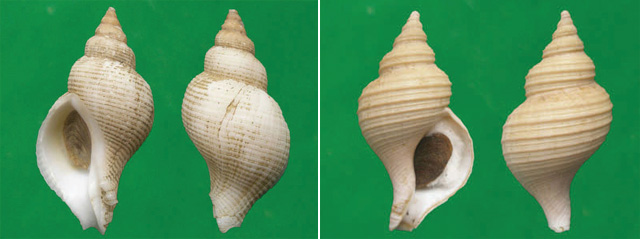
For instance, if there are two conches in front of me, looking more or less alike but spiraling in different directions, then we can use “left” and “right” to identify them: the left-handed conch and the right-handed conch.
But this “left” and “right” can have classificatory significance. Once we have a certain amount of background knowledge, we will know that left-handed conches are rarer.
For someone who lacks the relevant knowledge, or simply does not care about left-handedness and right-handedness, he will not take “left-handed conch” as a “kind of thing” to be identified; at most he will only treat “left-handed” as a temporary identification of an individual in a specific context. Only when someone truly cares about the difference between the types “left-handed” and “right-handed” can “left-handed” become a standard for further classification, rather than just an on-the-spot identification of an individual.
For example, if left-handed conches account for less than 5% of all conches (I am making up the number), does this natural fact determine that “left-handed conch” ought to become a special classification? Not necessarily. For example, if an apple weighs about 200 to 300 grams, then an “apple weighing between 250 and 255 grams” also accounts for less than 5% of all apples. Should it therefore be specially classified as a rare kind of apple?
Are an apple weighing between 245 and 250 grams and an apple weighing between 250 and 255 grams two different kinds of apples? This distinction is valid, but people generally only care about it on the spot when buying apples and weighing them; they do not take it as a standard for classification.
But between a diamond weighing 195 to 200 milligrams and a diamond weighing 200 to 205 milligrams, there is a difference worth caring about, because more than 1 carat is an important threshold for diamonds. Diamonds are indeed the larger they are, the rarer they are, and the larger they are, the more valuable they are; but 1 carat is a significant watershed, making “carat diamond” a distinct class.
After all this, all that has been said is that there are two ways to distinguish or identify things: distinguishing individuals, and distinguishing kinds. But the difference between these two ways of distinguishing is itself relative. The same means of distinction—left and right, weight, provenance, texture, and so on—can all be used either to distinguish individuals or to distinguish kinds. The key is not the situation of “things in themselves”—things themselves always differ, there are no two identical leaves, and in God’s eyes everything can be a class, or everything can be a unique individual. Things themselves merely offer us the possibility of distinguishing and grouping, but do not directly provide us with ready-made classifications.
The key lies in how much we “care about” a certain distinction: are we merely making a distinction for the immediate need of identifying individuals, or do we want to take this distinction as some relatively fixed category?
Classification is not simply something already existing in “nature,” independent of human thought and culture. Of course, this does not mean that classification is entirely the product of human whim and imagination. Nature certainly provides us with material constraints—that is to say, it provides the “possibility” of classification. How people actually “make” classifications, how they concretely distinguish things that can be classified, still depends on the relevant science (conceptual knowledge), technology (means of discrimination), and culture (values).
First, we need knowledge of the relevant concepts. For example, to classify by “rosewood,” we must first know what the concept “rosewood” means and what properties it has. We do not necessarily need an exact, strict, fixed definition, but in any case we need some conceptual preparation; this level is what is called “science.” Second, we need the corresponding technical ability to identify things. We need at least some means, rough or precise, by which to measure the difference between “rosewood” and “non-rosewood”; only then does “rosewood” as a classification become valid. Finally, we also need the corresponding cultural background, within which the relevant delimitation is meaningful to people.
Returning to “the table once used by Empress Dowager Cixi,” what is the difference between it and “the table once used by my great-grandfather”? Assuming that, with techniques such as archaeology, we really can identify the origin of this table, the reason the former is scarcer than the latter is nothing more than a difference in cultural recognition. Many people “know” the concept “Empress Dowager Cixi”; they accept this concept as a stable and lasting piece of knowledge, so the delimitation made on the basis of this knowledge can be valid. Of course, “my great-grandfather” can also be accepted as stable knowledge for a small handful of people in our family, but for other people this delimitation is no different from “this one on the left, this one on the right, the red one, the chipped one, Zhang San’s, Li Si’s,” and so on. Even if they can master the technical means of identifying this delimitation, they still will not accept it as a “classification.”
Of course, the difference here is still relative, a difference in the degree of “circulation range.” Likewise, many people do not know Empress Dowager Cixi and have no knowledge of this concept, so in their eyes there is no difference between “Cixi’s” and “Zhang San’s.” But we can “market” it to them. The way of marketing it is nothing more than trying hard to transmit knowledge of Empress Dowager Cixi to them. For example, we can tell them that Empress Dowager Cixi was “the most famous holder of real power in the late Qing,” known as the “Old Buddha,” and that she crushed the Hundred Days’ Reform, and so on and so forth. If he accepts this knowledge and thinks it is very important, then “Empress Dowager Cixi’s table” will also become more precious to them. Likewise, I can also market “the table of my great-grandfather,” for example by telling others that my great-grandfather beat up A Mao, punched A Gou, married A Hua, fathered my grandfather… I can also hope that they will accept knowledge about my great-grandfather, thereby making this table more precious in their eyes. But regrettably, the story of “my great-grandfather” does not seem nearly as compelling as the story of Empress Dowager Cixi.
So the result is that “the Empress Dowager Cixi’s table” and “my great-grandfather’s table,” though in some sense both are “one of a kind,” are not the same kind of unique: the latter, for most people, is only unique in the sense of an “individual,” unique only in the sense of “this one,” and adding the further specification “my great-grandfather’s” at most turns “this one” into “the one on the left,” making the definition of the individual a little clearer and more exact, but without turning it into a “class” that can be accepted as such. “The Empress Dowager Cixi’s table,” by contrast, is accepted not merely as an individual but as a “class” as well; although there is only one such singular item in this category, it is still recognized by people as a small “class.”
My great-grandfather’s table, my hair, my fingers, and things like that may seem precious and rare in my eyes, but for other people they are not rare at all. Their uniqueness is only uniqueness as individuals, not uniqueness as a distinctive class. Zhang San’s finger and Li Si’s finger are different individuals, but they both belong to the same kind of thing: “anyone’s finger,” and this kind of thing is by no means scarce. But if Zhang San is an accomplished Buddhist monk, then his finger might become a priceless śarīra relic, because a large group of people, rather than just a few, recognize “Zhang San” as stable knowledge, and this knowledge provides a meaningful taxonomy of things.
In a very long-winded and roundabout way, I have explained such a simple point: scarcity comes from the way things are “classified,” not from the “individual” itself. Every individual thing is unique in itself and thus not scarce in any meaningful sense; what determines how scarce it is, in different senses, is the way we classify it at different levels.
Every thing can belong under many layers of classification, and scarcity is always relative to some particular classificatory system. For example, “my great-grandfather’s table” may be a precious object to me, but how precious it really is still depends on the mode of classification. For instance, “my great-grandfather’s table” belongs to the larger class of “my great-grandfather’s relics,” and “my great-grandfather’s relics” in turn belong to the class of “anything passed down from my ancestors.” If what makes “my great-grandfather’s table” meaningful to me lies not in “table” but in “great-grandfather,” or perhaps not in “great-grandfather” but in “ancestors,” then although there is only one such table, it is still not an irreplaceable thing. If what I care about is just “whatever my great-grandfather left behind,” then labels like “table” and “chair” become, in effect, just like “this one” and “that one” again: specifications that distinguish individuals, rather than specifications that distinguish classes.
Value, too, is relative to classification. Compared with an ordinary “table,” “the Empress Dowager Cixi’s table” is undoubtedly scarcer and therefore more valuable, but that does not mean it is more valuable than an ordinary “antique,” or more valuable than “the Empress Dowager Cixi’s gem.” For insofar as it is a “table,” “the Empress Dowager Cixi’s table” is so rare that there is only one in the world; but insofar as it is an “antique,” it is at most a rather unremarkable member of that class. It cannot even be compared with “gem” unless the two are placed under the same higher-order category; only then does a comparison of scarcity become possible. But once it is placed under the relevant category, “the Empress Dowager Cixi’s table” can no longer be one of a kind.
“The Empress Dowager Cixi’s table” is a unique individual, but “individual” is not a class. Even if, in some sense, it is a class, then it is the largest class: everything is an “individual,” and as an individual, any individual is not scarce at all. “The Empress Dowager Cixi’s table,” as a “table,” is scarce, but that can only ensure that it becomes a relatively more expensive table; it cannot make it more expensive than anything else whatsoever.
The rule “what is scarce is valuable” is valid, but “scarce,” like “valuable,” is relative; it is determined by conceptual knowledge, technical means, and cultural background.
So let us return to the question of whether Bitcoin is scarce. First, you need to regard “Bitcoin” as a “class,” and then the 1 bitcoin, 0.5 bitcoin, and so on that you buy are all “belonging to Bitcoin.” What Bitcoin’s technical means can guarantee is that this concrete bitcoin in your hand has a determinate scarcity relative to the category “Bitcoin” (you possess one twenty-one-millionth of all bitcoins). But only when you take “Bitcoin” as a meaningful class does “one twenty-one-millionth of all bitcoins” become a relative measure of scarcity. And how scarce “all bitcoins” really are depends on your knowledge of Bitcoin and the cultural environment you inhabit.
For example, if you regard Bitcoin merely as “whatever code programmers whipped up,” “a string of numbers,” then such a thing is by no means scarce; it is easy to come by, and there are tons of it everywhere. If you regard Bitcoin as merely “one of various virtual currencies, like Q coins or game coins,” then it is not all that scarce either. Only when one recognizes Bitcoin as “the first decentralized cryptographic currency” does its distinctiveness become relatively clear.
Now suppose we copy Bitcoin’s program and create a knockoff coin like “Bi-Shabi Coin” or “Bi-Chuibi Coin,” with the total supply set at just 21. Would such a coin then be even scarcer? What one must notice is that a total supply of 21 merely makes “one Bi-Shabi Coin” scarcer relative to “all Bi-Shabi Coins”; but relative to what is the scarcity of “all Bi-Shabi Coins” itself measured? If it can only be seen as “just one of any number of knockoff coins,” then it is not scarce at all, and you can whip up a new knockoff coin at will. So in order to make a created knockoff coin valuable, you need to stack onto it a classification that is “not just anything,” such as “the first knockoff coin using the scrypt algorithm,” or “a knockoff coin endorsed by Zhang San’s team,” and so on. Of course, these added classifications also need to be recognized by others. If I do not care what is special about the scrypt algorithm and think it is simply “one of any cryptographic algorithms,” then “the scrypt algorithm” will not add much scarcity; whereas if I learn that this algorithm has a distinctive historical background, a distinctive position, and so on, and if these features seem to me to have long-term significance, then the gain it adds to scarcity will be greater. Likewise, with “endorsed by Zhang San,” if in my view Zhang San or Li Si is no different from “any Tom, Dick, or Harry” in classificatory terms, then this feature will not add much scarcity either.
On the premise that “decentralized cryptographic currency” is a meaningful class, then no matter how endlessly this large class proliferates, Bitcoin, as “the first,” already has a guarantee of scarcity. Unless no one cares about history, the distinction between “the first and its successors,” “the original and the imitator,” will forever allow “Bitcoin” to occupy an irreplaceable position among all cryptographic currencies. And the other knockoff coins must also rack their brains to distinguish themselves from “any knockoff coin whatsoever.” Of course, the present situation is that there are many knockoff coins that are almost impossible to distinguish from “just any knockoff coin” except by name, and they can still sell for a lot of money. This is simply because the whole category of “any cryptographic currency whatsoever,” relative to “the fiat money in the hands of potential investors” (foolish people, lots of money), still seems far too scarce.
How scarce and how precious Bitcoin is depends on how one classifies it, how one distinguishes it from other things, and under which larger category one examines it. For example, if you think Bitcoin is a unique security, then you can compare its scarcity with that of other securities such as stocks and bonds. If you think it is a unique anti-inflation tool, then you can compare its scarcity with real estate, gold, and the like. If you think it is money, then compare it with the dollar, the renminbi, and so on… And when we make these comparisons, Bitcoin’s 21-million cap becomes a concrete measure: it can be compared with gold’s total market value, with the money supply of the dollar, and so forth. But if we have not placed Bitcoin into an appropriate category for understanding, then its 21-million cap has no real meaning.
Translated from the Chinese original with AI assistance. The original text is authoritative.