
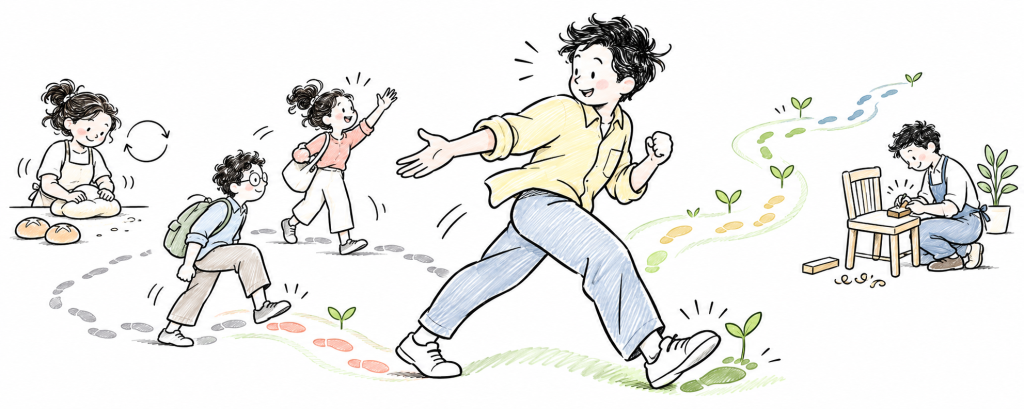
On November 1, the second session of the reading group on The Human Condition continued: first we finished the last three paragraphs of the preface, then moved into Chapter 1 and read the first five paragraphs of Section 1.
At the end of the preface, Arendt says that all she intends to do is “think what we are doing”; Section 1 immediately introduces the three activities of active life—labor, work, and action—as well as the corresponding three human conditions: life, worldliness, and plurality, finally arriving at natality and mortality. The discussion revolved around several questions: Does earning money count as labor? Does a bird building a nest count as work? Does AI have plurality? In the age of AI, what remains irreplaceable in human beings?
What follows was organized by Claude from the livestream recording, and I revised it. The quotations are from Wang Yinli’s translation. The main speaker was Hu Yilin; the other participants are unnamed.
Opening: tying together the preface again
Quite a few friends couldn’t make it last time, so let me first tie together the preface again. Arendt begins with the launching of the artificial satellite in 1957, and sees in it the impact of the technological age on human political action. One core issue we discussed last time was this: technology is becoming more and more specialized and automated, and the language of science is drifting farther and farther away from the language ordinary people can understand. Today, not only ordinary people can’t understand the cutting edge of technology; even mathematicians are almost unable to keep up with what AI is producing.
On the other hand, human life—including political, economic, and social life—is becoming more and more tightly bound up with technological questions. To discuss politics is nothing other than to discuss how we are to live, how we are to organize ourselves, how we are to make laws; but today, can we still discuss political questions without discussing technology? In Arendt’s time, the question was whether nuclear bombs should be restricted; today, the question is whether AI, synthetic biology, and genetic technologies should be restricted. These are all political questions, but also all technological questions.
The language of science has become detached from ordinary people, yet the relation between science and ordinary people has become ever closer. This is a paradox.
The result is that science and politics become more and more detached, or rather, ordinary people become detached from science and politics. In Arendt’s view, politics means people deliberating together; it should not be a matter of a small number of experts or elites conferring behind closed doors, otherwise what difference is there from monarchy or aristocracy? And if we hold fast to the ideals of today’s liberal democracy, then everyone should be able to participate, to express their concerns and demands, and through debate, deliberation, and compromise, public space should be formed. But the issues that are intimately tied to our daily lives have turned into scientific questions, while the language of science has become increasingly detached from ordinary people, so ordinary people increasingly cannot participate in substantive political life. Arendt already keenly perceived this trend at the time of the atomic bomb, the launching of the artificial satellite, and the rise of automation; today her judgment has been fully borne out. If we still adhere to political ideals such as freedom and democracy, then we will find that this situation is problematic.
Last time we also discussed what can be done. In fact, there is no way out—but first we have to pay attention to the source of this condition. One major direction of modern science is know-how: no longer probing into first principles, but focusing only on how to do things and what to do. This operationalist way of thinking itself is also a form of specialization and engineeringization. Arendt would say: I am not going to offer a universal solution that works once and for all.
Thinking about what we are doing
Arendt says:
For all these urgent issues and impasses, this book does not intend to provide an answer. Such answers are being given every day, and they are matters of practical politics, subject to the consent of the majority; nor are answers ever to be found in theoretical considerations or in one person’s opinion, as though the questions we are dealing with here could be definitively answered once and for all. What I intend to do below is, starting from our most recent experience and our most immediate fears, to reconsider the human condition. Obviously, this is a question of thought, and thoughtlessness—reckless headlongness, helpless bewilderment, or the repeated reiteration of “truths” that have become trite and hollow—seems to me precisely the hallmark of our time. Therefore, what I intend to do is very simple: merely to think about what we are doing.
What this passage is saying is: we need thought, not thoughtlessness. Thoughtlessness means repeating dogma, repeating bureaucratic cant, over and over again, and then looking for a once-and-for-all solution, as if “we just need to figure out how to do this or that.” It’s not that there are no answers, but that there are too many answers; everyone is giving answers. Yet political matters require the joint efforts of many people to bring them about. If she alone gives an answer here, it is of no use. What she wants to do is help us understand our condition. “The human condition” can indeed be rendered as “the human situation” or “the human predicament”: to understand our condition, our situation, to understand what we are doing, rather than first discussing what we should or should not do. To start talking about what ought to be done before even understanding what we are doing is very impulsive and very slapdash.
Let me add a couple of words: this attitude of know-how is also anti-political. For example, Arendt puts forward a plan. Fine, now we know that top scholars or politicians have a plan, and we may breathe a sigh of relief. But if we do not know what the basis of this plan is, what its reasons are, or even what sort of condition it is meant to address, then we still cannot participate in politics; we are still handing political life over to a small number of elites: wonderful, they have a plan now, and I don’t have to worry about it. But that is precisely the crisis we are meant to deal with: the increasing distance of the majority of ordinary people from politics.
Although Arendt says “I am not a philosopher,” this book is in fact still a foundational discussion in political philosophy, concerned with the most fundamental question: what are we doing.
“What we are doing” really is the central theme of this book. It deals only with the most basic distinctions of the human condition, discussing those activities that, traditionally and according to common opinion, fall within everyone’s capacity. Because of this point and for other reasons, the highest, and perhaps also the purest, activity of human beings—thinking—does not fall within the present inquiry. Thus the book is limited to a systematic discussion of labor, work, and action, which constitute the main three chapters of the book. Historically, I deal with modernity in the final chapter, and a discussion of the various outlines of the hierarchy of activities, as known to us from Western history, runs throughout the book.
Labor, work, and action are the three forms of active life, which the next chapter will unfold; opposed to active life is contemplative life, and thought belongs to contemplative life. Arendt will later criticize contemplative life—more precisely, she will criticize the confinement of people within contemplative life. But here she gives another reason: what this book discusses are the most general, the broadest human activities, those which, according to tradition and common opinion, fall within everyone’s capacity. Thought and contemplation are usually not considered something everyone can do or will do—for example, sitting in meditation, reflection: does that belong to labor, work, or action? It does not necessarily fit into any of these three categories. Some activities are the specialties of a minority; this book is not concerned with them for now. Historically, there have been all kinds of classifications and hierarchies of human activities; what Arendt offers is her own classification: labor, work, and action.
Two kinds of escape: fleeing the earth, fleeing back into the self
However, modernity and the modern world are not the same thing. From the standpoint of science, modernity, which began in the seventeenth century, came to an end in the early twentieth century; from the political standpoint, the modern world in which we live came into being with the first atomic explosion. …… On the other hand, the aim of historical analysis is to trace the roots of the world alienation of modernity—the double process by which humans flee the earth into the universe and flee the world back into the self……
Modern is a historical concept in the West, generally reckoned as beginning in the sixteenth or seventeenth century; in Chinese it is often translated as “modern times” or “the modern period.” Arendt says that this “modernity” had already ended by the early twentieth century, whereas the “modern world” in which we live today began with the atomic bomb. Today, geology discusses the “Anthropocene,” and one proposal is to date it from the atomic bomb explosion; that is a landmark event. What Arendt is concerned with is not contemporary history, but the history before the early twentieth century, asking how our present predicament came about; she is also concerned with those eternal things, namely the basic human condition—labor, work, and action. These are eternal; only their forms of expression change, and in the modern world they have already been alienated.
The result of alienation is already given here in advance as a conclusion: “humans flee the earth into the universe and flee the world back into the self.” We discussed fleeing the earth last time: Arendt does not oppose going out beyond the earth to explore and to take risks; she shares a respect for nature and a pride in human power. What she doubts is interpreting outward exploration as an escape from a prison. What that really means is: I do not truly want to explore; rather, I feel confused about my own condition, and think that life has no meaning, that I am oppressed, constrained. But if one cannot find freedom on earth, why would one find it on Mars? The earth is so suitable for habitation; generations upon generations have lived here, with food and drink. If you cannot build a good community on earth, can you really rebuild one on Mars?
Another kind of escape is fleeing the world and returning to the self: everyone becomes atomized, avoids public life, and just wants to hide under the covers scrolling on their phone, not speaking to neighbors, not participating in social activities. This is the disappearance of public life, the shrinking of the public realm. One escape goes outward, one escapes inward; wherever one runs, the feeling is always that this world oppresses me and makes me uncomfortable. If one cannot escape to Mars, then one escapes into one’s own inner world.
When we speak of fleeing back into the inner self, this involves contemplation and spiritual cultivation. Arendt is rather critical of contemplative life, and she would also question certain introspective, contemplative ways of living. But if it is merely a niche, elite, minority way of life, then there is nothing objectionable about it, because what she is discussing is the universally human condition. For ancient people, fleeing into the inner world was not escape, but advance: to purify the six sense faculties and sever worldly ties was a realm one had to strive to attain, the exact opposite of today’s direction of “I don’t want contact with other people.” Moreover, many traditions of Buddhism are not truly world-withdrawing: Buddhist scriptures are basically all lectures and debates—“Thus have I heard”—and even Chan Buddhism debates and publicly discusses problems; that itself is also a kind of politics. Of course, in ancient times there were also people who hid away in remote mountains and forests, living out of the world and not coming out, but as a general condition of an era, the disappearance of public space is a hallmark of modern people.
A participant asked how Arendt’s portrayal of the trends of the age is argued for, and I answered that this also does not require a very strict demonstration: if you lay out the historical situation, people can feel it, because we ourselves are living in this era. What state and what tendencies most people in this era are in is something we can ourselves sense, and we can judge whether her grasp of the trend is broadly correct. This book was, after all, written for people of our era.
Active life: a problem of translation
Now we enter Section 1 of Chapter 1, “The Active Life and the Human Condition”:
I shall use the term active life (vita activa) to designate the three fundamental human activities: labor, work, and action. They are fundamental because each of them corresponds to one of the basic conditions under which life on earth has been given to man.
“Life that has been given” is a bit like what Heidegger calls “thrownness”: the environment you are already in before you are born, not something you chose, that is, the eternal condition discussed earlier. Embedded within this eternal condition are the three forms of active life.
“Active life” is rendered by Zhong Shu as “practical life,” in opposition to contemplative life. This is a bit over-interpretive, but his meaning can still be grasped: active life is worldly, opposed to contemplative life; and worldly life, is that not practical life? Labor, work, and action are translated by Zhong Shu as labor, making, and practice. The problem is that active life was translated above as practical life, and here action is again translated as practice, so both terms end up rendered as “practice,” which is a little strange. Moreover, action itself does not mean “practice.” I’m not clear on the German, but Arendt herself knew English, and if she really had wanted to express practice, she should not have chosen the word action. So in my view, translating action as “action” is still the most accurate.
work can indeed be debated. ZHONG Shu translating it as “making” actually seems better to me than “work,” because “work” is too easily confused. One could say that the English word work turning into what we today understand as “work” is itself the result of modern alienation: work also means a work, as in your works are your signature works; the production of works is in fact making. It is the modern factory system that turned making and creation into the kind of “work” we understand today. Of course, translating it as “work” is not wrong; it’s just likely to mislead, and the more misleading a translation is, the more effective it can sometimes be. If you think it through carefully, there is also a sense of creation in the Chinese word “工作”: gong, to make something, after all still contains the character “作” (“to make/create”). We normally understand it in a slanted way, and what Arendt ultimately wants to talk about is precisely that the confusion of labor and work is one kind of modern alienation. So when we read it, it feels as though work and labor are easy to confuse; that is exactly the point that needs to be unraveled. Both translations are acceptable. Since we are reading Wang Yinli’s translation, let’s stick to labor, work, and action.Labor: Bread and Money
Labor is the activity corresponding to the life process of the human body; the body’s spontaneous growth, metabolism, and eventual decline all depend on labor to produce and supply the necessities that sustain the life process. The human condition of labor is life itself.
These three basic conditions are eternal. As long as humanity exists, these three conditions will exist. The first condition is life itself: as long as you are human, you have life, and you must follow the natural laws of life. What Arendt calls necessities are the things required to sustain life: bread, food; warmth and adequate clothing—you cannot freeze to death, you cannot starve to death. The activities that satisfy these basic needs correspond to labor.
One participant asked: Are the activities that meet the necessities of survival also things that change with the times? In ancient times people hunted; in modern times people tighten screws…
I said, in a certain sense, yes—but within that there are things that change and things that do not. You eat rice or noodles, wheat or cultivated meat; that changes with the times. But the fact that you have to eat does not change with the times. Tightening screws is actually not for eating; it is for making money. A bread factory can be said to produce necessities of life, but money is not a necessity of life. Without money, you can still have bread to eat—someone can provide it to you directly, or distribute it to you. The necessity is bread, not money. Now you have to tighten screws in order to eat; money has been inserted in between, as if money itself had become a necessity. That is a mistake. And taking money as a necessity leads to a whole system of confusion. Why there is a consumer society, a laboring society, why work and labor become confused—these are all tied to money, and Arendt will talk about this later.
Another participant did not quite understand: By this logic, does it mean that only the people who produce bread are laboring, while everyone else is not? Suppose someone does nothing at all and lies in bed every day eating bread—does opening the mouth to eat count as labor?
I said, buying bread and cooking are also labor. Opening the mouth to eat certainly counts too, only it is labor that can be disregarded. Labor is meant to satisfy the needs of life’s necessities, but not everyone has to labor equally. The distinction between free men and slaves in ancient Greece lay precisely in whether one had to labor: free men were noble because they had been freed from labor. But with respect to the overall human condition, labor has not been escaped; when free men could lie back and eat, it was thanks to the labor of slaves. The preface also says that automation seems to be helping us escape labor, letting machines do the drudgery for us; that looks like a good thing. But the premise is that we must escape a laboring society. If society is organized around labor, then no matter how far automation develops, we cannot escape labor.
Money is the same: if you do not earn this bit of money, you cannot eat; that kind of earning is labor. But if you are already satisfied in terms of food and still go out to earn money, then it is no longer for necessity. The ancient Greeks looked down on making money. There is the story of Thales: someone asked him what use it was to stare up at the stars, and he said there was no need for use. To prove that he too could make money, he observed the heavens, predicted an abundant olive harvest the next year, and reserved all the oil presses in advance, making a pile of money. Then he said: See, I can make money too; I’ve made enough in this one stroke, and now I’m going back to philosophy. Whether the story is true or not is another matter; the point is: the philosopher’s way of making money is not for feeding a household—he has already been exempted from that kind of busyness. In ancient Greece, business management and the handling of wealth were left to slaves.
That participant then asked: Then in modern times, with social welfare and minimum livelihood guarantees, do other activities no longer count as labor, because they are no longer necessities?
I said yes. The problem with modern people lies precisely here: once the basic crisis of food and warmth has been lifted, why do we still have to work? This kind of working is not labor—so is it work? Actually, no; Arendt will analyze that too. Even though our basic necessities for survival have already been met, we are still working, and in a certain sense we still treat it as labor. That is alienation. Doing things to meet the necessities of life is labor, but that does not mean labor can only be for survival necessities; in fact, your survival does not require nearly as much as all that, and yet you are still laboring. That is the problem of modernity.
For example, suppose I earn three loaves of bread a day—enough for one person; I earn nine loaves, enough for the whole family; I earn twenty, enough for neighbors too. All of that can be said to be labor for the necessities of life. But if I earn three hundred loaves a day, who is going to eat them? They can only rot at home. The problem is that earning three loaves of bread and earning three hundred loaves are the same kind of activity. If what you earn is truly bread, once you have enough to eat, you would stop. But now there is a mediator between working and bread, called money. You first earn money, then buy bread, and money can never be earned in excess—thirty, three hundred, three thousand, the more the better. Earning three hundred yuan and earning thirty yuan are the same labor process. With this extra layer of mediation, you lose yourself in the activity: you still live your active life in the mode of labor, but what your labor is now directed toward is an empty, abstract goal rather than your real needs of life.
That participant asked again: By this account, if labor is defined as the process of meeting life’s necessities, then isn’t this definition not so precise?
I said, this actually is not a definition; there will be a definition later. Here it says that labor “corresponds” to the life process of the human body, and correspondence is not the same as a perfectly tight relation of necessary and sufficient conditions. What is being explained here is why there are three divisions: because there are three corresponding directions. And the misalignment among these correspondences is precisely today’s condition of alienation.
The participant who had asked earlier about necessities of survival then asked: Where does Weber’s Protestant ethic fit into this misalignment?
I said, Christianity is a rather bad link in Arendt’s account. Christianity distinguishes between sacred life and worldly life, holding that worldly life is not important, what matters is sacred life, and sacred life has its own inner purpose; the Protestant ethic is also a form of sacred life, replacing secular life with sacred life, while secular life is in fact what is called active life here. So this is the Christian version of alienation. When we say modern people are alienated, that does not mean there was no alienation in antiquity; later on we will talk about how alienation came step by step, and the major stages are three layers: after Plato, philosophy shifted from politics to contemplation—this is the first fall; Christianity is another layer; and then in the modern industrial age, yet another. Christianity, through a new way of dividing things, also confused labor, work, and action.
Work: Nest and City
Work is the activity corresponding to the nonnaturalness of human existence, that is, human existence is not contained within the cyclical life of the species, and its mortality also cannot be compensated for by the life cycle of the species. Work provides a world of “artificial” things entirely different from the natural environment. This world becomes the dwelling place of each individual, yet it is itself destined to outlast them all. The human condition of work is worldliness.
Worldliness can also be called materiality or objectivity; the German version seems to emphasize this more. The life discussed earlier is naturalness: humans, like animals, are born, grow old, get sick, and die; if it is cold, they can freeze to death, if they are hungry, they can starve to death, and they also have reproductive needs and animal impulses. What makes humans human, the part beyond animals, the first layer is work, which emphasizes the material level: humans do not live in a natural environment, but in an artificial environment; the human lifeworld is composed of things humans themselves have made. These man-made things have a more enduring character than human life; for each person, they constitute a sturdier, almost immortal, lasting world. People change, while these things stand there for a long time, forming our living environment and also forming the conditions of human existence. The activity of producing and maintaining this artificial environment is work.
One participant asked: What about a bird building a nest?
This is in fact a basic question in philosophy of technology or the history of technology: do animals have technology? From the perspectives of biology and ethology, the situation of birds building nests and humans building their own material world is still very different. A bird building a nest is basically still a natural behavior, still “contained within the cyclical life of the species.” “Cyclical” here has another layer of meaning: what kind of nest a bird can build, when it builds it, and by what means it builds it are, in a sense, all determined in advance, written into its genes, part of its skill set for making a living. Some animals survive by fur and sharp claws; others survive by building nests. Someone studied why beavers build dams, and played recordings of running water to them on a tape recorder. When it heard a certain kind of flowing water, it would build a dam, even if there was actually no water there. That is an instinctive response, not a conscious action.
There is a very direct difference between human work, human creation, and technology: human technology is cumulative. When human beings create, they are not only doing so on the basis of their own life and genes, but also on the basis left behind by their predecessors: you refer to previous works, refer to the existing material world, and then stack layer upon layer on top of it, adding your own things. What previous generations created remains in the world and becomes the basis for later generations; this is what she calls “lasting.” A bird now builds a nest, but that has no direct effect on the nest-building of its offspring; the next generation still builds the same kind of nest in a cyclical fashion. Humans, by contrast, have their predecessors build the city first, and then the younger generation adds more buildings to the city, repairs it, and improves it.
Of course, one cannot absolutely say that animals have no accumulation at all; they may also have some cultural accumulation. Arendt is not trying to make a very strict definition here; she is speaking in terms of correspondences. As long as one does not get pedantic about it, the difference is obvious: human technical creation, human making, and the making of birds or other animals are clearly different. Labor and work are clearly different, though they are not entirely unrelated, which is why they can be confused. In a certain sense, today humans and animals are also confused: people no longer know what their own value is, and everyone has become “oxen and horses” [slaves]. The boundary between humans and animals is the boundary between labor and work.
Action: Does AI Have Plurality?
Action is the only activity that is not mediated by things or objects and occurs directly between people; what corresponds to it is the human condition of plurality, that is, not a single person, but people, the fact of living on earth and inhabiting the world. Although all aspects of the human condition are in some degree politically relevant, plurality is the condition unique to all political life… If human beings were merely the result of endless repetition and reproduction of the same mold, if their nature or essence were the same for everyone and predictable, like the nature or essence of anything else, then action would be an unnecessary luxury, a random intrusion into universal rules of conduct. Plurality is the condition of human action because in this respect all of us share one thing in common: no one is the same as anyone else who has ever lived, who is living now, or who will live in the future.
WANG’s translation of “not mediated by things or objects” is a little odd; a political activity is also a thing, after all. Here it is actually one word: not mediated by things, by objects—Shanghai dialect would call it “wùshì” (“things and matters”). Also, compared with the English, Wang’s translation misses one layer in the last sentence: the original says that all of us are the same, namely, human beings, and that the very way in which we are the same is precisely that no one is the same as anyone else who has ever lived, who is living now, or who will live in the future.
The human condition corresponding to action is plurality; ZHONG Shu translates this as “multiformity.” From this passage, you can see that translating it as multiformity is correct: the word itself is plurality, and what Arendt wants to emphasize is in fact multiplicity. Plurality means that there is not only you in the world; you exist among other people, as one among a group of people. And this group of people is different; that is precisely what the end of this passage emphasizes. If people were all cast from the same mold, then so-called plurality would in fact be singularity: countless copies of one thing would still be, in essence, one thing. Would they then need politics? No, because everyone thinks the same way—it is just one and the same program.
What we encounter today is precisely this problem: does AI have politics? Different versions of AI are different, but the same version—for example, if everyone uses ChatGPT 6.1—is the same. If I use GPT 6.1 to debate, and you use GPT 6.1 to speak on your behalf, do we still need to communicate? If we hand over all judgment, all communication, and all desire for speech to the program, then the program has no plurality: I have AI on my phone, you have AI on your phone; they are different copies of the same version—do they need to argue with one another? In essence, there is no conflict. But the human condition is plurality: there are many people, and you are different from all other people, past, future, and present.
Of course, different does not mean completely different, because people can communicate, there is universality, and we are all human. We are all human, yet all different: that is the human condition, and the activity that arises from this condition is action. Action is not for satisfying the bare needs of food and clothing or sustaining life, nor is it for creating a material world standing there before us; action is for bridging and smoothing over human plurality. Because people are different, there are debates, cooperation, disagreements, and conflicts. This is also why translating it as “plurality” may be better than “plurality” in the sense of “multiplicity”: dogs, cats, and monkeys are also countless, and every individual is unique, but they do not have as many conflicts as human beings, nor do they attach such importance to difference and to the independence of the individual as humans do. And human conflict is not the kind of life-or-death struggle where one mountain cannot hold two tigers; rather, it can be negotiated, discussed, adjusted, made compatible, and mutually understood.
This is not to say that labor and work have nothing to do with plurality. As was also said earlier in this section, labor and work also carry a political dimension, more or less; they are not necessarily devoid of politics. When working, people also cooperate, conflict, and communicate; there is plurality there too. Labor is like that as well: in a farm there is also cooperation and communication. This is not absolute. It is only to say that the kind of activity that corresponds especially to human plurality, that has to deal with human plurality, is called action.
Natality and Mortality
All three of these activities, and the conditions corresponding to them, are closely bound up with the most general situation of human existence: birth and death, natality and mortality. … Labor, work, and action, insofar as they all bear the responsibility of providing and preserving the world and planning for the sake of the ever-arriving newcomers who come into this world as strangers, are all rooted in natality. Yet among these three, action is most closely connected with the condition of human natality … and since action is the most excellent political activity, natality rather than mortality is the central category of political thought (mortality is the central category of metaphysical thought).
“The most excellent political activity” should be translated as “the most typical political activity.” The parenthetical “mortality is the central category of metaphysical thought” is an implication beyond the words; the original merely says, by contrast with metaphysics, that natality corresponds to politics, while mortality corresponds to philosophy, metaphysics, and contemplation.
Here there is a bit of a sense of “taking a swipe” at Heidegger. Heidegger’s entire philosophy places great emphasis on mortality and on death: the ultimate finitude brought by death forces you to cherish finite life, to distinguish what is important from what is not, and thereby to confer meaning on human existence. This is correct. But in Arendt, not only death but birth also provides meaning.
What is natality? “If one can innovate in a single day, let there be daily innovation”: there is always something new emerging, different from what is rigid and already there. In terms of the individual, every person is unique; in terms of the world, if there were no birth, no new life, no new thought, no new individuals, then politics would also be limited. If there were only the three of us in the world, and we had already talked things through and compromised, then perhaps politics would no longer be needed; we would just do what had already been decided. But there is always something new: I have a new idea, and after we made our three basic agreements, I changed my mind, so we still need negotiation, opposition, and conflict—this too is natality. And human natality is even more evident when other people join in, when new lives grow up, when external cultures and communities come to interact, when tourists arrive. What had not existed before appears: new individuals, new ideas, new needs and desires. Precisely because of this, we cannot find a once-and-for-all conclusion saying that the political system is fixed like this, that the law is fixed like this. This is not merely because legislators are incapable; it is because human beings are constantly changing, each person has new thoughts and needs, and every society will have new members.
Natality provides the meaning of political life and public life: why is this world interesting, splendid, and why does it make us linger? Because it can never be fully taken in, because new things are always happening, because there is ceaseless birth. From this dimension, what was said earlier concerns three conditions corresponding to three forms of the active life; now it is the two conditions in a broader sense: the active life as a whole corresponds to natality, while the contemplative life corresponds to mortality.
Discussion: Don’t Look for “Human Beings Are Irreplaceable”; Look for “The Individual Is Irreplaceable”
One participant raised a question: Recently one often hears the claim that AI can replace human beings. Looking back, one finds that people are always stubbornly answering the question “What makes humans special?” and only accept answers in one direction, refusing to accept the possibility that humans are not special. Before AI, the discussion was about the difference between humans and animals; with AI, even the intelligence humans once prided themselves on is being challenged, so people begin to agonize and search for other points. Does this show that all claims about human specialness are not necessarily so reliable?
I said that the value of Arendt’s book lies precisely in the fact that it also responds to this question, but she does not respond by talking about where human beings are special in terms of ability. If you approach it from the perspective of ability, then once you have one ability, AI can learn that ability; there is no job that only human beings can do and AI cannot, and such jobs will become harder and harder to find. But the human condition cannot be replaced by AI. First, life: AI does not have birth, aging, illness, and death; even if it has a life cycle, it is another kind of life, and the way AI maintains its “survival” is entirely different from the way humans maintain survival. Second, work: human creation of an immortal material world is, at least for now, not quite the same as AI; at least for now, AI does not have such a demand, though what the future holds is hard to say. Third, plurality: AI is program code, and one version can be copied infinitely, producing infinite replicas. One cannot say, “I am using 6.1001 and you are using 6.1002”; everyone is using the same thing. Nor can a person clone a few copies of himself to fight one another and compete with one another, but AI can. So even if AI has plurality, it is not the same as human plurality.
More importantly: one should not only look for what is unique to humankind, but for what is unique to you as an individual. Once you begin looking for what is unique about human beings vis-à-vis AI, you have already confined the answer to humanity’s universal capacities. What really matters is this: if something is uniquely yours as an individual, so unique that even other people cannot replace you, then of course AI cannot replace you either. Human action, human politics, is precisely about pursuing and displaying the uniqueness of the individual. Arendt will later emphasize this too: this uniqueness is not the uniqueness of human beings vis-à-vis other species, not the uniqueness of the species, but the uniqueness of you as a person, within humankind. Even if AI can replace humanity, it cannot replace you yourself, provided that you have already found your distinctive value within humankind.
The participant pressed on: Then how does one find this uniqueness?
I said that this uniqueness is not something ready-made to be found; it must be built and created. But this creation is not material manufacture; it is the aim of action. The result or goal of action is to shape a kind of uniqueness, and this has to be created in action, in public space. Take Qin Shi Huang, for example: even if you cloned a Qin Shi Huang today, that clone could not replace the original Qin Shi Huang, because he occupied a unique position in human history, a position he took, and no one else can take it again. Why did the ancient Greeks love the Olympics so much? Because it produced uniqueness: every champion of every Olympiad was recorded and sung about. Why did the Greeks love poets? Because poets sang of the deeds and names of immortal men. This uniqueness depends on society continuing, on someone still remembering, on the continuation of human history. This is one purpose of political life: political life of course also includes squabbling over details—whether you eat a bit more and I a bit less, how the bread is to be distributed—but more importantly, it is about producing this kind of uniqueness.
Of course, people can choose not to act. But the fundamental question is really: why should human beings live at all? What is so good about this world? Speaking earlier about natality was also a way of answering this question: this world is rich, and you too want to participate in that richness. This is not coercive, nor is it something that must be proved in advance; first and foremost, it is a fact: many people are searching for this kind of uniqueness. Even someone who lies in bed every day scrolling on their phone is, in many of their actions, pursuing uniqueness. For example, in mobile games, people open up the full collection of illustrated entries: you can look it up online and see the full set, so why must one spend money and time to unlock one’s own collection? Because “I unlocked this myself,” and my own history is in it, condensed with my sweat, wealth, and intelligence.
The participant said: But what if you tell such a person that there may be ten thousand people in the world just like you, who have unlocked exactly the same collection of illustrated entries?
I said that the reason such things become popular is precisely because they fill the desire to seek uniqueness. The fashion industry is like this too: fashion and styling are in fact template-based—tens of thousands of people dress this way—yet people pursue fashion in order to say, “I’m different from everyone else.” This is a contradictory situation, and the contradiction comes from the alienation of consumer society: consumer society turns the pursuit of uniqueness from something originally found in political life into a consumer behavior, using consumption to fill the satisfaction that should originally have been obtained in political life. Even today, in dormitory late-night chats, family gossip, and pontificating on the state of the world, we still pursue each person’s distinctiveness within our little circles; but the larger public sphere is gone, and many people’s needs of this sort go unsatisfied, so they replace action in public space with mass-produced goods. This is part of modern society’s alienation, but the need itself is widespread.
Discussion: After AI Does the Work for Us
Another participant mentioned that in Wu Guosheng’s book, there is a theory of Mumford’s, saying that human spiritual energy is too abundant, so it goes on to create things.
I said that this may be a question on a different level. Teacher Wu distinguishes three layers of technology: bodily technology, material technology, that is, instrumental technology, and social technology. Social technology is close to part of politics; bodily technology is in fact also an expression of psychological energy. Psychological energy points to another layer of motivation: human beings are not satisfied with the old and the given, but want something new to emerge and want to do things that do not follow convention; this may be similar to what Arendt calls natality. Mumford speaks of psychological energy in order to refute the instrumentalist view of history. Instrumentalism thinks that human beings developed technology in order to make a living, to eat and dress adequately, to hunt—in other words, it explains work in terms of labor. Mumford says that making a living cannot explain humanity: once a species can make a living, it will settle down, but human beings keep creating new forms to satisfy themselves, and these creative activities cannot be fully explained by the pressure of subsistence. His explanation is the discharge of psychological energy, which is of course rather mysterious and rather abstract, but what he means is non-necessary activities: dancing expends energy and does not bring food; why dance? Mumford says this is one way human beings dissipate psychological energy. If we take Arendt’s distinctions and cut through them, it is a division on another plane: as a discharge of psychological energy, dancing is closer to labor, a cyclical and recurrent activity; making a work of art is a kind of release; carrying out social and political activity is also a kind of release.
The participant returned to the initial question: The reason people discuss whether human beings are special is also because AI is something new.
I said that this is exactly the crisis described in the preface: what are laborers to do when there is no labor? Many current discussions of human specialness are driven by a sense of crisis: AI is replacing our labor, so what else can we do? Many answers are to search for a kind of labor that AI cannot perform and only humans can, as if people panic once there is no place for human beings to be useful through labor. Many people still have not figured it out: after labor, where does human value lie? When your value can no longer be measured by labor capacity or productivity, how should your value be measured? Traditional laborer society offers no answer, so when AI keeps replacing our labor, we feel an urgent sense of crisis.
The participant who had initially raised the AI question said that they too had this confusion. I said Arendt would say that you should go into politics, engage in social activities, and build your own uniqueness. AI can serve as your means, just as in ancient times politicians had many slaves at their disposal—but slaves do not provide uniqueness: a general may perhaps be unable to take the field or to earn money, but through leading those under him he gains honor. So do not look for things that human beings cannot be replaced in; look for the things that you yourself cannot be replaced in. In fact, that is precisely to revive political life and revive the public sphere. If Arendt were to say it, that is the direction; as for how exactly to revive the public sphere, that is the hard problem, and Arendt herself could not have predicted that far. A couple of years ago I kept saying that Web3 and the metaverse, these things, have an important mission: to revive public space. I still think there is hope. How to carry out a political revival in the modern sense is what really answers the question “What should people do after AI helps us do the work?”
The participant raised two doubts: first, even without AI, in the huge structures of modern society, people are already very easy to replace—programmers and even company bosses alike; second, it is hard to imagine what a society that does not work and spends all day doing politics would look like.
I said: the Greek polis was exactly such a society. That is why Arendt keeps emphasizing Greek civic life and treating it as a model. The problem with the Greek polis was that it was built on slave labor; if AI now replaces slave labor, can one reconstruct a polis-like life? That is a possible direction.
Another participant said: To some extent, this is a good opportunity. How to face a life without labor is something we may have been evading all along, and now we have been forced into this position.
I said: Yes, danger is also opportunity, a space for reorienting ourselves. In many current trends, at the very least one can see the old patterns loosening; how new patterns emerge is where we are worth learning from Arendt.
The discussion ended here, and the second Arendt reading group session came to a close.
Translated from the Chinese original with AI assistance. The original text is authoritative.