
An assignment from 中国科学报; the WeChat article was retitled “Where Are Museums, Born Out of the ‘Temple of the Muses’ and the ‘Cabinet of Curiosities,’ Heading in the Digital Age?” It should have been polished, so I am posting the original draft here.
What is a “museum”? If we trace the history back, the concept of the museum and the social role it plays have never been fixed; they have continuously changed along with society. This was true in the past, and it is even more true in the future: in this rapidly changing society, museums are giving rise to new meanings.
The word museum comes from Alexandria in the Hellenistic period. Originally it referred to a temple dedicated to the Muses—perhaps “Temple of the Muses” would be a more fitting translation. The Ptolemaic royal house that ruled this region was passionate about knowledge, and even issued the ambitious aspiration to “collect all the knowledge in the world.” To that end, with royal patronage, a series of scholarly facilities were built around the temple of the Muses, including a library, an anatomy room, a zoo, a botanical garden, an observatory, a great lecture hall, colonnades, dining halls, and more. Dozens of scholars were supported there for long periods, free to exchange ideas, conduct research, and give lectures. Famous scholars such as Archimedes and Euclid once studied or stayed there for extended periods.
In institutional terms, the Temple of the Muses was closer to later universities or research institutes than to a museum, but the “sanctuary of learning” it represented was indeed the spiritual source of the museum. During the Renaissance, European scholars admired the freedom and erudition of the Greek scholars, and therefore adopted the word museum to name their own places of concentrated learning.
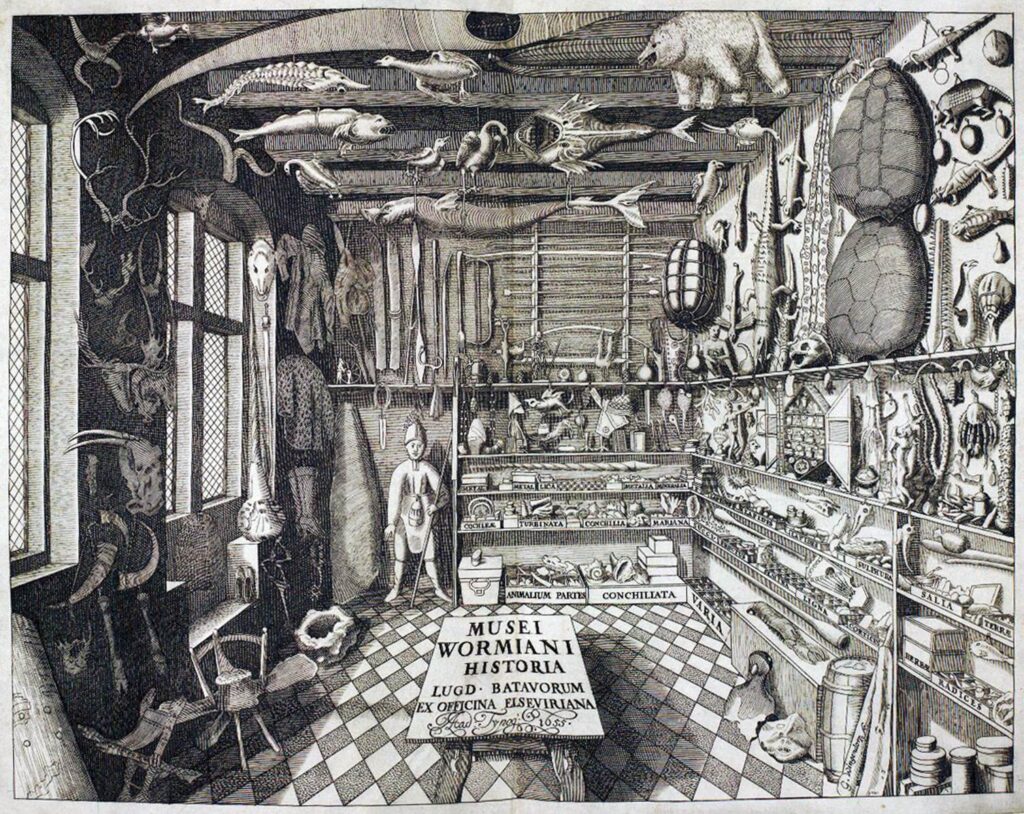
After the Renaissance, especially with the development of the Age of Exploration, Europe saw the direct precursor of the modern museum: the “cabinet of curiosities.” These cabinets of curiosities were also called “cabinets of curiosity” (Cabinets of curiosities), and many of them were named “temples of the Muses” as well. Unlike the private treasure vaults common in antiquity, the cabinet of curiosities did not seek to impress by the quantity of wealth or by splendor; rather, it pursued diversity and rarity in its collections. Most of the objects were gathered from all over the world by means of seafaring. In the name of curiosity, collectors and viewers paid more attention to the knowledge embodied in the objects than to their monetary value. At first these cabinets of curiosities were open only to friends and relatives, but they soon acquired a certain public character; many collectors even printed pamphlets to publicize their galleries and attract the public to visit and discuss them.

When the owners of some cabinets of curiosities died, unwilling to see their collections divided up and ruined by their descendants, they donated the collections to universities or other public institutions for scholarly research and public display. The great Ashmolean Museum and the British Museum both originally arose from private donations.
The ever more dazzling array of objects in cabinets of curiosities and museums, in turn, stimulated the development of natural history, especially taxonomy. As museums moved from private cabinets of curiosities to public institutions, people increasingly needed a public, scientific system of classification, and were no longer satisfied with randomly arranging objects by color or material. The greatest taxonomist, Linnaeus, conducted his taxonomic research precisely on the basis of collections (specimens); he regarded his own collection as a miniature “world museum” (world museum). The world museum “is divided into three halls (plants, animals, minerals), where the masterpieces of God are displayed.”
By the time of the Scientific Revolution, scientific instruments and experimental demonstrations had entered the museum. Early scientific experiments were often more demonstrative than discovery-oriented; for example, experiments like the Magdeburg hemispheres were grand public performances, and the museum was precisely a fixed venue for scientific interactive demonstrations. The famous oval hall of the Teyler Museum was not originally a display case at all, but an experimental table, and electrical experiments were the most popular item.
After the French Revolution, the modern educational system gradually took shape, and museums began to play their role within that system. For example, the Conservatoire National des Arts et Métiers in France, on the one hand, collected a large number of instruments and holdings from the Academy of Sciences, and on the other hand, also assumed educational functions; to this day it continues to operate as a joint institution of university and museum.
However, as the educational system further evolved, the frontiers of each science became increasingly specialized and difficult to attract ordinary audiences in an intuitive way. And as the kinds of holdings multiplied, the management and arrangement of museums also became increasingly complex. Thus, from the late 19th century to the early 20th century, museums began to move toward specialization, and scientific research and museum exhibition were separated into two distinct fields. Countries began to establish museum associations to study and coordinate museum operations. In addition, many administrators advocated division of labor among museums, with different museums focusing on different contents.
On the other hand, the world exhibitions that began in 1851 also brought a new style to museums. From that point on, world expositions and museums have always borrowed from one another. Expositions are like temporary exhibition halls for museums, while museums are like permanent expositions. Many of the legacies left by major expositions directly formed museum clusters; for example, what later became the South Kensington Museum can be traced back to the legacy of the first Great Exhibition of the Works of Industry of All Nations. In 1893 the South Kensington Museum split into the Science Museum and the Art Museum, each operating independently, which was also one of the signs of the independence of the modern science museum.
The audience for museums was initially limited to a small number of elite aristocrats; by the time of the Scientific Revolution it was mainly scientific researchers and intellectuals; after the Industrial Revolution it gradually expanded to the general public; and by the 20th century, children had also become the main visitors to museums, especially science museums.
The style of expositions was also changing. From the 1940s onward, the themes of world expositions gradually shifted from displaying industrial might to promoting cultural exchange. This too was due to new changes in the social environment. On the one hand, the development of atomic technology and space technology drew the most attention, but their principles were more complex and difficult to convey directly to the public, so they could only be presented through dramatized and entertainment-oriented forms; the rise of film and television also reinforced mass entertainment culture. On the other hand, the postwar baby boom led to a marked increase in the number of teenagers in the 1960s and 1970s, while the convenience of transportation and the rise of tourism also strongly promoted demand for family-vacation-style travel. As a result, museums and the emerging “science centers” began to assume the functions of tourist attractions and even entertainment venues.
Looking over history, we can see that all the functions museums have had—research, collecting, display, socializing, popular science, education, tourism, entertainment, and so on—have never been fixed, but have constantly been renewed as society changes. At the same time, some features of museums, such as the separation of research and exhibition, the separation of science and art, the combination with civic education, and being friendly to children, are all products of adaptation to corresponding social changes. Therefore, as we welcome new changes in society, museums will not remain stuck in their ways; rather, they may well develop entirely new forms.
The greatest change in today’s society is digitalization: human daily life and social relations increasingly depend on digital technology, and whether seeking knowledge or entertainment, we solve problems on our phones. In this environment, where are museums to go from here?
Perhaps museums are facing a new differentiation, for example splitting into physical and digital parts. The function of museums in popular science may to a large extent be replaced by digital platforms, but traditional physical holdings will not become obsolete entirely. On the contrary, in the digital age, many people have fallen into restlessness and emptiness, and these concrete objects, condensed with a weighty history, can better stimulate in viewers a sense of reality and reverence. As far as knowledge acquisition is concerned, viewing a virtual object may be more effective than viewing a physical one; but in terms of emotional resonance, physical holdings and their exhibition spaces remain irreplaceable. Therefore, in the digital age, physical exhibition halls may develop in a direction that places more emphasis on emotional arousal and atmosphere building.
Perhaps museums will also undergo a new integration; for example, the separation among history museums, science museums, and art museums may once again be brought together. On the one hand, the history of modern people is to a large extent the history of technology; on the other hand, cutting-edge technologies such as artificial intelligence are showing their impact on the fields of art and culture. In the new environment, paying attention to technology also means paying attention to history and art, so exhibition approaches that break down boundaries may become a new trend.
Beyond welcoming change, we also need to safeguard our legacy. Looking back at the many characteristics formed by museums in history, many outward appearances have been changing constantly, but many spiritual cores have remained consistent throughout. The spirit of “free inquiry” in the Temple of the Muses, the “curiosity” of the cabinet of curiosities, the public-spiritedness of the modern museum, the interactivity of the science center… these spiritual contents will not easily become outdated. Perhaps in the future, in addition to upholding the above traditional spirit, museums will also have new missions, such as bridging social divisions, highlighting multiculturalism, and so on. In any case, I believe that in an ever-changing future, museums will always be able to find their own distinctive social role.
Translated from the Chinese original with AI assistance. The original text is authoritative.