
Published in Journal of Guangxi Minzu University, 2023, v.29;No.107(01) 46-52
Abstract: Mumford was a pioneer in the discipline of history of technology, and his representative work Technics and Civilization has profound significance as an inspiration for historiographical method. His historiographical method can be developed as a “history of technical thought,” which, like the “history of scientific thought,” aims to sort out the “inner logic” of technological development, that is, a certain thread at the level of thought or spirit. A history of technical thought requires the introduction of the following four features: first, spirituality (no longer regarding technology merely as neutral material artifacts, but revealing the spiritual connotations of technology); second, unity (finding the unity among various technologies rather than merely listing them in fragmented fashion); third, coherence (finding a certain narrative logic in the history of technology, so as to summarize technological development from antiquity to the present); and fourth, reflexivity (taking “know thyself” as the ultimate philosophical concern). Mumford, in Technics and Civilization, offered corresponding answers: he elaborated the view that technology and spirit are mutually causal; advocated taking an overall view of technology as a system; and divided the periodization of the history of technology according to transformations in technological systems; finally, he posed for modern people the requirement of understanding their own age, namely, to “digest” technology.
Keywords: Mumford, history of technology, history of thought, technological system
0 Introduction
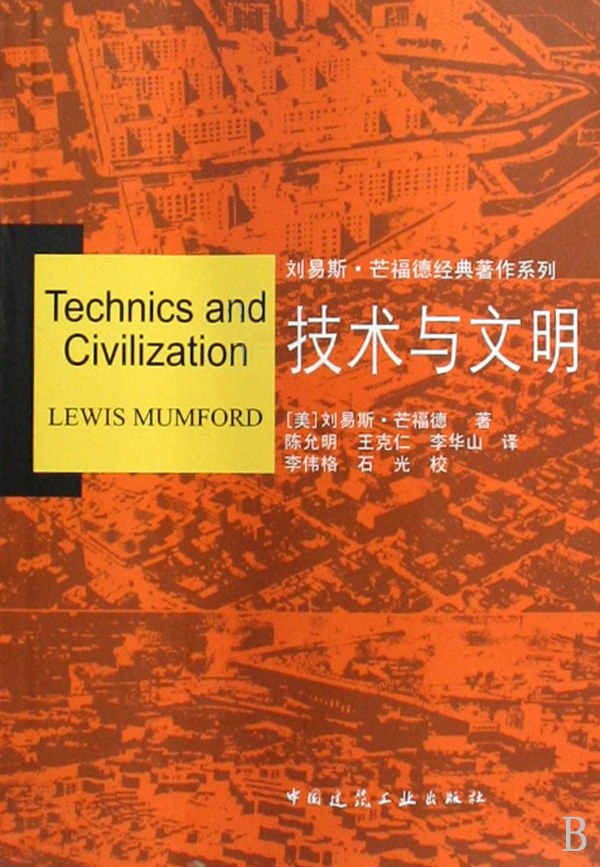
Lewis Mumford (1895-1990) was a pioneer in the discipline of history of technology, and his academic reputation was established by Technics and Civilization, published in 1934.
In 1969, the Society for the History of Technology awarded Mumford the “Leonardo da Vinci Medal,” the society’s highest honor, given for lifetime achievement and outstanding contributions in the field of history of technology.
The society’s official citation read: “Technics and Civilization … may have been the first work to pay sufficient attention to the cultural and aesthetic dimensions of technology itself, and also the first to regard the history of technology as an essential phase of human history.” [1]
Mumford was not a formally trained academic researcher; he preferred to think of himself as a “writer,” and his work also went beyond the scope of the ordinary historian. As the judges for the Leonardo da Vinci Medal put it, one may call Mumford’s field of scholarship the “philosophy of man” [1]; he always kept his eyes on “human nature,” and his history of technology and studies of the city were suffused with a humanistic spirit. The judges further added that this book could both inspire and stimulate mature scholars, and also serve as a readable introductory textbook for beginners.
By the twenty-first century, Mumford has not only not gone out of date, but has become even more important. Judging from the tendencies in the awarding of the Leonardo da Vinci Medal, compared with fifty years ago, historians of technology with humanist, feminist, and popular-cultural perspectives are more favored—and these perspectives were already embedded in Mumford’s writings.
New generations of historians of technology still draw inspiration from Mumford’s works. For example, among the recent years’ most acclaimed historians of technology, such as the 2017 laureate Arnold Pacey [2], the 2018 laureate Joy Parr [3], the 2019 laureate Francesca Bray [4], and the 2020 laureate Maria Paula Diogo, they still cite Mumford in their respective works. This shows that Mumford’s influence on the discipline of history of technology remains enduring.
As a humanist writer, Mumford was not especially strong in arranging historical materials; today, what we care about more is his vision, his concerns, and his method. However, Mumford himself did not clearly summarize or express his own distinctive historiographical method. This article will attempt, from the perspective of historiography, to organize and elaborate the distinctive ideas contained in Mumford’s Technics and Civilization.
1 From the History of Scientific Thought to the History of Technical Thought
I develop the historiographical program embedded in Mumford’s works as a “history of technical thought.” This concept corresponds to the “history of scientific thought.” But because the term “history of scientific thought” is also often misunderstood, let us first explain the basic characteristics of the “history of scientific thought.”
Here, the history of scientific thought (intellectual history of Science) that I am discussing is a term in Western history-of-science scholarship; as a historiographical program, it is usually opposed to the “social history of Science.” [5] It is also sometimes called “internal history” and “external history.”
It should be noted that the history of scientific thought does not simply mean the history of “scientific thought” (history of scientific thoughts); nor does so-called “internal history” mean that one should focus on “scientific content.” Both intellectual history and social history pay attention to “scientific thought” or “scientific content”; the difference is that the former is more concerned with the “inner logic” of how this scientific content develops and changes—that is, the relations of derivation or resonance among ideas, including ideas in science, philosophy, theology, and so on—whereas the latter is more concerned with their “external environment” (social, political, economic, and other contexts). If history of science merely records scientific content (for example, Newton published the three laws in 1687, Einstein published relativity in 1905), then it is neither internal history nor external history, but only a simple compilation of historical materials or some kind of “chronology of achievements.” It is only by further excavating what lineages actually connect Newton and Einstein, tracing the continuity or rupture in this sequence of intellectual developments, and examining the conceptual premises or consequences of these developments, that one is doing the work of “intellectual history.” In a certain sense, intellectual history is a philosophical undertaking: through dialogue with the ancients, it asks after the origins and development of thought, and ultimately answers the question, “Where do I come from?”
For instance, whether in intellectual history or social history, any narrative of the history of astronomy will mention figures such as Plato, Ptolemy, Copernicus, and Newton. But when sorting out the thread, Koyré reduced the rise of modern astronomy to a worldview or cosmological transformation such as “from the closed world to the infinite universe” [6]; that is what is meant by intellectual history. Social history, by contrast, might seek the line of astronomical transformation at the level of social relations such as printing workshops and lens makers.
In this sense, internal history and external history are not necessarily in conflict; rather, they are complementary perspectives. To use the writing of a person’s life as an analogy: a “résumé” tends to emphasize the external—the changes in social relations, achievements or status attained, and so on—whereas an introspective “spiritual journey” tends to emphasize the internal—such as “at thirty one stands firm, at forty one is free from doubt,” and so forth. A spiritual journey and a résumé can each be narrated independently, but they can also be juxtaposed or interwoven.
Back to the point: the “history of technical thought” (intellectual history of Technology) that I propose here is also not a history of “technical thoughts” (history of technical thoughts), but rather seeks, within the evolution and transformation of technology, some kind of “inner logic,” that is, a thread at the level of thought or spirit.
So how is such a historiographical method possible? We notice that technology seems somewhat different from science, because the achievements of scientists seem from the outset to be spiritual, and scientific development ultimately forms a relatively unified worldview. By contrast, achievements in the field of technology seem first and foremost material; moreover, technological achievements are relatively complex and diverse. How, then, can one sort out from among them a thread of thought?
To take the history of scientific thought as a model and introduce the program of intellectual history into the history of technology, we must solve the following problems:
- Spirituality: no longer regard technology merely as neutral material artifacts, but reveal the spiritual connotations of technology;
- Unity: find the unity among various technologies rather than merely listing them in fragmented fashion;
- Coherence: find a certain narrative logic in the history of technology, so as to summarize technological development from antiquity to the present;
- Reflexivity: take “know thyself” as the ultimate philosophical concern.
I will show that Mumford, in Technics and Civilization, already provided answers to the above questions:
1. Technology and spirit are mutually causal;
2. An overall view of technology (an ecosystem);
3. Archaic age—Palaeozoic age—Neozoic age;
4. Understanding and digesting technology
2 Technology and Spirit
Mumford’s interest in the history of technology originated in a magazine article he wrote in 1930, “The Drama of the Machines.” Because of this article, Mumford was invited to teach a course at the University of California on the theme of “the American machine age.” While preparing the course, he found that the available materials were insufficient, so he went to Europe for investigation and study, and finally completed Technics and Civilization in 1934. And already in his 1930 article, Mumford had expressed the original intention with which he understood technology. In the introduction to Technics and Civilization, Mumford himself quoted the article as saying: “If we are to have a clear understanding of the machine, we must consider not only the sources of its actual form but also the sources of its psychological form; just as we must also investigate the machine’s influence upon aesthetics and morals” [7]1.
Mumford noticed that the development of machines has its “psychological roots,” and that the consequences of machine development also include spiritual domains such as aesthetics and morals. Mumford’s point of departure was to connect the history of technology with the history of the human spirit.
More importantly, in Mumford’s view, technology and spirit are not two independent lines of thought that merely happen to be related from time to time; rather, they are mutually presupposing and mutually embedded.
On the one hand, behind technological inventions lie changes in ideas—not in the sense of technical ideas for concrete development and design, but in the sense of ideas in the domains of worldviews, habits of life, value pursuits, and the like. Mumford said: “In every major invention of the last 150 years in the field of material civilization, there has been not only a long internal development of technique, but a constant alteration in the minds of men. Only as men’s wants, habits, ideas and goals were redirected was it possible for a new industrial process to develop on a large scale.” [7]7
On the other hand, areas such as human ways of life and modes of thought are not innate and fixed either; they, too, are influenced by technological change. For example, “the regular, punctual mode of life first formed in monasteries was not something humanity possessed from birth. And now the lives of Westerners are completely governed by the clock, having become their ‘second nature.’” [7]17Mumford attached great importance to the historical significance of the mechanical clock; he even believed that “the key machine of the industrial age is not the steam engine, but the clock.” [7]15 This view can only be understood by examining tools and machines together with spirit, ideas, and ways of life. The mechanical clock changed humanity’s concept of time and the rhythm of life, championing standardization, automation, and precision, and complementing the modern factory system. Of course, Mumford did not belittle the role of the steam engine in the Industrial Revolution, but neither did he view the steam engine’s importance merely from the angle of productivity as a power tool. Like the clock, the steam engine’s truly important influence lay at the cultural and conceptual level: the huge and rigid steam engine eliminated the casualness of the family workshop and strengthened centralized and tightly controlled methods of management. As Mumford said: “The steam engine favored monopoly and concentration, required 24-hour work, and became a pacemaker” [7]151
The mechanical clock is not just a timekeeping device; the steam engine is not just a power tool… Mumford opposed an instrumentalist view of technology. He believed that technological inventions cannot be measured only by their utility and efficiency; rather, one must understand their causes and consequences from the standpoint of human ideas and ways of life.
3 Technological Systems
The instrumentalist view of technology that Mumford opposed is precisely the vulgar common view, which finds expression in many fields. For example, economists understand the Industrial Revolution as a revolution in energy-use efficiency; archaeologists understand prehistoric civilization as an age centered on stone tools; philosophers understand human essence as that of a tool user… Early historians of technology were not immune to this either. For instance, in the preface to the seven-volume magnum opus A History of Technology, edited by Charles Singer (1876–1960), he wrote: “The editors are convinced that in our technical civilization, man’s value lies in the understanding of methods and skills by which he has imposed control over his natural environment and gradually made his material life more comfortable.” [8]
In Mumford’s view, “tools for controlling nature” are only one aspect of technology, and not the crucial one at that. The most representative technological implements are not so much tools as containers. Stone spears and stone axes are easier to preserve than things like bamboo tubes and baskets, and thus reinforced the archaeologists’ bias. Steam engines, steel furnaces, and the like roar and clank, and so more easily attract people’s attention, reinforcing the bias of modern people. In the final analysis, in the various technologies of past and present, it is always the “masculine” side that draws more attention, while the “feminine” side is often overlooked: the former is active, aggressive, and controlling; the latter is passive, preservative, and inclusive.
Mumford said: “Almost without exception, all discussions of technology since Marx have overemphasized the role played by the movable and active parts of our industrial equipment” [7]11. People have failed to see that even these active things often do not function independently; they are merely components within a larger system. Behind them, there are many preservative and supportive things at work. Mumford said: “Because people’s attention is so easily drawn to the noisier, more active parts of the environment, practical facilities and equipment are often ignored when machines are discussed.” [7]13
For example, when we examine trains in the Industrial Revolution, the noisy, active steam locomotive always catches the eye first. So we regard the train as an application of the steam engine. But a train does not function by the locomotive alone; what ensures that the high-pressure steam engine can do its work includes background factors such as the tracks, stations, timetables, and the commercial environment. Taking all of these together is why Trevithick failed and Stephenson succeeded. And Mumford always placed apparently striking technological achievements under a larger “ecosystem” for examination.
At the very beginning of Technics and Civilization, Mumford put forward the concept of the “machine complex,” which “means the entire technical complex, or technical system. This encompasses all the knowledge, skills, techniques, and so forth acquired by industry or embodied in new technology” [7]13. In retrospect, in his later years he even described his own research as “ecological history”[9]. As Miller said, “Mumford’s social studies, like those of a biologist investigating nature, endlessly explore and search for the connections and intrinsic relations among various life phenomena. He always places the subject he is discussing—whether a book, a building, or a city—within a broader cultural environment for observation.” [10]
Value itself is part of the cultural environment; it is not a fixed yardstick external to the technological system. Only within an overall ecosystem can we properly assess the merits and defects of technology. For example, a single train and a carriage are not comparable in isolation. If there are no tracks, no coal industry, and no station scheduling system in the environment, then the train has nowhere to put its power to use. Moreover, the speed of a vehicle is not an absolute yardstick in itself; “faster, higher, stronger” is not always a good thing. Mumford said: “Rail transport may be faster than a small boat on a canal, and gas lamps may be brighter than candles. But speed and brightness are only meaningful when speaking of human aims or when discussing human and social values. If people wish to enjoy the scenery, then the slowness of a canal boat is more satisfying than the speed of a motorboat.” [7]251
Values themselves are embedded within the technological system. The reason modern people like to measure value by linear, quantifiable standards such as speed, efficiency, and intensity is precisely that this is an inward tendency of the modern machine complex. Mumford said: “The machine complex represents an attempt to substitute quantity for value in life” [7]251.
From the perspective of an “ecosystem,” the history of technology as Mumford presents it no longer faces the danger of fragmentation. The history of technology is at the same time the history of human civilization, a complete narrative about human destiny.
In the history of technology, Mumford saw that with the expansion of the “machine,” the pursuit of power or efficiency overwhelmed the pursuit of rich and diverse values. He said: “When humans try to seize power, they often abstract themselves. Or to put it another way, humans try to exclude all their other parts and leave only the impulse to seize power.”[7]29、[11]31
Mumford’s attitude was also “ecological” in this sense: he did not think machines or tools are bad and containers are good. No single technology or artifact is inherently good or bad; the key lies in whether the whole ecosystem is rich and diverse. A civilization that values tools alone and a civilization that values containers alone are both bad. The danger of modern technology does not lie in its ability to control nature and seize power, but in the fact that this tendency is excessively amplified, to the point that it excludes other values.
After Technics and Civilization, Mumford turned to the study of cities. His The Culture of Cities in 1938 and The City in History in 1945 became classics in the field of urban studies. His emphasis on cities is consistent with his view of technology, because individual technologies can only be properly assessed when placed within an overall system, and the city is precisely an ecological unit where all kinds of technology and culture converge. Mumford said: “The city is a maximum concentration of the powers and historical culture formed by human society. In the city, the various different beams of light scattered by human social life, and the radiance it emits, all converge and focus here, ultimately condensing into the efficacy and practical significance of human society.”[12]
4 Periodizing the History of Technology
From the perspective of the “technological system,” the whole of history can be divided into several different technological ages. Just as the Scientific Revolution is seen as a transition from an old paradigm to a new one, a technological revolution can also be seen as a switch from an old system to a new one.
Technics and Civilization divides Western civilization after the year 1000 into three stages, “each stage being a technical system” [7]101. These include:
Neotechnic age (roughly 1000–1750): the “water power–wood” system;
Paleotechnic age (roughly 1750–1850, that is, the period of the Industrial Revolution in the usual sense): the “coal–steel” system;
Neotechnic age (1850 to the present): the “electricity–alloy” system.
The neotechnic age was a period of cultural fusion in Europe, during which Europeans gathered resources from other cultures such as China, the Arab world, and ancient Greece, and integrated them into their own system. During this period, European civilization gradually formed differences from the earlier ancient civilizations. In ancient civilizations, technology was embedded within the network of life, and technological activity was inseparable from other links in the cultural environment. And “by the end of the Middle Ages, this cyclic integration in the cultural network had been broken; one part had detached itself from the network and started running amok on its own under full steam—namely, the desire to control the environment.” [7]40
This tendency for “technology to break away from life” is what Mumford called “the abstraction of man.” This tendency toward abstraction was especially evident in three fields in the late Middle Ages:
- Mining detached work from life. The “idea” embedded in mining was this: “Economic value is related to the amount of labor expended and the degree of scarcity of the product… The miner’s values, like the financier’s, became abstract and quantitative…. Only the miner’s environment is a world of inorganic matter, having nothing to do with food or life.” [7]71
- Capitalism detached value from life, “replacing the values of life with money values” [7]23. In the ancient view, “good” was always linked with “appropriate”: neither偏nor excessive, neither too much nor too little, was best. But in the money-value view, more value is always better, and there is never any restraint. The money-value view also complements the scientific notion of quantification[7]24
- Military activity detached social organization from life. Uniforms and weapons were among the earliest standardized products. Military organization trained people into robots that precisely obeyed orders, separating them from daily life and suppressing individuality.
These fields were not the whole of medieval society, so the tendency toward human abstraction remained latent and not yet fully manifest. It was not until the advent of printing broke the balance “between the concrete and the abstract”[7]124 that European society entered a kind of revolutionary period: the old system collapsed, while the new one had not yet been established.
It was only after 1750 that the new technological system first took shape in England. Why did the Industrial Revolution happen in England? Mumford’s answer was simple and blunt: because of barbarism[7]144. Because England was on the edge of the old European civilization, it had fewer cultural burdens and constraints, making it more likely to seize the lead.
Mumford loathed the barbarity and ugliness of the cultural environment in England at the time. He mocked: “At the peak of England’s dirty industry, working-class housing was densely built beside public sewers. Just then, however, the libraries of the middle class were filled with the works of complacent scholars, who in detail contrasted and discoursed upon the filth of the Middle Ages and the civilization and cleanliness of the present age.” [7]170 Mumford believed that this cognitive discrepancy arose because people looked at technology and life as separate, saw that modern technology was more powerful than medieval technology, and concluded from this that the modern age was more advanced than the Middle Ages. But people failed to notice that technological power is not always beneficial to human beings. Mumford said: “Speeding up the pace” has no meaning in itself; “deprived of serving human purposes, they are like sunlight shining on the Sahara Desert—they have no special meaning. In the Paleotechnic age, the increase of power and the acceleration of activity became ends in themselves, requiring no justification through beneficial effects on human beings.” [7]182
Mumford believed that under the technological system of the “neotechnic age,” this tendency to over-abstract and mechanize human beings might be reversed, but this was no easy task. If people cannot adopt an overall, systematic, life-centered view to assess technology, then new technologies may not necessarily shape new cultures and ideas.
Mumford cites an observation by the philosopher Russell: “Every improvement in transportation capacity increases the distances that people are compelled to traverse; a man a hundred years ago took half an hour to walk to work, while today a man goes to work by car, but it still takes half an hour.” [7]240 Mumford himself also offered a remarkably far-sighted insight: “Communication technologies enable a certain item of information to be transmitted more quickly and effectively, but now people have to spend more time dealing with the explosion of junk information” [7]240.
New technologies do not necessarily benefit everyone; those with vested interests in the old system are more likely to use new technologies to consolidate their own interests. For example, the acceleration of transportation has helped factory owners hire employees who live farther away (and therefore may be paid less), rather than easing the commuting burden of workers.
Mumford borrowed the concept of “pseudomorph”[7]233 from Spengler (pseudomorph originally refers to the displaced substitution of rock structures: one kind of rock infiltrates the fissures of another, forming an outward appearance that looks like the second kind of rock, though in essence it remains the first kind; Spengler introduced the term into the realm of culture). Mumford believed that technology is always embedded in a larger cultural–ideational system; they usually shape one another and select one another, but the replacement of technologies does not necessarily bring about the renewal of culture. Sometimes new technologies are instead used to consolidate the most stale parts of the old culture’s existence: “New inventions and new equipment are often used to preserve, renew, and stabilize the structures of the old order. Outmoded technical equipment harbors political and financial vested interests.……The industrial world produced in the nineteenth century had already become technically obsolete and socially on the verge of death, but unfortunately the maggots growing on its rotten corpse may influence and even destroy the new order that replaces it.” [7]195
“Even the most advanced technology cannot promise that social progress will necessarily follow, just as electric lights can make no promises to monkeys in the jungle.” [7]195 If we look only at the succession of technologies themselves, at the acceleration or intensification of technology, then it is all too easy to be blinded by the “illusion of progress” and forget that the progress of civilization has always had to be won through people’s comprehensive efforts in thought, ideas, society, politics, and so on.
5 Digesting Technology
Mumford’s grasp of the trend of technological history ultimately returns to the present, to answer the question of our time: what are we to do?
First of all, the study of technological history itself is the basis of all action, Mumford said: “The study of the process of the emergence and development of modern technology is the basis for understanding and strengthening the current reappraisal of machines. A comprehensive appraisal of the machine may perhaps bring us one step further along the road toward becoming masters of the machine.” [7]10
The purpose of historical research is, first and foremost, to break habitual prejudices and reactivate the mindset of innovators, refusing to take any established order as a matter of course. “Some of the bold innovations of the pioneer generation of the past have now become fixed routine for the masses, and they have long since become accustomed to them, without in the least catching the passion of their predecessors’ innovations.……We live every day in such an atmosphere, and this atmosphere shapes us……We are simply incapable of evaluating the effects produced by this atmosphere, much less of estimating the trends in the development of the machine system……” [7]318
Mumford opposed those romanticists who advocated “going back to the past.” The Industrial Revolution was terrible, so should one flee from machines and return to the agricultural age? Mumford despised this escapist attitude. He pointed out that the ancient people so admired by the conservatives were not themselves conservatives; people of antiquity were often dissatisfied with the status quo and always longed for a better society. It was precisely because these earlier generations opened up new ground and explored, generation after generation, that human civilization could keep changing. Mumford quipped: “They propose returning to the conditions of life of the original pioneers, yet they do not possess the spiritual strength of those pioneering trailblazers of the time.” [7]263
Mumford was even more opposed to those technocratic advocates who urged us to “adapt to reality”; they had rashly surrendered to the machine system, submitting to the logic of machine operation without thinking of resistance, no longer exploring it or controlling it. That too is cowardice. An attitude of initiative and mastery—“If this is humanity’s attitude toward nature, then why is humanity so cowardly when facing the machine system?” [7]278
To understand technology, Mumford used a distinctive term—assimilate—which carries the senses of digesting, absorbing, accepting, assimilating, and understanding; for the moment, let us translate it as “digest.” He said: “Our ability to go beyond the machine depends on our ability to digest the machine. Only when we truly grasp the objective, calm, neutral truths of the machine world can we further comprehend the more complex, richer organic realm, and the deeper mysteries of human nature.” [7]320
“Digesting” means precisely taking something that is “inside” us but does not wholly belong to us, crushing it, chewing it, and making it our own. The key point is that technology is not something external to humanity, but an intrinsic part of human civilization. Technology and the human spirit, culture, and way of life shape one another; technology affects every aspect of human life, but conversely, the choices and changes made in every microscopic aspect of human life will in turn affect technological development. Therefore, in the face of technological trends, there are not only two choices: total flight or total submission. Precisely because we view technology as a whole, we are able to see the various choices and efforts of human beings within subtle contexts. Human beings can never play God and choose the entire technological system, but every choice made by each individual will ultimately influence the trend of technology.
Mumford said: “Technics and civilization as a whole are the result of human choices, inclinations, and struggles, whether deliberate or not. They appear to be the most objective and scientific things, but in fact they are often irrational—yet even if uncontrollable, they are not external. Choice itself is embodied in the small incremental changes of society, in decisions made every moment, and in grand struggles;……If anyone cannot see this element of choice in the development of machines, that only exposes his own incapacity; he has failed to notice the gradually accumulating effects until they are piled so densely together that they seem entirely external and inhuman. To reconquer the machine and bring it under human intention, we must first understand and digest it.” [7]9、[11]6
[References]
[1]SHOT. The Leonardo da Vinci Medal[J]. Technology and Culture, 1970,11(2):205-213
[2]Pacey, Arnold. Meaning in Technology[M]. Cambridge: The MIT Press, 1999.
[3]Parr, Joy. Sensing Changes[M]. Vancouver: UBC Press, 2010.
[4]白馥兰.技术与性别[M]. 江湄、邓京力译. 南京:江苏人民出版社, 2021.
[5]万辅彬,吴国盛.走向西方科学史 走向科学通史——北京大学吴国盛教授访谈录[J].广西民族大学学报(自然科学版),2009,15(02):2-7
[6]柯瓦雷. 从封闭世界到无限宇宙[M].张卜天译.北京:商务印书馆,2016.
[7]芒福德. 技术与文明[M]. 陈允明等译. 北京:中国建筑工业出版社,2009.
[8]辛格等.技术史I[M]. 王前、孙希忠主译. 上海:上海科技教育出版社,2004:19
[9] Miller, D.L.. Lewis Mumford: A Life[M].Oxford: Oxford University Press,1989:84.
[10]芒福德.刘易斯•芒福德著作精萃[M].唐纳德·L·米勒编.宋俊岭、宋一然译. 上海:中国建筑工业出版社,2010:3
[11]Mumford, Lewis. Technics and Civilization[M].New York:Harcourt,1966.
[12]芒福德.城市文化[M]. 宋俊岭等译.北京:中国建筑工业出版社,2009:1
Translated from the Chinese original with AI assistance. The original text is authoritative.