
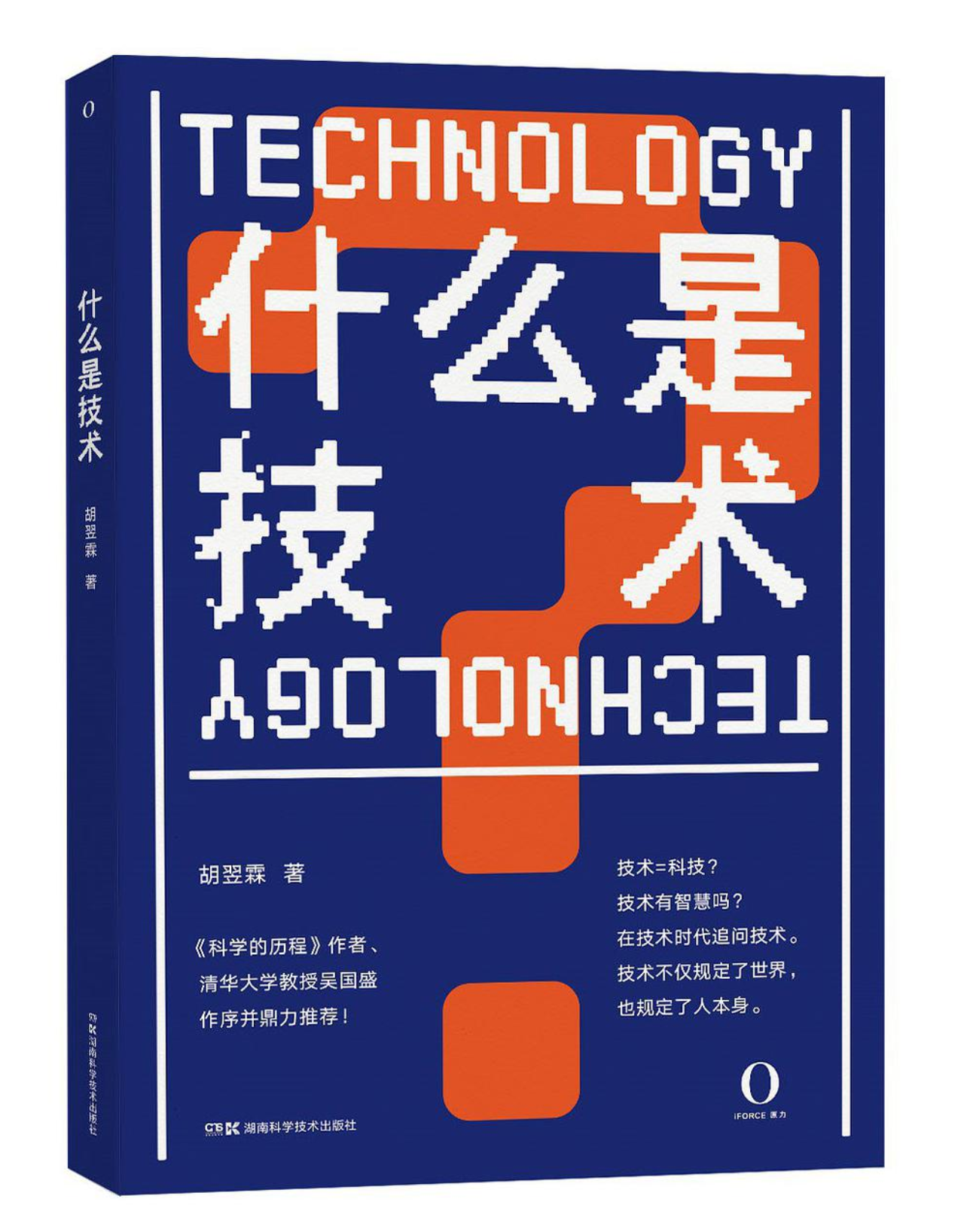
Thanks to China Science Daily, which usually invites me to write book reviews; this time, since it was my own book, we simply did an interview. Zhang Wenjing did a very good job with both the interviewing and the editing—it’s just that the headline is a bit over the top (though there was nothing to be done about that). The finished piece can be found on ScienceNet; here I am posting my original written answers.
- First, could you talk about how the book What Is Technology came to be? In the opening sentence you say, “We are now in a ‘technological age.’” In a technological age, what is the background and significance of asking “what is technology”?
The origin of this book really does not have any lofty reason. A lot of its contents were articles I had written gradually over the past few years; in a sense, it is a collected volume, a small summary of a certain stage. But I did not want to publish it in the style of an anthology, so I reselected the existing articles with “technology” as the main thread, and additionally wrote and revised some material, arranging it into a relatively complete structure.
Much of my writing is spontaneous; it is not done for publication or for appearance somewhere. The impulse to write comes, I suppose, from a personal desire to know and a desire to express. In Section 3 of Chapter 1 I wrote that if I do not want to be a “puppet on strings,” if I do not want to content myself with “coasting along until death,” then I naturally have to constantly reflect on my own situation.
The “technological age” is the broad background of every one of our situations. Each person has his or her own fate, but on the whole we are all under the domination of “technology.” Technology is not merely a neutral, dispensable tool; rather, it is the ground of our entire world, shaping our ways of living and our patterns of thought. So, in simple terms, asking about technology in a technological age is a basic step in every contemporary person’s “know thyself.” Anyone who does not ask about technology is being inauthentic toward themself.
- The book is titled What Is Technology, but it does not in fact give “technology” a precise definition. Instead, through a survey of the history of technology and discussions in the philosophy of technology, it approaches the understanding of technology from multiple angles. The chapters seem scattered on the surface, but in fact they are a chain of closely linked reflections; even the wording often contains “advance hints.” Why present it in this way?
First, the “chain of closely linked reflections” you mention is a bit exaggerated. As I said earlier, this book grew out of several articles I had written separately in the past; after filling them out and smoothing them over, they were collected into one volume, so it is not really a continuous process of thought. But I did indeed hope to present something relatively complete as a whole through the medium of a book.
How much text we use for an expression is closely related to how we understand that expression. The shorter something is, the more we want it to be precise and vivid. For instance, a “definition” may be only ten or so characters long, and we feel it is precise, authoritative, ironclad. But in fact, the meaning of that definition requires an entire ready-made system in order to be understood. For example, Newtonian mechanics comes right out and defines force as “the cause of changes in motion.” This definition seems to rewrite the ancient philosophers’ definition (“force is the cause of motion”), but anyone who has studied the history of science knows the change was not that simple. The concept of “motion” itself changed (for Aristotle, motion and change were synonymous); the concept of “cause” also changed (from the richly layered four causes to an external cause of translational motion); the concept of “force” changed as well (it became mathematized) … If you detach the conceptual shifts implied behind each word, then merely holding up a ten-character “definition” to ancient people, they would not understand it. A “definition” is effective because it rests on our entire “historical background,” on the conceptual configuration we take for granted. But the very thing we need to ask about is precisely this background; in that sense, simply giving a definition is meaningless. What matters more is to ask how these definitions are actually understood by us. A definition is the starting point of my inquiry, not the endpoint.
Now social media is flourishing, and America is ruled by Twitter. A hundred characters on Weibo are longer than a definition, but they cannot contain complex argument, so what we see more often is a struggle of “positions.” This is why communication on Twitter or Weibo so easily falls into “polarization,” into a black-or-white split. Before discussing anything, people first ask whether your butt is crooked or not; only if you are standing firmly in the right position are you allowed to speak. And what you say is not judged by your argument, but by your conclusion and attitude.
About 1,000 characters can make up a Moments post on WeChat. It can accommodate some argument and evidence, but it still cannot support deep discussion, much less reflect controversy and uncertainty, so what it produces is a kind of fast-food style knowledge dissemination. Things like guides and dogmas are well suited to being spread in 1,000 characters. Besides a clear conclusion, they can also provide readers with some concretized, operational routines—for example, in health-maintenance knowledge.
Only around 10,000 characters do we reach the length of a proper academic paper. It can accommodate a relatively complete argument, and can even lay out opposing views and criticize them one by one. But the reason a paper is effective is that it must rely on an existing academic community. Within an academic community, among peer scholars, there is a certain consensus, a certain basic training and common knowledge, so a paper can build further discussion on the foundation laid by colleagues and predecessors. The price, of course, is that once you step outside the circle it becomes hard to read; not only ordinary people cannot understand it, but even non-specialist scholars find it difficult to enter.
Beyond 100,000 characters, only a full-length book can construct a relatively independent “thought-space.” It allows non-specialist readers not merely to skim, but to follow the line of thought into its depths. I compare writing a book to constructing a “garden.” On a table-sized space you can only do potted plants; to do a “garden,” however you look at it, you have to count it in acres. A garden has wholeness, and only such wholeness can let visitors “enter it,” rather than merely looking down on it from outside. But this wholeness does not necessarily mean an effect of monolithic solidity. A garden also emphasizes divisions within itself; it is not something you can take in at a glance and command as a whole. Rather, it is one scene after another, with the visitor’s movement leading them into different contexts; different “scenes” have different themes. Here there is a pond, after turning the corner there are strange rocks, and so on. The scenes must keep changing, but not in a way that is too abrupt or arbitrary; the various scenes should illuminate one another. What I have tried to do with so-called advance hints and sectional discussion is also an attempt to create this kind of wholeness: divided yet not scattered, varied yet not chaotic. Of course, it may not have been very successful, but that is the strategy.
- Some readers on Douban also think that in the book you may have made the concept of “technology” too large and too broad. What is your view on this?
It is not that I have made the concept of “technology” too broad; rather, in this age, the concept of “technology” is simply that broad. Since I want to ask about the background of the age, wherever I look there is technology; technology is everywhere. I have not invented a new usage of the word “technology” out of thin air. My usage all comes from things one may encounter in everyday language.
The problem is that many people are content to find a definite definition and then think they have grasped the concept of technology. This is actually a kind of self-deceptive evasion of the problem.
This broadness of the concept is not my conclusion; it is the starting point of my inquiry. I am precisely trying to trace, from this ubiquity and breadth, the basic elements that make technology what it is. “Mediacy,” “teachability,” and so on are tentative answers I have tried out, but fundamentally we still find it difficult to summarize the unity of the concept of “technology” in a few words. We have to understand it through “history.”
I said at the beginning that we do not understand “what China is” by simply drawing an already existing and clearly defined “national border”; we must understand it through history. Imagine that China unified the entire world, and all the land on earth became Chinese territory—then how should the word “China” be understood? Would the word “China” automatically disappear overnight once the last piece of territory was annexed? “Technology” is now in a similar situation. Since modern times, technology has advanced and conquered territory, dominating every field of production and life, making it difficult for us to shrink the concept of technology to a clearly defined boundary. But technology has not always had such power from ancient times; therefore we need to use the history of technology to trace the origins and development of technology and its status.
- Although this book involves the academic fields of the history of technology and the philosophy of technology, in style it counts as a popular book. In the book you often use analogy and other methods to dissolve the difficulty and dryness of academic discussion, making the text more readable. What considerations led you to this writing style? Is it your consistent style of writing? What is the significance of bringing cutting-edge scholarship in this field to the public? Is your classroom style like this as well?
First, let me correct one point: “academic discussion” is not necessarily “difficult and dry,” especially philosophical discussion—it should not be “dry.” Philosophical discussion is exciting. Many philosophical classics that are considered arduous, once you actually read into them and enter the author’s world of thought, let us feel a vigorous passion. That is also why I love philosophy. Of course, history, when pursued deeply, is also a lot of fun—much more fun than today’s industrialized tourism. When you travel, you are basically just taking in strange customs and unusual things, experiencing different ways of life and different environments, which makes us feel novelty. But reading history produces that same effect: we can feel, under different times and different cultures, ways of living with their own unique flair. How can that be called dry? What is called dryness may be some of the stages that must be passed through on the journey. For example, if you want to go on an excursion and there is neither subway nor bus, then you have to spend half a day on a bumpy, winding mountain road. That stretch is hard and dry. But some realms are exciting precisely because they are somewhat distant from us; if you want to appreciate the beautiful scenery, you must endure the corresponding dry journey.
Also, some kinds of interest are at a higher level; you need a reserve of knowledge in order to understand them. If your reserve is not enough, if your basic knowledge is insufficient, then you will find it dull and tedious, even repellent. For example, if I tell you the story of the Huarong Trail in Romance of the Three Kingdoms, and you see Guan Yu letting Cao Cao go, then if you do not know the background, do not know that Guan Yu and Cao Cao had once had an obligation between them, and do not know how much Guan Yu values loyalty, you will find it baffling, even infuriating. You will think Guan Yu is just a fool, that he somehow let the enemy’s big boss go, simply disregarding the larger situation, and you will have no way to understand what Guan Yu is agonizing over. If you do not know the Oath in the Peach Garden and directly see Liu Bei, in order to avenge Guan Yu, personally march east to Jiangdong regardless of the Sun-Liu alliance, you will also be baffled. This is not because Romance of the Three Kingdoms is not written in a popular style, but because every story has antecedents and consequences; without prior groundwork, understanding it is very different. Many academic questions are similar. To understand what is so knotty about a problem, you need to know a great deal of advance context. These advance contexts themselves are actually not obscure, but they in turn have more advance contexts. So if ordinary people directly enter a specific academic field, they will feel completely at sea, and may not even have heard many basic terms—like not even knowing that Kongming and Wolong are the same person. Of course then you cannot read it in; it will make no sense.
Of course, many scholars also have a bad tendency: they deliberately make things dry and obscure in order to flaunt their professional status. We should avoid that style. We ought to recognize that whether in academic writing or popular writing, every sentence and every word we write is there to express meaning more simply, more clearly, and more fluently.
Among all academic fields, philosophy is the most special, because the fundamental problem of philosophy is always “know thyself”; each person must constantly return to the “self,” return to the questioner. If you do an engineering research project, once you are finished you are not speaking to yourself; you are speaking to other fellow scholars, or quite simply to the construction team. So depending on the reader, you must speak in the language they can most easily accept. But in philosophy, in the end, you are speaking to yourself; you are speaking to the self that asks the questions. That naturally requires that we do not express ourselves in the language of a specific discipline, but return to our own mother tongue to tell the story.
And “I” is a unity. I am not just a specialized researcher; every expert is also a “common person,” and beyond professional work our more primary way of living is everyday life. If I do not split myself apart, but instead take this everyday-living self as the one I am responding to, then I naturally require my language to keep returning to everyday life—starting from everyday language, and ultimately returning to everyday language. Rather than saying that I am pushing academic research to the public, it is better to say that I am trying to unify the self as scholar with the self as everyday-living person.
- Before this book, you should already have published four books, right? What are the approximate styles of these four books? In the preface, Teacher Wu Guosheng says that you enjoy writing books more than writing papers. Why are you so fond of writing books?
In answer to Question 2, I said that a length of around 100,000 characters can constitute a relatively self-contained intellectual space, whereas a paper has a much harder time achieving that. Of course, what Wu Laoshi says in the preface is in fact partly meant to nudge me a bit, because my publication of papers has been somewhat slow; he hopes I will devote some energy to publishing a few more papers, and that is indeed as it should be. I am working hard on it. My previous few books were roughly like this: the first, Stories from the History of Scientific Culture, was a work from my graduate-school years, published as a collected volume around the time I completed my doctorate. It is relatively loose and immature, so nowadays I generally do not like to mention it. The Strong Program of Media History was compiled from my doctoral dissertation, with the aim of bringing media ecology into the horizon of phenomenological philosophy of technology, and I think it has a certain academic value. Outdated Wisdom — Fifteen Lectures on the General History of Science and The Extension of Man — A General History of Technology were respectively the results of the courses I taught on “General History of Science” and “General History of Technology,” and they reflect the style of my lecture notes. Outdated Wisdom is relatively complete, recording the content of an entire semester. The Extension of Man is an excerpted and condensed version, the essence of the general history of technology course; I first put out one volume to test the waters, and I am now writing a more comprehensive and richer work on the history of technology.
- Seeing the title What Is Technology, some readers may think of Wu Guosheng Laoshi’s What Is Science. Compared with science, which is a foreign import, when one explains “what technology is” for domestic readers, does it have its own characteristics and difficulties?
Actually, I think “technology” is also a “foreign import.” Ancient China certainly had a long string of related concepts such as “skill,” “art,” “artifice,” “method,” “style,” “craft,” and “tool,” but there was no concept that exactly corresponded to the word “technology” as we use it today. The “technology” that dominates our everyday life today, and the idea of “technology” in our minds, are both not native to China; like “science,” they are both “foreign imports.”
Because today the meaning of technology is broader, it makes it easier for us to take it as a universal, general, neutral concept; this neutral perspective is even more entrenched than the one we take toward “science.” Through the efforts of several generations of scholars, including Wu Laoshi, we are now increasingly able to accept that “science” is a distinctive tradition with a specific cultural background. But even Wu Laoshi himself differs from me on whether “technology” is universal in this sense. This may be precisely where discussing “what technology is” is harder than discussing “what science is.” Because “technology” is so broad, we can discuss a particular technology concretely, but it is hard to make “technology” as a whole into an object of reflection.
“Technology” as a whole has two levels: one is the level of material existence, namely the “technological environment” and “technological system”; the other is the level of ideas, namely the concept of “technology.” I believe that these two levels of technology, like science, both possess their own totality and unity. This unity needs to be outlined through the tracing of the history of technology under the guidance of philosophy of technology. My current book is still very far from completing this task.
- Could you give a few examples and talk about which of the comparatively original new views you put forward in the book they are?
I don’t know what you mean by “comparatively original new views.” Generally speaking, every “view” is almost never entirely new. In the history of scholarship, others must certainly have proposed it in different ways. The pursuit of so-called “absolute novelty and originality” is itself a rather non-specialist way of understanding things.
Of course, scholarship needs novelty and must contribute something new, but this new thing is very hard to sum up in a few words as a “view.” For example, “light is particles” was said by Newton, and then Einstein wanted to say it again, but the contexts in which they made that claim were completely different, and the meanings it generated in the academic world were also completely different.
As for this book, if I really had to boast a little about its distinctive features, I would say it is not specific views, but rather the perspective and method. First is the perspective that combines the history of technology with philosophy of technology; second is a phenomenological mode of thinking. But these do not appear in the main text as conclusive results.
If I must talk about views, I think the idea of a “technology reserve zone” is relatively fresh, and the final line of thinking about “Western substance, Chinese application” is also relatively distinctive.
Translated from the Chinese original with AI assistance. The original text is authoritative.