
Published in Science News of China (2020-12-10, p. 7, Book Review), with the title changed to “Seeing Information from the Perspective of an Entrepreneur”
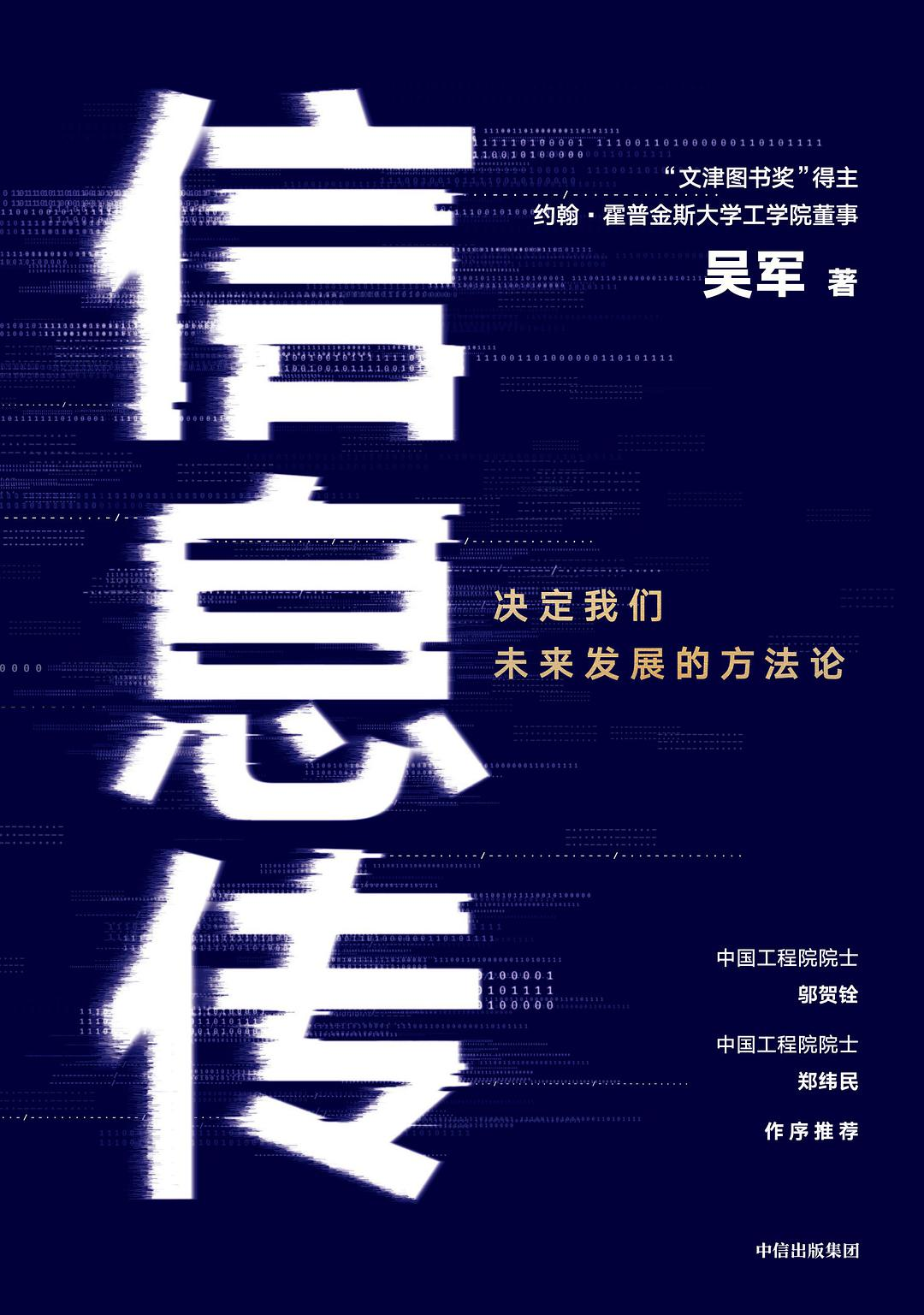
“We happen to live in an information society, and we need to understand information,” Wu Jun says at the beginning of Information Biography: “Although we all live in the information age, very few people can clearly say what information is, or how it determines and affects our lives. That is the reason I wrote Information Biography.”
Wu Jun believes that information can be approached from the following three dimensions: 1. What information is; 2. The essence of information technology; 3. The history of information.
The first two dimensions can roughly be summed up as “information science” and “information technology”: the former understands information theoretically, while the latter understands information at the level of technological practice.
In the first dimension, Wu Jun cites Shannon’s information theory and argues that the content and form of information are both appearances; its essence is the measurement of uncertainty. In the worldview of information theory, this world is nothing but a composition of energy and information, and the various creations and inventions of human civilization are nothing but the development and use of energy or information.
As for the dimension of information technology, Wu Jun believes that it “can be summarized as technologies for transmitting, processing, and storing information.” This includes telegraphs, telephones, the internet, and so on.
These two dimensions are both very clear, but when we put them together, we seem to encounter some paradoxical situation: according to the worldview of information theory, in fact any technological invention is some way of controlling certainty or uncertainty. Not to mention that things like writing, paper, musical instruments, and painting can clearly be counted as information technologies in the pre-information age, even axes, bows and arrows, houses, and so on can, in a broad sense, be said to be technologies for processing information. An axe stores a definite shape in the material of wood and iron; this shape guides a definite action, and this action, in a definite way, constrains the release of muscular force so as to accomplish a definite purpose—splitting open certain definite materials. The essence of an axe is to carve out a definite order out of chaos.
Human technological activity, and even the life activity of organisms in general, is a local negentropization; in this sense, an axe, like writing and disks, is a carrier of information, and all technologies are “information technologies.”
But clearly, when we speak of “information technology,” this “information” is not being used in the sense of information theory as a science, but in a narrower sense. So even telegraphs and telephones can only barely squeeze into the ranks of “information technology,” and only the various digital technologies that rose after the advent of the internet are the main referent of “information technology.”
If we think that the definitions of words are precise and fixed, then the above phenomenon really does constitute a paradox: namely, it is difficult for us to derive the definition of “information technology” directly from a combination of the “information” and “technology” defined by information science. But words and concepts themselves are not absolutely fixed; they have their own contexts and histories. Once we recognize the historicity of concepts, the contradiction disappears.
So the first two dimensions given by Wu Jun can ultimately be understood smoothly only when placed under the third dimension: the dimension of history.
Surveying history, “information technology” is not entirely the “application” of “information science”; it is not as if scientists first gave a once-and-for-all definition of “information,” and only then did information technology develop. On the contrary, information science’s understanding of information has drawn its inspiration from the ever-rising “information technology.”
Wu Jun divides the history of the development of information technology into two eras: first, the “spontaneous era,” from Morse code to the first half of the twentieth century; second, the “self-conscious era,” marked by Shannon’s information theory, continuing to the present day.
The reason for taking the telegraph as the starting point is that the telegraph “has a relatively strong relevance to the information we understand today.” What exactly this relevance is, Wu Jun does not seem to explain very clearly. In my view, the telegraph is the first technology that could separate general “information” from the “messenger.” In antiquity, with very few exceptions, the movement of “messages” and messengers was the same. Beacon towers were one exception, but they could only transmit very specific information in very limited circumstances (signals). The telegraph, however, made it possible for information to detach itself from the concrete messenger; from that point on, the formless and intangible “information itself” became a concept that the general public could also understand.
In other words, only after the telegraph did a question like “What is information?” become possible to raise. Shannon could not have appeared before the telegraph, because the word “information” had not yet even appeared, much less could anyone have pursued the essence of information. (The English word information certainly existed earlier, but it meant the act of instructing or knowledge that had been instructed.)
Therefore, the so-called “spontaneous era” was a period in which technology was ahead of science: with the help of new technologies, “information” had already become “independent” in transmission, but it had not yet acquired a prominent position within the field of scientific theory. By the time of Shannon, science finally overtook it, and began to lead the further development of information technology. Computers and the internet were not only products of the spontaneous development of the history of technology; they also developed under the guidance of a generation of theorists such as Turing, Wiener, and Shannon.
Still, science and technology have never fully become one. Scientists, inventors, engineers, entrepreneurs, and various other positions have always remained relatively independent, yet overlapping with one another, jointly driving the development of information technology. The relationship among science, technology, and the market cannot be neatly summed up once and for all with a simple formula; it can only be grasped through history.
In history, the tension between science and technology ultimately has to dissolve into the wider public, because whether science or technology, both must eventually be digested and carried forward by entrepreneurs or founders, turned into new products, and launched into the market, finally changing people’s ways of life and ways of thinking.
Therefore, Wu Jun does not need to wrestle with the conflict between scientific definitions and technological definitions, because he is not discussing the definition of information from the standpoint of a logician or linguist in the first place. Nor is his standpoint that of a scientist or inventor; it is closer to that of an entrepreneur or founder. He pays special attention to summarizing the gains and losses of entrepreneurs in various historical stories—for example, that Morse’s success depended not only on luck but also benefited from the uninhibitedness of thought, and that Tesla’s frustration in old age was because “character determines fate,” and so on.
In addition, Wu Jun’s understanding of the contribution of innovators is not based on the vulgar opinion of pursuing the “first inventor”; rather, he attaches greater importance to the “last inventor” (p. 78). This is because no technology appears out of thin air. Before a certain technology becomes relatively fixed and then becomes popular in the market, it often undergoes a long process of gestation and development, involving many scientific principles and technical conditions, and it is difficult to determine exactly who was first. The “inventor” remembered by history often refers to the “last person” who finally completed the integration and basically finalized the technology. Historically speaking, the last person as inventor is often precisely the first person as entrepreneur, so the most famous inventors in history are often the most commercially successful entrepreneurs—that is, the first people to actually launch best-selling products that changed the world. Watt, Morse, Edison, Bell, and so on are all similar.
As a scholar specializing in the history of technology and the philosophy of technology, from a philosophical perspective or from the perspective of the history of science and technology, this Information Biography is relatively weak both in conceptual clarification and in the citation of materials, but to criticize this book from that standpoint would be unfair. Because from the standpoint of entrepreneurs, Wu Jun clearly understands the needs of entrepreneurs better than I do. History may not be able to provide a formula that guarantees success, but it can at least inspire our thinking and help us avoid some unnecessary detours.
Translated from the Chinese original with AI assistance. The original text is authoritative.