
Published in China Science Daily (2020-01-02, Section 7, Book Review)
Its Decades-Long Bestseller Status Was No Accident
From One to Infinity is the famous popular-science classic by the renowned physicist Gamow. Published in 1947 and revised and republished in 1961, it was translated into Chinese in 1978 by Mr. Bao Yongning, and has already been wildly popular at home and abroad for decades.
Gamow died in 1968, more than 50 years ago now, so this classic work has become a “public-domain book.” As a result, many new translations suddenly appeared on the market.
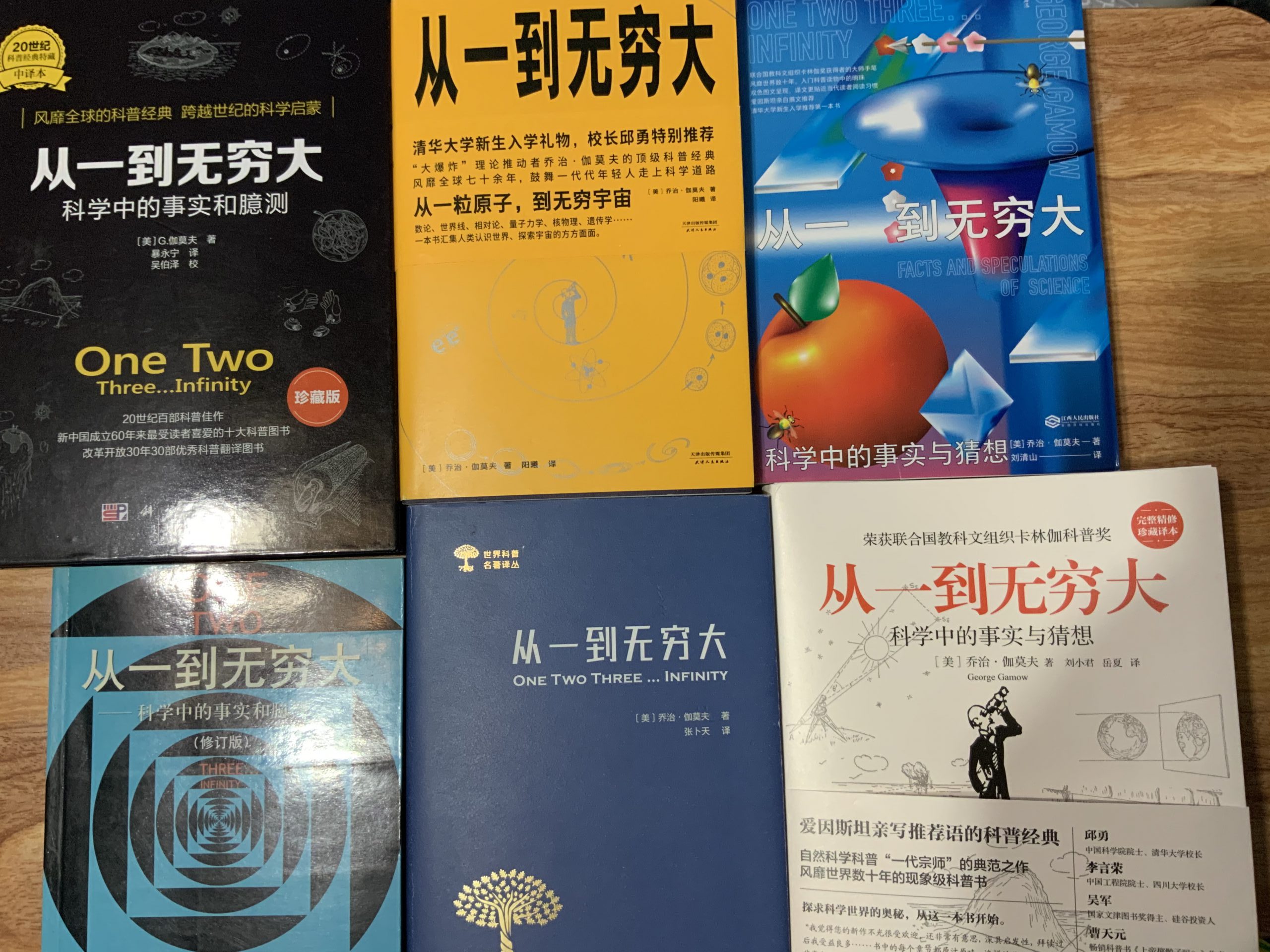
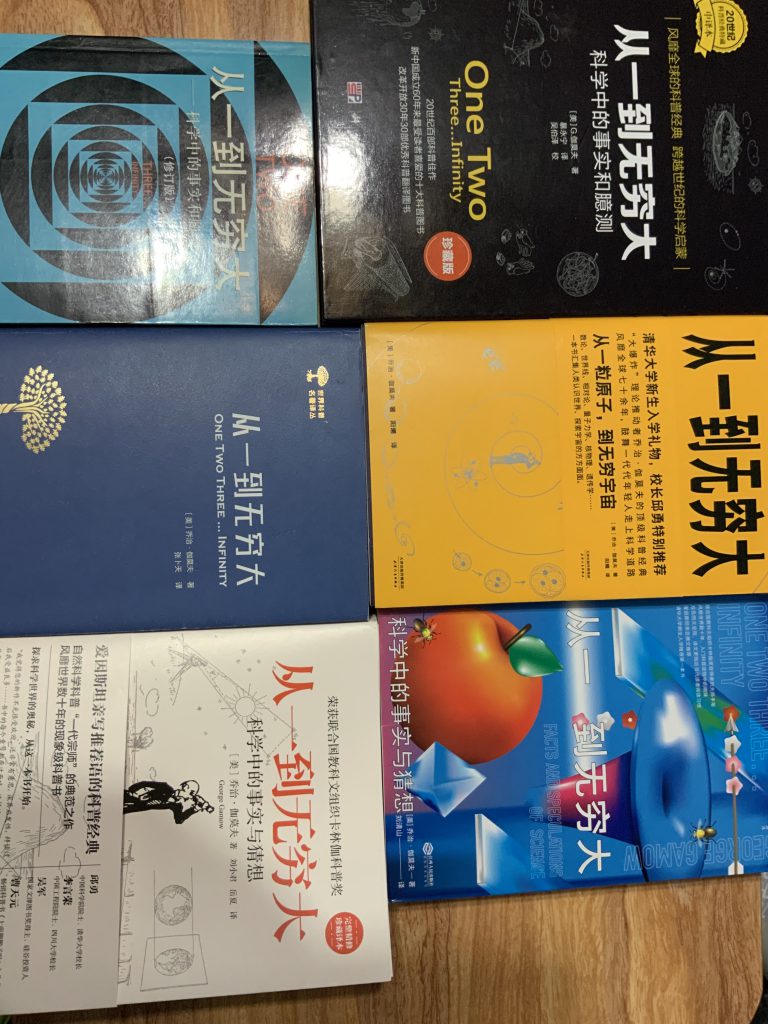
In addition to the repeatedly reprinted Bao Yongning translation from Science Press, I have already found at least seven new translations, including Liu Qingshan’s translation from Jiangxi People’s Publishing House, Zhang Butian’s translation from The Commercial Press, Yang Xi’s translation from Tianjin People’s Publishing House, Liu Xiaojun/Yue Xia’s translation from Culture Development Press, Gao Hui’s translation from Jiangsu Phoenix Science and Technology Publishing House, Yang Yingwei’s translation from United Publishing House, and the Little Kangaroo Studio translation from Heilongjiang Science and Technology Publishing House…
Public-domain books often become the Tang monk’s flesh that publishers scramble for. Literary classics such as Andersen’s fairy tales and the Sherlock Holmes stories may have as many as hundreds of editions, but for a popular-science book to be so hot is clearly a rare sight.
Classic literary works often remain evergreen and never become “out of date.” Modern readers still read the Book of Songs and Homer’s epics, Dream of the Red Chamber and Shakespeare; their interest and profundity have not become stale with the passing years, and they can still draw modern people into immersive reading. But scientific works are often not like this. Modern people stopped reading Newton long ago, let alone Voltaire’s Philosophical Principles of Newton’s Mechanics, which he wrote in order to popularize Newtonian mechanics among the public. Scientific classics and popular-science classics were once as wildly popular as Shakespeare in their day, but they soon entered the “stacks of old papers” and drifted out of the general public’s sight, to be studied only occasionally by historians of science and historians of texts.
The reason is simple: science is an undertaking of constant self-renewal. Li Bai will not refute Qu Yuan, nor can Su Shi revise Li Bai. But Kepler can supersede Copernicus, and Einstein can supersede Newton. Once a new scientific theory matures, the old one becomes “out of date.”
Especially in the rapidly changing 20th and 21st centuries, the sciences have been updated so quickly that, in the preface to the revised edition 13 years after the first, Gamow himself admitted that it was a matter of “luck” that From One to Infinity was still not too out of date after more than ten years. So then, after 13 years and then nearly 60 more, is this book still not out of date merely because of luck?
Objectively speaking, the book’s popularity does indeed owe something to luck. First, its publication in China coincided with the end of the Cultural Revolution and the restoration of the college entrance examination. In an era of scarce resources, this book stood out and became scientific reading for the enlightenment of a large number of Chinese people who aspired to scholarship. Today, the university students of the 1980s have, by happy chance, made their careers; naturally, they enthusiastically recommend this book to their younger successors. Tsinghua University president Qiu Yong is one of them: he selected this book as a matriculation gift for Tsinghua freshmen — something emphasized in the promotional copy of several translations.
Of course, this book is not only popular in China; it has also remained a bestseller abroad. So this is not just a matter of luck — Gamow’s writing skills are indeed extraordinary.
Gamow’s Distinctive Strengths
1. Broad scope. Broad scope is the most obvious feature of this book. One can see from the table of contents that the book’s themes cross mathematics, relativity, quantum mechanics, particle physics, probability theory, the life sciences, cosmology, and many other disciplines. As Gamow says in the preface, he tries to present readers with the whole “cosmic picture,” sketching the “entire foundation of science” without leaving any blind spots. Compared with its grand theme, however, the book is not long. Although excellent popular-science books have been appearing in abundance in recent years, popular-science books that can handle such a broad theme in such a brief format are still rare. After all, it is not easy to attain Gamow’s breadth of vision and range of learning.
2. A focus on fundamentals. To survey every field of science in a short book, one certainly cannot go into great detail. Thus, what Gamow presents are the most fundamental pieces of knowledge in each discipline, or rather the most central “ways of thinking.” This aspect, too, happens to be one that does not easily become obsolete. Decades later, the various sciences have added many new developments, so Gamow’s introductions are of course nowhere near frontier-level or comprehensive, but as far as the foundational, introductory parts of each discipline are concerned, there is not much in this book that needs correction.
3. Grounded in everyday life. Gamow focuses on the basic parts of each science, but he does not dryly haul out a few formulas or propositions to explain them. What he tries to present is some kind of “picture” or “perspective” — that is, how scientists look at problems. In order to make the scientist’s perspective clear, Gamow often begins from everyday experience and gently leads the reader onward. For example, in the opening discussion of mathematics, he starts from the activity of “counting”: “one, two, three…” When discussing the spatial view of relativity, he starts from ordinary spatial experience — “we all know what space is… forward, backward, left, right…” When discussing theories of the composition of matter, Gamow begins with “a bowl of clam chowder”…
Scientific thinking is a kind of “critical transcendence” of everyday thinking. Naive notions have their rationality, but they are often full of ambiguity and need proper guidance to enter science. This is precisely where Gamow’s greatest skill lies: through vivid and interesting examples and analogies, he builds a bridge from common sense to science. Although scientific theory develops at a dizzying pace, the experiential patterns of our everyday world are relatively stable, and this also makes Gamow’s method of “elevating common sense” hard to become obsolete.
4. Historical perspective. In addition to being rooted in everyday life, Gamow also often draws on knowledge from the history of science, including comparisons between ancient Greek thinkers and modern science, as well as the origins and development of certain modern scientific discoveries. This historical knowledge is also not easy to become obsolete.
5. Skillful use of mathematics. Mathematics is the cornerstone and backbone of the entire modern scientific edifice. Mathematical factors run through everything from the microscopic to the macroscopic, from physics to biology, and they also run through the entire From One to Infinity. Hawking once said that every mathematical formula in a popular-science book might halve its sales, and From One to Infinity contains quite a few mathematical expressions. In many places, Gamow presents the complete derivation process, while some of the more complex formulas are placed in the notes. These mathematical derivations do indeed look a little intimidating. I do not know exactly how much this style may have discounted the book’s sales, but these mathematical elements make the book’s charm more enduring. One must know that “classic” works are often not written as “beginner-friendly” pieces designed to flatter the reader. A proper amount of mathematical content may scare off some readers who fear difficulty, but it is more attractive to students with a strong thirst for knowledge. Gamow’s calibration of the mathematical element is exquisitely balanced: challenging on the one hand, yet never cumbersome or dull on the other. And these mathematical elements, of course, are also among the parts least likely to become obsolete.
6. Vivid illustrations. The book contains a total of 128 illustrations and 8 photographs, all of which are inserted at just the right points in the narrative context, vivid and on-topic, forming an organic part of the whole exposition. Unlike many popular-science books, which have pitifully few illustrations and often like to pad things out with a few portraits of scientists, the 128 illustrations here are entirely free of dead weight: every one is useful, closely related to the surrounding text, and some even come with detailed captions. The occasional cartoon figures give the style a playful, endearing feel, yet the scientific content remains accurate.
In short, if what we hope to read in a popular-science book is cutting-edge scientific knowledge or recent scientific discoveries, then a book more than 70 years old is of course long out of date. But if what we hope to read is some sort of guide — a guide leading us from everyday thinking toward scientific thinking, helping us understand the origins and foundations of the basic sciences, and cultivating interest in mathematics and the natural sciences — then From One to Infinity is still a good choice.
Science is an undertaking of successive generations, and in the end we must stand on the shoulders of those before us in order to move things forward. But we cannot leap onto the shoulders of giants all at once; we need to start from the flat ground of everyday life, and only through continual learning can we finally climb onto the giants’ shoulders. When we are striving to leave the ground, it is undoubtedly an extraordinarily fortunate thing to have a great predecessor bend down and lend us a hand. More than half a century has passed, and a human pyramid has long since formed on the shoulders of physicist Gamow, so Gamow can no longer carry us to the very forefront of science. But as a writer of popular science, Gamow can still bend down, take us by the hand, and send us off on the first step of the climb toward science’s summit.
Which Translation Is Better?
Comparing the various translations is a thankless task, and I do not want to go too deeply into it, but there are still some comparisons that I cannot help making.
Bao Yongning’s old translation is generally recognized as an excellent one: fluent and accurate, with no major problems. In the afterword to the Commercial Press edition, Zhang Butian points out some minor factual errors in the old translation, but he also notes that such small mistakes are hard to avoid in any book.
The reason for so many new translations is not dissatisfaction with the old one, but rather the scramble for “public-domain books.” I compared several translations as I read them — Zhang Butian (Commercial Press), Liu Qingshan (Jiangxi People’s), Yang Xi (Tianjin People’s), and others — and the gratifying thing is that, at least from my rough perusal, the translators all seem quite serious; none of them is a rushed, slapdash job. If there is any difference among the versions, it lies less with the translators than with the publishers’ craftsmanship.
In terms of book design, the Commercial Press edition is a plain hardcover and has the strongest feeling of being a “classic.” By contrast, the Jiangxi People’s edition has a gaudy, childish cover and gives off a cheap feeling (though this edition is indeed relatively inexpensive). The Tianjin People’s edition adds many highlighted key points and even comes with a mind map as a bonus.
As for editorial content, I must especially criticize the famous Commercial Press: there are some very glaring typesetting errors. For example, 10110 was printed directly as 10110; 1/lnN had both the 1 and the N simply omitted. In another place, v and V were reversed (Bao Yongning’s translation also reverses v and V, but it reverses them everywhere, so it remains mathematically correct. In the Commercial Press translation, however, they are reversed in the main text but not in the footnote.) These are problems one could spot at a glance simply by checking the formulas, and their appearance means that the mathematical content was almost not proofread at all. It is astonishing that such elementary errors appear דווקא in the Commercial Press.
By the way, Gamow says 5065 which is equal to 10110. Clearly, this does not mean the two numbers are “equal,” but that they are of the same order of magnitude. Most translations render this as “equals” or “that is,” but only the Liu Qingshan translation has “its order of magnitude is,” showing sensitivity to and seriousness about the numbers.
As mentioned above, From One to Infinity is on the whole not out of date, but it is undeniable that some of its details do indeed need updating. The best way may be to add them appropriately in the form of translator’s notes, and this is once again where the differences among the various translations become apparent.
For example, Gamow mentions that “negative protons” are very likely to exist, but have not yet been observed experimentally. Bao Yongning’s translator’s note says, “The existence of negative protons was experimentally confirmed in 1956.” Liu Qingshan and Yang Xi’s notes are more detailed, both mentioning the 1955 experiment by Segrè and Chamberlain.
Another example: Gamow believed that the microscopic components of matter had already been traced as far as nucleons, electrons, and neutrinos, and that the search had therefore “reached the end.” This clearly does not accord with the later flourishing of particle physics, and mainstream quark theory holds that nucleons are not the most fundamental elements of matter. Bao Yongning, Liu Qingshan, and Yang Xi all include notes on this point, whereas Zhang Butian’s translation has none at all.
There are also some issues that may stem from the author’s own calculation mistakes. For example, in deciphering “Captain Kidd’s” code, the tables and diagrams in the original book do not match up; there is an obvious error. Bao Yongning’s translation recalculates the table according to the diagram, while the other translations all leave it unchanged. In calculating the probability of a full house in Texas Hold’em, Gamow also clearly makes a slip somewhere; on this point, Liu Qingshan provides more than half a page of notes explaining the correct method, whereas Bao Yongning simply adds two lines noting the part that was overlooked. The correct answers given by the two translators are the same. There are also a few minor points that only Liu Qingshan’s translation takes seriously; for instance, Gamow’s simplification of 2169.6 to 2169 is pointed out in an editorial note as well (this edition includes both translator’s notes and editor’s notes).
As for the illustrations, Liu Qingshan’s translation uses color printing, which looks a bit clearer and more comfortable. Yang Xi’s translation preserves the original images in full (including the English labels), while adding Chinese in color beside the English labels. Although this is a lazy way of avoiding the trouble of cutting out the letters, it has a certain charm when read. The Business edition still has the worst effect: as shown in Figure 35, the little cars are all printed into blobs of ink.
All in all, I feel that Bao Yongning’s classic translation can still be the reader’s first choice. The translations by Liu Qingshan (Jiangxi People’s Publishing House) and Yang Xi (Tianjin People’s Publishing House) each have their own features—the former is more inclined to be exacting, while the latter includes underlining and mind maps—whereas Zhang Butian’s translation (Business) is the most unsatisfactory. Of course, Zhang Butian himself, as a senior translator specializing in the history of science, may be the most outstanding in terms of professional and linguistic ability, but from the standpoint of editing and the finished published product, this translation is a relative failure.
Translated from the Chinese original with AI assistance. The original text is authoritative.