
Published in Jiemian Review, retitled “From the Amazon Fire to Amazon Cloud Service Failure: Human Fragility and Vanity”
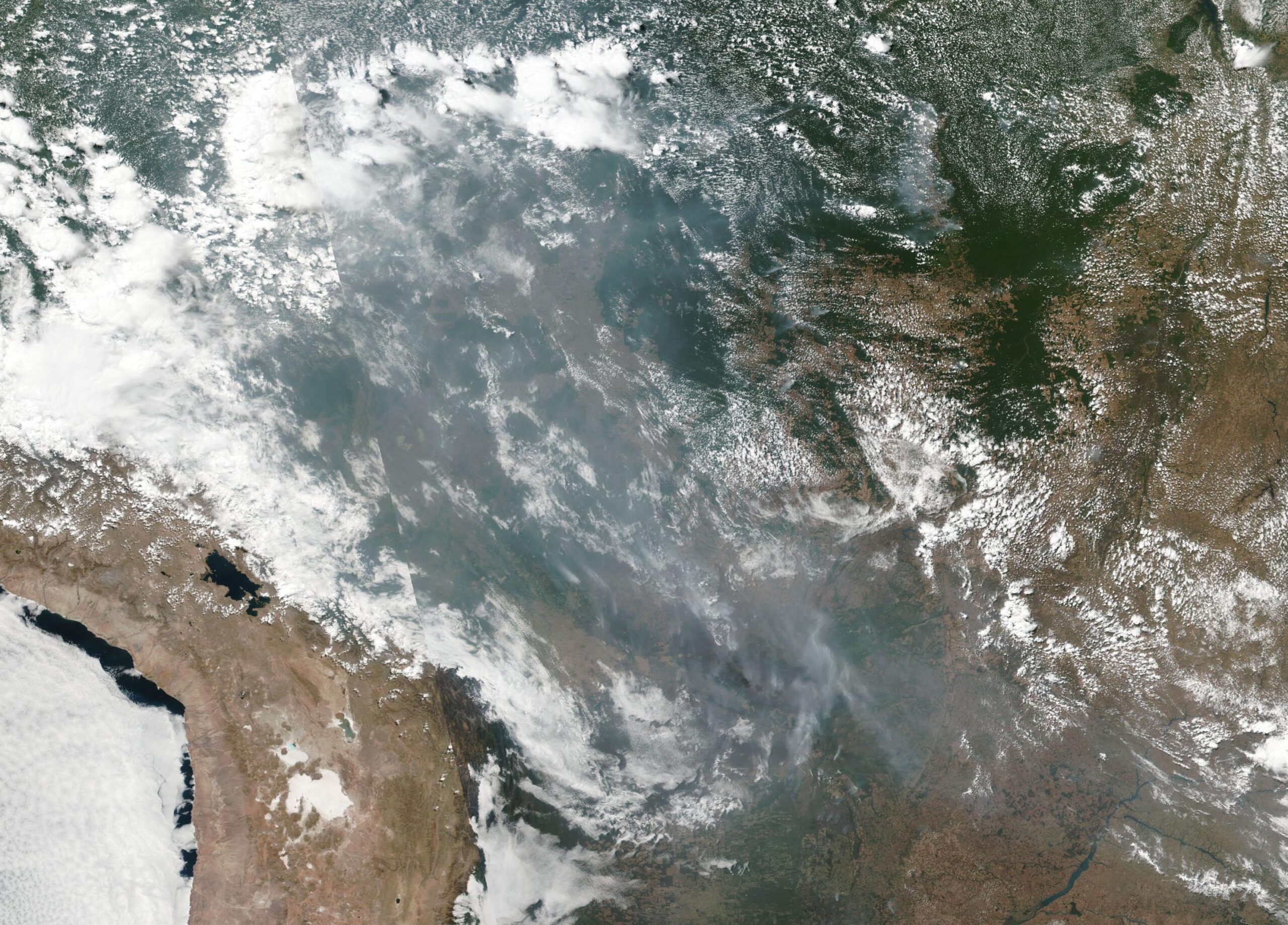
The fires in the Amazon rainforest have been burning for three weeks. The Brazilian government says they are beyond control. As for the cause of the fires, that is still unclear, and when they will finally go out will probably depend on the whim of Heaven; human beings say they are powerless.
In the past two days, this fire has drawn widespread attention on Chinese social media, along with a great deal of alarmist talk. But many people have also learned for the first time how important the Amazon rainforest is—the so-called lungs of the Earth, whose daily oxygen “output” accounts for 20% of the global total.
Of course, that is indeed alarmist. Although the figure is not wrong in terms of oxygen production, it does not mean that one-fifth of every breath we take comes from the Amazon, because within the ecosystem of the entire rainforest, the oxygen produced is immediately absorbed again. The Amazon rainforest is a major producer of oxygen as well as a major consumer of it; on the whole, the two just offset each other, and its contribution to the globe is negligible. The oxygen we rely on for breathing actually comes mainly from the oceans.
Moreover, forest fires are not necessarily terrible, because forest fires happen all the time. Some are caused by humans, some by nature, and many fires are themselves part of the renewal cycle of ecosystems, so there is no need to make a fuss.
But information on social media is often extreme: either it is alarmist, or it overcorrects and insists that fires are entirely normal and that we can all sleep soundly. But that attitude is problematic too, because this fire does in fact have cause for concern.
First of all, of course, because this fire is especially large in scale. We know that small forest fires do not cause global disasters, but once the scale becomes too large, they will inevitably also cause global climatic anomalies. Most crucially, we still do not know where the line lies between what degree of fire is “normal” and what degree becomes disastrous.
Second, although most of the oxygen produced by the Amazon rainforest is internally recycled, the fire itself precisely signifies the destruction of that cycle. We know that the Amazon rainforest contains 10% of the world’s carbon reserve (in the biosphere). Once it no longer circulates, but instead turns its carbon stock into carbon dioxide and releases it globally, then it could indeed trigger an irreversible disaster. Moreover, once an existing cycle is broken, it is very likely to slide into a new vicious cycle. For example, global warming will accelerate the death of the rainforest (a rise of 3 degrees in global average temperature may cause three-quarters of the Amazon rainforest to die), and the death of the rainforest in turn will intensify global warming.
Third, this fire is very likely man-made. Either someone deliberately set it, or it is related to the forest clearing that has been accelerating over the past two years. This proves human beings’ helplessness in environmental protection. Although farsighted people long ago recognized the fragility of ecosystems and the importance of protecting the environment, people have never been able to unite. This fire has at least let us discover that if someone really were to set fire to the Amazon rainforest for profit or simply out of a mentality of revenge, we could only stand there and “admire” the spreading flames, utterly powerless, and would even find it difficult to trace the cause.
Finally, this fire is like fever and coughing, an outward manifestation of a “disease,” but before the symptoms break out, the source of illness is often already deeply entrenched. So is this disease of the Earth’s lungs merely a cold that can heal itself, or a serious pneumonia that can recover only through outside intervention, or a lung cancer beyond cure that can only slowly worsen? We do not know. Skilled doctors always say that one should “treat before illness arises”; we all know that prevention is more important than treatment, but human beings always have to wait until the root of the ecological disease has become so deep that its outward manifestations are extremely obvious before they are capable of responding.
Take the great London smog of the old days as an example. The foul air lasted for more than a hundred years, but it was not until the 1952 outbreak of disaster, which caused more than ten thousand deaths and one hundred thousand illnesses, that the British were able to unite in controlling pollution. Even then, many people after the disaster claimed that the mass deaths were due to an influenza epidemic. To this day, human beings still seem much the same: faced with the various manifestations of global warming and ecological destruction, people remain at odds and cannot agree. Who can expect human beings to “treat before illness arises”? On the contrary, after a huge global disaster breaks out, if people can merely reach some agreement and make a little repair, that is already something to thank Heaven for.

Just as I was conceiving this article, my personal website went down. After a frantic round of fruitless troubleshooting, I discovered that it was actually an Amazon cloud server failure. Not only was my little website affected, but many major sites went down too; many online games were interrupted, and some exchanges even developed bugs.
The company “Amazon,” named after the rainforest, is not only the world’s largest online store, but also provides the world’s most popular cloud servers. Many websites and online services, large and small, rely on Amazon.
When Amazon’s cloud service failed, I found myself powerless, able only to wait quietly for Amazon to return to normal on its own. That feeling of helplessness is strikingly similar to how we feel in the face of the Amazon rainforest fires.
The resemblance between this Amazon and that Amazon lies in the fact that both are basic links in a certain ecosystem. The safety of the Amazon rainforest concerns the stability of the global ecological network, while the operation of Amazon cloud services concerns the stability of the global Internet network.
The more complex an ecosystem is, theoretically speaking, the higher its stability. Yet stability is relative. In a complex ecological network, the species at the top of the food chain are more dependent on the existing ecosystem; once the entire system undergoes an irreversible upheaval, the impact on those top species will be enormous. In every round of mass extinction in the natural history of the Earth, it is always the species at the top of the food chain that die out first.
The ecological structure of cyberspace is similar. My personal website has no very complex functions, and not many people visit it; perhaps even no netizen noticed that it had broken down. But the larger the website, the greater the damage when failure strikes. A large interactive game, or a large exchange, processes huge amounts of data every minute and every second; a failure that is trivial to me is very likely a major catastrophe that leaves a large website in a state of panic.
I am not the first person to compare the Internet economy with the ecological environment. On the contrary, the word “ecology” has already been overused. Many entrepreneurs emphasize their ecological awareness. But what is often linked with ecology are things like “balance,” “cycle,” and “stability,” and very few people emphasize the other side of ecology: “fragility” and “powerlessness.”
Tiny individuals are extremely fragile in the face of an ecosystem; the stronger one is, the more fragile one becomes, and the more one is not master of one’s own fate. The destruction of a rainforest will not threaten the position of cockroaches, but it will certainly endanger human survival. In the “Anthropocene,” the technological environment created by human beings has also become an important part of the Earth’s ecological system. This, on the one hand, highlights human strength; on the other hand, it also intensifies human fragility. Cockroaches do not depend for their survival on the Amazon rainforest, nor are they concerned with Amazon cloud services. But human survival depends on more and more things. Every new technology created by human beings has become a new dependency for human beings; once they go wrong, we are almost powerless.
We always underestimate the harshness of “ecology.” One entrepreneur after another believes that they can create an “ecosystem,” and the most arrogant notion of all is the idea of extraterrestrial colonization—people believe that we can find a planet similar to Earth and there create, out of thin air, a stable and sustainable ecosystem for human survival. But on Earth itself, the most Earth-like of all places, we are unable to control this already perfected ecosystem. We cannot even manage a single Amazon rainforest properly—how can we expect ourselves to have the ability to conjure up an ecosystem out of nothing?
In my view, true “ecological” thinking begins with facing up to one’s own smallness and weakness. This does not mean that we will do nothing; on the contrary, only when we fully recognize the smallness of the individual and the severity of ecological problems can human beings possibly unite and establish a social order capable of adapting to ecological change.
Translated from the Chinese original with AI assistance. The original text is authoritative.