
Giving a Lecture to Middle School Teachers and Students
On August 17 and 18, I was invited to Jiangsu Province Qinghe High School to take part in an exchange. They had an experimental project in educational reform, aiming to add elements of the history of technology to the teaching of the high school course “General Technology.”
Jiangsu Province Qinghe High School is in Huai’an; it is not some famous school, but I was still very interested in this topic. Of course, it was also quite rare for the teachers there to think of inviting me, so I was more than happy to go.
At the time, the incoming freshmen were undergoing military training, and I gave them a lecture on the story of Watt. The next day I exchanged views with the members of the research group, introducing my understanding of and design for a “General History of Technology” course. But it seemed that this research group had only just been put together; the teachers all lacked familiarity with the history of technology, and the exchange was not very in-depth. Of course, the teacher who invited me had thought about it more carefully, and I believe my going there to exchange views still had its effect.
Adding the history of technology to middle school teaching is a very interesting idea, so I also began to think: what kind of knowledge of the history of technology do middle school students actually need?
Of course, speaking in general terms, science history and technology history, as general history education that bridges the humanities and the sciences, are needed by students of any age. In fact, in existing Chinese language classes and in courses across the natural sciences, there is already a certain amount of content from the history of science and technology interspersed throughout.
Of course, the history of science and technology content in existing textbooks is terrible. For example, when I was talking to them about Watt this time, I began with a primary-school Chinese textbook from the Shanghai Education Press, Grade One, which includes an article called “Why Did the Pot Lid Move?”—that is the well-known fabricated story about Watt.
I pointed out that promoting the scientific spirit of seeking truth through deceitful fabrication is itself unacceptable; moreover, the so-called scientific spirit that a fabricated story is trying to convey does not fit the actual situation in the history of science and technology.
Take the story of Watt, for example: it clearly embodies a fictitious model of how the history of technology develops, including: 1. observing nature (little Watt observing the kettle); 2. a sudden flash of inspiration (the clever little Watt); 3. being a nonconformist (his grandmother’s incomprehension); 4. painstaking study (the lesson plan’s subtle emphasis on the word “finally”); 5. an entirely new creation (inventing the steam engine). But every one of these points is debatable—in reality, 1. reading texts is often more important than observing nature; 2. compared with an outsider’s inspiration (a child’s naive idea), professional training and long-term accumulation are necessary conditions for research; 3. scientists and inventors are often understood by their peers and supported by the wider world; they have colleagues, friends, and patrons; 4. certainly there are poor and hardworking scientists, but more abundant material conditions and richer financial returns are more likely to promote invention and creation; 5. discoveries and inventions are often minor improvements standing on the shoulders of predecessors, rather than unprecedented creations out of nothing.
Given that scientific communication is still very weak overall, and backward views of the history of technology remain very popular, then when speaking about the history of technology to middle school students in their rebellious phase, saying more about pictures that overturn preconceptions should be able to broaden students’ horizons, enliven their thinking, and encourage them to explore and verify things further. That is the first layer of meaning in teaching middle school students the history of science and technology.
Then why talk about the history of technology rather than the history of science? On this point, in fact, I think both should be taught, and the history of science should be taught even more. But on the one hand, technology, compared with science, more directly shapes our lifeworld, and more vividly becomes the theme of the present era, so it has greater practical significance and reflective significance. This is also my longstanding positioning of a general history of technology, so I will not dwell on it here.
Can “General Technology” Really Be Taught?
Of course, more crucially, we need to find a gap in the existing educational system. Right now, middle schools do not have a place for a “history of science” course, but there is a “General Technology” course, which seems to have been revised from the earlier “labor and technology” class. Since this ready-made slot exists, adding an appropriate amount of content from the history of technology on this platform is a natural thing to do.
When I was in high school, I studied labor and technology, though it was relatively advanced, teaching things like CAD and the like. Now this “General Technology” course is clearly much richer and more complex. After a preliminary look, I found that, depending on the teachers, the way the course is taught is not uniform: some emphasize design, others hands-on work.
But in any case, what is the meaning of this course?
In the Baidu Baike entry for “general technology,” I saw the explanation for “why study ‘General Technology’?”: “With the leap-forward development of science and technology, technology has increasingly become an objective presence almost everywhere and at all times in our lives, becoming an important factor in social development and progress. Therefore, technological literacy is the basic literacy of contemporary young people, and the general technology course is a course that every student in ordinary high school must study.”
The first half of that is fine, but why does this “therefore” follow? Air is everywhere, food is everywhere—so should we also have to study the literacy of breathing, the literacy of eating, and the literacy of drinking water? Perhaps those also need to be learned, but what needs to be learned in that regard was probably already learned in early childhood.
Other specialized technical knowledge, of course, is to be learned at the higher education or vocational education stage. So if it is neither something to be learned in early childhood nor something to be learned at a higher stage, then what kind of literacy is it that high school students must precisely learn?
The concept of “general technology” is also rather strange. I found that the corresponding English word is general, and when this word is used to define a discipline, it is often translated as “general,” as in “general physics,” “general biology,” and so on. Roughly speaking, this is equivalent to an “introduction to physics,” but with an additional layer of “generality”: that is to say, “general” stands in opposition to “special,” and “general” stands in opposition to “specific.” Physics is divided into many specific fields, and the general disciplinary foundations needed before entering those specific fields are called “general physics.”
This concept is relatively clear in the system of theoretical sciences, because the modern system of scientific disciplines is very complete, and each subject has a fairly distinct pedagogical path; some disciplines do indeed have general methods. But the so-called “general XX” are all still specific subjects. I have never heard of “general science” or “general technology.” If one had to say something, perhaps mathematics class counts as the general introduction to all sciences? Or, adding “experimental methods,” studying mathematics and studying experiments probably count as the general introduction to modern mathematical, physical, and experimental science. Even so, such a “general science” course has never actually been launched.
And the positioning of “general technology” is much more troublesome. The specific branches of technology are far more numerous than those of modern science, but the entire field of technology is not nearly as systematized as modern science, nor does it have a reductionist framework, and it is very difficult to find a hub-like methodology such as “experiment.” Some technologies also require experiments; some emphasize design; some only require mechanical repetition; some emphasize flexibility and adaptation… Looking at the arrangement of the “General Technology” textbooks, it seems that “design” has been taken as some kind of core thing. But even so, is there a unified set of principles to be found for “design” activities in each field?
The foundation of science is mathematics and experiment; the foundation of technology is design and practice. This positioning is rather passable in broad outline, but if one pursues it in detail, one still ends up confused. As a result, in teaching practice, what “General Technology” provides students is not some “general” thing, but still some specific cases—for example, teaching students to design a cup, make a circuit board, try 3D printing, and so on. But in what sense these activities are actually “general” is not really clear.
Of course, what I mean is not that the concept of “general technology” cannot be made to make sense. On the contrary, I originally intended to put forward this concept. In my article “Outlines of a General History of Technology” (技术通史论纲), I said that so-called “A General History of Technology” would be better understood as “A History of General Technology.” But at the time I still had not realized that there was a course called General Technology, and I kept emphasizing the meaning of general in the sense of “overall” and “general.”
This concept needs to be supported by the history of technology and the philosophy of technology—that is to say, “technology” is some kind of totality and general kind of existence. We can understand this totality through Heidegger’s “referential whole,” or Echeverría’s “technical system,” or through media ecology’s concepts of “environment” or “ecology.”
I myself have not yet completed the philosophical construction in this area, and returning to the discussion of high school courses, we need a more concrete teaching strategy. How exactly should we teach high school students “general” technology?
The Proper Positioning of a Technology Course for High School Students
As mentioned above, technology is important, but why is it precisely high school students who should learn it? How should a general education course designed for high school students be positioned?
The stage-specific characteristic of high school students is, first of all, that by age they are precisely in the “rebellious phase.” High school students are physically developing and mentally maturing; they are close to adulthood but not yet adults, and this is one of the most unstable periods. Therefore, dogmatic and compulsory training is not suitable, especially for subjects that have no direct relation to the college entrance examination; it is hard to get students interested. But if a course can just happen to stimulate students’ independence and reflection, then such an enlightening course is suitable for high school students.
And the pressure of the college entrance examination hangs overhead. In the present environment, it is impossible to take the gaokao lightly. So for students, parents, and even school leaders and teachers, one question they must pursue is: what exactly is the meaning of this course in relation to the gaokao?
A reflective general education course certainly will not directly help with the gaokao, but we can turn the question around and ask: what, in itself, is the meaning of these subjects that are studied for the gaokao?
Traditionally people say, “Master mathematics, physics, and chemistry, and you’ll never be afraid traveling the world,” but in reality we know that in most professions, most of what we learned in middle school is useless. Mastering mathematics, physics, and chemistry seems to be only for coping with the gaokao—but after coping with the gaokao, what should one study next? That is exactly the choice high school students are about to face, yet they are often completely at sea, with no clue at all.
The key is that what students are exposed to from childhood is only the “content” of each discipline; they do not have the chance to reflect on the “meaning” of each discipline, and they do not understand the roles that each discipline plays in the modern world. So if they understand more about the origins and development of each discipline in the history of human civilization, this will undoubtedly help students form a clearer sense of where the things they are studying, and the things they may need to study in the future, actually stand.
The teacher who invited me is a chemistry teacher, and we talked about many issues in chemistry teaching. Many students do not understand the meaning of chemistry, and on top of that public opinion often exaggerates prejudice against chemistry (natural is best, we hate chemistry…). Students thus have many doubts about this subject, and beyond coping with exams, they have difficulty finding inner motivation to care about it.
The status of chemistry as a discipline is indeed a bit awkward, neither high nor low. It is not as foundational as mathematics and physics, but it is also higher in status than subjects like biology and geography—why is that? To understand the status of chemistry, one has to understand the role chemistry played in modern history. For example, in the Scientific Revolution, the tradition of “alchemy—chemistry” played a role no less important than the “astronomy—physics” tradition. During the Industrial Revolution, the role of the chemical industry was also crucial; the emergence of chemical factories, especially the rise of the alkali industry, was no less significant than the steam engine. In today’s world, chemistry is even more ubiquitous: in clothing, food, housing, and transportation, there is no place where chemistry and the chemical industry are not involved. These important meanings of chemistry cannot be seen from theory alone; they emerge more clearly when viewed from a historical perspective, especially the perspective of the history of technology.
Ordinary people all say science drives technology, and technology is applied science. But how exactly science can be applied to technology, and then become what is called the primary productive force, is not something to be taken for granted. Besides chemistry, physics, biology, geography, and so on can all be connected through the history of technology, revealing how the development within scientific theory is linked to changes in the actual lifeworld.
It is not that if students understand the history of the chemical industry, they will fall in love with chemistry; perhaps after learning history, they may end up hating chemistry even more, who knows. But increasing their understanding of the origins and development of things is always able to encourage students to think more deeply about the meaning of study, rather than simply disliking study because they do not do well at it.
In addition to playing an integrative, motivating, and inspiring role in education for other subjects, the practical or hands-on dimension is also something contained in the General Technology course. In this respect, too, the history of technology is worth bringing in. In current teaching practice, teachers often take students to do some temporally disordered crafts—for example, using modern equipment to make an ancient product. This is because the real production methods of modern products are often line-based: each worker merely performs some simple operations mechanically, and workers do not need any overall understanding of the principle of the entire production line at all. Even the designer is actually one member of the production line, carrying out operations in an orderly fashion within a certain process, and the final design outcome is often also the product of team collaboration. So if high school students are asked to imitate the design and manufacturing process of modern technological products, it is either too dull or too complex. Therefore, what is actually easy to operate is often still to have students make something premodern. Students often know what it is, but not why it is so; under the teacher’s hand-holding instruction, they may learn simple operations on machine tools, but they do not understand what these operations are for.
And there is also the issue of cost here. The very top schools in big cities may have the conditions to let high school students come into contact with the most cutting-edge equipment and understand the latest production methods. But given the material conditions and teaching staff conditions of ordinary schools in broader regions, it is hard to keep up with the times. The most suitable practical activities to promote are still those at the technological level around the Industrial Revolution, such as using a simple machine tool to do some manufacturing and assembly of mechanical objects.
But the question is: what is the meaning of these operations? Is it just doing hands-on work for the sake of hands-on work, letting students have fun? Then if we are doing the same kind of “outdated manufacturing,” if we add teaching in the history of technology and let students, while operating, understand the origins and development of these things in the history of technology, understand how ancient artisans, modern artisans, and today’s mass-production methods developed step by step, and understand the historical position of these now-outdated processing methods, then the same hands-on activity acquires a deeper and more inspiring meaning.
As for the so-called cultivation of “creativity” and the like, it is hard to teach directly in a targeted way; but at the very least, saying more about cases of invention in the history of technology can also help students understand the real process of technological innovation.
Although the existing “General Technology” course has many flaws, it does indeed provide a brilliant entry point for bringing the history of science and the history of technology into general education, and that is also why I was attracted to this teaching topic. I am preparing to get hold of a set of the “General Technology” textbooks and take a look; if I have the chance, I will write some more specific thoughts later.
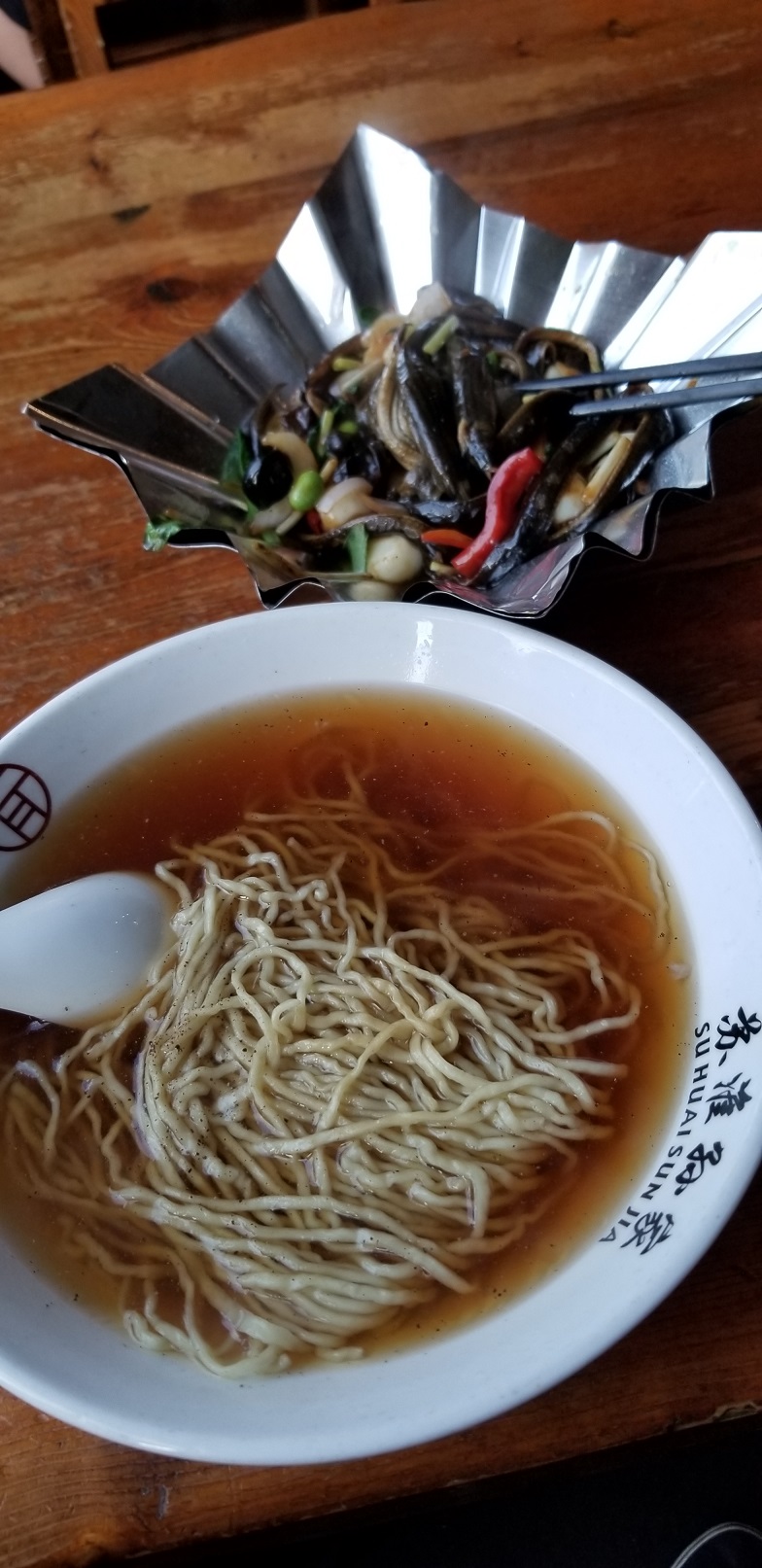
Finally, Huai’an has pretty good food culture, and the teachers at Qinghe High School were very hospitable. Unfortunately, those two days my stomach just happened to be a bit unsettled, so I did not eat to my heart’s content. I had several meals of long fish (eel), which were excellent~
Translated from the Chinese original with AI assistance. The original text is authoritative.