
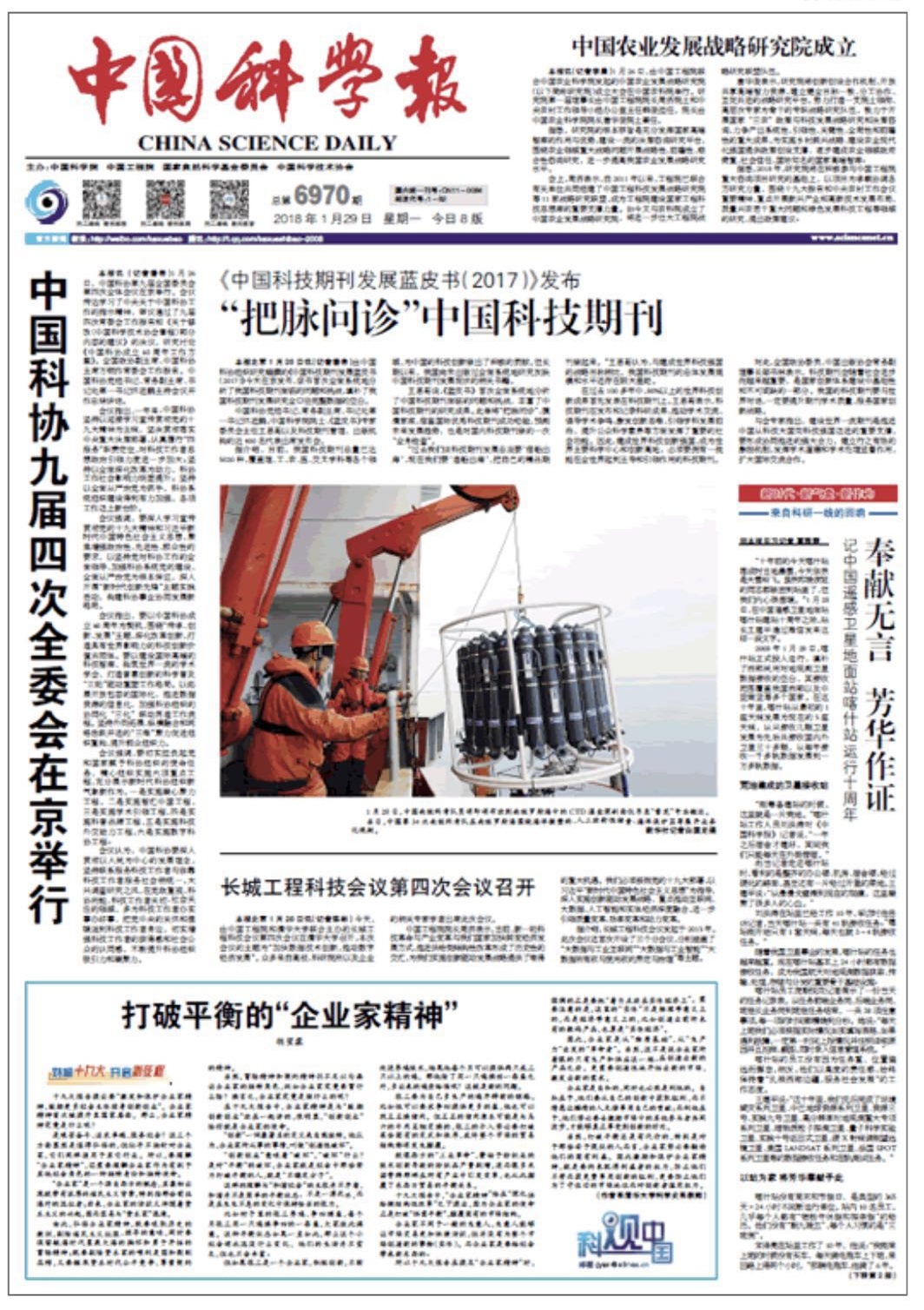
This article was published in Science and Technology Daily (2018-01-29, p. 1, News) and, at the time of publication, a few sentences were deleted, but the key content was retained.
The reason I focused on the report to the Nineteenth National Congress was simply that the commission requested it, but I can accept this kind of accommodation; especially since my final paragraph was not cut, the critical stance remains quite clear.
The report to the Nineteenth National Congress proposed to “stimulate and protect entrepreneurial spirit, encouraging more social actors to devote themselves to innovation and entrepreneurship,” thereby elevating “entrepreneurial spirit” for the first time in a solemn way to the level of national strategy.
So what exactly is “entrepreneurial spirit”? Earlier, a State Council document had already given an official set of definitions: “We must promote the spirit of entrepreneurs’ patriotism, dedication to work, observance of law and discipline, and hard struggle; the spirit of innovation and development, focused quality, and pursuit of excellence; and the spirit of fulfilling responsibilities, daring to shoulder burdens, and serving society.”
The three aspects mentioned here—“hard struggle, pursuit of excellence, and service to society”—are obviously worth promoting, but they do not seem to apply solely to entrepreneurs. People in other walks of life, such as workers, scholars, and leaders, should all have the spirit of hard struggle, pursuit of excellence, and service to society. So to understand “entrepreneurial spirit,” it is not enough to talk only about these three points; we also need to understand what unique missions “entrepreneurs,” as a social role distinct from others, are supposed to have.
So what kind of role, exactly, is an “entrepreneur”? Clearly, this is a concept originating in the West, but if we are to promote entrepreneurial spirit in China in the new century, the first thing is to distill the essence and remove some dross or confusion from the concept.
When the word entrepreneur (entrepreneur) first appeared, it carried a strong colonialist background, referring in particular to those expeditionaries who went overseas; later, the vitality of entrepreneurs also accompanied the rise of capitalism, and so the term easily became confused with “capitalist.”
Now that we want to promote entrepreneurial spirit, of course we must learn from history and strip away the meanings of colonial conquest and plunder, while retaining the broad horizon of the age of sail, with its stars and sea, and the adventurous spirit of pioneering; we must strip away the greed and exploitation of the capitalist, while inheriting the spirit of fair competition and respect for contracts from the age of capital.
Of course, the spirit of adventure and the spirit of contract are still not enough to sketch out the unique role of the “entrepreneur.” What, after all, is the entrepreneur taking a risk over? In other words, what exactly does an entrepreneur do?
In the report to the Nineteenth National Congress, entrepreneurial spirit is discussed together with “encouraging innovation and entrepreneurship.” Clearly, “innovation and entrepreneurship” is precisely the mission of the “entrepreneur.”
The most famous definition of “innovation” comes from Schumpeter. Schumpeter believed that what entrepreneurs do is called “creative destruction.”
“Innovation and entrepreneurship” means “destruction.” Destruction of what? It is destruction of “balance.” Entrepreneurs are those in society who strive to break balance; they are “disruptive elements.”
This does not conflict with a “harmonious society.” Harmony is not simply a state of balance, not a stagnant pool of water, but the proper tension maintained amid ceaseless change.
Let me give a simple example: suppose in a village there are two households, Zhang San’s and Li Si’s. Zhang San raises chickens, Li Si fishes. Every month Zhang San sells one chicken to Li Si and gets one fish in return, and everyone is very satisfied. If such a balanced state were maintained forever, then this little society would never change; their lives would not be impoverished, but neither would they become richer.
But if Zhang San is an entrepreneur, actively innovating, striving for excellence, and constantly improving chicken-raising techniques, and as a result can provide two chickens, three chickens every month… then what happens? Besides selling one chicken for one fish, to whom should he sell the extra chickens produced by his innovation?
Clearly, if Li Si still maintains the old level of output and insists that Zhang San exchange two chickens or three chickens for Li Si’s one fish, that is obviously unfair. If Zhang San’s innovation brings him no benefit, while Li Si, who is always content with the status quo, enjoys the full dividends of innovation, such a society can hardly develop sustainably. So if Zhang San wants to exchange his extra chickens for more returns, he has to open up new sales channels and establish new social relationships. For example, he may ask Li Si to provide more fish; if Li Si cannot meet the demand, he may have to go to Wang Wu, who raises pigs, to exchange for pork. But Wang Wu’s pork may originally have been exchanged with Ma Liu’s beef, and Zhang San’s involvement is bound to break some established patterns and orders; perhaps the trade structure of the entire market will be overturned. The Western “Industrial Revolution” began with technological innovation in the textile industry leading to a dramatic increase in textile output; this change spread rapidly like a line of dominoes being pushed over, triggering transformations in all industries, and thereby overturning the balance in East-West trade relations.
So in the report to the Nineteenth National Congress, “entrepreneurial spirit” is proposed precisely under “deepening supply-side structural reform,” because the entrepreneur’s mission is to break “supply-demand equilibrium” and overturn established market structures.
Entrepreneurs are different from ordinary “businessmen” (businessman); entrepreneurs are supposed to bring new things to society. For example, if Wang Wu runs errands between Zhang San and Li Si, helping Zhang San sell chickens and keeping a piece of the chicken butt for himself, helping Li Si sell fish and keeping a fish tail for himself, then Wang Wu is a “businessman,” not an entrepreneur. He can make market transactions faster and more active, but he does not create new things (entities) for the market as a whole. So when the report to the Nineteenth National Congress mentions “entrepreneurial spirit,” what it emphasizes is precisely that “the focus should be placed on the real economy.” It should be noted that “real” here is not meant in the physical-science sense, but in the economic sense; creating unprecedented digital products should also count as part of the “real economy.”
Thus, the entrepreneur is a “revolutionary” who begins from the “material foundation” and from the “productive forces.” Of course, this does not mean that entrepreneurs only focus on the production and supply side; after creating new products, they must more importantly open up new markets in a creative way and stimulate new demand.
Entrepreneurs are selfish, and at the same time they are inevitably altruistic: selfish, because they want to obtain the dividends from their own innovation and are unwilling to let lazy people enjoy their contribution for nothing; altruistic, because they must stimulate the other participants in the market to progress together in order to truly enjoy the benefits of innovation. For example, after Zhang San improves chicken-raising techniques, he will naturally hope that Li Si also improves fishing techniques, so that he can win a richer life, rather than simply eating chicken until he is sick of it. If the other participants in the market all remain in a state of eating raw meat and drinking blood, then no matter how many sweaters I sell them, what I get in exchange can only be the most primitive products. Only the common prosperity of the whole society is what truly accords with the “self-interest” of entrepreneurs.
Of course, breaking balance always has a cost, especially for those who are content with the status quo; entrepreneurs are bound to touch their established interests. Therefore, to stimulate and protect entrepreneurial spirit means to constrain the power of vested interests, to prevent them from enjoying the dividends of innovation free of charge without lifting a finger, and even more to prevent them from abusing power against innovators in order to defend their old market position.
Translated from the Chinese original with AI assistance. The original text is authoritative.