
| Two official notices, nine overlapping passages, and one revoked master’s degree. The real question raised by this celebrity academic controversy is: after a breach of trust, which old credits must be reset to zero, and who has the authority to decide when trust may be restored? |
Introduction
Within eight days, two official notices reached opposite conclusions. On July 5, 2026, Renmin University of China said that Jiang Fangzhou’s master’s thesis contained some irregularities in notes and textual expression, but no academic misconduct was found; on July 13, after reopening the case on the basis of new leads, the university determined that nine passages in the thesis overlapped textually with an overseas journal article, and that the relevant content was neither cited nor included in the bibliography, and decided to revoke her master’s degree. Jiang Fangzhou then said that she accepted the university’s handling of the matter and apologized to readers and teachers.
The significance of this controversy lies not merely in the fact that a well-known writer’s degree was revoked. It has brought before the public a question long obscured by the slogan of “zero tolerance”: once a paper is found to involve deliberate plagiarism, appropriation, or fabrication, should the system deal only with that paper, or should it reassess the author as a person? Can someone who has lost academic credibility start over again? Who has the authority to decide whether to trust them anew?
Hu Yilin, a PhD in philosophy from Peking University and a scholar of the history of technology and philosophy of technology, said in an interview that knowledge errors and breaches of integrity must be strictly distinguished. Errors of opinion, unintentional experimental mistakes, or omissions can be dealt with on their own terms; but deliberate academic misconduct exploits the community’s default trust in researchers, and therefore cannot be dismissed simply by withdrawing one piece of work.
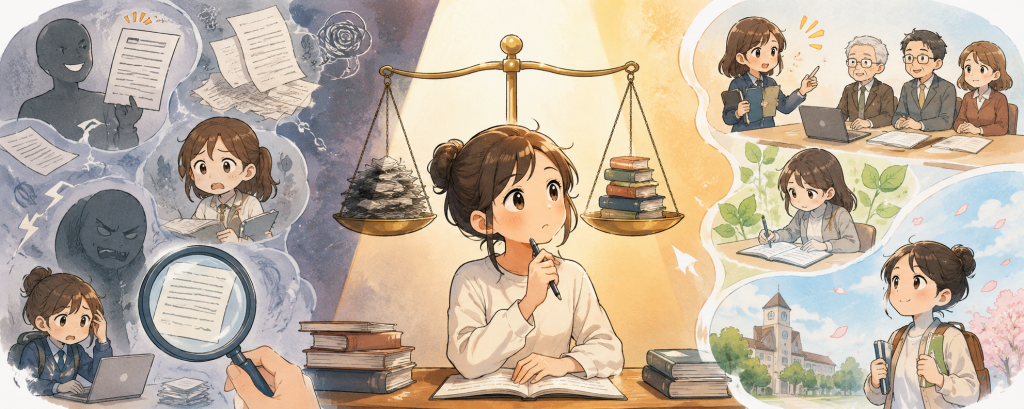
Errors can be about the matter; fraud must be about the person
In Hu Yilin’s view, an honest researcher may very well advance a mistaken argument, and may also arrive at a problematic conclusion because of insufficient ability, limitations of experimental conditions, or inadvertent carelessness. The reason science and scholarship can progress is precisely that they rely on errors being discovered, corrected, and replaced. If every error were elevated into a trial of character, the academic community would only become more conservative and timid.
Deliberate plagiarism, appropriation, and fabrication are another matter entirely. Hu Yilin said, “If it is plagiarism, appropriation, deliberate fabrication, or other forms of academic misconduct, then what it reflects is a problem of personal integrity, and one can no longer deal with the matter without dealing with the person.”
Academic production cannot operate on the basis of total surveillance. Readers do not verify every citation sentence by sentence, peer reviewers cannot reproduce every experiment, and hiring committees cannot, under ordinary circumstances, recheck the original materials of all of a candidate’s papers. The reason a researcher can enter evaluation procedures with a résumé, a degree certificate, and a list of papers is that the system first trusts that the author has truthfully explained what comes from themselves, what comes from others, how the data were obtained, and whether the research process was real.
Therefore, what a fraudster gains is not only the benefit brought by a particular paper. They have also overdrawn the credit that the academic community originally extended to every researcher. Deleting the paper in question can eliminate one direct gain, but it cannot automatically repair the trust relationship that has already been damaged.
Harsh punishment for breaches of trust is precisely the condition for a permissive society
Hu Yilin understands academic misconduct within the same institutional logic as forgery of documents and the production of counterfeit and substandard goods. Modern society is able to reduce cumbersome proof, cross-checking, and ubiquitous surveillance precisely because a large number of contracts first accept an individual’s signature, self-reporting, and self-certification.
“An authoritarian society presupposes that everyone is bad and watches them relentlessly, whereas a modern system presupposes that everyone is trustworthy and treats them with respect.” Hu Yilin believes that the looser the prior screening, the less it is acceptable for the cost after a breach of trust is proven to be merely perfunctory. Severe ex post sanctions are not the opposite of a free order; rather, they are the condition that allows the majority of honest people to be spared daily inspections.
He used an extreme but clear formula to explain this deterrent mechanism: “If I commit fraud a hundred times and get caught once, and I am only punished by losing the gain from that one time, while the remaining ninety-nine times go undetected and still benefit me, that will not deter a fraudster.” If the punishment merely withdraws one achieved result once the fraud is caught, the expected payoff from fraud may still remain positive. What the system truly needs to break is the possibility of treating fraud as a low-risk arbitrage strategy.
This also explains why the more the academic community hopes to remain free, relaxed, and mutually respectful, the less it can downgrade deliberate fraud into an ordinary formatting mistake. Setting fewer hurdles for honest people and holding the untrustworthy to account seriously are two sides of the same high-trust system.
“One-vote veto” does not mean a universal ban on work; it means canceling default credit
In further discussion, Hu Yilin narrowed the meaning of “one-vote veto.” It should not be understood as a universally applicable lifelong ban on employment issued by the state, nor does it mean that all universities must make the same personnel decision. Universities have freedom to run schools; research institutions, journals, and individual researchers are also subjects capable of making their own judgments.
“What I mean is only that public trust should be reset to zero in a public sense, while each university and each researcher is a free subject; a given subject of course has the right to decide, based on its own investigation and judgment, whether to trust them,” Hu Yilin said.
The so-called resetting of public trust to zero means that someone who has broken trust can no longer, merely by virtue of a degree from a prestigious university, an existing title, the number of articles in top journals, or a record of peer review, demand that others continue to extend the original presumption of credibility. In the past, when a university saw that a candidate had graduated from a famous institution and published several papers, it could usually take these experiences as credit certificates already filtered through multiple layers. Once serious fraud is verified, that information is no longer sufficient to automatically prove competence.
But resetting public credit to zero does not deprive specific institutions of the freedom to extend new credit. If a certain university is willing to incur additional costs and conduct stricter cross-checking of a candidate’s representative works, original materials, research process, and subsequent integrity record, it may still decide after independent judgment whether to hire them. The difference is that the institution can no longer take the old résumé as a ready-made answer; it must instead bear the responsibility of investigation and the risk to its reputation for re-trusting.
A paper can serve as a representative work; it can no longer be just a number
Hu Yilin further distinguished between two kinds of academic evidence that are often conflated: representative works and paper counts.
“The remaining papers can still participate in review as ‘representative works,’ but they cannot participate as a count, such as ‘has published X papers,’” he said. Representative work means the reviewer is willing to read, verify, and judge the actual quality of that paper; paper count, by contrast, assumes that each article has already passed through the multiple checkpoints of journals, peers, and institutions, and can be directly converted into résumé points.
This distinction both avoids automatically judging the other papers of someone who has broken trust as false, and refuses to let those papers continue to vouch for the author without verification. Epistemologically speaking, an untrustworthy person may still write correct, valuable articles; occupationally speaking, they have already lost the qualification to bulk-exchange all their existing achievements for credit.
In other words, a paper can still be re-examined on the basis of its content, but it can no longer continue to participate in a numbers game merely as an entry in a database. Losing default trust in a person does not mean discarding their words because of who they are; allowing a work to be re-examined does not mean restoring the author’s original credit line.
Toleration is not the restoration of old credit, but the permission to build new credit
Hu Yilin does not deny the possibility of reform and a fresh start, but he believes that toleration must be tied to the normative environment at the time the act occurred, the party’s subjective malice, the consequences caused, and the attitude afterward; one apology cannot flatten all differences.
The first situation in which toleration is possible is when historical norms change. Citation practices, duplicate publication, and translation conventions in the early academic community may not conform to today’s standards, but at the time they were not generally regarded as misconduct. The system should not apply later-formed rules retroactively without limit, and it certainly should not substitute today’s technical detection results for historical judgment.
The second situation is when the person proactively corrects the problem before it is exposed by others. If a young student leaves problems behind because of inadequate training or exposure to bad academic habits, and later reports them voluntarily, retracts the work, gives up the related benefits, and accepts review, this shows at least a willingness to place integrity above luck. For someone who has already become an independent scholar, voluntary confession can only reduce responsibility; it cannot easily erase the consequences of deliberate fraud.
The third situation is truly starting over after old credit has been reset to zero. A person whose degree has been revoked can study again and obtain a degree again; someone who has broken trust can also, on the premise of openly disclosing the past, submit the new achievements formed thereafter to fresh evaluation. But this is not about reviving the old résumé; it is about bearing the cost of accumulating from zero. Whether to re-grant a teaching post or other trust-based position should be decided independently by each university and institution according to its own standards.
In the Jiang Fangzhou case, Hu Yilin especially values the party’s choice after the first investigation. The first notice did not find academic misconduct, but that did not prevent the person concerned from proactively disclosing problems not covered by the material reported by others. If one knowingly still has serious defects but continues to rely on the first conclusion to defend one’s own credit, then accepting punishment afterward is difficult to equate with proactive correction.
What is needed is not a secret blacklist, but public judgments and due diligence
As for how to preserve records of broken trust, Hu Yilin opposes creating another simple and heavy-handed secret blacklist. He prefers that the facts, evidence, reasoning, and appeal outcomes of each investigation be made publicly available, and that hiring units and award-granting institutions bear the responsibility of due diligence.
“There’s no need to create a special blacklist; as long as all judgments are made public, anyone who wants to verify should be able to find them. Academic institutions, when hiring, should do ‘due diligence’ just like companies,” he said.
This arrangement is different from a database with only names and labels. Public judgments should not only tell the outside world that someone was once found guilty of academic misconduct; they should also explain what work was involved, what evidence was used, how subjective malice was judged, what defense the person involved presented, and why the institution took the corresponding action. Only in this way can later readers make differentiated judgments based on the severity of the behavior and the extent of correction.
Hu Yilin believes that publicly published academic achievements already fall within the sphere of public evaluation, and scholars bear a higher duty of candor than ordinary professions. “Academic research itself is publicly published, and scholars have a responsibility to be as candid as possible; publicly published articles have never had anything to do with privacy.” Private information unrelated to the case can of course be protected, but the sources of academic works, the investigation process, and the grounds for judgment should not be obscured on the pretext of privacy.
The current Degree Law also incorporates procedural safeguards as conditions for revoking a degree: when a degree-granting unit intends to make a revocation decision, it must inform the person concerned of the relevant facts, reasons, and basis, and hear their statement and defense. Public judgment and due process are not in conflict; on the contrary, only judgments with sufficient reasoning and the opportunity for defense are worthy of being used by other institutions as the basis for due diligence.
What Celebrities Lose Is Not Only Their Degrees, but the Credibility Premium Built into Their Personas
Jiang Fangzhou does not mainly make a living from a university post, which means the consequences of this incident are not entirely the same as those of a professional scholar being removed from office. But Hu Yilin believes that, for a long time, she entered public life through a composite identity as a young writer, an intellectual woman, and a graduate of a prestigious university, and her academic background had already become part of her personal brand.
“Jiang Fangzhou does not entirely mix within the academic world, but she still treats her academic background as an intrinsic part of her public identity, and profits from her ‘genius’ persona; she cannot be compared in the same breath with an ordinary student,” he said.
The revocation of a degree is an institutional sanction imposed by the school; the public’s reduced trust and the media’s reappraisal of her former image are the reputation market’s reaction to information about breached trust. For ordinary students, the system should give more consideration to education, growth, and starting over; for public figures who have long drawn attention and opportunities from an identity grounded in knowledge, their existing reputation itself has already been accumulated by social trust. After a breach of trust, bearing a larger credit discount is not an additional punishment, but the disappearance of the original credibility premium.
Hu Yilin said bluntly: “So now it has completely ‘collapsed’—the persona has fallen apart, and the public image must be rebuilt. That is the minimum cost.” Rebuilding does not mean quickly returning to the starting point through a single apology, but rather abandoning the default credibility provided by the old persona and once again submitting to public judgment through subsequent writing, public explanations, and long-term conduct.
Conclusion
The institutional problems left behind by the Jiang Fangzhou incident cannot be solved by the phrase “zero tolerance” alone. Too lenient a response would make fabrication a low-risk arbitrage; an overly uniform lifetime ban on practice might in turn infringe the freedom of universities and academic institutions to make their own judgments. A more workable principle is this: the disputed work is revoked according to law, and the existing public credit is reset to zero; other works are not automatically treated as false, but they can no longer continue to serve as unverified quantity-based assets; the investigative process and the reasons for the ruling are made public, and specific institutions, after completing stricter due diligence, independently decide whether to grant trust again.
This kind of system is harsh, but it also leaves room for a fresh start. It does not require society as a whole to permanently hate those who have broken trust, but it does require that such people cannot inherit their past credit; it does not let the state make personnel decisions for all universities, but it does require every institution willing to trust again to truly investigate and publicly take responsibility.
Hu Yilin said: “Scholars hope to respect and trust one another, and hope to have a free and relaxed environment; therefore, we need all the more to insist on severe crackdowns on fraudsters.” Relaxation toward the honest and seriousness toward the fabricator have never been two opposing values. The former is possible precisely because the latter has drawn a price line around trust.
Sources of Facts (for editorial verification)
1. Renmin University of China situation report of July 5, 2026; Xinhua: “Renmin University of China Announces that Jiang Fangzhou’s Master’s Thesis Was Found to Have No Academic Misconduct.”
2. Renmin University of China situation report of July 13, 2026; Xinhua: “Renmin University of China Decides to Revoke Jiang Fangzhou’s Master’s Degree.”
3. The Paper: “Master’s Degree Revoked, Jiang Fangzhou: I Accept the School’s Decision and Apologize to Readers and Teachers,” July 13, 2026.
4. The Law on Academic Degrees of the People’s Republic of China (in force as of January 1, 2025).
Translated from the Chinese original with AI assistance. The original text is authoritative.