
Notes
As I said before, the final exam is “completely open-book,” and you may bring electronic devices to search the internet.
The “attendance questions” are also my own new idea, something I wanted to try while the class size was still small. Why set attendance questions? I think students who take a course can roughly be divided into three broad types: first, those who are habitually diligent and honest, who will keep coming no matter whether the teacher’s lectures are good or bad; second, those who are habitually coasting, who will almost never come no matter whether the teacher’s lectures are good or bad; and third, those who are free-spirited and discerning, who will keep attending if the teacher is interesting, and will gradually come less and less if the teacher is not.
My favorite are the third kind of students. I also hope to keep these students through interesting classes, rather than through compulsory roll calls. Judging from the attendance rate across this semester, I think I have been fairly successful.
So why do I still set attendance questions? I do not want to add pressure to free-spirited students. In fact, I have always believed that in a semester-long course, even one you really like, missing class once or twice is normal. Everyone gets headaches or fevers now and then, or suddenly has some important appointment or other; in such situations, just skip class directly—there is no need to ask for leave specially. So I tried to design the attendance questions so that students who skipped class three times could still pass them without much pressure. (If many people get them wrong, I can consider giving everyone an extra 5 points, making sure more than half the class can get full marks.)
I want to put all the pressure on the second type of student, that is, the habitual coasters. Such students may come once at the beginning of the term and once at the final exam, and once they learn that the teacher does not take attendance, they simply never come to class. These students will not have a change of heart because I work hard to teach, or because I teach brilliantly and interestingly, since they never listen in the first place—however hard I try, it is useless.
Their homework is often no good either, but apart from plagiarism, given my lenient grading policy, they may still muddle through with a fairly decent grade. So I hope to use this attendance-question segment to penalize them and open up a clear grade gap between them and normal students.
On the very first class, I stated clearly that this was a “water course,” but perhaps some people misunderstood my notion of “water.” By “water course,” I mean a class format in which the teacher chats and the students listen like they are hearing an oral storyteller. There is no requirement for active previewing or discussion, students do not have much outside-class work, and the grading at the end is relatively lenient. But that does not mean I teach this course carelessly or perfunctorily. On the contrary, in many respects I am not only serious, but also exacting.
Why is this course relatively “water”? As I said, I want to treat it as a flagship course, an “advertising” course, so as to let more students get to know our Department of History of Science and myself. After becoming interested in the relevant issues in this introductory course, some students will go on to choose those advanced, less “water” courses. So I have positioned this course as one that mainly aims to spark interest, and the larger the audience the better.
But the problem is that students who habitually skip class just to collect credits are not “audience” at all. They do not listen, so there is no question of sparking interest. Then I have no need to be overly lenient with such students; otherwise it would also be unfair to the students who attend carefully.
By the way, as for plagiarism, this touches on the side of me that is very exacting: plagiarism is absolutely not allowed. I have said this many times in my class: as long as you do not plagiarize, you will definitely pass. The implication is that if you plagiarize, I will fail you.
Of course, plagiarism itself comes in two situations. One is that the student truly does not understand academic norms very well: he is genuinely attending class and completing the homework relatively carefully, but has not handled the distinction between quotation and plagiarism properly. For such a student, of course I will still give him a chance, tell him the correct way to cite, and send it back for revision. But there is another situation: the habitual coaster. He does not really listen carefully to class, and is basically trying to take advantage of the teacher’s soft heart or lax checking, hoping to bluff his way through. For this kind of student, I am not even willing to give him a chance; I am more inclined to fail him outright. (Of course, like the person mentioned in the comments to the previous post, I feel that he does not even belong to the second category; to this day I still find it hard to understand.)
How to deal with plagiarism? If I were considering only my own safety, perhaps turning a blind eye and letting him pass with 60 points would be best, because some students nowadays are quite scary, and if they casually make a report against you, I could well end up in a very passive position. Of course, I trust that Tsinghua University is still a decent place, that students are not likely to be too extreme, and that the university leadership would not be too unreasonable… On the other hand, if one considers this from the standpoint of being responsible to students, I think the best way is to fail them mercilessly and without any room for compromise; that is the best thing for the student’s future. If the teacher sees plagiarism and still speaks to the student gently, gives them another chance to correct it, and then, fearing trouble or retaliation, timidly passes the student at the end, this is unquestionably indulgence of the student—the student will think: plagiarism is no big deal, if I bluff my way through nothing happens, and even if I can’t bluff my way through, at worst I just rewrite one paper; at most I pretend to lower my head, apologize, and express determination, and then I’ve fobbed it off.
It is precisely because university teachers in general are so inactive, and so inclined to “make peace and keep things quiet,” that students’ plagiarism goes unpunished, objectively encouraging the habit of plagiarism. Some people have even proposed abolishing undergraduate theses, because undergraduate theses are inevitably all plagiarized. At some less prestigious universities, students are not learning how to write a proper paper at all; instead, they are learning how to plagiarize without being detected by plagiarism-checking software… No wonder some media outlets now engage in “rewriting” and do so with such confidence, with not a trace of shame.
I am powerless to reverse the atmosphere of the whole society, but at least in my own conduct, I must insist on not colluding with ugly things. What I hope to convey to students is this: writing without plagiarism is not difficult, while once you plagiarize, it becomes a shame that can never be erased.
If a student still insists on plagiarizing in a water course where passing is otherwise guaranteed without plagiarism, or even in a reading-notes assignment in which quotation is perfectly legitimate, then that student is probably beyond saving. But I still hope to give him the correct lesson: that is, contempt and failure. Showing anger and contempt toward ugly things is the right attitude; if, in the face of students’ ugly behavior, I insist on pretending sympathy, understanding, tenderness, and the like, then that kind of orientation is even worse. As the saying goes, “only when one knows shame can one become brave afterward” (知耻而后勇); if one feels no shame at all about plagiarism, how can one expect him to correct himself?
The final exam is the same. I only hope there will be no cheating or plagiarism, and that no one will come and test my resolve.
I am posting the exam paper directly below. After the exam is over, I will comment on each essay question in the comments, and other students are also welcome to leave messages here.
I. Attendance Questions (5 points each, 7 questions total, 25 points maximum)
Do not doubt the teacher’s math: it means that even if you answer 2 questions wrong, you can still get full marks.
If you have almost never missed class or often spoke up in class, but are not confident about the attendance questions, you may greet me when handing in your paper; if I really recognize your face, full marks are guaranteed.
- When the teacher mentioned in class that three students had already submitted their homework, he said that two of them were writing reading notes on which book?
A A Brief History of Humankind; B Technical Elements; C Technology and Civilization; D Introduction to the History of Technology; E Outdated Wisdom;
- In Lecture 12, “Pollution,” which recommended book did the teacher not include in the PowerPoint slides, but write on the blackboard?
A A Natural History of the Future; B Collapse; C Sand County Almanac; D Out of Control; E The Limits to Growth;
- In Lecture 9, “Watt,” when the teacher mentioned that, while making a popular science program with his advisor, a sentence his advisor said was cut by the production team, what was that sentence?
A Watt did not actually come from a poor family; his grandfather was an official; B Watt became a very rich man; C Watt was divorced;
D Watt manipulated public opinion to attack his competitors; E Watt spent his later years entangled in various patent lawsuits;
- In Lecture 7, “Perspective,” which of the following images was shown by the teacher in the PowerPoint slides? (However, it was omitted in the version uploaded to the online classroom.)
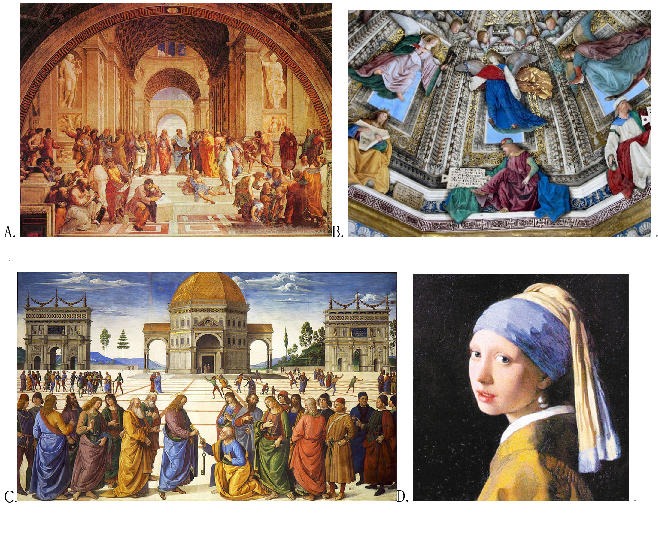
- In the final class, the teacher said he was very moved that so many people still came to the last lesson, and that he himself really felt like skipping class—because?
A He was having a bout of rhinitis; B He was extremely busy with all sorts of things close to the end of term; C He had stayed up late; D The weather was too hot; E He had not prepared the lesson sufficiently
- The teacher had one question that was not made clear in class, so afterward he posted an explanation in the online classroom discussion area (now deleted). What was this post about?
A The governing principle of Watt’s steam engine governor; B The valves and inlet-air problem of Watt’s steam engine;
C The drainage problem of the condenser in Watt’s steam engine; D How the steam engine drove the textile machine;
E The principle of the sun-and-planet gear system in Watt’s steam engine;
- At one class session, the teacher once opened a webpage to advertise a lecture. What was that lecture about?
A Technical achievements in ancient Greece; B Mumford’s theory and its practical significance; C Geometry in ancient art and artifacts;
D Technology as a visual spectacle of wonders; E A journey to explore Leonardo da Vinci;
II. Essay Questions (25 points each, 75 points maximum. Choose any 3 of the following 5 questions to answer.)
If you answer more than three, only the three highest-scoring will be counted. Please manage your time carefully.
When citing any material, indicate the source (for online sources, roughly give the author or title). Plagiarism is not allowed.
1. In this course, which topic or detail do you think the teacher handled with errors or omissions? Or are there any contents that the teacher did not cover but that you think are especially worth discussing? If you were to teach the class, how would you do it? Please choose one topic, write out your lesson-preparation ideas, and you may attach reference materials or a lecture outline.
2. What exactly is technology? Can you give a concise definition and explain it with historical examples?
3. Mumford said, “The key machine of the modern industrial age is not the steam engine, but the clock.” How should this statement be understood?
4. Steam engines existed long before Watt, so why do we still treat Watt’s steam engine as the symbol of the Industrial Revolution?
5. What ideological and conceptual preconditions made the telegraph possible, and what ideological and conceptual consequences did it have?
Translated from the Chinese original with AI assistance. The original text is authoritative.