
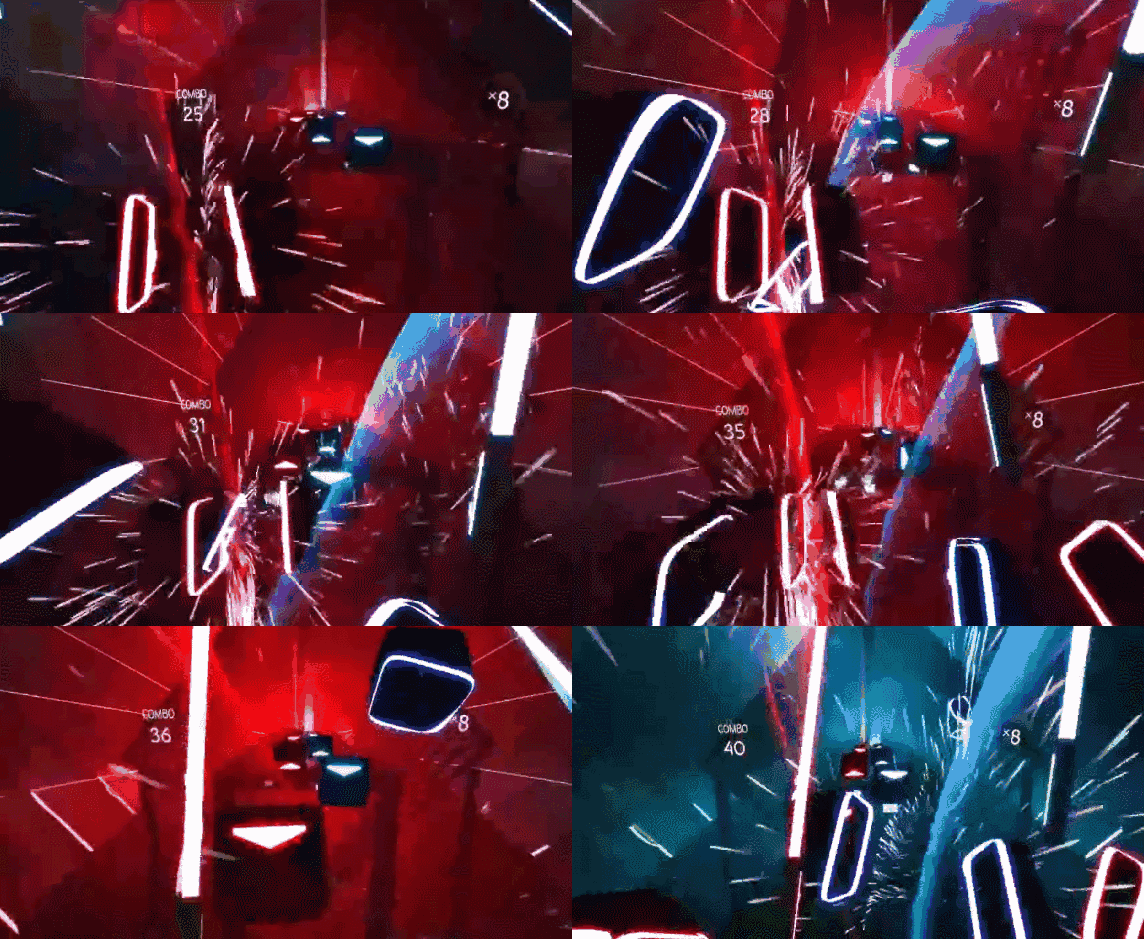
Recently I’ve basically been grinding Beat Saber in VR, so I should count as having reached the expert level, right? Among the official songs, aside from standard mode where everything is A rank and Full Combo, I’ve recently started tackling no-arrow mode and one-handed mode, and in both modes I’ve also got 3 FC clears each~
Just the other day, in the introductory philosophy of technology class, we had just finished discussing Stiegler’s tertiary retention, and one of the links in that discussion was a phenomenological analysis of music. Applying that whole phenomenological analysis here is actually kind of interesting.
When people first get into the game Beat Saber, many of them look at expert difficulty and sigh in awe, feeling it’s out of reach, thinking that only by “memorizing the map” could one possibly clear it.
The rules of Beat Saber are very simple: one small block after another flies toward you in rhythm with the music, and you have to use the appropriate hand (left or right) to slash each block in the proper direction according to the color and arrow it shows. If you keep missing or cutting the wrong way too many times in a row, it’s game over. The full combo I’ve achieved means not missing a single one and getting none wrong from beginning to end.
But at expert difficulty the frequency with which the blocks come flying at you is terrifying. Facing the flood of incoming blocks, we feel at a loss, feeling that with an ordinary person’s reaction speed, it’s impossible to clear it by “adapting on the fly” — you just can’t react fast enough. Of course we still believe that there must be experts who can clear it, but our thought was that experts surely have to rely on “memorizing the map” to do so.
What does “memorizing the map” mean? As the phrase suggests, it means memorizing the board, that is, memorizing the level. In other words, although one’s on-the-spot reaction speed can’t keep up with the blocks, if the actions required for each song are fixed, then as long as I remember the whole sequence and practice the established order of actions, I can clear the level.
But when I actually played it, things exceeded my expectations. In fact, it seems I didn’t really “memorize the map”; I didn’t deliberately memorize the sequence of actions, and I still always kept my eyes fixed on the incoming blocks and completed the game through immediate response. One piece of evidence that I wasn’t relying on memorization is that now, when I encounter a new song, I can basically get through expert difficulty right away.
And there was actually one turning point that clearly improved my skill: I discovered it while playing Gangnam Style. In one section, the “horse-riding dance” part, the directions from which the blocks come are designed cleverly, so that you’re supposed to make the motion of riding a horse and swinging a whip. At first I tried to swing according to the established rhythm, but in practice I found that I still made mistakes often, and once I made a mistake I would fall out of rhythm, causing more and more mistakes. Later I realized that with each “whip swing,” I should be watching each and every block; of course sometimes with my eyes straight ahead, sometimes through peripheral vision, but in any case I had to pay attention to every block, had to see every one, and only then could I make it through the horse-riding dance without missing a single one. After clearing Gangnam Style, when I went back and played the opening stages again, I also consciously paid attention: not relying on memorization, always keeping my eyes on the flying blocks, reacting however the blocks looked, and then I felt my level had suddenly jumped up a whole tier.
But if one says that “memorizing the map” completely doesn’t exist, that also doesn’t seem quite right. The fact is, for any song, if you play it enough, your level will of course improve, and I really did, consciously or not, memorize the action sequences for many key sections.
The key question is: what exactly is “immediate response,” and what exactly is “memorizing the map”? And what is the relationship between immediate response and memorizing the map?
Phenomenology makes it clear at a glance: immediate response is “primary retention,” and memorizing the map is “secondary retention.” And we also need to add Stiegler’s insight: primary retention and secondary retention are not independent of one another, but interwoven with one another; within primary retention there is already secondary retention, and what synthesizes the two kinds of retention is tertiary retention, that is to say, “technology.”
And Beat Saber also points me toward something that goes beyond Stiegler. In Stiegler, this “technology” mainly refers to external memory, materialized supports: for example, through computer technology one can replay the “same song” over and over again, making possible the experience of the same level. But here I find that this “technology” also includes another level, namely “bodily technique.”
What exactly am I practicing? What exactly is what keeps getting better and better? It’s the “technique” of playing this game—my technique is getting better and better. But how is my technique able to become better and better? In the final analysis, what exactly is my “technique”?
In fact, my technique is not simply that my ability for “immediate response” (primary retention) has improved, nor simply that my ability for “memorizing the map” (secondary retention) has improved; rather, it is my ability to synthesize primary retention and secondary retention that has improved.
What exactly is it that I see in primary retention? Is it the same “note,” or the same “song”? Stiegler points out that hearing a sustained sound as the “one” of a note and hearing a sequence of notes as the “one” of a song are not the same thing. “Hearing it as a song” presupposes that I have “heard a song”; without the re-presentation of this secondary retention, the primary-retentional activity of “hearing a song” would also be impossible.
In Beat Saber, let’s look again: when I am “responding immediately,” what exactly is the “object” I am facing? Just one block after another? Not necessarily. In the immediate response of a beginner (dizzy circles), the object’s “one” is nothing more than a single block; they look at one block and make one response. But after repeated practice, what I see in front of me is probably no longer one block after another, but a group after a group of blocks, or rather one “action” after another, or else one stretch of rhythm after another. Faced with three or five blocks arriving one after another, I may be able to regard them as “one,” as one object that requires me to respond through a certain action (for example, a quick up-and-down flick of the wrist, a crosswise swing with both hands, and so on). The “retentions and protentions” in my present circle of awareness are also different: at every moment I can prepare for the string of blocks coming afterward (protention).
So where exactly does my “technical level” show up as being higher? It shows up in the richer structure that has sedimented in my “circle of awareness.” Our way of playing is the same: “see an object, make a response.” But your “one” is just a simple “one block—one action,” whereas my “one” is “one stretch of rhythm—one set of actions.” Then naturally, my response efficiency will be much stronger than yours.
One of phenomenology’s most fundamental insights is that the “one” is not already there, isolated, and nakedly laid out before your eyes as some X; the “one” is the result of synthesis in intuition, and this “one” that has been synthesized is endowed with “history” and “structure.” Maybe if you hear this as purely philosophical speculation, you won’t understand what on earth I’m talking about — but if you experience the structure of this “one that presents itself in the here and now” through Beat Saber, does it become easier to understand?
Translated from the Chinese original with AI assistance. The original text is authoritative.