
Recently, a memo circulating internally at Google was exposed. The author argued that the company’s gender imbalance was not a problem at all, because women are naturally unsuited to being programmers; and if one really wanted to promote diversity, one should promote “ideological diversity” rather than gender or ethnic diversity, because conservative ideology is currently suffering from discrimination.
After the memo was exposed, public opinion exploded, everyone turned on the employee, and Google decisively fired him.
At first I didn’t think much of it. Of course I do not agree with this male employee’s remarks, and Google had nothing to say for firing him. But then I read some rebuttal articles reposted by various websites, and after seeing those arguments using “science,” “facts,” “truth,” and “data” to refute gender discrimination, I really felt like venting. In order to rebut gender discrimination, many arguments that seem ironclad actually give off, on closer inspection, a rather exasperated air.
Those of us who study the philosophy of science are most wary of things said in the name of science. Certainly, there is a great deal of research that can be used to support the claim that there is not much difference between the sexes in various abilities, including programming. But the problem is that these studies themselves, and the interpretation of them, are not necessarily completely neutral either.
What is even more frightening is this: if we must invoke science to prove that women are naturally about the same as men in order to support women’s equal status, then if there really were a scientific study proving that women are indeed inferior to men in some respect, would everything supporting gender equality collapse?
In this incident, the “memo” “discriminating against women” solemnly cited authorities and talked science, while the anti-discrimination public response likewise talked science in a rigid, formulaic way. “Science” is cast in the role of arbiter, but is that really all right?
Anyone who has studied the philosophy of science knows that the conclusions science itself can reach are often extremely cautious, limited conclusions under a series of conditions. Whether one is talking about gender equality or gender inequality, such broad and sweeping issues are not conclusions that modern science itself can deliver. They are all things that can only be reached after people with various ideologies have wrapped and interpreted extremely limited scientific conclusions in many layers.
Let us first set aside the issue of gender equality and read the so-called “scientific evidence” with a normal frame of mind.
Take, for example, this article, “Do physiological differences between men and women mean women can’t do programming? It’s time to refute that with data.” This is a translation. I briefly checked the original; the deviation is probably not too great, so I’ll discuss the Chinese version here. After all, I am not trying to comment on that article itself, but on a typical kind of defense.
The central idea of this article is that “the supposed differences between men and women have been greatly exaggerated; even if they exist, they are the result of social and cultural discipline.” — In principle I agree with this sentence, but in fact, because the writer is often too eager to prove gender equality, the contradictions embedded in this sentence tend to be exposed.
This sentence contains two layers of meaning. To use a somewhat imperfect analogy, it is like a defense saying: “First, Zhang San didn’t kill anyone.” “Second, even if Zhang San did kill someone, he was coerced by Li Si.” These two layers of defense contradict each other, because if Zhang San didn’t kill anyone, there is no question of anyone coercing him. But in fact, such self-contradictory defenses often do appear in court; defense attorneys often have one strongest line of defense, but if it fails, they may retreat to a weaker one.
On the issue of anti-discrimination, there are likewise these two levels of question: first of all, is there or is there not a difference in job performance between the male employees and female employees who are working now?
The strong defense would of course answer: almost no difference; female employees’ work ability is in no way inferior to that of male employees. Given similar ability but different treatment, the difference in treatment must come from discrimination.
If the strong defense holds, then solving the discrimination problem is actually not difficult: just rely on the laws of competition in the free market. If it is indeed the case that the work ability of male and female employees is 100:100, or 98:100, while the salary ratio is 100:80, then if companies that discriminate against women tend to hire more men, and companies that do not discriminate against women hire more women, the non-discriminating companies will certainly be able to obtain higher work efficiency at lower cost, and thus will surely gain an advantage in market competition. In the brutal competition of the market, entrepreneurs often do not talk morality and only look at profit, so even entrepreneurs who discriminate against women would, in order to pursue profit, hire more female employees. In the end, relying on market adjustment, at least in terms of salary and benefits, men and women should converge toward balance.
But the problem is that the strong defense does not always hold. In fact, many feminist defenders fully recognize that in many positions today, female employees’ work ability is not entirely equal to men’s, because in many fields there is the problem of so-called “social and cultural discipline”: discipline has put women at a disadvantage, making it hard for them to compete head-on with the dominant gender on equal terms. In order to protect vulnerable groups, one must rely on people of insight to take the lead and set the direction.
This is the position of the weak defense: although in the relevant field women’s performance is indeed currently inferior to men’s, that is the result of postnatal conditioning rather than innate determination. Therefore, in order to change the cultural environment, one must protect women as a disadvantaged group—giving them “equal pay” even before they can produce “equal work,” and raising women’s treatment beyond what market rules alone would provide.
What Google and similar companies are doing is, in fact, a matter on this level: beyond the market, they are additionally increasing the proportion and treatment of women (and other disadvantaged groups).
At this level, then, a whole series of further questions can be discussed. For example, if women’s disadvantaged situation is the result of cultural discipline, then must commercial companies also be made to pay for it? Promoting equality and reducing prejudice should of course be educators’ proper business. In primary and secondary schools and at universities, educators should consciously create an atmosphere of equality and eliminate discrimination; there is no problem with that. But in the free market, must entrepreneurs also sacrifice profit and efficiency to pay for the consequences of education? Is this requirement placed on entrepreneurs a kind of “moral blackmail”?
Of course, we can argue that companies must also pay for mistaken discipline, because the market economy is in fact part of the cultural environment and also participates in discipline. In particular, giant companies like Google must bear a certain social responsibility beyond making money, so sacrificing efficiency in order to improve women’s treatment is also appropriate.
But the bad thing is that many anti-discrimination debaters evade or refuse to admit that “promoting diversity” means sacrificing efficiency. On the contrary, they always insist on the “strong defense,” firmly maintaining that women’s real work ability is already on par with men’s, yet from time to time they also slip, intentionally or not, into the weak defense. This is where the contradiction arises.
Of course, in fact most of the discussion is about degrees rather than yes-or-no questions, so this kind of “contradiction” does not amount to a logical antinomy. Even so, in many argumentative steps, it still comes across as forced.
Once the conclusion is set in advance, all sorts of evidence can be used to support one’s position. But if one changes one’s “preconception,” the same “data” can also be used to support a completely opposite conclusion.
For example, the article then cites: “A 2005 study found that across 128 areas of human psychology and behavior, 78% of gender differences were either very small or close to zero.”
Turn that around, and it means that across 128 areas, 22% of gender differences were not slight but rather large.
“78% of gender differences are small” and “22% of gender differences are larger” are logically equivalent statements, but they feel very different. Besides, is 22% a lot or a little? In other words, if one in every five areas shows a large difference between men and women, doesn’t that actually support the claim that gender differences are large?
Of course, supporters may immediately add an explanation: most of those larger gender differences are in “irrelevant” areas, such as the ones mentioned later in the article—“men are stronger, more aggressive, masturbate more often, and are more prone to casual sex.” But only four are listed here; you should know that there ought to be as many as 28 items in that 22%, so what are the remaining at least 24 items? It is hard not to suspect that the writer deliberately selected the most “unpleasant” items to list, in order to highlight how trivial that 22% is.
But even so, these four carefully selected differences may not all “have little to do with the workplace.” For example, does being “stronger” really have nothing to do with the workplace? You must know that programmers are a profession requiring heavy physical labor. Overtime work is part of daily life at IT companies, and dropping dead from overwork is all too common in the programmer industry. Setting aside other occupations, at least the IT giants probably have no face to say that programming has nothing to do with physical strength.
The next paragraph in the article is also all over the place and bewildering: “A 2014 study on leadership further pointed out that there is also no difference between men and women in leadership ability, but interestingly, when leadership was evaluated using only others’ assessments, women’s leadership was better; when leadership was evaluated using only self-assessment, men usually displayed a more confident attitude than women.” — So I was puzzled: when only others’ assessments are used, women are better; when only self-assessment is used, men are better—so how did they arrive at the conclusion that there is “no difference”? Did the scores from others and self-assessments average out to exactly the same? Or did the researchers use yet another set of criteria?
“Leadership” is a concept that is very difficult to quantify. It is, by its very nature, multidimensional. For instance, Zhang San may lead a team with higher output, while Li Si may lead a team with better quality; so who is the better leader? Wang Wu may lead a team that is orderly and uniform, while Ma Liu may lead a team that is warm and congenial; so who is the better leader? “Leadership” is not unassessable, but it can be assessed along many dimensions.
To mix together various different dimensions, give only a linear, one-dimensional total score, and then care only about whether this final total score is equal between men and women—that is a very absurd thing. In fact, we can adjust the weight of each dimension so that no matter what actual differences exist, we can still ensure that men and women end up equal in the total score. But is there any point in doing that?
In fact, the sentence in the article has already revealed that male leadership and female leadership differ in quality, fitting entirely different dimensions of evaluation; yet the writer stubbornly ignores qualitative differences and emphasizes quantitative sameness. How blind can one be?
Then, as for mathematical ability, it suddenly hurls out 4,000 papers, leaving me a bit stunned: “The consistent result of about 4,000 studies is that the gender difference in math performance is close to zero. The patterns of difference in the two sexes are very similar, with slightly more variation among males.”
But in fact, this result also fits the expectations of most “biased” people: the best and the worst in math are both boys. Fine then, 4,000 studies have already agreed that in mathematics males show greater variance, while females are relatively more concentrated in the middle. But the author’s conclusion is, after simply averaging, that the “difference is zero.” The problem is that if we are considering occupations like high-end engineers, technical experts, programmers at big companies, and so on, we should note that the potential entrants to these professions are not exactly equivalent to everyone, but rather the group with a higher level of education and more outstanding ability. In other words, the people who can become programmers at companies like Google are very unlikely to be the average or below-average students in an ordinary primary or secondary school; more often they are the best of the best. And what about the weaker students? They are simply not very likely to become potential employees of large IT companies at all.
So the question is, if we are talking about top students, then what happens when we consider the male-female ratio? As said above, boys and girls have the same average score, but boys have greater variance; therefore, the conclusion is that among mathematical top students, there are more men than women. As long as boys’ variance is even a little larger than girls’, the more one considers the most elite talent, the more the difference will be magnified.
Of course, the article immediately shifts to the weak defense again: “Even if men have the advantage in mathematical ability, that is mostly the result of cultural bias.” I of course agree with this sentence with both hands, and the word “mostly” is also rigorous. But the problem is that the surrounding argument is again puzzling.
At the elementary school stage, girls’ math scores are better, while by high school boys overtake them; the more traditional the country, the more obvious this is. This can indeed support the influence of postnatal discipline on math performance. But on the other hand, one should also note that elementary school mathematics and high school mathematics are not the same kind of subject at all. At first, elementary school math mainly involves counting and calculation, while secondary mathematics mainly includes proof and algebraic operations. And it is complex geometric proof and algebraic operations that require a high degree of abstract thinking, which in essence depends very heavily on spatial imagination (algebraic manipulation in fact also requires spatial ability; at least for me, manipulating a complex equation is a process of moving symbols around from one place to another). And according to older research, “spatial ability” is “the largest known cognitive gender difference.” I don’t know whether that research has already been refuted by the academic community, but at the very least we should note that elementary school math and high school math do not increase in difficulty along a single linear scale; rather, they exist along different dimensions.
The next passage is the most baffling of all. For a moment I thought the translation was seriously off, but after checking the English version I found that it really did mean something like this: “In fact, if teachers know students’ names while grading, boys perform better on math tests. But if grading is done anonymously, girls perform better. If college students are reminded of their gender before a math test, girls’ scores will be 43% worse than boys’; but if students are told that the math test is just a problem-solving exercise, the gender gap disappears.”
Of course, subjects’ biases can greatly affect experimental results, which is why modern experimental methods place special emphasis on the “double-blind” method. But the question is, what kind of math test could produce such a dramatic difference? This is a test for college students—just reminding them of gender produces a 43% swing?
I don’t know whether this 43% means something like boys decrease by 21% and girls increase by 21%, or whether the girls are especially affected. If girls are affected more, then this proves a significant gender difference: girls’ math performance is actually so vulnerable to situational emotion (which is also one of the traditional prejudices against women). Of course, in fact I do not believe this. A normal math assessment could not possibly have such great uncertainty. In numerical computation, a problem is either done right or not; in proof problems, either the proof works or it doesn’t; there is no such huge gray area. If one really wants to achieve such an obvious effect, that can only mean that the so-called math test or math teacher in this experiment is flawed.
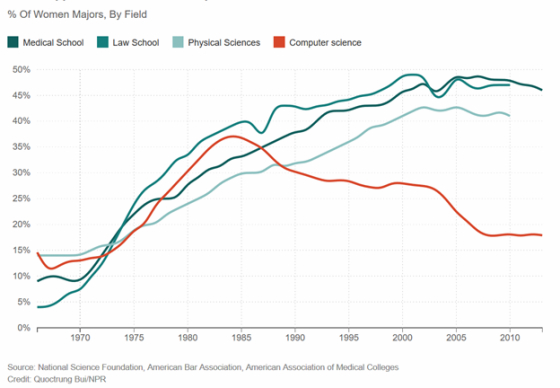
Finally, a chart is presented showing that “since the 1980s, women’s enrollment rates have been rising in medicine, law, and the natural sciences, but have been continuously declining in computer science.” The writer tries to use this chart to support the claim that “the reason there are fewer female engineers is not physiological, but social conditioning. Women have never been encouraged to enter computer science.” But again I wonder: has women’s entry into the natural sciences long been encouraged? Isn’t the prejudice that women are unsuited to studying the natural sciences even older and more deeply rooted? And computer science is essentially something new—especially the entire IT industry that rose at the end of the last century with the advent of personal computers and the internet. For ordinary people, it can almost be said to have been an entirely new thing; most people had never even heard of it. So how could a social and cultural prejudice against it have been established so quickly? How could this newly established prejudice be so powerful, moving against the current at a time when other traditional prejudices were weakening day by day? Compared with other disciplines, does the fact that this new prejudice was established so quickly and took effect so quickly not suggest that the relationship between computing and women is especially peculiar? I do not want to over-interpret this chart, but if one insists on interpreting it, I’m afraid one may not be able to draw the conclusion the writer wants.
It needs to be emphasized again and again that I have no intention whatsoever of taking the side of the “memo.” In fact, similar problems may be even more serious on the “conservative” side—recklessly, impatiently citing large amounts of so-called “science,” “evidence,” and “facts.”
I think that gender equality is first of all a matter of taste, an aesthetic question; second, an ethical question, a political question; third, an economic question, a social question; and only at the very end does it become, in a small way, a scientific question. Does it really matter so much whether men and women are biologically equal or unequal by nature? Is the boundary between innate and acquired really so sharp?
If women really are biologically less adept at math, then what? Does that mean the idea of gender equality must be discounted? If women really are just as biologically adept at math as men, then what? Does that mean the diverse cultures and subcultures shaped by social or technological environments are no longer worthy of respect?
Nowadays many people rely on science to prove the legitimacy of egalitarian ideas, much as many “natural theologians” once relied on science to prove the legitimacy of faith. At the time, that may have seemed formidable, even highly persuasive, but it surrendered the initiative; once science developed, theories changed, and religion failed to keep up, still hanging on to outdated scientific conclusions, the whole edifice of faith would collapse in an avalanche.
Today’s papers on gender equality, racial equality, and the like place too much emphasis on the stark differences between binary categories such as innate and acquired, biology and mind, individual and environment, nature and culture, and so on, assuming that whatever is shaped by nurture is cultural rather than natural (or innate). From the standpoint of philosophy of technology, this line of thought is questionable.
At the end of my paper “Rubbish,” I mentioned that modern people, having mistakenly attributed the tragedy of “the Holocaust” to “racial discrimination,” have since become extremely sensitive to “discrimination.” But from the very beginning the problem was not “discrimination,” but a one-dimensional way of thinking in terms of “useless—useful.” Modern people use linear, quantitative standards to measure things; this logic itself is precisely the core of the Holocaust, and yet we still know only how to measure gender differences along a single dimension, in terms of whether they are equal or not—abilities that are “useful” must be equal, while abilities that are “useless” (such as physical strength) may be unequal, and then men and women are equal! But this logic itself may be even more dangerous than discrimination.
Translated from the Chinese original with AI assistance. The original text is authoritative.