
When I first talked about getting up, the second case would naturally be breakfast.
1. Cross-section: Breakfast
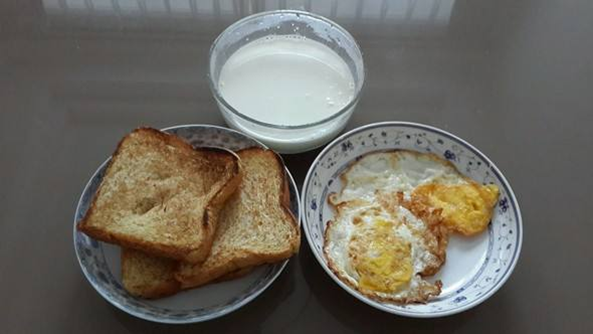
The picture above was found in a casual search; it isn’t my own breakfast, but it looks fairly everyday, so let’s start from here.
Why eat breakfast? — For nutrition? For health?
What is breakfast? — Isn’t breakfast not a regular meal?
What do you eat for breakfast? — Fried eggs, milk…
2. Technical conditions

Many things make breakfast possible. First, what makes breakfast breakfast is a certain temporal rhythm: we eat breakfast before reading or going to work. Second, custom and nutrition science have made breakfast something regarded as necessary. Then there are two fried eggs in breakfast, which requires the raising and sale of chickens, as well as the relevant techniques for frying, such as vegetable oil and water, electricity, and coal gas. The last glass of milk likewise requires dairy farms, and also steps such as sterilization, refrigeration, and distribution.
If we keep going, including pots, bowls, pans, chairs, stools, tables, and benches, including animal domestication and the use of fire, and so on—the history of the techniques behind eating can be pursued without limit. But here we must consciously rein ourselves in; in this class I will focus on the origins of modern industrial technology.
3. Historical tracing
1. The origin of breakfast
People have always had to eat. If we call the first meal of the day breakfast, then breakfast of course has existed since antiquity. But the problem is that the concept of breakfast in the modern sense is actually very new.
What we now know as breakfast is, first, the first meal in the “three meals a day” pattern; second, unlike the later two meals (lunch and dinner), whose menus are relatively similar, breakfast is generally thought to be lighter, and also more important (the claim that breakfast is the most important meal, I heard often when I was young, but perhaps in recent years it has faded).
So when did the idea of breakfast in this sense begin? Of course different cultures have different traditions. But generally speaking, many cultures in antiquity did not have a tradition of three meals a day. For example, in ancient China the dominant pattern was two meals a day; records show that during the Shang dynasty the rule was the first meal around 8 a.m. (da shi, “big meal”) and the second around 4 p.m. (xiao shi, “small meal”). Even through the Ming and Qing dynasties, the tradition of “two meals a day” was still preserved, but depending on the family there might be extra snacks and light refreshments. For example, officials could often enjoy a light snack at the yamen around noon; and the emperor, besides the two main meals, could also have several extra rounds of snacks and late-night food. But in any case, three meals a day was not a universal standard.
It was the same abroad. The convention of three meals a day was truly established in modern society, it is said, only in the early 20th century, when at that time John Kellogg was promoting on the health magazine Good Health, which he edited, the idea that “breakfast is the most important meal.”
Who was Kellogg? He was a doctor, and could also be counted as a scientist, but his main identity was actually that of an entrepreneur. Kellogg invented the wildly popular breakfast cornflakes.


At the time, Americans did not have the notion that breakfast had to be eaten; even if they did eat it, it was often bread and meat. Cornflakes were something entirely new. How were consumers to be made to accept them? Aside from ordinary advertising and marketing, Kellogg especially promoted two ideas: first, breakfast is the most important meal of the day and is of major significance to health. Second, one should eat less meat; eating meat incites lust, whereas a cereal diet can prevent masturbation. Especially for mothers of boys, breakfast cornflakes were the best choice.
The function of preventing masturbation does not seem to have spread, but the ideas that breakfast is important and that breakfast should be light became popular. This also involved the historical background of the early 20th century. First, after the American West had been developed, vast quantities of corn were planted, and there was an urgent need to open up markets; second, during World War I and World War II, resources were tight in various countries, and European countries also actively promoted replacing meat with grains, beans, and the like. Another interesting crop is the carrot. Originally, Europeans did not eat carrots; they were used mainly as fodder. But because of shortages, the British government went to every length to promote carrots. For example, once, with the help of a new type of radar, the British Air Force shot down many German warplanes in the darkness of night, but to the public it was advertised as being because our ace pilots had eaten a lot of carrots and improved their night vision, which was why they were so formidable.
So are carrots actually good for the eyes? I don’t know. We discover that some scientific theories or bits of scientific common sense come from the promotion of businessmen or politicians—does that prove that this knowledge must therefore be false? Not necessarily. Breakfast may really be important; carrots may really be healthy. We do not need to doubt everything, but at least maintaining a “vigilant” attitude is necessary. Many things said in the name of “science” or “officialdom” are not necessarily more solid than what is said in advertisements. The biggest difference between a “scientific text” and other promotional texts is not that it is necessarily neutral and objective, but that through standardized citation it makes it easier for people to trace things back to their source.
2. Eggs
Eggs are naturally laid by chickens, but for ordinary people like us to be able to eat so many eggs, industrial conditions of production are also required.
A little piece of knowledge here: what vertebrate is the most numerous on land? It certainly isn’t human beings; the most likely answer is chickens. The number of domesticated chickens in stock has long surpassed ten billion.
“Stock” here refers to the chickens currently alive in chicken farms, but their lifespan is much shorter than humans’. In less than two months, nearly all the chickens in stock have to be replaced.
In recent years, the media exposed a batch of broiler chickens that were only 45 days from hatching to being eaten, crying “speed-grown chickens,” and KFC really took a stray bullet for that one. But in fact, 45 days in modern poultry farming has long ceased to count as speed-growing; it is just the norm.
According to the U.S. chicken industry1, before 1930 broilers were slaughtered at an average weight of 1.3 kilograms and needed 113 days of raising; by 2010, they needed only 42 days to be ready for market, but weighed 2.58 kilograms.
| Period | Weight at slaughter (kg) | Age at slaughter (days) |
| around 1930 | 1.3 | 113 |
| around 1950 | 1.4 | 95 |
| 2000 | 2.25 | 47 |
| 2010 | 2.58 | 42 |
Such improvements of course depend on industrialization: first, breeding technology, so that almost all chicken farms in the world are now the same breed of white-feathered chicken. Second, scientifically balanced feed, because different growth stages require different feeds. Antibiotics are naturally also necessary, mainly because once a chicken epidemic breaks out in concentrated farming, that’s the end. Then there are some of the most horrifying technologies from the standpoint of animal ethics: high-density raising, light control, and so on—no letting chickens sleep, no letting them move, only letting them eat feed all day long.
The breeding of laying hens and broilers follows roughly the same model; laying hens are basically fixed egg-laying machines.
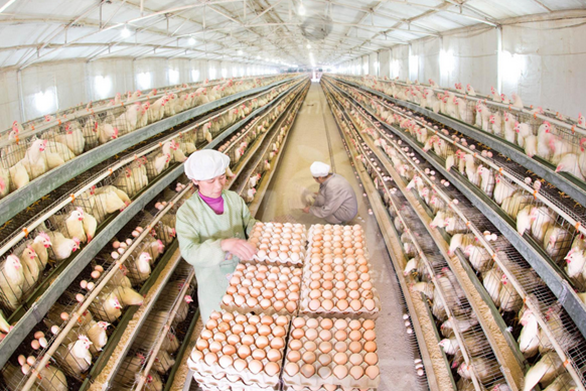
Personally, I am a cruel meat-eater, but I understand the concerns of animal protectionists. Here I do not wish either to extol the heaven-defying power of modern industry or to preach the ideals of animal ethics; I simply want to trace the origins and development of the eggs on the table.
3. Vegetable oil
Frying a fried egg naturally requires oil, and generally we use a bit of soybean oil, peanut oil, or the like—vegetable oil. But the everyday use of vegetable oil is by no means ancient.
In ancient China, cooking mainly used lard and other animal fats, which the ancients called “zhi” or “gao.” What about the ancient West? Western Europeans, whose roots were nomadic, seem to have mostly used butter (made from milk), while Mediterranean civilization had a long tradition of using olive oil. But whether lard, butter, or olive oil, the price was relatively high. The ancients also knew how to extract vegetable oil from various plants, but it was not cheap either. In antiquity, the main use of vegetable oil was for lamps rather than for cooking.
The large-scale industrial production of vegetable oil in modern times is also a late development. On the one hand it required the abundance of grain brought by modern agriculture; on the other hand it also required a highly efficient, large-scale refining industry.
This refining industry does not only refer to refining vegetable oil; it also needs the support of the petroleum industry. The main technology for producing vegetable oil today is “solvent extraction,” a technique invented only in the mid-19th century, which requires the use of gasoline (n-hexane) as a solvent. This gasoline has a very low boiling point, so it is first used to dissolve the oil from the raw material, and then heated so that the gasoline evaporates, leaving the vegetable oil behind. Of course, the final product must still go through a series of refining processes such as degumming, deacidification, decolorization, and deodorization; in the end, no gasoline can be detected in the finished product.
By the way, modern technology often relies on “cannot be detected.” If danger cannot be detected, it seems to mean safety, but that is also somewhat suspect. One must know that ordinary vegetable oil and refined “drainage oil” are also “indistinguishable by detection”; does that mean drainage oil can also be drunk with confidence? Here I am, incidentally, alluding to the hot debate over genetically modified organisms. My attitude is still that I personally eat whatever I want, but I also understand the safety concerns of anti-GMO advocates. Such safety anxieties may not be eliminated by scientific evidence, because no matter how scientists declare that no toxicity can be detected, they cannot eliminate the doubter’s distrust of the production process itself.
That is a digression. In the production of vegetable oil, we still have to thank the petrochemical industry. Modern industry has not only brought us gasoline solvents, but also coal gas and natural gas, making the flames of modern stoves stronger and easier to control.
So the technique of “stir-frying,” which today is most familiar to Chinese people, only truly became widespread among the masses in the 20th century. Of course, stir-frying appeared at the latest by the Song dynasty, but at first it was a closely guarded secret of large restaurants; later it gradually spread to the common people, but it still remained a high-end technique rather than an everyday household practice. By the Ming and Qing periods, some cookbooks recorded stir-frying, but the proportion was very small. For example, among the more than 100 dishes recorded in Jin Ping Mei, only five or six were stir-fried dishes.
Of course, I do not want to deny the long-standing and profound Chinese culinary culture. In fact, what truly counts as deep cultural substance does not lie in being merely “ancient” or “the earliest” and the like, but in the ability to continuously adapt to new environments and continually create and enrich.
By the way, I tried tracing the origin of “fried egg.” The word itself seems quite old, after all “hebao” is not a modern term, but the earlier “fried egg” seems to have referred to a poached egg rather than a fried egg. The origin of the fried egg itself does not seem very clear; I did not continue to investigate it.
3. Milk
The custom of drinking milk in modern times also formed fairly late. Of course, drinking milk is a custom promoted globally by Europeans of pastoral origin, but in fact even nomadic peoples did not drink milk as casually as if it were water. Generally, milk was also made into butter, cheese, and other products. Fresh milk was difficult to store, and moreover adults generally did not have this dietary habit, so it was rarely popularized in ancient food culture.
For modern people to be able to have a glass of milk a day, that of course also depends on vast industrialized production.
Just as with broiler chickens and laying hens, the raising of beef cattle and dairy cattle is also highly industrialized. In a certain sense, the situation of dairy cows is even more cruel than that of laying hens, because hens do not need to be fertilized to lay eggs; viewed generally, eggs are not considered life. But dairy cows must continually give birth in practice in order to continually supply milk. So where do the calves go? Of course, some female calves are raised to take over milk production, but most male calves are slaughtered directly. Because beef cattle have their own breeds and dairy cows have their own breeds, raising male calves to grow up and eat as meat is also inefficient, so the most efficient method is to strangle them while they are still small, chop up the meat, and make it into feed.
The feed that mother cows eat very likely contains the flesh of calves. This is also why people used to say that mad cow disease was karmic retribution in a vicious cycle. It was only after mad cow disease that people became aware of controlling feed so as to avoid bovine ingredients in cattle feed, but the fact that animal-derived ingredients are contained in the feed of all kinds of herbivores has always remained standard practice in the industry.
The concept of a “male baby dairy cow” is also a product of industrialization. In the traditional sense, a dairy cow, like a “wet nurse,” is a specific role played by a specific sex at a specific period of time. Of course there could be no such things as male wet nurses or baby wet nurses. But thanks to modern breeding science, the “dairy cow” has become a specialized species; globally, “dairy cow” basically refers to Holstein cattle and their crossbreeds, so naturally one can have seemingly absurd concepts such as a “male baby dairy cow.”
The large-scale raising of dairy cows has also caused serious ecological problems. For example, the digestive systems of ruminants produce methane; a few individuals letting out a little methane gas is of course trivial, but once the scale reaches this level it becomes quite considerable. Speaking of greenhouse gases emitted by modern industry, the biggest source is of course power generation, the second is heating, and the third is probably dairy cattle farming; the greenhouse gases produced by cows farting are higher than automobile exhaust.
The mass production of milk satisfied human demand for drinking milk; in fact, perhaps the reverse is even more accurate: the mass production of milk created the human demand for drinking milk. Teacher Tian Song once wrote a famous and powerful essay, “Why on Earth Would an Animal Called Human Drink the Milk of an Animal Called Cow?,” which satirized and investigated the custom of modern people drinking milk. Although I disagree with many of the specific arguments in its details, its perspective is enlightening. In the eyes of the ancients, “drinking milk” was a pejorative expression; only newborn infants had the right and the need to drink milk—what kind of state was it for adults to still not be weaned? Even for nomadic peoples, one only hears of swilling wine and devouring chunks of meat; one never hears of any hero making an entrance while gulping down milk.
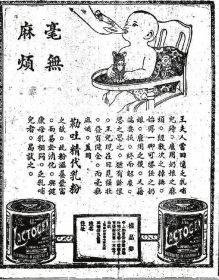
Only newborns, when their mothers’ milk is insufficient, have a need to drink milk. So the habit of promoting milk in industrial society also began with infant formula. Added to this was the boost from nutritional science, and milk went from being merely an emergency stopgap used in special circumstances, to a health product for nourishing and tonifying, and finally to a daily necessity.
4. Refrigeration
Milk was initially sold mainly in the form of milk powder; for us to be able to eat fresh milk now also requires advanced refrigeration and transportation technology.
By the way, let me also talk a little about cattle raising. In ancient China, ancient India, and so on, cattle were mainly used for farming and were less often eaten; even less would one keep cattle idle instead of plowing, fatten them up, and then eat the meat. The custom of eating beef also came from the West, but to eat meat as routinely as modern people do, there were still a series of technical conditions needed in slaughtering and transportation.
Before refrigeration technology was mastered, people had to slaughter meat and cook it immediately. Fresh meat bought home had to go into the pot that very day; otherwise it could only be made into jerky or cured meat. So the place where cattle were slaughtered had to be very close to where city dwellers lived. For example, the long-established London livestock market was right in the city center; in the 19th century, at one point “220,000 cattle and 1.5 million sheep were driven into the city center for on-site slaughter.”
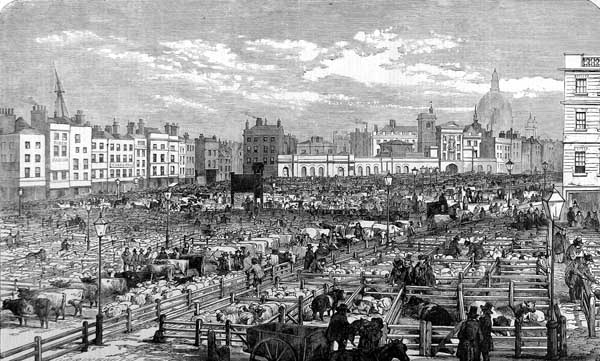
In the United States, driving live cattle all the way from the ranch to the slaughter site gave rise to a legendary profession—the cowboy. Because American Westerns (like Chinese martial-arts films) romanticized cowboys, many people perhaps have forgotten what cowboys actually did; as the name suggests, cowboys are those who attend to cattle.
The peak of cowboy activity was from 1866 to 1886, when 20 million cattle were driven from Texas to railway stations in Kansas and then transported by rail to major cities on the East and West Coasts for sale.
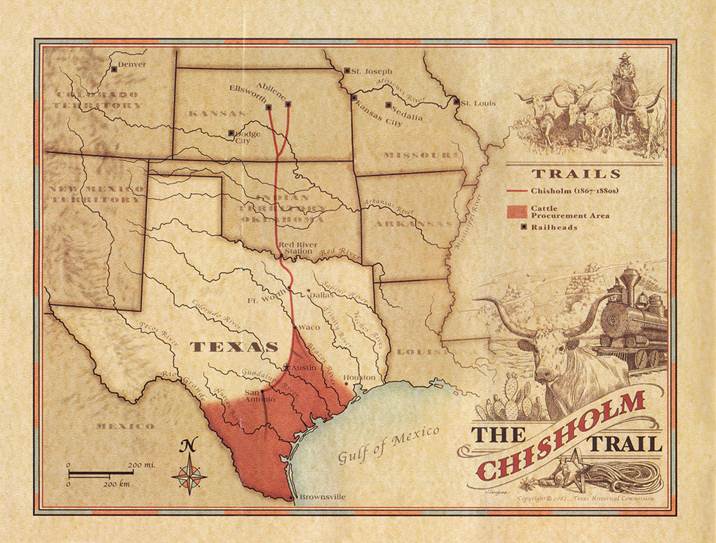
A typical herd consisted of 1,500 to 3,000 cattle and required 8 to 12 cowboys to care for them. They could not move too fast, lest the cattle lose too much weight; they traveled less than 25 kilometers a day, and the longer routes were about 1,600 kilometers.
It was not until refrigeration technology was applied that large meat-processing plants built in the suburbs gradually replaced on-site slaughter in the city center.
Meat processing was one of the earliest industries to apply large-scale mass production. For example, the image below depicts the production scene of a meat-processing plant in the second half of the 19th century:
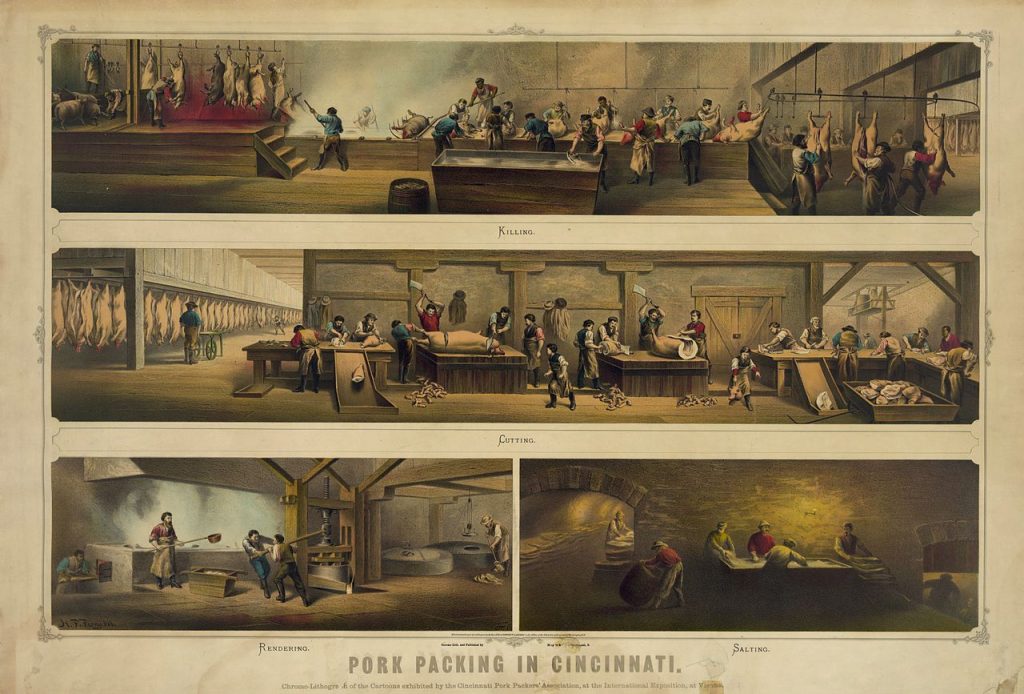
Notice that in some production links, one can already see forms of assembly-line work—that is, “the pig moves, the people do not.” Each worker does his or her own part, responsible only for the single task in front of them.
The Ford automobile assembly line that we are familiar with may be the most influential assembly line, but it is certainly not the first. In fact, the origin of Ford’s assembly line was that an employee of the Ford company visited and inspected a Chicago meat-processing plant, and was inspired to make an attempt after returning.
To speak again of refrigeration technology: in fact, the earliest use of refrigeration did not rely on artificial cooling, but on natural ice. In ancient China, wealthy families also had the tradition of storing ice in cellars, but only Westerners turned ice into a global trade.
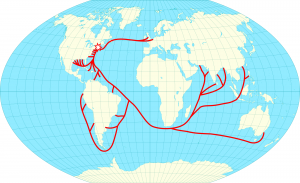

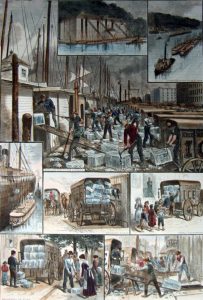

At that time, the main customers using ice were meat-processing plants. The picture below shows the refrigerated railcar used by a Chicago meat-processing plant, which used natural ice to refrigerate meat and then transport it by rail.
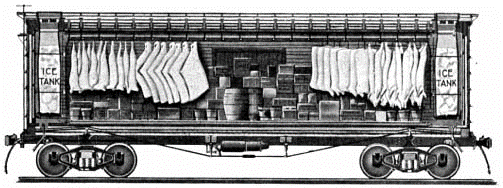
With the first successful artificial refrigeration on a cargo ship in 1878, natural ice was gradually replaced by artificial refrigeration. It was not until the 1930s, with the mass production of highly efficient refrigerants such as Freon, that refrigerators, air conditioners, and other cooling appliances began to enter every household.
IV. Entering the Context
In the historical cases above, we have already noticed the changes in ways of life and modes of thought implied behind the history of technology. In this breakfast, what are some things that modern people take for granted but ancient people would have found strange? For example:
1. Earthlings should all eat breakfast
2. It is normal for a person to eat one egg every day
3. It is normal to stir-fry a dish and fry an egg with cheap vegetable oil
4. Adults can also drink milk every day
V. Ancient and Modern Compared
The transformation of dietary life by industrialization has been earthshaking; many of today’s eating habits, including many classic dishes, trace their origins back and turn out not to be very old at all.
The benefits that industrialized food production brought people are obvious: cheapness and abundance. Ordinary families can eat meat at every meal and drink milk every day. But many dimensions have been lost as well.
For example, the relationship between food and status has grown increasingly faint. In ancient times, “the meat-eaters” often referred to the privileged class. For example, the often-misquoted famous line by Gu Yanwu says: “Those who safeguard the state, its ruler and his ministers—the meat-eaters—should deliberate it; those who safeguard the realm, even the lowly common man, have a duty therein.” It means that the rise and fall of the world is the responsibility of every man, but as for maintaining the state’s political order, let the noble meat-eaters worry about that; it has little to do with ordinary people.
In India, the relationship between class and food is reversed: the noble Brahmins are strictly vegetarian, while the untouchables eat all kinds of meat.
Ideologies around diet, such as vegetarianism, have increasingly developed in modern times, but many ethical and ritual dimensions of diet and its processes in tradition have been downplayed. Even vegetarians and anti-GMO activists mostly focus on the food ingredients themselves as objective material objects—for example, whether there are animal-derived ingredients, whether there are toxins, and so on—while paying less attention to the production process.
Breeding science has greatly increased the yield of crops and livestock, but at the same time it has caused species to become homogenized. Many local varieties have almost disappeared, and the breeding of crop seeds or livestock is often controlled by a small number of multinational corporations. Advanced transportation and centralized production models have also led to the erosion of local food cultures; the food available in supermarkets in Beijing is almost the same as that in Shanghai.
Nutrition science has enabled people to regulate their diets more rationally, but at the same time it has seized the authority to decide what counts as a rational diet. The influence of culture and tradition has increasingly faded; “grandmothers” (the elderly) are not only made to seem incapable because they cannot keep up with rapidly changing high technology, even their areas of special expertise have lost their voice. This perhaps explains why older people are more easily influenced by the pseudo-science about food circulating on WeChat Moments, because only under the banner of science can they possibly regain even a little status in food culture.
From ancient times to the present, diet has always been one of the core domains of human culture, and in the industrial age, dietary life is also one of the domains most profoundly reshaped by industrialization. Yet when discussing modern technology, this domain is often neglected, because “eating” is often assumed to be the least technical of matters. “As easy as eating” is often used as a metaphor for something that requires hardly any skill, but even things that are “as easy as eating” are not so simple.
Recommended Reading
There are already quite a few books on the history of food culture on the market, but most of them are written by foreigners. Chinese people always pride themselves on being a great country of food, but although our food culture is indeed rich, we still fall far short in terms of critical awareness and scholarly attitude.
I’ve recently read some rather interesting books, such as 《The Taste of Civilization: The History of Human Food》, 《Cooking, Cuisine, and Class》, 《It All Depends on Dinner: Curious Anecdotes Behind Ordinary Food》, and so on.
References
Translated from the Chinese original with AI assistance. The original text is authoritative.