
My most recent after-sales experience on JD was extremely poor. In fact, the matter was very simple: I returned the item, but they still shipped it; when it came time to refund me, they also wanted me to bear the shipping fee. After I filed a transaction dispute, JD did nothing, and the merchant impersonated JD customer service and called to say that a refund was possible. Right up until the end, JD still refused to give me a simple ruling, and instead defined my behavior as “refusal without reason.”

To be a bit more detailed: I bought something, and when the expected delivery time had passed I saw that it still hadn’t shipped, so I contacted the merchant to confirm the shipping time. The merchant couldn’t give a definite answer, so I said I’d return it and didn’t want it anymore (I had already bought another one from a different seller, and it arrived very quickly). But a few hours after I had already submitted the return request, the merchant shipped the item, and my cancellation request failed, with a prompt telling me that I could choose to refuse delivery. In the end, after I refused delivery and then applied for a return, the merchant said I had to bear the shipping fee. (Actually there was shipping insurance here, and the shipping fee could have been waived, but the merchant did not mention this.) Of course I didn’t agree, because they should not have shipped it in the first place. After I had requested a return, how could they still ship it and then make me bear the shipping fee? The merchant was unwilling to accept my explanation, so I filed a transaction dispute on JD.
After I filed the transaction dispute, the merchant, in the name of JD customer service (this is my inference, later verified), called me and vaguely said that I was right, that they were willing to refund the full amount, and asked me to withdraw the dispute form. Although I had my suspicions, I still withdrew it. Throughout this process, JD’s official side never appeared.
Two more weeks passed. I saw that the money still hadn’t arrived, so I checked the order details and found that the last line of the logistics information said “customer refused delivery without reason.” I felt dissatisfied and again lodged an appeal with JD customer service. Besides getting the money refunded as soon as possible, I also asked for my “reason” to be affirmed. I thought my “reason” was very simple and very clear: shipping the item after I had returned it was the merchant’s mistake, so my refusal of delivery was of course “with reason.” I asked that “customer refused delivery without reason” in the order record be changed to “customer refused delivery.”
But this request was not granted. Customer service asked me to call JD Express (the delivery was also handled by JD Express). I asked why she wouldn’t help me make the call, and she replied that she was a marketplace customer service agent and did not handle delivery. I said even if you don’t make the call, I just want you, speaking as JD customer service, to say to me out loud: I was not without reason; my reason was legitimate. Can you do that? The answer was no. The conversation ended unhappily.
I’m recording this exchange, on the one hand, to vent some of my frustration; on the other hand, because it offers a certain philosophical illustration. The assembly-line division of labor in the modern occupational system makes each person’s responsibilities extremely trivial and specialized, and all affairs are governed by procedures and measured by money, leaving no room for moral judgment. What I wanted in money terms (a refund) was easy to solve, but what I hoped to get from customer service was an ethical stance, and that was actually harder. Even a very obvious, very simple principle, a conclusion that should be easy to judge from the standpoint of an observer, could not be produced from the standpoint of customer service. Once she gave such a judgment, the responsibility she would have to bear would immediately expand beyond the narrow little territory of authority and responsibility in which she had originally been placed.
Of course I was being “persistent to the point of nitpicking.” Perhaps this nitpicking is of little consequence, but the truly important problem is that in the conveyor-belt world of Gestell, there is less and less room left for “taking things seriously.” Only money and efficiency are measured and compared, while “truth” — even the “reason” behind the simplest action — is no longer cared about by anyone.
————
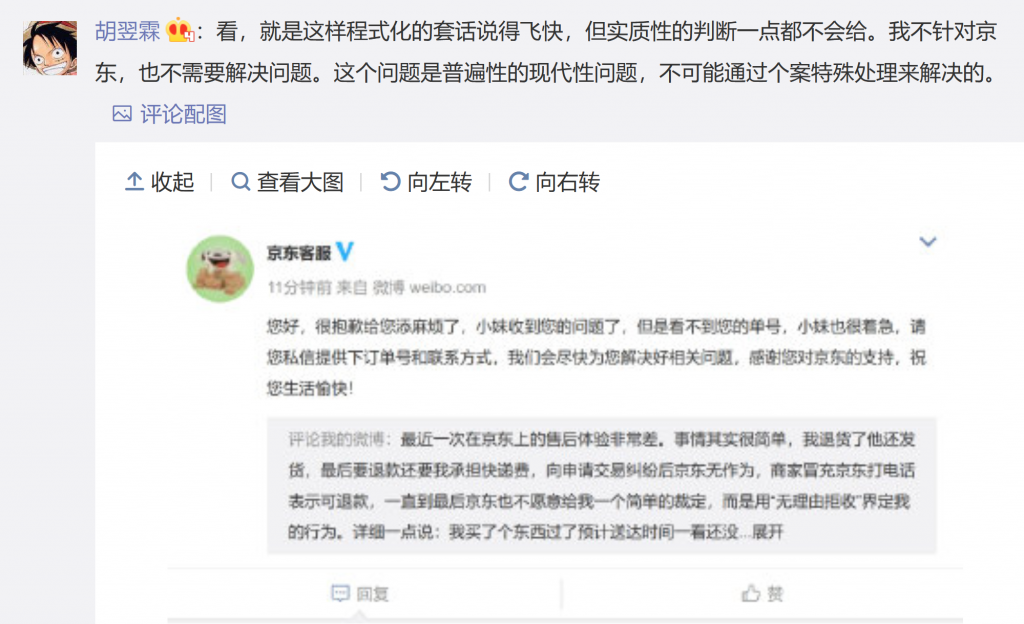
Addendum: five minutes after I posted this on Weibo, I already received a comment from JD customer service. Quite ironic.
Translated from the Chinese original with AI assistance. The original text is authoritative.